
Chef Juliette
John Dory (St. Pierre)
John Dory has the delicacy of sole and the firmness of turbot. A light flouring, a quick butter sauté, and nut-brown beurre noisette show exactly why looks never mattered.
A cooking platform built around craft, culture, and the stories behind what we eat.
Created by Chef Juliette
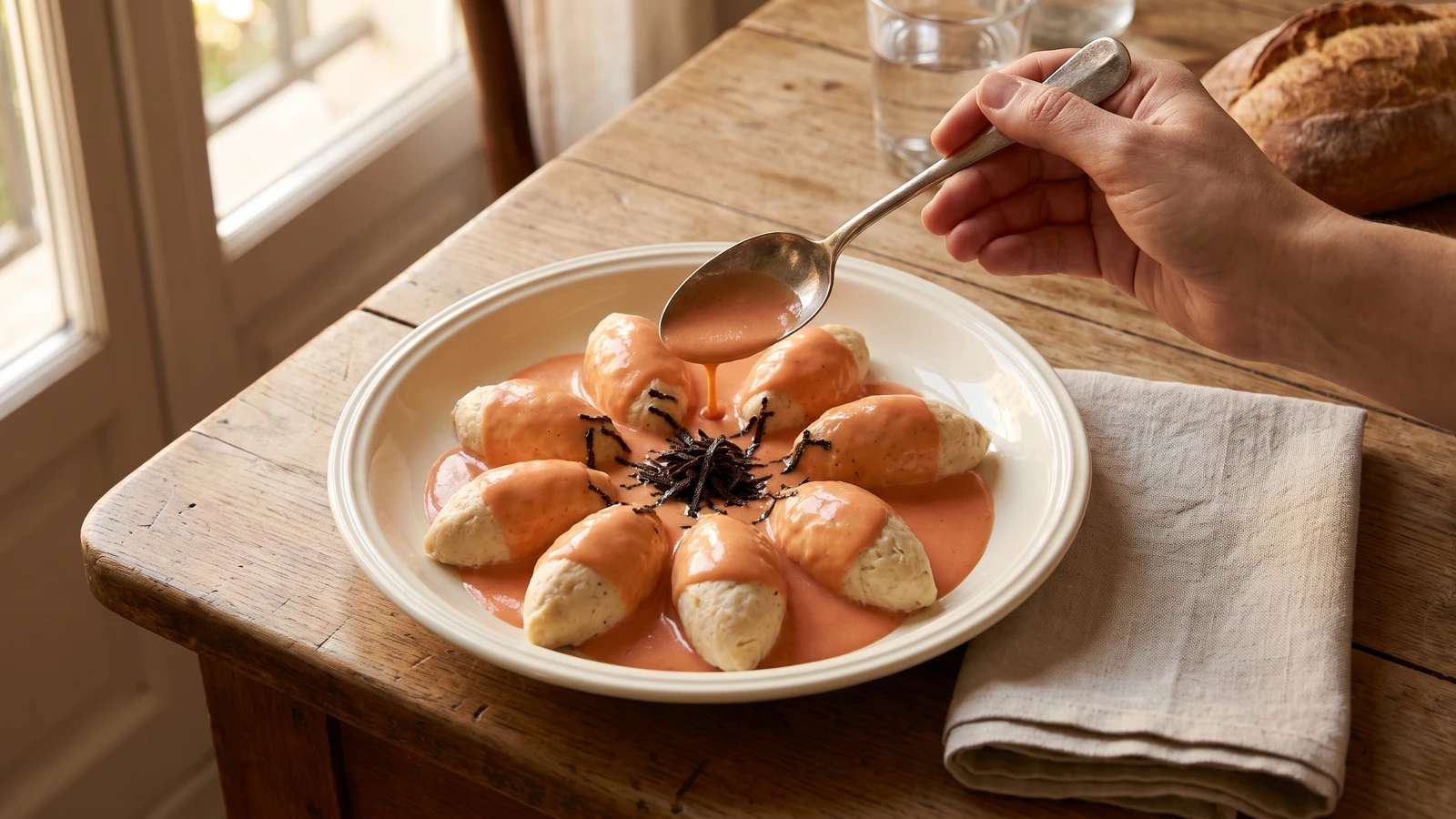
Based on No. 1658, Quenelles de Volaille d’Uzès, from Le Guide Culinaire (1907) by Auguste Escoffier
Silken moulded chicken quenelles hide an Allemande-bound centre, then meet a glossy tomato-tinted Aurore and black truffle julienne, a formal composition made workable for four at home.
Quenelles de Volaille d’Uzès (moulded chicken quenelles from Uzès) teach the discipline of a forcemeat: everything stays cold, and the cream enters slowly enough to become part of the chicken rather than leak out during poaching. That is the one true thing to know before touching a pan. Master this emulsion and a whole family of quenelles, mousses, and delicate farces opens before you. C’est la même grammaire.
The original kitchen assumed a saucier on staff, a poultry stockpot never off the fire, ranks of oval metal moulds, and a salamander waiting elsewhere on the range. The salamander has no work here, and maintaining separate sauce stations is brigade scaffolding. At home, one poultry velouté is divided into reduced Allemande, enriched with yolk and cream for the minced chicken centre, and Aurore, tinted with tomato for coating. Eight small moulds and a covered bain-marie, a water bath, replace the batterie. What stays is the dish itself: panada-and-cream forcemeat, a sealed filling, a gentle poach, and truffle cut julienne in the centre. One cook, one stove, one evening.
When the quenelles are right, the knife passes through a tender ivory shell into a richer chicken centre, while the coral Aurore pools around them and the black truffle smells of earth and walnuts. Before you touch the processor, chill the bowl, blade, chicken, panada, and cream. Cold is the step that decides everything.
Quenelles de Volaille d’Uzès belong to the classical grand-kitchen repertoire, but their place-name points precisely to Uzès in the Gard, where black truffles from the surrounding limestone country have long marked celebratory cooking. Unlike Lyon’s quenelles de brochet, these are poultry forcemeat shaped in moulds, filled, and served as a composed main dish, with the truffle julienne in the centre announcing Uzès rather than flavouring the forcemeat. The dish traveled to home tables by shrinking the battery of moulds and sauces, while its defining sequence of panada, Allemande, gentle poaching, and Aurore remained intact.
Quantity
1 lb 3 oz (525 g)
divide into 300 g for the forcemeat and 225 g for the filling
Quantity
5¼ cups (1.25 L / 1.25 kg)
divided
Quantity
⅓ cup (80 ml / 82 g)
Quantity
1½ tablespoons (22 ml / 21 g)
Quantity
⅓ cup (80 ml / 40 g)
Quantity
½ cup (120 ml / 120 g)
Quantity
1
Quantity
1½ tablespoons (22 ml / 21 g)
Quantity
3 tablespoons (45 ml / 42 g)
Quantity
⅓ cup (80 ml / 42 g)
Quantity
3 tablespoons (45 ml / 45 g)
Quantity
2
Quantity
2 teaspoons (10 ml / 10 g)
Quantity
½ cup (120 ml / 120 g)
Quantity
1½ tablespoons (22 ml / 21 g)
diced
Quantity
1 small truffle (about 1 oz / 30 g)
fresh or whole preserved, drained if necessary
Quantity
2 teaspoons (10 ml / 12 g)
divided
Quantity
½ teaspoon (2.5 ml / 1 g)
divided
| Ingredient | Quantity |
|---|---|
| skinless chicken breastdivide into 300 g for the forcemeat and 225 g for the filling | 1 lb 3 oz (525 g) |
| unsalted, well-flavoured chicken stockdivided | 5¼ cups (1.25 L / 1.25 kg) |
| whole milk for the panada | ⅓ cup (80 ml / 82 g) |
| unsalted butter for the panada | 1½ tablespoons (22 ml / 21 g) |
| plain flour for the panada | ⅓ cup (80 ml / 40 g) |
| cold heavy cream for the forcemeat | ½ cup (120 ml / 120 g) |
| large egg white | 1 |
| softened unsalted butter for the moulds | 1½ tablespoons (22 ml / 21 g) |
| unsalted butter for the velouté | 3 tablespoons (45 ml / 42 g) |
| plain flour for the velouté | ⅓ cup (80 ml / 42 g) |
| heavy cream for the Allemande | 3 tablespoons (45 ml / 45 g) |
| large egg yolks | 2 |
| fresh lemon juice | 2 teaspoons (10 ml / 10 g) |
| smooth tomato purée or passata | ½ cup (120 ml / 120 g) |
| cold unsalted butter for finishing the Aurorediced | 1½ tablespoons (22 ml / 21 g) |
| black trufflefresh or whole preserved, drained if necessary | 1 small truffle (about 1 oz / 30 g) |
| fine saltdivided | 2 teaspoons (10 ml / 12 g) |
| ground white pepperdivided | ½ teaspoon (2.5 ml / 1 g) |
Bring 2 cups (500 ml) of the chicken stock to the barest simmer in a small saucepan. Add the 225 g portion of chicken, cover, and poach without boiling until the centre reaches 165°F (74°C), about 12 to 15 minutes. Lift it out and cool it promptly, then mince it into pieces no larger than ¼ inch (5 mm). Strain and reserve the poaching stock. A hard boil tightens the white meat, so keep the liquid at a quiet tremble.
Bring the milk, panada butter, and a pinch of the measured salt just to the boil. Add the panada flour all at once and beat firmly over medium-low heat until the paste gathers into a ball and leaves a faint film on the pan, about 2 minutes. Spread it thinly on a plate, cover its surface, and chill until completely cold. Set aside 2 tablespoons of the cold panada as insurance against a loose forcemeat.
Melt the velouté butter without colouring it, stir in the velouté flour, and cook the roux gently for 2 minutes. Gradually whisk in 2¾ cups (650 ml) of hot reserved stock, scraping the corners of the pan so no roux hides there. Simmer gently for about 20 minutes, skimming when needed, until the velouté is smooth, lightly reduced, and coats a spoon. Strain it. Reserve ¾ cup (180 ml) for the Allemande and keep the remainder for the Aurore.
Reduce the reserved ¾ cup (180 ml) velouté to about ½ cup (120 ml), stirring often. Whisk the egg yolks with the Allemande cream, then temper them with several spoonfuls of hot velouté before returning everything to the saucepan. Stir over very low heat until the Allemande thickens enough to hold the minced chicken together, but never let it boil. Add the lemon juice, salt, and white pepper, then fold in the minced chicken and cool the filling. If the first flecks of yolk appear, take the pan off the heat, whisk in a teaspoon of cold cream, and strain immediately. Ça se rattrape before the liaison fully scrambles.
Chill the processor bowl and blade for 15 minutes. Process the 300 g raw chicken with 1 teaspoon of the measured salt until it becomes smooth and tacky. Add the cold panada in pieces, then the egg white. With the machine pulsing, add the cold cream in four small additions, scraping the bowl between each, until the forcemeat is glossy and holds a soft peak. If a greasy sheen appears, stop adding cream and set the bowl over ice for 10 minutes, then pulse briefly and continue by teaspoons. Ça se rattrape while it is still cool. Poach a teaspoon of forcemeat in barely simmering water for 3 minutes; if it spreads, pulse in the reserved panada one spoonful at a time, and if it is firm or rubbery, pulse in a teaspoon of cold cream.
Butter eight 4-ounce (120 ml) oval quenelle moulds generously. Spoon or pipe the forcemeat across each bottom and up the sides in an even layer about ¼ inch (6 mm) thick, leaving a hollow in the centre. Divide the cold Allemande-bound chicken among the hollows without letting it touch the moulds, then cover completely with the remaining forcemeat and smooth the tops. Press gently around the seam so the filling is sealed inside. Air pockets and broken seams are the enemies here, not an imperfect oval.
Heat the oven to 325°F (160°C). Set the moulds on a folded towel in a deep roasting pan and pour in hot water to reach halfway up their sides. Cover the pan loosely with foil and poach until the quenelles feel resilient and their centres reach 165°F (74°C), about 20 to 25 minutes. The water should barely tremble. If it begins boiling, add a cup of cold water and lower the heat at once; the texture may be a little coarser, but the quenelles will hold.
While the quenelles poach, whisk the tomato purée into the remaining velouté and simmer gently until the Aurore turns coral, loses any raw tomato taste, and coats the back of a spoon. Strain it, taste for salt and white pepper, then whisk in the diced cold butter off the heat. If the sauce tightens too far, loosen it with reserved stock by the spoonful. If the butter leaves a greasy rim, whisk in a teaspoon of cold water away from the heat until the gloss returns.
Lift the moulds from the bain-marie and let them stand for 3 minutes. Loosen each edge with a thin knife, turn the quenelles onto a clean lint-free kitchen towel, and let the cloth take up the surface moisture, just as the original linen did. If one clings, dip the base of its mould in hot water for 5 seconds and try again. Arrange the quenelles in a circle on a warmed round serving dish, placing any small crack toward the centre.
Spoon the warm Aurore generously over every quenelle, allowing a little sauce to pool around the circle. Cut the truffle julienne, into fine match-shaped rods, and mound it in the open centre of the dish. Serve at once while the forcemeat is tender and the sauce still gleams. À table!
1 serving (about 400g)
Culinary guides, cultural storytelling, and the editorial depth that makes cooking meaningful.
Discover Culinary ExplorerChef Juliette
John Dory has the delicacy of sole and the firmness of turbot. A light flouring, a quick butter sauté, and nut-brown beurre noisette show exactly why looks never mattered.

Chef Juliette
Fresh haddock proves its delicacy in the meunière pan: a fine flour crust, moist pearly flakes, and beurre noisette sharpened with lemon and parsley, ready from one skillet in half an hour.
Chef Juliette
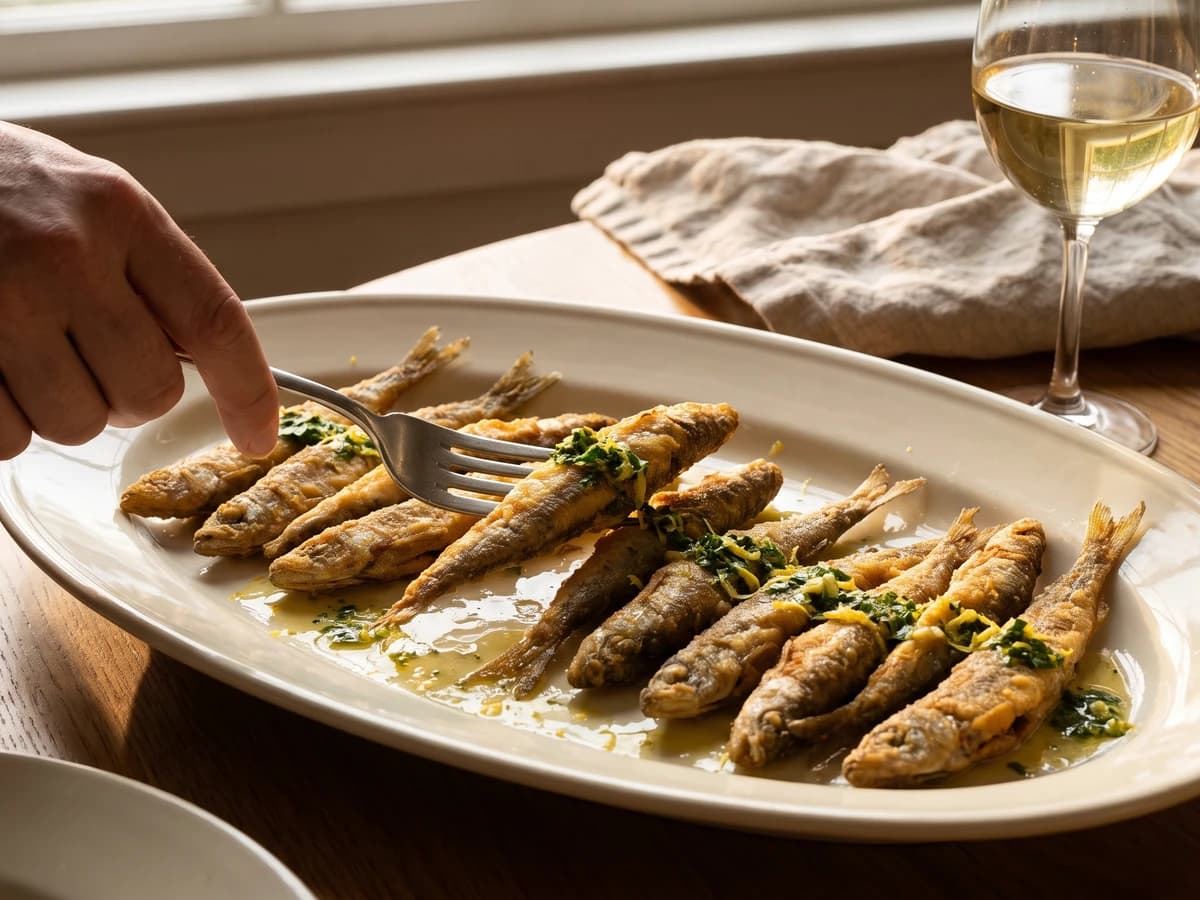
Éperlans à l’Anglaise turns small fish into a lesson in disciplined coating: boned smelts under a close, crisp crumb, pan-fried in clarified butter and finished with bright, half-melted maître d’hôtel butter.

Chef Juliette
Tiny smelts, shallot, mushrooms, white wine, gratin sauce, and fine bread raspings meet a fierce oven, where the fish must turn tender in the same breath the buttered crust bronzes.