
Chef Juliette
John Dory (St. Pierre)
John Dory has the delicacy of sole and the firmness of turbot. A light flouring, a quick butter sauté, and nut-brown beurre noisette show exactly why looks never mattered.
A cooking platform built around craft, culture, and the stories behind what we eat.
Created by Chef Juliette
Based on No. 1656, Boudins de Volaille Soubise, from Le Guide Culinaire (1907) by Auguste Escoffier
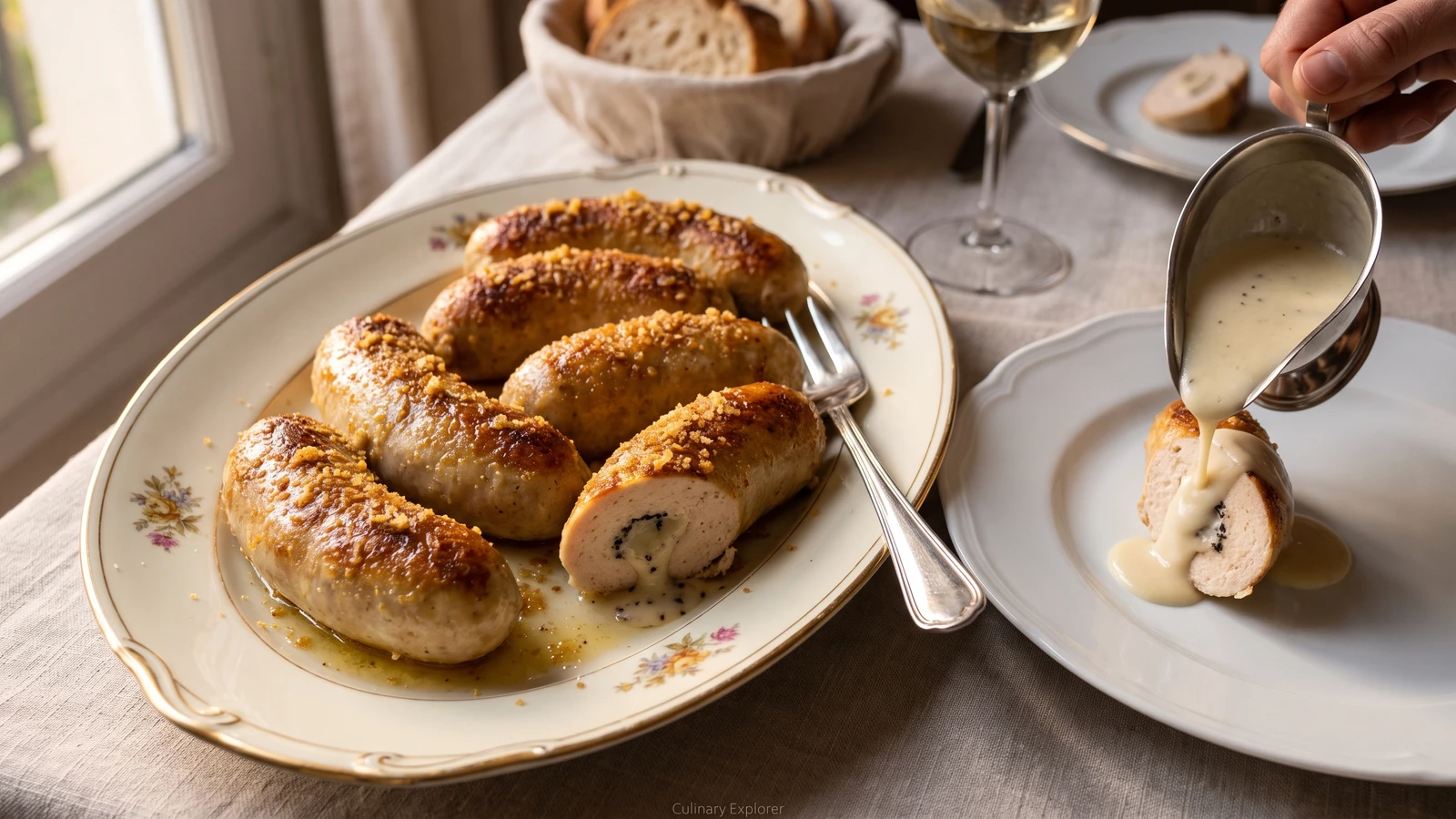
Boudins de Volaille Soubise hide a cold truffled onion purée inside delicate chicken forcemeat, then take an egg-and-crumb coat and clarified-butter browning, with silky Soubise passed at the table.
Boudins de Volaille Soubise (chicken forcemeat rolls filled with truffled onion purée) teach the discipline of moisture. The filling must be reduced until it holds a furrow, then chilled completely before it touches the chicken. Leave free liquid in that Soubise and it weeps inside the boudin, opening the seam and splitting the delicate crumb.
The source recipe assumed a garde-manger working from a bowl of cold forcemeat, a saucier tending separate Soubise pots, and stock never off the fire. For one cook, one stove, one evening, one onion-and-rice Soubise is divided before the truffle goes in: part is reduced hard for the center, while the remainder becomes the clear sauce served alongside. A food processor replaces the mortar and tamis, buttered parchment supplies the practiced hands needed for shaping, and a wide sauté pan does the coloring. The salamander stays dark because this entry calls for clarified butter, and that butter-gold crust is part of the dish.
Separate sauce pots and hand-pounding were brigade scaffolding. The cold emulsion, dry filling, gentle poach, egg-and-crumb coat, and clarified-butter coloring must stay. When the boudins are right, the shell is evenly bronzed, the chicken beneath is pale and tender, and the truffled center holds cleanly at the first cut. Reduce that filling until no moisture gathers around it, then make it thoroughly cold. That is the step that decides the dish.
Boudins de volaille belong to the Parisian classical kitchen, where delicate poultry forcemeats were shaped into the plump form of boudin and paired with the established sauce families of the canon. Despite the name, these contain neither blood nor casing; boudin describes their cylinder, while Soubise supplies the onion-and-rice purée that traveled from grand dining rooms into the cuisine bourgeoise. This variation replaces the usual salpicon, a garnish of fine dice bound with sauce or forcemeat, with a truffled Soubise center and passes an untruffled Soubise claire at the table.
Quantity
4 cups (950 ml / 600 g)
thinly sliced
Quantity
6 tablespoons (90 ml / 85 g)
divided
Quantity
¼ cup (60 ml / 50 g)
rinsed and drained
Quantity
3 cups (710 ml / 710 g)
divided
Quantity
1 teaspoon (5 ml / 6 g), plus more to taste
Quantity
¼ teaspoon (1.25 ml / 0.5 g)
Quantity
2 tablespoons (30 ml / 20 g)
fresh or preserved and drained, finely chopped
Quantity
1 lb 2 oz (500 g)
trimmed and cut into 1-inch pieces
Quantity
1½ teaspoons (7.5 ml / 9 g)
Quantity
¼ teaspoon (1.25 ml / 0.5 g)
Quantity
⅛ teaspoon (0.6 ml / 0.25 g)
Quantity
2 (¼ cup / 60 ml / 60 g)
Quantity
¾ cup (180 ml / 180 g)
Quantity
2 tablespoons (30 ml / 30 g)
Quantity
1 tablespoon (15 ml / 14 g)
Quantity
2 (½ cup / 120 ml / 100 g without shells)
beaten
Quantity
2 cups (475 ml / 180 g)
Quantity
¾ cup (180 ml / 165 g)
| Ingredient | Quantity |
|---|---|
| yellow onionsthinly sliced | 4 cups (950 ml / 600 g) |
| unsalted butterdivided | 6 tablespoons (90 ml / 85 g) |
| long-grain white ricerinsed and drained | ¼ cup (60 ml / 50 g) |
| unsalted chicken stockdivided | 3 cups (710 ml / 710 g) |
| fine sea salt for the Soubise | 1 teaspoon (5 ml / 6 g), plus more to taste |
| ground white pepper for the Soubise | ¼ teaspoon (1.25 ml / 0.5 g) |
| black trufflefresh or preserved and drained, finely chopped | 2 tablespoons (30 ml / 20 g) |
| boneless, skinless chicken breasttrimmed and cut into 1-inch pieces | 1 lb 2 oz (500 g) |
| fine sea salt for the forcemeat | 1½ teaspoons (7.5 ml / 9 g) |
| ground white pepper for the forcemeat | ¼ teaspoon (1.25 ml / 0.5 g) |
| freshly grated nutmeg | ⅛ teaspoon (0.6 ml / 0.25 g) |
| large egg whites | 2 (¼ cup / 60 ml / 60 g) |
| cold heavy cream | ¾ cup (180 ml / 180 g) |
| cold heavy cream for rescuing the forcemeat (optional) | 2 tablespoons (30 ml / 30 g) |
| softened unsalted butter for the parchment | 1 tablespoon (15 ml / 14 g) |
| large eggsbeaten | 2 (½ cup / 120 ml / 100 g without shells) |
| fine dry breadcrumbs | 2 cups (475 ml / 180 g) |
| clarified butter | ¾ cup (180 ml / 165 g) |
Melt 4 tablespoons of the unsalted butter in a heavy saucepan over low heat. Add the onions with half the Soubise salt, cover, and cook for 15 to 18 minutes, stirring occasionally, until completely tender but still pale. Browning would give the sauce a sweetness and color it does not want. Stir in the rice, add 2½ cups (590 ml) of the chicken stock, and bring it to the barest simmer. Cover and cook for 25 to 30 minutes, until the rice crushes easily under a spoon and the onions have nearly dissolved. Purée until smooth, then press through a fine-mesh sieve while warm.
Transfer 1¼ cups (300 ml / about 300 g) of the Soubise to a wide skillet. Cook over medium-low heat, stirring and scraping the pan continuously, until it has reduced to about ¾ cup (180 ml / about 180 g). It must hold a firm furrow when the spatula crosses the pan, and a spoonful set on a cold plate must show no watery rim. Remove it from the heat, fold in the chopped truffle, and taste for salt and white pepper. Spread the purée in a shallow dish, cover its surface, and chill for at least 1 hour. If liquid gathers as it cools, don't shape the boudins. Ça se rattrape: return the filling to the skillet, reduce it further, and chill it again.
Chill the food processor bowl and blade for 15 minutes, and place the diced chicken in the freezer until very cold and slightly firm at the edges, about 20 minutes. Process the chicken with the forcemeat salt until it forms a sticky paste. Add the egg whites one at a time, processing only until each disappears, then add the ¾ cup of cold cream in a thin stream with the white pepper and nutmeg. This farce mousseline, a cream-lightened chicken forcemeat, should be smooth, glossy, and cold enough to cling firmly to a spoon. If it turns loose or grainy, stop before adding anything else. Chill it over ice for 10 minutes, then process briefly with 1 tablespoon of the optional cold cream; add the second only if needed. Poach a teaspoonful in barely trembling water for 2 minutes, taste it, and correct the seasoning.
Divide the cold truffled Soubise into eight short batons, each about 3 inches long and 1½ tablespoons in volume. Chill them while you prepare eight sheets of parchment, each about 8 by 10 inches, and brush the centers lightly with softened butter. Spread one-eighth of the farce mousseline on each sheet in a rectangle about 4½ by 3½ inches. Lay a Soubise baton along the center, keeping it clear of every edge. Lift the parchment to fold the chicken around the filling, seal the long edges of forcemeat together, and roll each parcel into a snug cylinder. Twist and tie the parchment ends. Chill the shaped boudins for 20 minutes.
Bring a wide pan of water to 180°F (82°C), with only an occasional small bubble breaking the surface. Lower in the wrapped boudins and keep the water between 176°F and 180°F (80°C and 82°C), turning them once, for 16 to 20 minutes. The center of a test boudin must reach 165°F (74°C). Boiling water makes the forcemeat expand before it sets and can split the seam. If a parcel begins to swell, lower the heat immediately; if it opens, lift it out, wrap it tightly in fresh buttered parchment, and return it to gentler water. The crumb will cover the repaired seam.
Lift the boudins from the water and let them settle in their wrappers for 10 minutes, then chill for at least 30 minutes. Unwrap them only when firm and cold, and blot every surface dry. Roll each boudin first in beaten egg and then in the fine breadcrumbs, pressing gently so the coating is complete but not heavy. The source calls for egg and crumbs, with no flour layer, and the chilled surface holds them perfectly. Set the coated boudins on a rack and chill for 15 minutes so the crust adheres.
Warm the remaining plain Soubise over low heat, adding as much of the reserved ½ cup (120 ml) chicken stock as needed to make it flow in a smooth ribbon. Pass it through the clean sieve once more, then whisk in the remaining 2 tablespoons unsalted butter off the heat. This is the Soubise claire, the stock-built, pourable onion sauce served separately. It should lightly coat a spoon without standing stiffly on it. If it is thin, reduce it gently; if it tightens, loosen it with another spoonful of stock. Correct the salt and white pepper, then keep it warm without boiling.
Let the crumbed boudins stand out of the cold for 15 minutes. Heat half the clarified butter in a wide sauté pan over medium heat until fluid and shimmering. Brown four boudins at a time, rolling them through quarter turns for 8 to 10 minutes, until the crumbs are evenly butter-gold and the centers are hot. Add more clarified butter as the pan requires, and repeat with the second batch. If the crumbs color before the centers warm, lift the pan from the heat for a moment and continue at a gentler pace.
Arrange two boudins per person on warm plates or bring all eight to the table on an oval platter. Pass the Soubise claire in a warm sauceboat rather than pouring it over the crust in advance; the separate sauce preserves the crisp crumb until each diner helps themselves. À table!
1 serving (about 460g)
Culinary guides, cultural storytelling, and the editorial depth that makes cooking meaningful.
Discover Culinary ExplorerChef Juliette
John Dory has the delicacy of sole and the firmness of turbot. A light flouring, a quick butter sauté, and nut-brown beurre noisette show exactly why looks never mattered.

Chef Juliette
Fresh haddock proves its delicacy in the meunière pan: a fine flour crust, moist pearly flakes, and beurre noisette sharpened with lemon and parsley, ready from one skillet in half an hour.
Chef Juliette
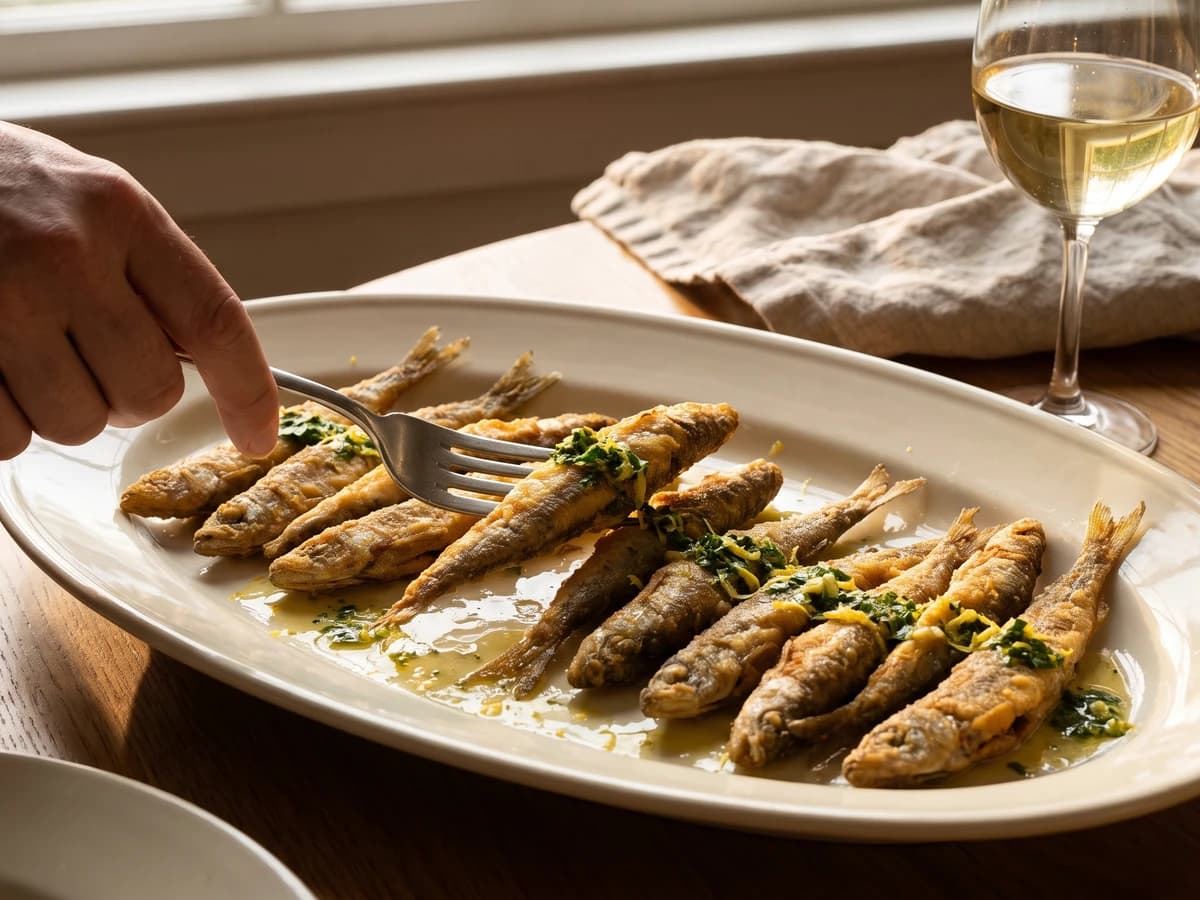
Éperlans à l’Anglaise turns small fish into a lesson in disciplined coating: boned smelts under a close, crisp crumb, pan-fried in clarified butter and finished with bright, half-melted maître d’hôtel butter.

Chef Juliette
Tiny smelts, shallot, mushrooms, white wine, gratin sauce, and fine bread raspings meet a fierce oven, where the fish must turn tender in the same breath the buttered crust bronzes.