
Chef Juliette
John Dory (St. Pierre)
John Dory has the delicacy of sole and the firmness of turbot. A light flouring, a quick butter sauté, and nut-brown beurre noisette show exactly why looks never mattered.
A cooking platform built around craft, culture, and the stories behind what we eat.

Created by Chef Juliette
Based on No. 1653, Giblet Pie, from Le Guide Culinaire (1907) by Auguste Escoffier
Pâté d’abatis turns modest poultry giblets into a generous supper: browned in butter, bound with a light consommé sauce, cooled completely, then sealed beneath puff pastry that rises crisp and gilded.
Pâté d’abatis (giblet pie) teaches one unbending rule: the filling must be cold before puff paste touches it. Obey that, and the lid rises into crisp, butter-gold layers above tender giblets and a light, gleaming sauce. Ignore it, and warmth from below softens the butter between those layers, so the pastry stews before it can bake.
The old formula assumed a consommé pot never off the fire and puff paste waiting at the pastry bench. At home, good prepared chicken consommé and all-butter puff pastry are the honest equivalents. Making both from the beginning was brigade scaffolding, so it can go. Here the quantity is scaled for four, and the gizzard and heart begin ahead of the liver because they do not share a cooking clock. The flavourings and sequence remain spare, exactly as the dish intends: giblets, butter, flour, consommé, pastry.
What must stay is the dish itself: brown the giblets, singer them with flour, moisten with only enough consommé to cover, cook them three-parts toward tenderness, then cool the filling quickly and completely. One cook, one stove, one evening. Before you reach for the pastry, press a spoon into the middle of the filling and make certain there is no warmth hiding underneath.
Pâté d’abatis belongs to French cuisine bourgeoise, particularly the Parisian and national household table where every useful part of a dressed bird had a destination. In classical kitchen language, abatis included the edible poultry trimmings, such as gizzard, heart, liver, neck, and wing tips, while pâté here meant a pastry-covered pie rather than a smooth forcemeat. Household thrift traveled into the grand kitchen through two refinements, clear consommé and puff paste, then returned to the home table as a handsome way to serve modest cuts.
Quantity
2 cups (475 ml / 340 g)
trimmed and thinly sliced
Quantity
1½ cups (355 ml / 225 g)
trimmed and quartered
Quantity
¾ cup (180 ml / 115 g)
trimmed and cut into large pieces
Quantity
3 tablespoons (45 ml / 42 g)
divided
Quantity
3 tablespoons (45 ml / 24 g)
Quantity
2 cups (475 ml / 475 g)
divided
Quantity
Up to ½ teaspoon (2.5 ml / 3 g)
only if needed
Quantity
1 sheet, about 14 ounces (400 g)
kept cold
Quantity
1
Quantity
1 teaspoon (5 ml / 5 g)
| Ingredient | Quantity |
|---|---|
| chicken gizzardstrimmed and thinly sliced | 2 cups (475 ml / 340 g) |
| chicken heartstrimmed and quartered | 1½ cups (355 ml / 225 g) |
| chicken liverstrimmed and cut into large pieces | ¾ cup (180 ml / 115 g) |
| unsalted butterdivided | 3 tablespoons (45 ml / 42 g) |
| all-purpose flour | 3 tablespoons (45 ml / 24 g) |
| clear chicken consommédivided | 2 cups (475 ml / 475 g) |
| fine salt (optional)only if needed | Up to ½ teaspoon (2.5 ml / 3 g) |
| all-butter puff pastrykept cold | 1 sheet, about 14 ounces (400 g) |
| large egg | 1 |
| cold water | 1 teaspoon (5 ml / 5 g) |
Pull away the tough outer membrane and any yellow lining from the gizzards, then slice them across the grain about ¼ inch thick. Trim the vessels and excess fat from the hearts and quarter them. Remove connective tissue and any green-stained portion from the livers, then divide each lobe into two or three large pieces. Pat everything thoroughly dry. Wet giblets sputter and stew in the butter; dry surfaces give you the browning that builds the sauce.
Melt 2 tablespoons (30 ml / 28 g) of the butter in a wide sauté pan over medium-high heat. When the foam subsides, fry the gizzards for 6 to 8 minutes, turning until their edges are well bronzed. Add the hearts and fry for another 3 to 4 minutes. Transfer both to a plate. Brown the liver for about 1 minute on each side, just until coloured outside, then place it on a separate plate. Work in batches if the pan becomes crowded. The brown film left behind is the fond, the foundation of the sauce, so leave it exactly where it is.
Return the gizzards and hearts to the pan and add the remaining 1 tablespoon (15 ml / 14 g) butter. Singer, meaning sprinkle the browned pieces moderately with flour, then turn them over medium heat for 90 seconds so the flour cooks without taking dark colour. Pour in 1¾ cups (415 ml / 415 g) of the consommé a little at a time, scraping every trace of fond from the pan. The sauce should just cover the pieces, not drown them. Hold back the remaining consommé for adjustment.
Bring the sauce to the barest simmer, partially cover, and cook the gizzards and hearts for 18 to 22 minutes. Add the browned liver and simmer for another 4 to 5 minutes, until every piece has reached 165°F (74°C) but the gizzards still offer a little resistance at their centres. This is three-parts cooked toward tenderness, yet safely cooked before chilling. The sauce should be light, clear-looking, and just thick enough to cling. If it tightens into paste, whisk in the reserved consommé a spoonful at a time. If it is watery, lift out the giblets and simmer the sauce briefly before returning them. Ça se rattrape. Taste the sauce and add salt only if the consommé needs it.
Leave the filling in the pan and set the pan in a shallow bath of ice water, taking care that no water enters it. Stir occasionally until the fierce heat has gone, then refrigerate uncovered for 45 to 60 minutes, until the sauce is lightly set and the centre is thoroughly cold. Cover once cold. If the middle still feels warm, wait. Warm filling melts the pastry's butter from below, and no amount of extra gilding can repair that.
Heat the oven to 400°F (200°C), or 360°F (180°C) with a fan, with a rack in the lower-middle position. Pour the cold filling into a shallow 1½-quart (1.4-litre) pie dish. Roll the cold puff pastry about ⅛ inch (3 mm) thick and slightly larger than the dish. Cut a ¾-inch (2 cm) strip from the edge. Brush the dish rim with cold water, press the strip onto it, brush the strip lightly with more water, and lay the pastry lid over the top. Press firmly to seal without stretching, then trim the edge. If the pastry becomes soft or greasy, refrigerate the assembled pie for 10 to 15 minutes before continuing.
Beat the egg with 1 teaspoon (5 ml / 5 g) cold water. Gild the pastry by brushing it with a thin, even coat of the beaten egg, keeping the wash away from the cut edge so the layers are not glued together. With the back of a small knife, score shallow curved streaks across the lid without cutting through it. The scoring gives the puff paste room to open while preserving the sealed cover described by the old formula.
Bake for 25 to 30 minutes, until the pastry is high, crisp at the edges, and a deep butter-gold, with the sauce bubbling visibly where it meets the rim. Check that the filling has returned to 165°F (74°C) at the centre. If the pastry colours before the filling is hot, cover the top loosely with foil and give it another 5 minutes. Rest the pie for 10 minutes so the light sauce settles beneath the crust, then serve from the dish. À table!
1 serving (about 320g)
Culinary guides, cultural storytelling, and the editorial depth that makes cooking meaningful.
Discover Culinary ExplorerChef Juliette
John Dory has the delicacy of sole and the firmness of turbot. A light flouring, a quick butter sauté, and nut-brown beurre noisette show exactly why looks never mattered.

Chef Juliette
Fresh haddock proves its delicacy in the meunière pan: a fine flour crust, moist pearly flakes, and beurre noisette sharpened with lemon and parsley, ready from one skillet in half an hour.
Chef Juliette
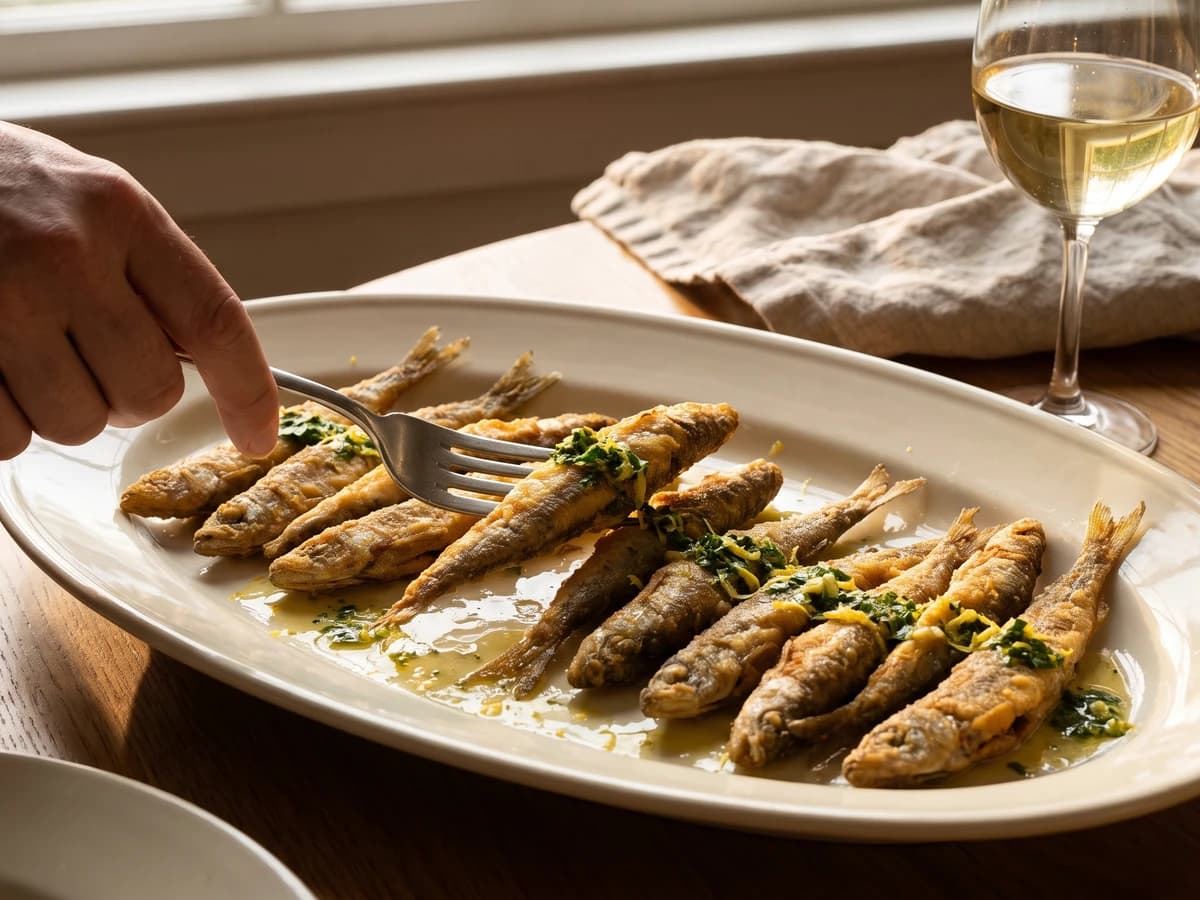
Éperlans à l’Anglaise turns small fish into a lesson in disciplined coating: boned smelts under a close, crisp crumb, pan-fried in clarified butter and finished with bright, half-melted maître d’hôtel butter.

Chef Juliette
Tiny smelts, shallot, mushrooms, white wine, gratin sauce, and fine bread raspings meet a fierce oven, where the fish must turn tender in the same breath the buttered crust bronzes.