
Chef Juliette
John Dory (St. Pierre)
John Dory has the delicacy of sole and the firmness of turbot. A light flouring, a quick butter sauté, and nut-brown beurre noisette show exactly why looks never mattered.
A cooking platform built around craft, culture, and the stories behind what we eat.
Created by Chef Juliette
Based on No. 1650, Tourte de Poussins à la Paysanne, from Le Guide Culinaire (1907) by Auguste Escoffier
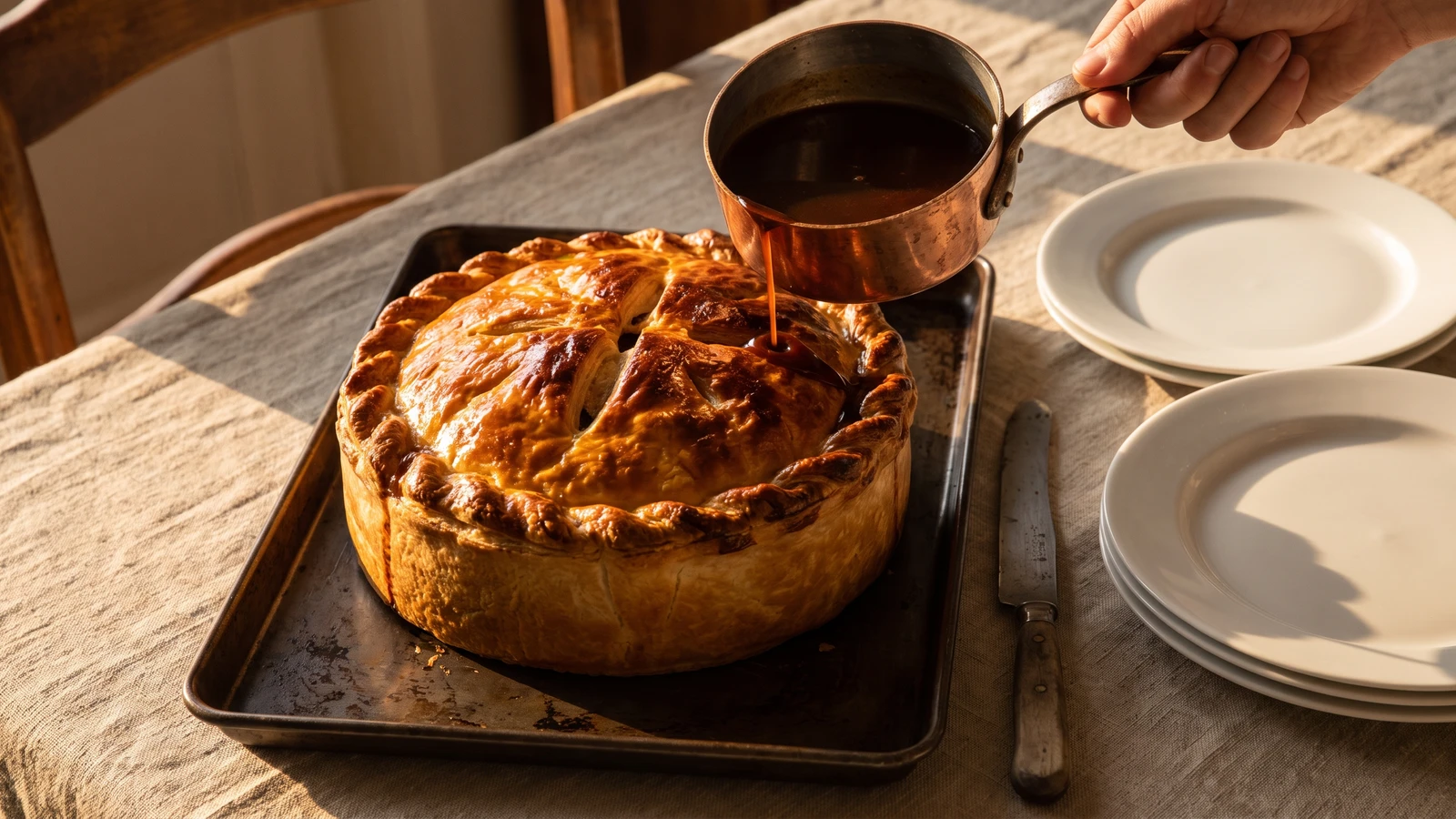
Half-poussins, sausage meat, and dry duxelles enclosed in burnished short paste, with glossy demi-glace poured through the top slit the moment it leaves the oven. Country generosity, disciplined by exact pastry work.
Tourte de Poussins à la Paysanne (country-style poussin pie) teaches the discipline of keeping a filled pie dry until its crust has done its work. The half-poussins, sausage meat, dry duxelles, and sautéed mushrooms go under the short paste with no loose sauce; only when the crust stands bronzed and sealed does the demi-glace enter through the slit. That separation is the one true thing to know before touching a pan.
The original assumed ten tiny half-chicks, dry Duxelles waiting from batch work, and a saucier drawing half-glaze from stock never off the fire. Here ten halves become four, each of the two forcemeat coatings is reduced to four-tenths, and a good prepared demi-glace replaces the separate sauce station. The ten-inch base stays because market poussins are larger and the two-inch bare margin makes the seal. It did not call for a salamander, so neither do we. One cook, one stove, one evening.
The separate sauce station and batch preparation are brigade scaffolding and can go. The two forcemeat coatings, dry mushroom work, bacon veil, tight pleated seal, and immediate pour through the slit are the dish and must stay. Cool every filling before it touches the paste; warm or wet filling melts the butter before the oven can set the crust.
Tourte de poussins à la paysanne belongs to the French cuisine bourgeoise table and the classical repertoire of closed poultry pies, rather than to one claimed province. Such pies traveled from household feast baking into grand kitchens, where dry duxelles, layered forcemeat, and demi-glace gave a practical pastry enclosure a more exact architecture. The name à la paysanne means country-style here, but it does not identify a regional peasant recipe; its rustic title conceals an organized service method, with the sauce held back until the crust is baked.
Quantity
4 cups (960 ml / 500 g)
Quantity
1 cup plus 2 tablespoons (270 ml / 250 g)
cubed
Quantity
1½ teaspoons (7.5 ml / 9 g)
for the short paste
Quantity
½ cup plus up to 2 tablespoons (120 to 150 ml / 120 to 150 g)
Quantity
2 tablespoons (30 ml / 16 g)
for rolling
Quantity
6½ cups (1.55 L / 450 g)
very finely chopped for the dry duxelles
Quantity
2 small (about ½ cup / 80 g)
finely minced
Quantity
2 tablespoons (30 ml / 28 g)
for the duxelles
Quantity
½ teaspoon (2.5 ml / 3 g)
for the duxelles
Quantity
¼ teaspoon (1.25 ml / 0.6 g)
for the duxelles
Quantity
2 small (12 to 14 oz / 340 to 400 g each)
split lengthwise into 4 halves
Quantity
1 teaspoon (5 ml / 6 g)
for the poussins
Quantity
½ teaspoon (2.5 ml / 1.2 g)
for the poussins
Quantity
2 tablespoons (30 ml / 28 g)
for stiffening the poussins
Quantity
1 cup (240 ml / 240 g)
Quantity
1¾ cups (420 ml / 120 g)
coarsely chopped
Quantity
1 tablespoon (15 ml / 14 g)
for sautéing the chopped mushrooms
Quantity
4 very thin slices (about 2 oz / 55 g)
Quantity
1 large egg plus 1 teaspoon water (5 ml / 5 g)
beaten together for gilding
Quantity
¼ cup (60 ml / 60 g)
warmed and pourable
| Ingredient | Quantity |
|---|---|
| all-purpose flour | 4 cups (960 ml / 500 g) |
| cold unsalted buttercubed | 1 cup plus 2 tablespoons (270 ml / 250 g) |
| fine sea saltfor the short paste | 1½ teaspoons (7.5 ml / 9 g) |
| ice water | ½ cup plus up to 2 tablespoons (120 to 150 ml / 120 to 150 g) |
| all-purpose flourfor rolling | 2 tablespoons (30 ml / 16 g) |
| white or cremini mushroomsvery finely chopped for the dry duxelles | 6½ cups (1.55 L / 450 g) |
| shallotsfinely minced | 2 small (about ½ cup / 80 g) |
| unsalted butterfor the duxelles | 2 tablespoons (30 ml / 28 g) |
| fine sea saltfor the duxelles | ½ teaspoon (2.5 ml / 3 g) |
| freshly ground black pepperfor the duxelles | ¼ teaspoon (1.25 ml / 0.6 g) |
| small poussinssplit lengthwise into 4 halves | 2 small (12 to 14 oz / 340 to 400 g each) |
| fine sea saltfor the poussins | 1 teaspoon (5 ml / 6 g) |
| freshly ground black pepperfor the poussins | ½ teaspoon (2.5 ml / 1.2 g) |
| unsalted butterfor stiffening the poussins | 2 tablespoons (30 ml / 28 g) |
| plain fresh pork sausage meat | 1 cup (240 ml / 240 g) |
| white or cremini mushroomscoarsely chopped | 1¾ cups (420 ml / 120 g) |
| unsalted butterfor sautéing the chopped mushrooms | 1 tablespoon (15 ml / 14 g) |
| unsmoked streaky bacon | 4 very thin slices (about 2 oz / 55 g) |
| egg washbeaten together for gilding | 1 large egg plus 1 teaspoon water (5 ml / 5 g) |
| prepared demi-glacewarmed and pourable | ¼ cup (60 ml / 60 g) |
Mix the 4 cups of flour with the salt. Cut in the cold butter with your fingertips or a pastry blender until most pieces resemble coarse crumbs but a few remain the size of small peas. Add ½ cup of ice water and toss lightly; add the remaining water a spoonful at a time only until the dough holds when pressed. Kneading develops toughness, so stop as soon as it comes together. Divide it into a smaller piece for the base and a larger piece for the domed cover, flatten both into discs, wrap, and chill for at least 45 minutes.
Melt the duxelles butter in a wide skillet over medium heat. Soften the shallots without browning, then add the finely chopped mushrooms, salt, and pepper. Cook briskly at first, stirring as they release their water, then lower the heat and continue until the pan is dry, the mixture gathers around the spoon, and no liquid appears when you press it. You need about ⅔ cup (160 ml / 110 g) of dry duxelles. If it still looks glossy with mushroom liquor, keep cooking; wet duxelles will soak the pastry. Spread it on a plate and cool completely.
Pat the poussin halves dry and season them with the salt and pepper. Melt the butter in the cleaned skillet over medium heat until it foams. Raidir, or stiffen, the poussins for 2 to 3 minutes per side, turning them just until the outer flesh firms and loses its raw softness. They should not cook through, and deep browning is not the purpose here. Transfer them to a rack or plate and let them cool completely.
Raise the heat beneath the skillet and melt the remaining tablespoon of butter. Add the coarsely chopped mushrooms in one layer and sauté until their liquid has boiled away and their edges take a little bronze, 5 to 7 minutes. Keep them moving only enough to prevent scorching; constant stirring makes them stew. Spread them on a separate plate and cool completely.
Set a heavy baking sheet in the lower third of the oven and heat it to 375°F (190°C), or 350°F (175°C) with convection. Mix the cold dry duxelles thoroughly with the sausage meat, then divide the forcemeat into two equal portions. On a lightly floured surface, roll the smaller pastry disc about ⅛ inch (3 mm) thick and cut a 10-inch (25 cm) round. Lay it on parchment over a flat metal pie pan or tart base. Spread one portion of forcemeat in a 6-inch (15 cm) circle at the center, leaving a full 2-inch (5 cm) margin of bare paste.
Arrange the four cooled poussin halves compactly over the first coating, cut sides down, tucking in wing tips and keeping sharp bones away from the future cover. Sprinkle the sautéed mushrooms evenly over and between them. Pat the second portion of forcemeat into thin pieces and fit them over the poussins as a second coating. Lay the bacon slices over the mound with their edges slightly overlapping. The fillings must be cold and dry before the pastry closes over them. This is the principle that decides the tourte.
Roll the larger pastry disc about ⅛ inch (3 mm) thick and wide enough to cover the mound without stretching. Brush the bare margin of the base lightly with water, drape over the cover, and press around the filling to release large pockets of air. Seal the two layers firmly, trim the edge evenly, and pleat it at regular intervals. Chill the assembled tourte for 20 minutes, then gild it with the beaten egg, streak the top lightly with the back of a knife, and cut a 1-inch (2.5 cm) slit at the center.
Set the pan directly on the preheated baking sheet and bake for 40 minutes before checking. Continue for 5 to 15 minutes, until the pastry is deeply golden, the pleats are crisp, and a thermometer inserted through the slit reaches 165°F (74°C) in the thickest part of a poussin thigh without touching bone. Check that the central sausage layer has reached at least 160°F (71°C). If the top bronzes before the filling is ready, cover it loosely with foil and keep baking; color is negotiable once it is handsome, safe doneness is not.
The moment the tourte leaves the oven, pour the warm demi-glace slowly through the central slit, one tablespoon at a time, pausing as the forcemeat drinks it in. If the sauce sits stubbornly on top, widen the slit with a small knife or use a heatproof funnel; if it is too thick to flow, loosen it with a teaspoon of hot water. Rest the tourte for 15 minutes so the sauce settles through the layers, then cut it into four portions, giving each guest one half-poussin beneath its share of crust. À table!
1 serving (about 480g)
Culinary guides, cultural storytelling, and the editorial depth that makes cooking meaningful.
Discover Culinary ExplorerChef Juliette
John Dory has the delicacy of sole and the firmness of turbot. A light flouring, a quick butter sauté, and nut-brown beurre noisette show exactly why looks never mattered.

Chef Juliette
Fresh haddock proves its delicacy in the meunière pan: a fine flour crust, moist pearly flakes, and beurre noisette sharpened with lemon and parsley, ready from one skillet in half an hour.

Chef Juliette
Éperlans à l’Anglaise turns small fish into a lesson in disciplined coating: boned smelts under a close, crisp crumb, pan-fried in clarified butter and finished with bright, half-melted maître d’hôtel butter.

Chef Juliette
Tiny smelts, shallot, mushrooms, white wine, gratin sauce, and fine bread raspings meet a fierce oven, where the fish must turn tender in the same breath the buttered crust bronzes.