
Chef Juliette
John Dory (St. Pierre)
John Dory has the delicacy of sole and the firmness of turbot. A light flouring, a quick butter sauté, and nut-brown beurre noisette show exactly why looks never mattered.
A cooking platform built around craft, culture, and the stories behind what we eat.
Created by Chef Juliette
Based on No. 1648, Poussins à la Polonaise, from Le Guide Culinaire (1907) by Auguste Escoffier
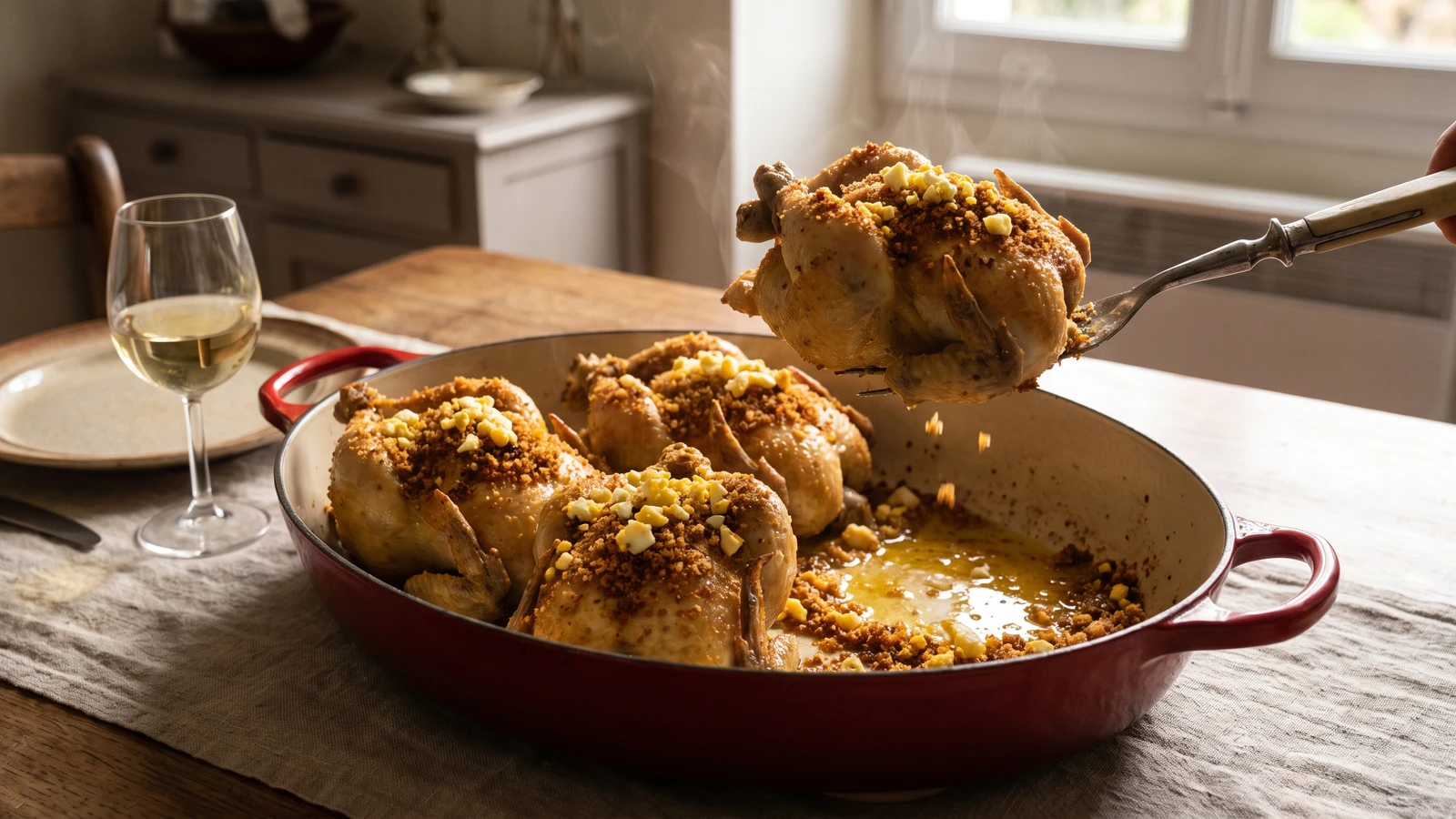
Four butter-browned poussins hide a tender gratin forcemeat stuffing, then leave the cocotte under lemon and crisp crumbs fried in beurre noisette: generous classical poultry for one attentive cook.
Poussins à la Polonaise (young chickens stuffed with a rich forcemeat and finished with butter-fried crumbs) teaches the importance of order. Brown first, cook gently second, add the crisp finish last. The final flourish is beurre noisette (butter cooked to hazelnut color), but the one true thing to know before touching the pan is this: the birds must take their bronze before entering the cocotte, because gentle enclosed heat can finish the meat but cannot create that color afterward.
The original entry assumed a brigade with Gratins (No. 268) already prepared, enough hands to truss a tray of birds, and an oven fierce enough to fry their skins in butter before they moved into a cocotte. At home, one broad cocotte does the browning on the stove and the cooking in the oven. The separate frying vessel and transfer are brigade scaffolding, so they go. The stuffing proportions, butter browning, last-minute lemon, and four-to-one ratio of butter to crumbs are the dish itself, so they stay. Four small birds, one cook, one stove, one evening.
When the poussins are right, their skins are deeply burnished, the stuffing remains tender, and the crumbs crackle softly under the knife while beurre noisette gathers at the bottom of the serving dish. Don't hurry the initial browning. That is the step that decides the dish.
Poussins à la Polonaise belongs to the Parisian classical service repertoire, where à la Polonaise named a finishing manner rather than claiming that the entire dish arrived unchanged from Poland. French kitchens used the name most recognizably for vegetables dressed with butter, breadcrumbs, parsley, and often chopped egg; this poultry entry keeps the butter-and-crumb finish but moves the parsley into the stuffing and adds lemon at the table. It is a fine example of a named garnish traveling between categories within the canon and becoming the identity of a complete cocotte dish.
Quantity
4, each 14 to 16 ounces (400 to 450 g)
Quantity
¾ cup (180 ml / 170 g) Gratins (No. 268)
chilled and ready to use as gratin forcemeat
Quantity
½ cup firmly packed (120 ml / 75 g)
soaked in cool water, pressed very dry, and weighed after pressing
Quantity
2 tablespoons plus 2 teaspoons (40 ml / 38 g)
softened
Quantity
2 teaspoons (10 ml / 2 g)
finely chopped
Quantity
1½ teaspoons (7.5 ml / 9 g)
Quantity
6 tablespoons (90 ml / 85 g)
Quantity
8 tablespoons (120 ml / 113 g)
Quantity
½ cup (120 ml / 28 g)
Quantity
1 tablespoon (15 ml / 15 g)
Quantity
2 tablespoons (30 ml / 28 g)
reserved only for remaking scorched beurre noisette
| Ingredient | Quantity |
|---|---|
| poussins or small Cornish game hens | 4, each 14 to 16 ounces (400 to 450 g) |
| prepared Gratinschilled and ready to use as gratin forcemeat | ¾ cup (180 ml / 170 g) Gratins (No. 268) |
| fresh white breadcrumbssoaked in cool water, pressed very dry, and weighed after pressing | ½ cup firmly packed (120 ml / 75 g) |
| unsalted butter for the stuffingsoftened | 2 tablespoons plus 2 teaspoons (40 ml / 38 g) |
| flat-leaf parsleyfinely chopped | 2 teaspoons (10 ml / 2 g) |
| fine sea salt | 1½ teaspoons (7.5 ml / 9 g) |
| unsalted butter for browning | 6 tablespoons (90 ml / 85 g) |
| unsalted butter for the beurre noisette | 8 tablespoons (120 ml / 113 g) |
| fine dry white breadcrumbs | ½ cup (120 ml / 28 g) |
| fresh lemon juice | 1 tablespoon (15 ml / 15 g) |
| additional unsalted butter (optional)reserved only for remaking scorched beurre noisette | 2 tablespoons (30 ml / 28 g) |
Heat the oven to 400°F (200°C), with a rack set just below the center. Press the soaked fresh breadcrumbs until no water drips when you squeeze them, then weigh out 2⅔ ounces (75 g). Work the softened butter through the crumbs, add the parsley, and fold in the chilled Gratins (No. 268) just until the mixture is even. Divide it into four portions of about 2½ ounces (71 g) each. If the mixture slumps instead of holding a spoon mark, chill it for 10 minutes. Ça se rattrape. Don't add more dry crumbs, because that would alter the book's proportion.
Pat the poussins thoroughly dry, including inside the cavities, and season them with the salt. Place one portion of stuffing inside each bird without packing it tightly; the filling needs a little room to warm and expand. Fold the skin flap over the cavity, tie the legs together, then run the twine around the body to hold the wings close. This is the home translation of trussing as for entrées: compact birds that brown evenly, without the brigade's elaborate needlework. If the cavity won't close, remove a spoonful of filling rather than forcing it out through the skin.
Heat 4 tablespoons (60 ml / 57 g) of the browning butter in a broad cocotte over medium-high heat until the foam subsides. Brown the poussins two at a time, turning them carefully until the breasts, backs, and sides are a deep butter-gold, about 8 to 10 minutes per batch; replenish the butter as needed. This color must be made now. If the milk solids turn black or smell acrid, lift out the birds and wipe away the burnt butter before continuing with fresh butter. Ça se rattrape, but burnt butter left in the pot will follow the dish to the table.
Return all four poussins to the cocotte in a snug single layer, breast-side up. Cover and roast for 15 minutes, then remove the lid, baste once with the clean butter in the pot, and continue roasting for 10 to 15 minutes. They are ready when the thickest part of a thigh and the center of the stuffing both register 165°F (74°C). If the skin has browned enough before the centers are ready, replace the lid and continue gently. Add no stock or water; this is a butter-finished cocotte preparation, not a braise. Transfer the birds to a warm serving dish and rest them uncovered for 8 minutes.
While the poussins rest, melt the 8 tablespoons (120 ml / 113 g) of finishing butter in a small pale-lined skillet over medium heat. Swirl as it foams; when the foam thins, the milk solids turn hazelnut brown, and the butter smells nutty, remove the pan from the heat and stir in the ½ cup (120 ml / 28 g) dry breadcrumbs. Return it to low heat and stir for 1 to 2 minutes, until the crumbs are evenly crisp and bronze. This preserves the entry's exact four-to-one ratio of butter to crumbs by weight. If the solids turn black, don't cover the mistake with crumbs. Discard the scorched butter, wipe the pan, and begin again with the reserved butter.
At the last possible moment, sprinkle each poussin with a few drops of lemon juice, using no more than the tablespoon in all. Spoon the beurre noisette crumbs generously over the birds, letting the remaining butter collect beneath them. Serve at once, while the crumbs are crisp and the butter still gleams. À table!
1 serving (about 445g)
Culinary guides, cultural storytelling, and the editorial depth that makes cooking meaningful.
Discover Culinary ExplorerChef Juliette
John Dory has the delicacy of sole and the firmness of turbot. A light flouring, a quick butter sauté, and nut-brown beurre noisette show exactly why looks never mattered.

Chef Juliette
Fresh haddock proves its delicacy in the meunière pan: a fine flour crust, moist pearly flakes, and beurre noisette sharpened with lemon and parsley, ready from one skillet in half an hour.
Chef Juliette
Éperlans à l’Anglaise turns small fish into a lesson in disciplined coating: boned smelts under a close, crisp crumb, pan-fried in clarified butter and finished with bright, half-melted maître d’hôtel butter.

Chef Juliette
Tiny smelts, shallot, mushrooms, white wine, gratin sauce, and fine bread raspings meet a fierce oven, where the fish must turn tender in the same breath the buttered crust bronzes.