
Chef Juliette
John Dory (St. Pierre)
John Dory has the delicacy of sole and the firmness of turbot. A light flouring, a quick butter sauté, and nut-brown beurre noisette show exactly why looks never mattered.
A cooking platform built around craft, culture, and the stories behind what we eat.

Created by Chef Juliette
Based on No. 1620, Suprêmes de Volaille à la Valois, from Le Guide Culinaire (1907) by Auguste Escoffier
Crisp butter-gold suprêmes, a juicy center, last-minute stuffed olives, and Sauce Valois in its own warm boat: a lesson in coordinating crust and emulsion without sacrificing either.
Suprêmes de Volaille à la Valois (crumbed chicken breast fillets with stuffed olives and Sauce Valois) teaches one precise thing: a coating pané à l'anglaise, floured, passed through seasoned egg, and crumbed, must set the instant it meets properly heated clarified butter. That immediate crust protects the breast while it cooks, giving you juicy poultry beneath an even butter-gold coat.
The brigade recipe assumed a saucier tending the warm emulsion, a stock never off the fire for meat glaze and poaching, and separate hands to stuff olives, bread chicken, and manage the skillet. At home, prepared low-sodium demi-glace supplies the measured glaze, good unsalted stock fills one small poaching pan, and a heatproof bowl over warm water replaces the sauce station. No salamander is needed. The bulk farce, large holding pans, and separate fry station were scaffolding; a tiny chicken mousseline, a low oven, and a twelve-inch skillet bring the dish down to four servings. The à l'anglaise crust, clarified butter, last-minute poached olives, and Sauce Valois served apart must stay. They are the dish. One cook, one stove, one evening.
The sauce can wait warmly for a few minutes, and the stuffed olives can wait cold, but the breaded chicken cannot forgive lukewarm fat. The decisive moment is its first contact with clarified butter hot enough to hiss at once without scorching the crumbs.
Suprêmes de Volaille à la Valois belongs to the codified Parisian grand-kitchen repertory, where names drawn from royal houses identified composed sauces and garnishes rather than a regional larder. Sauce Valois is a Béarnaise-family warm emulsion enriched with meat glaze; classical compilations often place it beside Sauce Foyot, and some treat the two names as nearly interchangeable. Served from a sauceboat with crisp crumbed poultry and last-minute stuffed olives, the composition passed readily onto bourgeois celebration tables.
Quantity
4, about 6 ounces (170 g) each
trimmed to an even thickness
Quantity
1 ounce (30 g)
finely diced
Quantity
1 teaspoon (5 ml / 5 g)
Quantity
2 teaspoons (10 ml / 10 g)
very cold
Quantity
20, about ⅔ cup (160 ml / 100 g)
rinsed and dried
Quantity
1 cup (240 ml / 240 g)
Quantity
1½ teaspoons (7.5 ml / 9 g)
divided
Quantity
½ teaspoon (2.5 ml / 1 g)
divided
Quantity
½ cup (120 ml / 60 g)
Quantity
1 cup (240 ml / 250 g) Anglaise (for Egg-and-bread-crumbing) (No. 174)
prepared and chilled
Quantity
2 cups (475 ml / 120 g)
Quantity
1⅔ cups (400 ml / 360 g)
warm and divided
Quantity
3 tablespoons (45 ml / 45 g)
Quantity
3 tablespoons (45 ml / 45 g)
Quantity
2 tablespoons (30 ml / 20 g)
minced
Quantity
1 teaspoon (5 ml / 2 g)
lightly crushed
Quantity
2 tablespoons (30 ml / 6 g)
leaves finely chopped and stems reserved
Quantity
1 tablespoon (15 ml / 2 g)
finely chopped
Quantity
2, about 1¼ ounces (36 g)
Quantity
1 tablespoon (15 ml / 15 g)
Quantity
2 tablespoons (30 ml / 30 g)
warmed until fluid
Quantity
1 teaspoon (5 ml / 5 g)
| Ingredient | Quantity |
|---|---|
| skinless, boneless chicken breast suprêmestrimmed to an even thickness | 4, about 6 ounces (170 g) each |
| very cold chicken tenderloinfinely diced | 1 ounce (30 g) |
| pasteurized egg white | 1 teaspoon (5 ml / 5 g) |
| heavy creamvery cold | 2 teaspoons (10 ml / 10 g) |
| small pitted green olivesrinsed and dried | 20, about ⅔ cup (160 ml / 100 g) |
| unsalted chicken stock | 1 cup (240 ml / 240 g) |
| fine sea saltdivided | 1½ teaspoons (7.5 ml / 9 g) |
| finely ground white pepperdivided | ½ teaspoon (2.5 ml / 1 g) |
| all-purpose flour | ½ cup (120 ml / 60 g) |
| Anglaise (for Egg-and-bread-crumbing)prepared and chilled | 1 cup (240 ml / 250 g) Anglaise (for Egg-and-bread-crumbing) (No. 174) |
| fine white breadcrumbs | 2 cups (475 ml / 120 g) |
| clarified butterwarm and divided | 1⅔ cups (400 ml / 360 g) |
| dry white wine | 3 tablespoons (45 ml / 45 g) |
| white wine vinegar | 3 tablespoons (45 ml / 45 g) |
| shallotminced | 2 tablespoons (30 ml / 20 g) |
| black peppercornslightly crushed | 1 teaspoon (5 ml / 2 g) |
| fresh tarragonleaves finely chopped and stems reserved | 2 tablespoons (30 ml / 6 g) |
| fresh chervilfinely chopped | 1 tablespoon (15 ml / 2 g) |
| pasteurized large egg yolks | 2, about 1¼ ounces (36 g) |
| cool water | 1 tablespoon (15 ml / 15 g) |
| unsalted meat glaze or prepared low-sodium demi-glacewarmed until fluid | 2 tablespoons (30 ml / 30 g) |
| fresh lemon juice | 1 teaspoon (5 ml / 5 g) |
Make a tiny mousseline, a smooth chicken forcemeat. Sprinkle the cold diced tenderloin with a pinch each of salt and white pepper, then chop and smear it against the board with the flat of a knife until smooth and tacky. Beat in the egg white, followed by the cold cream a few drops at a time. Keep everything cold so the mixture stays bound. Transfer it to a small piping bag and fill the cavity of each olive without mounding the ends. Chill the stuffed olives while you prepare the chicken.
Place each suprême between sheets of parchment and tap the thicker end until the breast is an even ⅝ inch (1.5 cm) thick, keeping its natural shape. Dry well, then season both sides with most of the remaining salt and white pepper. Set the flour, the Anglaise (for Egg-and-bread-crumbing) (No. 174), and the breadcrumbs in three wide dishes. Coat each breast lightly with flour and shake off every loose patch, immerse it thoroughly in the Anglaise, then press it into the crumbs until evenly covered. If a bare patch appears, touch only that spot back into the Anglaise and crumbs. Rest the breaded suprêmes uncovered in the cold for 15 minutes so the coat adheres. Discard the flour, Anglaise, and crumbs that contacted raw chicken.
Combine the wine, vinegar, shallot, peppercorns, and reserved tarragon stems in a small saucepan. Boil steadily until only about 1½ tablespoons (22 ml) of sharp, fragrant liquid remains. Strain it into a heatproof bowl, pressing the shallot lightly, then let it cool until warm rather than hot. This concentrated reduction supplies the acidity that keeps the butter in balance.
Bring 1 inch (2.5 cm) of water to the barest simmer in a saucepan and set the bowl of reduction over it without letting the bowl touch the water. Add the yolks and cool water, then whisk constantly until pale, thick, and ribboning, reaching about 150°F (66°C). Remove the bowl from the pan. Whisk in ⅔ cup (160 ml / 145 g) of the warm clarified butter first by drops, then in a thin stream once the emulsion has body. Whisk in the warm meat glaze or demi-glace, lemon juice, chopped tarragon, and chervil, then correct the salt and pepper. If the sauce turns oily, stop adding butter and whisk in a teaspoon of cool water. If it separates completely, ça se rattrape: put a teaspoon of cool water in a clean warm bowl and whisk the broken sauce into it one spoonful at a time. Hold the finished Sauce Valois over warm water at 120 to 130°F (49 to 54°C), never over direct heat.
Heat the oven to 200°F (95°C) and set a wire rack over a small tray. Heat the remaining 1 cup (240 ml / 215 g) clarified butter in a heavy 12-inch (30 cm) skillet until it reaches 350°F (175°C); a loose crumb should hiss immediately and turn gold without blackening. Cook the suprêmes two at a time, lowering them away from you, for 3 to 4 minutes per side. Turn only once. The crust should become evenly butter-gold while the center reaches 160 to 162°F (71 to 72°C), then carry to 165°F (74°C) during its brief rest. Hold the first batch on the rack in the low oven while the second cooks. Skim loose burnt crumbs between batches and let the butter return to temperature. If the coating colors before the chicken is ready, lower the heat at once and finish that breast on the rack in the oven. Never press it with the spatula; that only drives out its juices.
While the final suprêmes cook, bring the chicken stock to a bare simmer in the smallest saucepan that will hold the olives. Add the stuffed olives at the last moment and poach gently for 3 to 4 minutes, rolling them once, until the chicken filling is opaque and reaches 165°F (74°C). Do not boil them. If the filling begins to push out, pull the pan from the heat and let the olives finish in the hot stock. Drain them carefully and blot only their undersides.
Arrange one suprême on each warmed plate or overlap all four on a warm oval platter. Set five stuffed olives around each portion. Stir the Sauce Valois gently, loosening it with a teaspoon of warm water if it has tightened, then pour it into a warmed sauceboat and serve it separately. Do not blanket the crust before it reaches the table; each guest spoons the sauce beside the chicken so crisp crumb and warm emulsion remain distinct. À table!
1 serving (about 280g)
Culinary guides, cultural storytelling, and the editorial depth that makes cooking meaningful.
Discover Culinary ExplorerChef Juliette
John Dory has the delicacy of sole and the firmness of turbot. A light flouring, a quick butter sauté, and nut-brown beurre noisette show exactly why looks never mattered.

Chef Juliette
Fresh haddock proves its delicacy in the meunière pan: a fine flour crust, moist pearly flakes, and beurre noisette sharpened with lemon and parsley, ready from one skillet in half an hour.
Chef Juliette
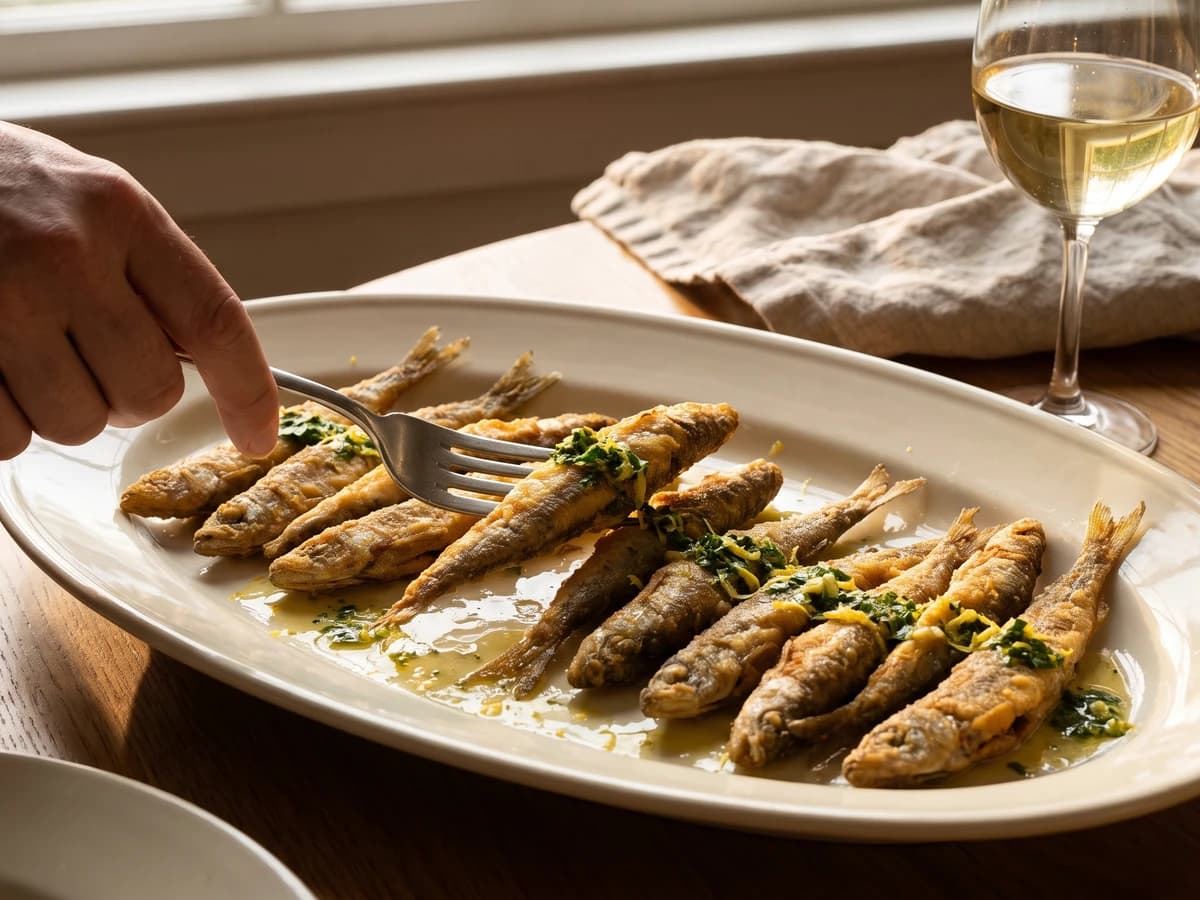
Éperlans à l’Anglaise turns small fish into a lesson in disciplined coating: boned smelts under a close, crisp crumb, pan-fried in clarified butter and finished with bright, half-melted maître d’hôtel butter.

Chef Juliette
Tiny smelts, shallot, mushrooms, white wine, gratin sauce, and fine bread raspings meet a fierce oven, where the fish must turn tender in the same breath the buttered crust bronzes.