
Chef Juliette
John Dory (St. Pierre)
John Dory has the delicacy of sole and the firmness of turbot. A light flouring, a quick butter sauté, and nut-brown beurre noisette show exactly why looks never mattered.
A cooking platform built around craft, culture, and the stories behind what we eat.
Created by Chef Juliette
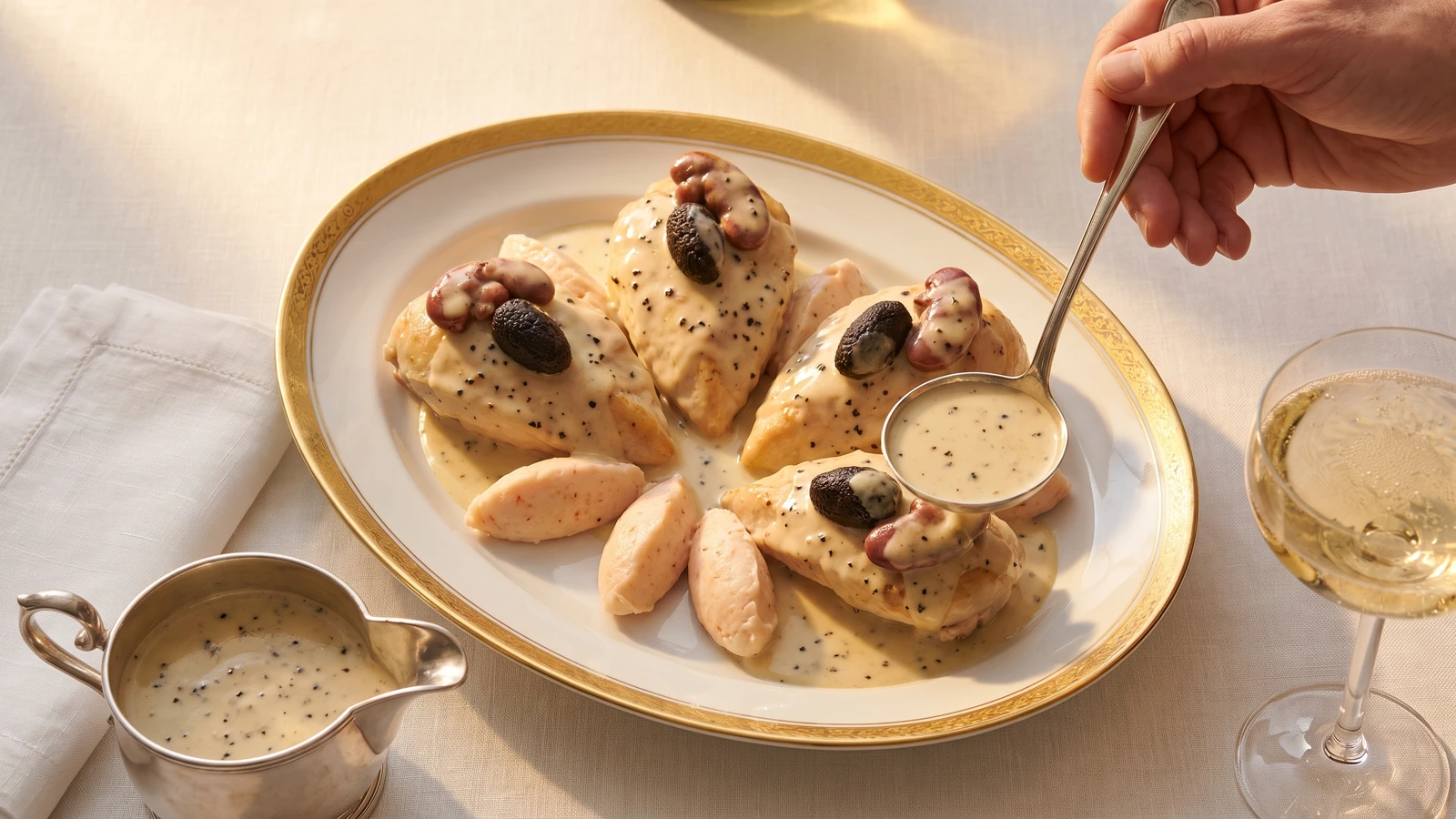
Based on No. 1615, Suprêmes de Volaille Régence, from Le Guide Culinaire (1907) by Auguste Escoffier
Four heart-shaped suprêmes, each poised on a crayfish-butter chicken quenelle and cloaked in truffle-scented Allemande: a celebration dish whose real luxury is precise temperature, timing, and generous sauce.
Suprêmes de Volaille Régence (Régence-style poached chicken breasts) teaches coordination: the quiet art of bringing a quenelle, a poached suprême, and a liaison-finished sauce together at the same tenderness and temperature. Suprême means the breast fillet of the bird, shaped here into a heart. The one true thing to know before touching a pan is that the chicken forcemeat must remain cold. Warm it, and the emulsion smears into something heavy; keep it cold, and the quenelles swell tender beneath the breasts.
The original entry assumed a saucier, a stock never off the fire, prepared crayfish butter, ready-cleaned cockscombs and cock’s kidneys, and several hands to poach, sauce, garnish, and serve together. A salamander is neither needed nor wanted because Régence is coated, not gratinéed. At home, a quick shell-infused butter, one pan of stock reused for poaching, a food processor, and a warmed platter do the work. The brigade choreography is scaffolding and can go; the crayfish-butter forcemeat, heart shape, gentle poach, truffle-scented Allemande, and crown arrangement are the dish and stay. One cook, one stove, one evening.
The rare poultry garnish remains exactly as the entry gives it when a specialist can supply it fully prepared. If it cannot be sourced safely, omit it and say so at the table rather than inventing a counterfeit; the result is a reduced Régence presentation, not the complete classical one. Before you begin, chill the processor bowl and blade. That cold forcemeat is the step that decides the dish.
Suprêmes de Volaille Régence belongs to the Parisian grand-kitchen repertoire rather than to a French province; Régence names a composed garniture in which truffle, cockscomb, cock’s kidney, crayfish butter, and delicately poached poultry signal abundance. The preparation traveled into formal bourgeois cooking through the classical sauce system, with Allemande sauce held by the saucier and finished for service. Its luxury lies as much in labor as in ingredients: several separately prepared elements must arrive hot and delicate without one overwhelming another.
Quantity
4 large (about 1½ pounds / 680 g total), plus 3¾ ounces / 105 g extra chicken breast meat
kept thoroughly chilled
Quantity
Shells from 12 crayfish (about 3 ounces / 85 g shells)
rinsed and thoroughly dried; tail meat reserved for another meal
Quantity
6 tablespoons (90 ml / 85 g)
cubed
Quantity
1
Quantity
½ cup (120 ml / 120 g)
Quantity
2 teaspoons (10 ml / 12 g)
divided
Quantity
½ teaspoon (2.5 ml / 1 g)
divided
Quantity
4½ cups (1.08 L / 1,080 g)
divided
Quantity
1 tablespoon (15 ml / 14 g)
softened
Quantity
5 tablespoons (75 ml / 70 g)
divided
Quantity
⅓ cup (80 ml / 42 g)
Quantity
2
Quantity
¾ cup (180 ml / 180 g)
divided
Quantity
2 teaspoons (10 ml / 10 g)
Quantity
1 tablespoon (15 ml / 15 g)
Quantity
1 small (about 1 ounce / 25 g)
drained
Quantity
4
Quantity
4
obtained fully prepared from a specialist poultry supplier
| Ingredient | Quantity |
|---|---|
| skinless, boneless chicken breast halveskept thoroughly chilled | 4 large (about 1½ pounds / 680 g total), plus 3¾ ounces / 105 g extra chicken breast meat |
| unseasoned cooked crayfish shellsrinsed and thoroughly dried; tail meat reserved for another meal | Shells from 12 crayfish (about 3 ounces / 85 g shells) |
| unsalted butter for crayfish buttercubed | 6 tablespoons (90 ml / 85 g) |
| large egg white | 1 |
| cold heavy cream for chicken forcemeat | ½ cup (120 ml / 120 g) |
| fine sea saltdivided | 2 teaspoons (10 ml / 12 g) |
| ground white pepperdivided | ½ teaspoon (2.5 ml / 1 g) |
| unsalted chicken stockdivided | 4½ cups (1.08 L / 1,080 g) |
| unsalted butter for poaching pansoftened | 1 tablespoon (15 ml / 14 g) |
| unsalted butter for roux and sauce finishdivided | 5 tablespoons (75 ml / 70 g) |
| all-purpose flour | ⅓ cup (80 ml / 42 g) |
| large egg yolks | 2 |
| cold heavy cream for Allemande sauce and rescuesdivided | ¾ cup (180 ml / 180 g) |
| fresh lemon juice | 2 teaspoons (10 ml / 10 g) |
| truffle essence or preserved-truffle juice | 1 tablespoon (15 ml / 15 g) |
| preserved black truffledrained | 1 small (about 1 ounce / 25 g) |
| fully cooked and peeled cock’s combs (optional) | 4 |
| fully cooked cock’s kidneys (rooster testicles) (optional)obtained fully prepared from a specialist poultry supplier | 4 |
Crush the clean, dry crayfish shells into small pieces. Melt the 6 tablespoons of butter over low heat, add the shells, and cook very gently for 12 to 15 minutes, stirring often, until the butter has taken on a coral-red tint and smells distinctly of crayfish. Do not let the milk solids or shells brown. Strain through a fine sieve lined with damp cheesecloth, pressing firmly, then chill until the butter is soft but no longer liquid. Measure 3 tablespoons (45 ml / 42 g) for the forcemeat.
Remove the tenderloin from each breast and reserve it with every trimming. Set each breast smooth-side up between sheets of parchment and flatten it gently to an even ⅝ inch (1.5 cm), preserving its thickness rather than beating it into a cutlet. Cut a shallow notch in the broad end, round the two shoulders, and trim the tapered end to form a clean heart. Season the four suprêmes with ¾ teaspoon of the salt and a little white pepper, cover, and return them to the cold. Combine the tenderloins and trimmings with enough of the extra breast meat to make 8 ounces (225 g) for the forcemeat.
Put the chilled 8 ounces (225 g) of chicken into the cold processor bowl with ¾ teaspoon salt and ¼ teaspoon white pepper. Process just until it becomes smooth and tacky, then add the egg white and the measured crayfish butter. With the machine pulsing, add the ½ cup of cold cream in a thin stream and stop as soon as the farce mousseline, the cream-enriched chicken forcemeat, looks satin-smooth. Poach a teaspoonful in barely trembling water and taste it. If the mixture looks oily or grainy, stop immediately, set the bowl over ice, and beat in 1 tablespoon of the reserved cold sauce cream. Ça se rattrape. Cover and chill for 20 minutes.
Melt 3 tablespoons (45 ml / 42 g) of the sauce butter in a heavy saucepan. Stir in the flour and cook this roux blond, a pale cooked mixture of butter and flour, for 3 minutes without allowing it to color. Whisk in 2½ cups (600 ml / 600 g) of the chicken stock gradually, keeping the mixture smooth. Bring it to a bare simmer and cook for 20 minutes, stirring and skimming occasionally, until the velouté lightly coats a spoon. If lumps form, pass it through a fine sieve and continue; the sauce has lost nothing.
Bring the remaining 2 cups (480 ml / 480 g) of stock to 180 to 185°F (82 to 85°C) in a wide sauté pan. It should tremble at the edge but never boil. Using two large spoons dipped in warm water, shape the cold forcemeat into four long, even quenelles, each large enough to support one suprême. Lower them into the stock, cover with a parchment cartouche, and poach gently for 12 to 15 minutes, turning once, until their centers reach 165°F (74°C). Lift them out with a slotted spatula, cover, and keep warm. Strain and reserve the poaching liquor.
Wipe the sauté pan clean and butter it with the softened tablespoon of butter. Arrange the heart-shaped suprêmes in one layer and add enough strained poaching liquor to come halfway up their sides. Cover with a fresh parchment cartouche and hold the liquid at the same bare tremble. Poach for 8 to 12 minutes, depending on thickness, until the chicken remains plump and its center reaches 165°F (74°C). Boiling tightens the meat and distorts the hearts, so lower the heat at the first hard bubble. Transfer the suprêmes to a warm plate, cover loosely, and strain the liquor again.
Whisk the egg yolks with ½ cup (120 ml / 120 g) of the cold sauce cream. Add ½ cup (120 ml / 120 g) of strained poaching liquor to the velouté and simmer until it again coats the spoon lightly. Whisk a ladleful into the yolk mixture, then return everything to the saucepan over very low heat. Stir continuously until the Allemande sauce thickens to nappe, coating the back of a spoon, and reaches at least 160°F (71°C). Never let it boil. Remove it from the heat and whisk in the remaining 2 tablespoons of sauce butter, the lemon juice, the truffle essence, and the finely chopped truffle trimmings. If tiny grains appear, pour the sauce at once through a fine sieve into a cool bowl and whisk in reserved cold cream one spoonful at a time. Ça se rattrape.
Cut four olive-shaped pieces from the preserved truffle. Warm them briefly in a little hot poaching liquor with the prepared cockscombs and cock’s kidneys, if using, without boiling. Arrange the four quenelles as a crown on a warmed oval platter, their narrow ends pointing toward the center, and set one heart-shaped suprême on each. Coat every portion generously with the truffle-scented Allemande sauce. On each suprême, place one olive-shaped truffle and one cock’s kidney with a cock’s comb between them, exactly in the order of the original garnish. Pass the remaining sauce separately and serve at once. À table!
1 serving (about 360g)
Culinary guides, cultural storytelling, and the editorial depth that makes cooking meaningful.
Discover Culinary ExplorerChef Juliette
John Dory has the delicacy of sole and the firmness of turbot. A light flouring, a quick butter sauté, and nut-brown beurre noisette show exactly why looks never mattered.

Chef Juliette
Fresh haddock proves its delicacy in the meunière pan: a fine flour crust, moist pearly flakes, and beurre noisette sharpened with lemon and parsley, ready from one skillet in half an hour.
Chef Juliette
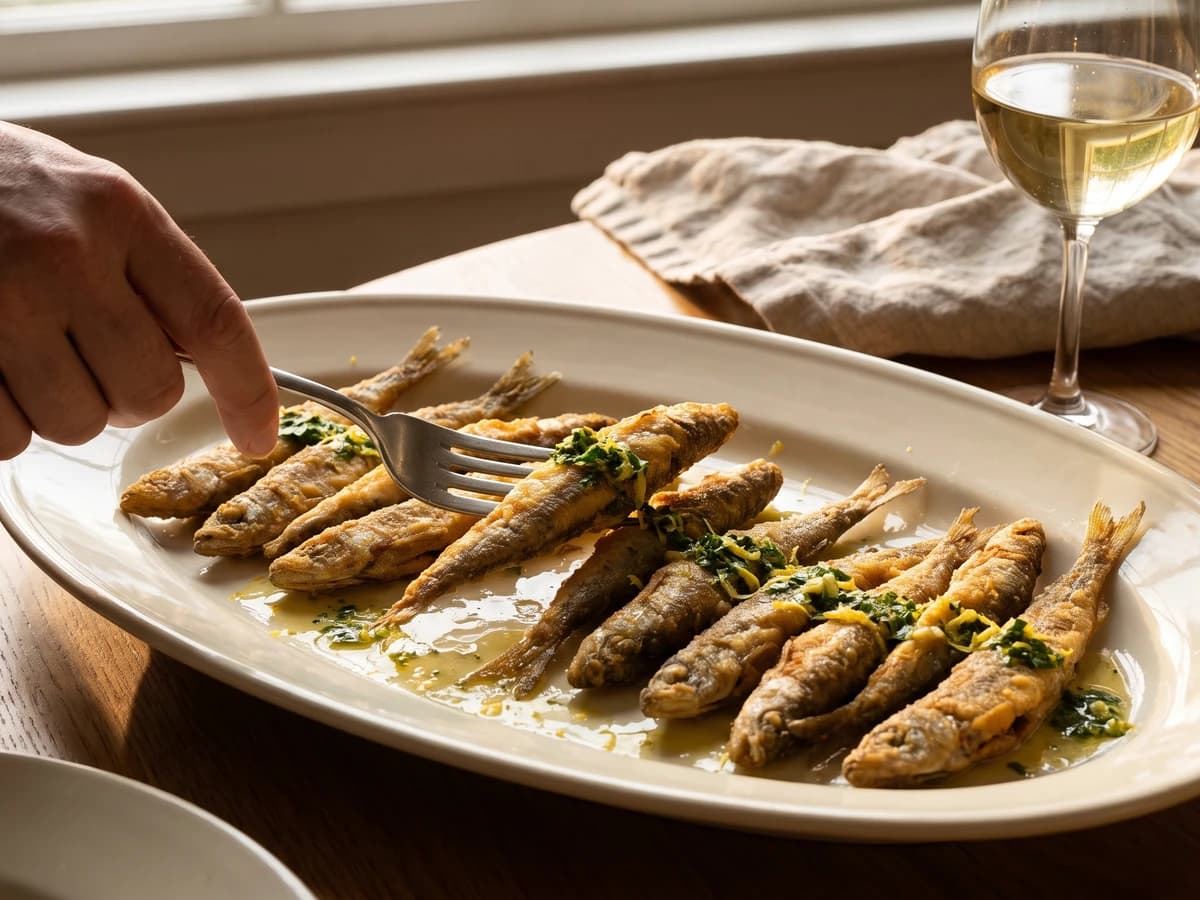
Éperlans à l’Anglaise turns small fish into a lesson in disciplined coating: boned smelts under a close, crisp crumb, pan-fried in clarified butter and finished with bright, half-melted maître d’hôtel butter.

Chef Juliette
Tiny smelts, shallot, mushrooms, white wine, gratin sauce, and fine bread raspings meet a fierce oven, where the fish must turn tender in the same breath the buttered crust bronzes.