
Chef Juliette
John Dory (St. Pierre)
John Dory has the delicacy of sole and the firmness of turbot. A light flouring, a quick butter sauté, and nut-brown beurre noisette show exactly why looks never mattered.
A cooking platform built around craft, culture, and the stories behind what we eat.
Created by Chef Juliette
Based on No. 1612, Suprêmes de Volaille au Parmesan, from Le Guide Culinaire (1907) by Auguste Escoffier
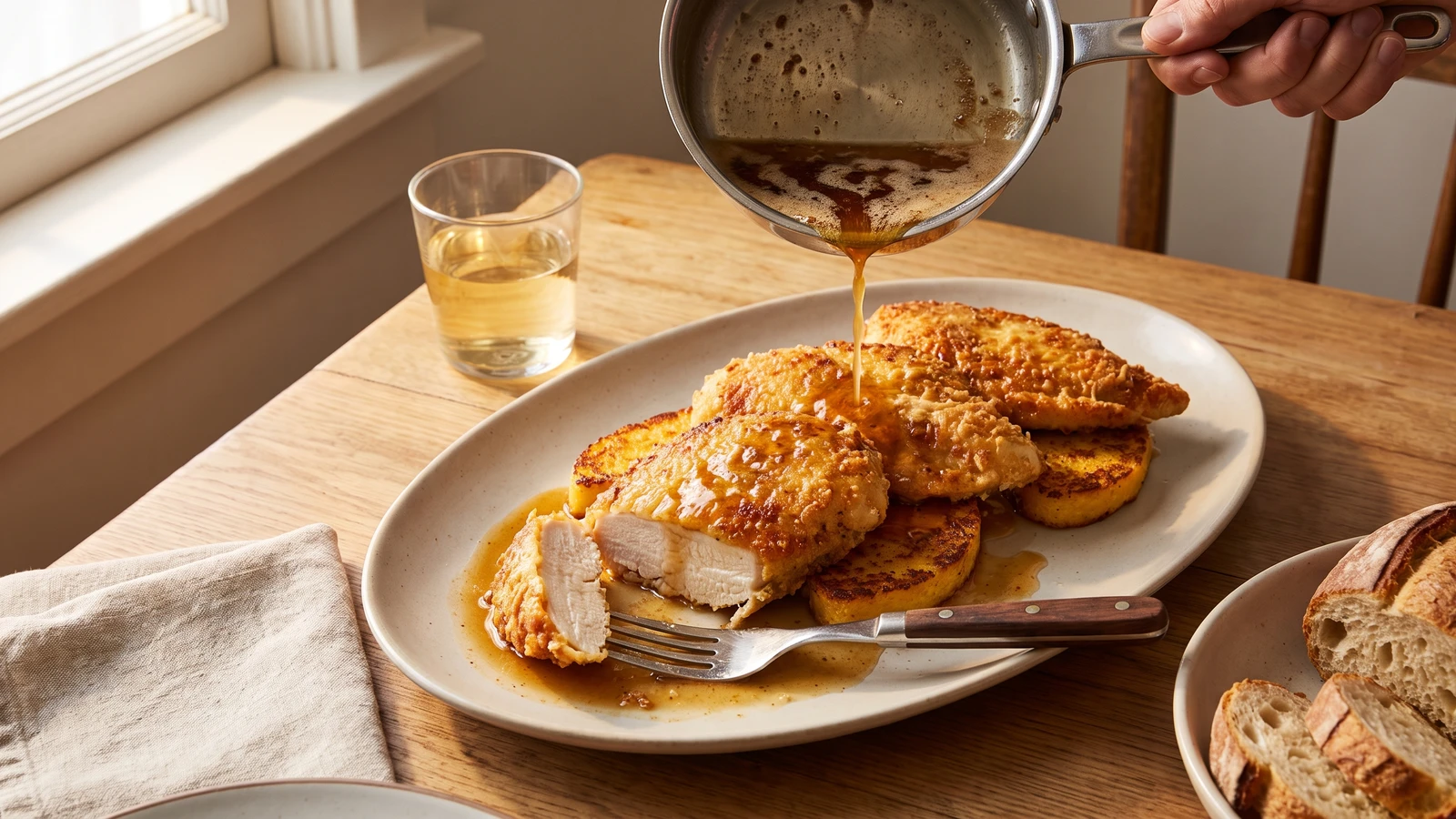
Parmesan replaces crumbs around tender chicken suprêmes, while butter-browned polenta croûtons catch every spoonful of beurre noisette. The lesson is heat: bronze the cheese gently before the chicken loses its tenderness.
Suprêmes de Volaille au Parmesan (Parmesan-crusted chicken breasts) teaches the discipline of the sauté. Parmesan browns faster than chicken cooks, so the suprêmes must be even in thickness and the heat must remain moderate. Get that balance right and the coating turns deeply golden while the meat stays tender beneath it.
The original entry assumed a brigade tray of Polenta (No. 2294) already cold, a commis to shape the croûtons, and enough burners to cook every piece at once. It needs no stock kept on the fire and no separate sauce from a saucier; a salamander would only scorch the cheese. At home, one chilled polenta slab, one wide skillet used in sequence, and a low oven standing in for the holding cabinet do the same work. Four small breasts replace the brigade quantity, and their thick ends are gently flattened because modern market breasts are larger and less even.
The tray, spare hands, and extra burners are scaffolding, so they can go. The egg-and-Parmesan coating, the butter sauté, the clarified-butter croûtons, and the last-minute beurre noisette (nut-brown butter) are the dish, so every one stays. Before the first suprême meets the pan, make its thick end match its thin end; even thickness lets the cheese reach bronze at the same moment the chicken reaches tenderness.
Suprêmes de Volaille au Parmesan belongs to the cosmopolitan Parisian classical table rather than to one French province, with Parmesan and maize polenta absorbed from the Italian kitchen into the grand repertoire. Here croûtons does not mean bread, but pieces of set polenta cut to echo the shape of the chicken and browned in clarified butter, a classical habit of making the garnish mirror the principal piece. The dish moved easily into the bourgeois home because its grand appearance depends on disciplined sautéing, not elaborate equipment.
Quantity
4 (about 1⅓ pounds / 600 g total)
Quantity
1 teaspoon (5 ml / 6 g)
Quantity
½ teaspoon (2.5 ml / 1 g)
Quantity
2 (about ½ cup / 100 g without shells)
beaten
Quantity
1¼ cups (300 ml / 110 g)
finely grated
Quantity
2½ cups (600 ml / 600 g) chilled Polenta (No. 2294)
for 4 suprême-shaped croûtons
Quantity
3 tablespoons (45 ml / 42 g)
for browning the polenta croûtons
Quantity
3 tablespoons (45 ml / 42 g)
for sautéing the suprêmes
Quantity
4 tablespoons (60 ml / 57 g)
for the beurre noisette
| Ingredient | Quantity |
|---|---|
| small boneless, skinless chicken breast fillets | 4 (about 1⅓ pounds / 600 g total) |
| fine sea salt | 1 teaspoon (5 ml / 6 g) |
| freshly ground white pepper | ½ teaspoon (2.5 ml / 1 g) |
| large eggsbeaten | 2 (about ½ cup / 100 g without shells) |
| Parmesanfinely grated | 1¼ cups (300 ml / 110 g) |
| prepared polentafor 4 suprême-shaped croûtons | 2½ cups (600 ml / 600 g) chilled Polenta (No. 2294) |
| clarified butterfor browning the polenta croûtons | 3 tablespoons (45 ml / 42 g) |
| unsalted butterfor sautéing the suprêmes | 3 tablespoons (45 ml / 42 g) |
| unsalted butterfor the beurre noisette | 4 tablespoons (60 ml / 57 g) |
Heat the oven to 200°F (95°C) and set a small sheet pan inside. Reach for the Polenta (No. 2294) fully chilled and firm, then cut four pieces about ½ inch (1.25 cm) thick, each tapered into the rough silhouette of a chicken suprême. Pat their surfaces dry. Cold polenta cuts cleanly; if a croûton cracks, press the edges together while cold and chill it for another ten minutes. Ça se rattrape.
Heat the clarified butter in a wide skillet over medium heat. When it flows freely and gleams, add the polenta croûtons without crowding and cook for 3 to 4 minutes on each side, until their faces are golden and their edges feel firm beneath a spatula. Clarified butter matters here because its milk solids have been removed, letting the polenta brown without bitter specks. Transfer the croûtons to the warm sheet pan and hold them in the low oven.
Pat the chicken dry. Place each suprême between sheets of parchment and tap only the thick end until the breast is an even ⅝ inch (1.5 cm) thick; this is shaping, not pounding it into a cutlet. Season both sides with the salt and white pepper, then let the meat stand for 10 minutes while you arrange the coating dishes.
Put the beaten eggs in one shallow dish and the finely grated Parmesan in another. Dip each suprême into the egg, let the excess fall away, then press it into the Parmesan so both sides wear a thin, close coat with no heavy clumps. Coat the chicken immediately before it reaches the skillet. If the cheese becomes wet and pasty while it waits, it slides away from the meat; scrape off the loose patch, press on fresh Parmesan, and carry on.
Wipe the skillet clean and melt the sautéing butter over medium-low heat. When it foams and begins to quiet but remains blond, lay in the suprêmes with space between them. Cook without disturbing them for 3 to 4 minutes, until the underside is evenly golden and releases when eased with a thin spatula. Turn once and cook the second side for another 3 to 5 minutes, until the coating is bronzed and the thickest part of the chicken reaches 165°F (74°C). Parmesan browns quickly, so if the crust darkens before the centre is ready, lower the heat, set a lid slightly ajar over the skillet, and give it another minute. Ça se rattrape. Transfer the chicken to a warm plate for a brief rest.
Wipe every loose cheese crumb from the skillet, because burnt Parmesan can masquerade as browned butter solids. Add the finishing butter and cook over medium heat, swirling the pan as it foams. Watch the pale milk solids on the floor of the skillet: when they turn hazelnut-brown and the butter smells toasted, pull the pan from the heat at once. If the specks go black, don't pour it over the chicken. Wipe the pan and begin again with fresh butter; burnt beurre noisette cannot be reasoned with.
Set one hot polenta croûton on each plate and place a suprême directly over it, matching their shapes. Spoon the beurre noisette over the chicken at the final moment, letting a little run down onto the polenta. Serve immediately, while the Parmesan remains crisp and the butter still gleams. À table!
1 serving (about 330g)
Culinary guides, cultural storytelling, and the editorial depth that makes cooking meaningful.
Discover Culinary ExplorerChef Juliette
John Dory has the delicacy of sole and the firmness of turbot. A light flouring, a quick butter sauté, and nut-brown beurre noisette show exactly why looks never mattered.

Chef Juliette
Fresh haddock proves its delicacy in the meunière pan: a fine flour crust, moist pearly flakes, and beurre noisette sharpened with lemon and parsley, ready from one skillet in half an hour.
Chef Juliette
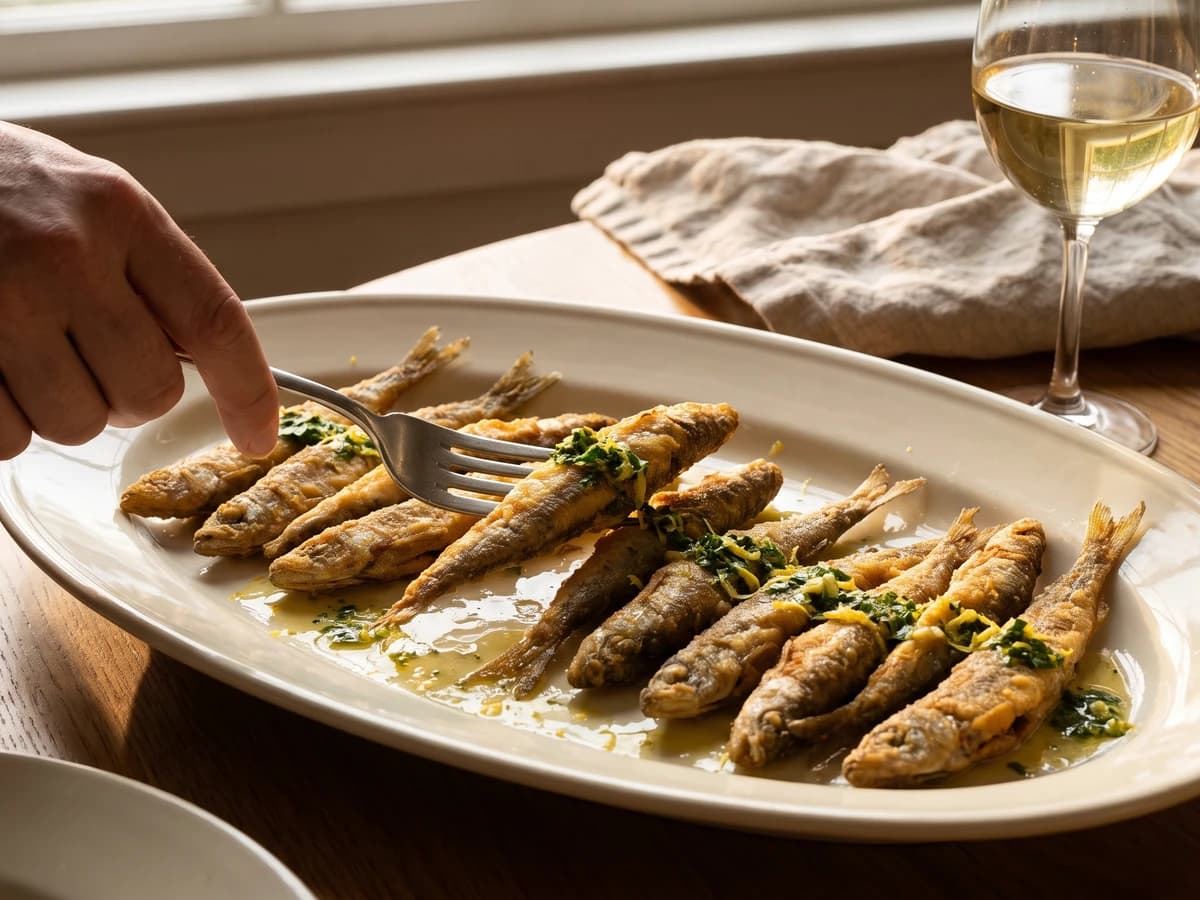
Éperlans à l’Anglaise turns small fish into a lesson in disciplined coating: boned smelts under a close, crisp crumb, pan-fried in clarified butter and finished with bright, half-melted maître d’hôtel butter.

Chef Juliette
Tiny smelts, shallot, mushrooms, white wine, gratin sauce, and fine bread raspings meet a fierce oven, where the fish must turn tender in the same breath the buttered crust bronzes.