
Chef Juliette
John Dory (St. Pierre)
John Dory has the delicacy of sole and the firmness of turbot. A light flouring, a quick butter sauté, and nut-brown beurre noisette show exactly why looks never mattered.
A cooking platform built around craft, culture, and the stories behind what we eat.
Created by Chef Juliette
Based on No. 1562, Poulet Sauté Lathuile, from Le Guide Culinaire (1907) by Auguste Escoffier
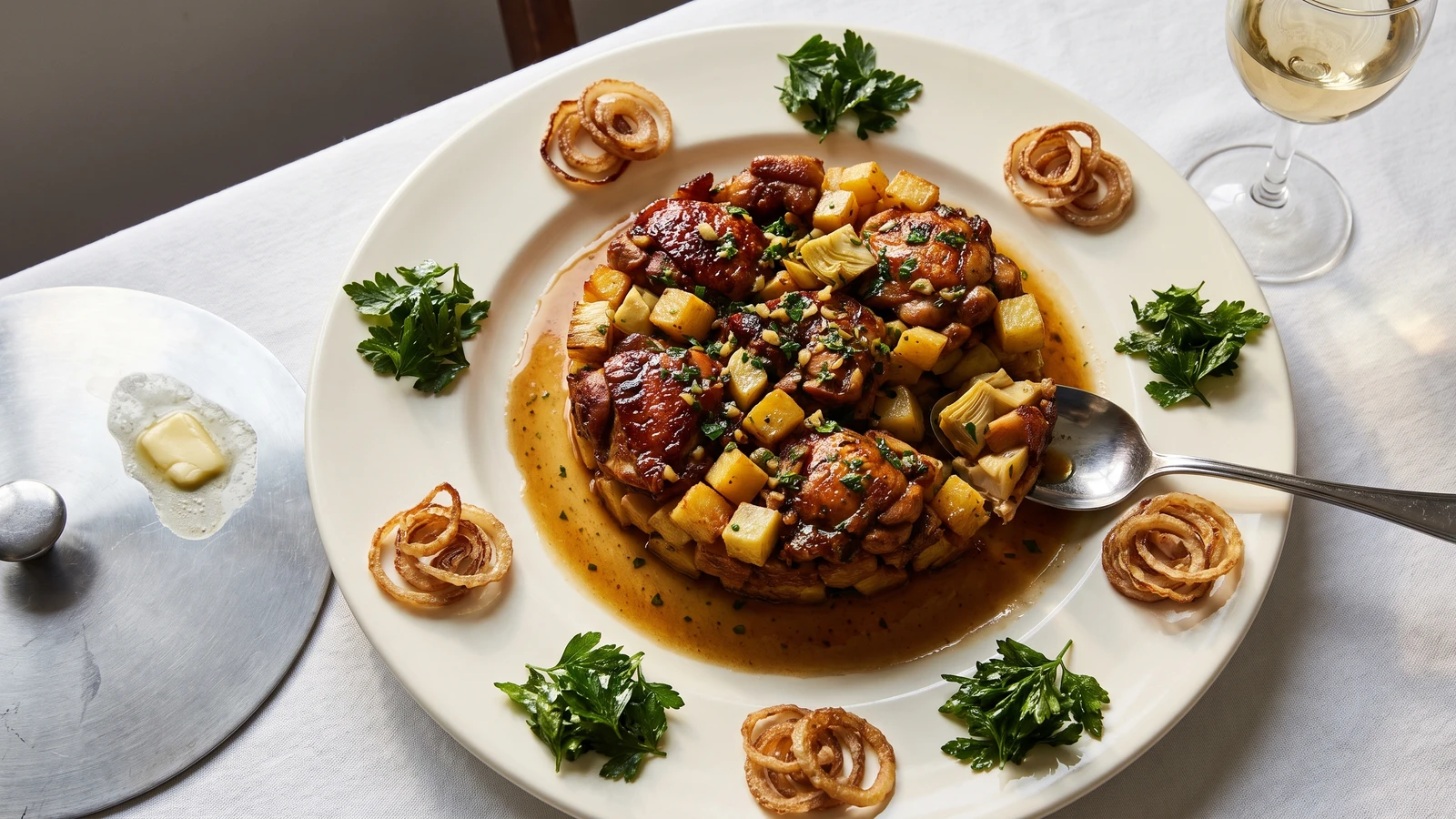
Chicken, potato, and artichoke browned as one butter-rich round, turned with conviction, lacquered with glace de viande, and ringed with crisp onion and green fried parsley.
Poulet Sauté Lathuile (Lathuile-style sautéed chicken) teaches that geometry can be flavor. Chicken, potato, and raw artichoke must color together in a pan just large enough to make them behave as one Pommes Anna (compact potato cake) round. Stir them and you have a pleasant sauté; leave them close, still, and well buttered, and you build the crust that defines Lathuile.
The original entry assumes glace de viande (meat glaze) beside the range, drawn from a stock never off the fire, and a cook practiced enough to toss a loaded sauté pan. At home, prepared glaze from the freezer and a flat metal lid do those jobs. The formula is already one small chicken for four, so the butter, potato, artichoke, and glaze ratios stay untouched; only the unspecified onion and parsley garnish receives a household quantity. A brigade fryer is scaffolding, and a small saucepan replaces it. The fitted pan, full measure of butter, and whole turn are the dish and must stay. One cook, one stove, one evening.
When it lands, chicken skin and little dice share a Maillard-bronze crust, the glace catches every crevice, and beurre noisette (nut-brown butter) runs over the round before crisp onion and very green parsley ring it. The likely failure is hesitation at the turn: fit your pan and metal lid together before the butter melts, because the single decisive inversion is the one step that matters most.
Poulet sauté Lathuile belongs to Parisian classical service, where small chickens were cut into sauté pieces and identified by a precise garnish rather than by a regional sauce. Its potato and raw-artichoke dice cook beside the bird and leave the pan as a single Pommes Anna-style round, an unusual marriage of sauté and moulded garnish. The title follows the canon's pattern of dedicatory names, not regional ones, and the surviving method is firmer evidence than stories about the person or table it honored.
Quantity
1, 3 to 3¼ lb (1.35 to 1.5 kg)
cut into 10 small sauté pieces
Quantity
6 tablespoons (90 ml / 85 g)
Quantity
1½ cups (360 ml / 225 g)
peeled and cut into ½-inch (1.25 cm) dice
Quantity
1 cup (240 ml / 140 g)
cut into ½-inch (1.25 cm) dice
Quantity
3 tablespoons (45 ml / 50 g)
Quantity
1 large bunch, about 2 packed cups (480 ml / 55 g)
1 tablespoon finely chopped; remainder divided into small, completely dry sprigs
Quantity
⅛ teaspoon (0.6 ml / 0.5 g)
crushed to a paste
Quantity
5 tablespoons (75 ml / 70 g)
Quantity
1 large, about 10 oz (285 g)
cut into ¼-inch (6 mm) roundels and separated into rings
Quantity
½ cup (120 ml / 60 g)
Quantity
2 cups (480 ml / 440 g)
Quantity
2 teaspoons (10 ml / 12 g)
divided
Quantity
¾ teaspoon (4 ml / 1.5 g)
divided
| Ingredient | Quantity |
|---|---|
| small chickencut into 10 small sauté pieces | 1, 3 to 3¼ lb (1.35 to 1.5 kg) |
| unsalted butter for sautéing | 6 tablespoons (90 ml / 85 g) |
| waxy potatoespeeled and cut into ½-inch (1.25 cm) dice | 1½ cups (360 ml / 225 g) |
| fresh raw artichoke bottomscut into ½-inch (1.25 cm) dice | 1 cup (240 ml / 140 g) |
| prepared glace de viande | 3 tablespoons (45 ml / 50 g) |
| flat-leaf parsley1 tablespoon finely chopped; remainder divided into small, completely dry sprigs | 1 large bunch, about 2 packed cups (480 ml / 55 g) |
| garliccrushed to a paste | ⅛ teaspoon (0.6 ml / 0.5 g) |
| unsalted butter for beurre noisette | 5 tablespoons (75 ml / 70 g) |
| yellow onioncut into ¼-inch (6 mm) roundels and separated into rings | 1 large, about 10 oz (285 g) |
| plain flour | ½ cup (120 ml / 60 g) |
| neutral frying oil | 2 cups (480 ml / 440 g) |
| fine sea saltdivided | 2 teaspoons (10 ml / 12 g) |
| freshly ground black pepperdivided | ¾ teaspoon (4 ml / 1.5 g) |
Before heating anything, arrange the chicken in a 12-inch (30 cm) heavy sauté pan, dark meat toward the hotter centre and breast pieces near the rim. The pieces must form one close layer, with just enough room for the vegetable dice to fill their gaps. Pat the chicken dry and season it with 1¼ teaspoons salt and ½ teaspoon pepper. Cut the potatoes without rinsing them, because their surface starch helps bind the round; cut the artichoke last, then dry both vegetables thoroughly and toss them with ½ teaspoon salt and ⅛ teaspoon pepper.
Heat the neutral oil in a small deep saucepan to 350°F (175°C). Season the flour with the remaining ¼ teaspoon salt and ⅛ teaspoon pepper. Dredge the onion roundels lightly, shake away every excess, and fry them in small batches until crisp and evenly golden, about 2 to 3 minutes; drain them on a rack. Lower the completely dry parsley sprigs into the oil for 5 to 8 seconds, just until crisp and brilliantly green, then drain them separately. If the parsley is damp, stop and dry it again, because water makes hot oil spit dangerously.
Melt the sautéing butter over medium heat until it foams and smells sweet but hasn't browned. Arrange the chicken skin-side down in the fitted pattern, then scatter the potato and artichoke dice into every space and press them into a level, close round. Cook without stirring or prying for 12 to 15 minutes. The chicken and vegetables are ready to turn when their undersides are deep golden and the dice at the rim have begun to hold together. If they color too quickly, lower the heat; if they're still pale after 12 minutes, raise it slightly.
Take the pan off the heat and loosen only the outer edge with a thin spatula. Tilt the pan and spoon any loose butter into a heatproof cup so it cannot run during the turn. Cover the pan with the flat metal lid, grip both firmly with dry oven mitts, and invert the entire round onto the lid in one controlled stroke, turning away from your body. Set the pan down, slide the round back with its uncooked side against the pan, and return the reserved butter around the edge. If the crust fractures, fit the pieces snugly together and press them for 30 seconds. Ça se rattrape: the second crust will knit the round again.
Cook the second side over medium-low heat, undisturbed, for 12 to 16 minutes. Check the chicken through the side of a piece: the breast must reach 165°F (74°C), and the thigh should reach at least 170°F (77°C); the potato and artichoke should yield cleanly to a small knife. If the crust is ready before the chicken, lower the heat, cover for 3 to 5 minutes, then uncover and crisp the base for another minute. Mix the chopped parsley with the garlic. Warm the glace de viande until pourable, spoon it over the chicken, sprinkle with the parsley and garlic, and cook for 1 minute more, just until the glaze clings.
Warm a broad round platter. Loosen the edge of the Lathuile, tilt the pan toward the platter, and slide the whole round out in one smooth movement, keeping the glazed chicken side uppermost. Don't peck at it with a spatula; confidence preserves the crust. If a few dice remain behind, tuck them back into their proper place while they're hot, then brush the seam with a little glaze.
Melt the finishing butter in a clean, pale saucepan over medium heat. Swirl as it foams, then watch for the milk solids to turn hazelnut brown and smell distinctly nutty. If the specks race toward dark brown, lift the pan from the heat and keep swirling; once the butter smells acrid, it must be replaced. Pour the beurre noisette over the entire round. Arrange alternating small heaps of fried onion and very green fried parsley around the platter, then serve immediately. À table!
1 serving (about 360g)
Culinary guides, cultural storytelling, and the editorial depth that makes cooking meaningful.
Discover Culinary ExplorerChef Juliette
John Dory has the delicacy of sole and the firmness of turbot. A light flouring, a quick butter sauté, and nut-brown beurre noisette show exactly why looks never mattered.

Chef Juliette
Fresh haddock proves its delicacy in the meunière pan: a fine flour crust, moist pearly flakes, and beurre noisette sharpened with lemon and parsley, ready from one skillet in half an hour.

Chef Juliette
Éperlans à l’Anglaise turns small fish into a lesson in disciplined coating: boned smelts under a close, crisp crumb, pan-fried in clarified butter and finished with bright, half-melted maître d’hôtel butter.

Chef Juliette
Tiny smelts, shallot, mushrooms, white wine, gratin sauce, and fine bread raspings meet a fierce oven, where the fish must turn tender in the same breath the buttered crust bronzes.