
Chef Juliette
John Dory (St. Pierre)
John Dory has the delicacy of sole and the firmness of turbot. A light flouring, a quick butter sauté, and nut-brown beurre noisette show exactly why looks never mattered.
A cooking platform built around craft, culture, and the stories behind what we eat.

Created by Chef Juliette
Based on No. 1547, Poulet Sauté à la Durand, from Le Guide Culinaire (1907) by Auguste Escoffier
Poulet Sauté à la Durand makes flour earn its keep: crisp oil-sautéed chicken circling fried onion rondelles, with a ham cornet of buttery tomato concassée at the center and no sauce to conceal careless browning.
Poulet Sauté à la Durand (floured chicken sautéed with fried onion, ham, and tomato) teaches one clean lesson: the dredging is the crust, and there is no sauce to hide behind. Dry chicken, flour applied at the last moment, and properly heated oil are the whole foundation. Let the flour turn damp before frying and it becomes paste; crowd cool oil and it drinks fat instead of forming a crisp shell.
The original entry assumed brigade timing, with one hand watching the chicken while another fried onion rondelles, thin round slices, and a finished platter waited at the pass. It does not call on a saucier, a stockpot never off the fire, or a salamander, so I won't invent their work. At home, one wide skillet, a small saucepan, and a low oven used as a warm shelf let one cook sequence the same composition. I have changed the simultaneous service into two manageable frying batches and nothing more. The crown, the fried onions, and the ham cornet belong to the dish; they are not brigade scaffolding to be discarded.
Flour each piece only when the oil is ready, then shake it hard enough that no loose dust remains. That one moment decides the Durand. If the coating has already dampened, brush it away and dredge again. Ça se rattrape.
Poulet Sauté à la Durand belongs to the grand-hotel dining room of French grande cuisine rather than to a regional larder; Durand identifies a named garnish of fried onion rondelles and a ham cornet filled with butter-cooked tomato concassée. Its form shows familiar bourgeois ingredients passing into formal platter service, with the chicken arranged as a crown so every part of the garnish remains visible. Durand is not a sauce: no stock, cream, or reduction enters the entry, and the dish rests entirely on its floured sauté and exact arrangement.
Quantity
1, about 3 lb (1.35 kg)
cut into 8 pieces
Quantity
2 teaspoons (10 ml / 12 g)
divided
Quantity
1 teaspoon (5 ml / 2 g)
Quantity
¾ cup (180 ml / 90 g)
Quantity
1 cup (240 ml / 220 g)
divided
Quantity
2, about 8 oz (225 g)
sliced crosswise into ⅛-inch (3 mm) rondelles
Quantity
1 medium (4 oz / 120 g), or ½ cup (120 ml / 120 g)
peeled and seeded if fresh, concassed
Quantity
2 tablespoons (30 ml / 28 g)
Quantity
1 very thin, broad slice, about 1 oz (30 g)
| Ingredient | Quantity |
|---|---|
| small whole chickencut into 8 pieces | 1, about 3 lb (1.35 kg) |
| fine saltdivided | 2 teaspoons (10 ml / 12 g) |
| freshly ground black pepper | 1 teaspoon (5 ml / 2 g) |
| all-purpose flour | ¾ cup (180 ml / 90 g) |
| neutral frying oildivided | 1 cup (240 ml / 220 g) |
| small yellow onionssliced crosswise into ⅛-inch (3 mm) rondelles | 2, about 8 oz (225 g) |
| ripe plum tomato, or drained canned whole tomatoespeeled and seeded if fresh, concassed | 1 medium (4 oz / 120 g), or ½ cup (120 ml / 120 g) |
| unsalted butter | 2 tablespoons (30 ml / 28 g) |
| mild cooked ham, preferably jambon de Paris | 1 very thin, broad slice, about 1 oz (30 g) |
Set the oven to 225°F (110°C) and place a wire rack over a rimmed sheet pan inside it; set an oven-safe oval platter alongside to warm. Pat every chicken piece completely dry, then season with 1½ teaspoons of the salt and all the pepper. Leave the pieces uncovered while you prepare the garnishes, but do not flour them yet. Wet skin makes wet flour, and wet flour cannot give you the crust this dish requires.
If using a fresh tomato, score its base, lower it into boiling water for 20 seconds, cool it under cold water, then peel, halve, and seed it. Concassée means roughly chopped: cut the flesh into small, irregular pieces rather than crushing it into purée. Melt the butter in a small saucepan over medium-low heat, add the tomato and ¼ teaspoon of the salt, then cook for 5 to 8 minutes, stirring occasionally, until the juices have evaporated and the tomato holds a soft mound while still gleaming with butter. If it remains watery, keep it over gentle heat; if the butter begins to brown, add 1 teaspoon of water and lower the heat. Keep the concassée warm. Roll the ham slice into a cornet, a neat cone with a generous overlap, and chill it seam-side down so it keeps its shape. Do not fill it yet.
Heat ¼ cup (60 ml) of the oil in the wide skillet over medium-high heat until it shimmers. Fry the onion rondelles in two or three loose batches, turning them as their edges color, until deep golden and lightly crisp, about 3 to 5 minutes per batch. Crowding traps moisture and gives you limp onions, so leave them room. Drain each batch in a single layer on the warm wire rack, season with the remaining ¼ teaspoon salt, and return the rack to the low oven uncovered. If the rings seem soft when lifted from the oil, give them another 30 seconds in the pan rather than trying to dry them under a cover.
Wipe any onion fragments from the skillet, add the remaining ¾ cup (180 ml) oil, and heat it to 350°F (175°C). Spread the flour in a shallow dish. Dredge the thighs and drumsticks only when the oil is ready, pressing flour onto every surface and then shaking off every loose speck. Lower them into the oil skin-side down and sauté for 18 to 24 minutes, turning every 4 minutes, until the coating is an even Maillard bronze and the meat reaches at least 175°F (80°C) beside the bone. Transfer them to the rack in the low oven. Skim the dark flour crumbs from the oil, restore the heat, then dredge and sauté the breast pieces and wings in the same manner for 12 to 18 minutes, removing each piece when its thickest part reaches 165°F (74°C). The oil should remain between 325°F and 350°F (165°C and 175°C). If the crust darkens before the meat is ready, stop frying and finish that piece on the rack in a 350°F (175°C) oven. Ça se rattrape. What you must not do is keep scorching the flour while hoping the center catches up.
Stir the tomato concassée over low heat just until its butter shines again. Arrange the chicken pieces around the edge of the warm platter in a generous crown, alternating light and dark pieces. Heap the fried onion rondelles in the open middle. Nest the ham cornet seam-side down at the center of the onions, then spoon the warm tomato concassée into it, allowing just a little red to show above the rim. Bring the platter straight to the table while the flour crust is still crisp. À table!
1 serving (about 275g)
Culinary guides, cultural storytelling, and the editorial depth that makes cooking meaningful.
Discover Culinary ExplorerChef Juliette
John Dory has the delicacy of sole and the firmness of turbot. A light flouring, a quick butter sauté, and nut-brown beurre noisette show exactly why looks never mattered.

Chef Juliette
Fresh haddock proves its delicacy in the meunière pan: a fine flour crust, moist pearly flakes, and beurre noisette sharpened with lemon and parsley, ready from one skillet in half an hour.
Chef Juliette
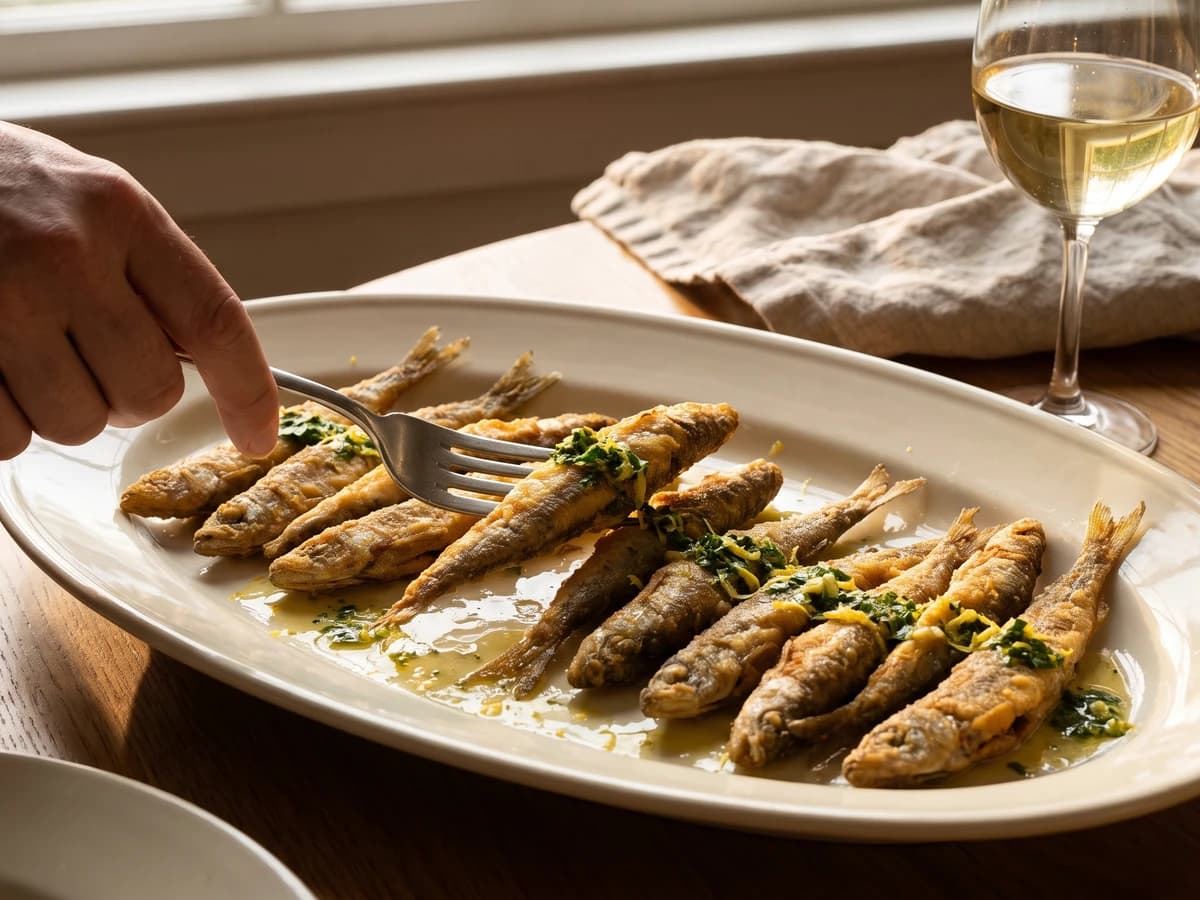
Éperlans à l’Anglaise turns small fish into a lesson in disciplined coating: boned smelts under a close, crisp crumb, pan-fried in clarified butter and finished with bright, half-melted maître d’hôtel butter.

Chef Juliette
Tiny smelts, shallot, mushrooms, white wine, gratin sauce, and fine bread raspings meet a fierce oven, where the fish must turn tender in the same breath the buttered crust bronzes.