
Chef Juliette
John Dory (St. Pierre)
John Dory has the delicacy of sole and the firmness of turbot. A light flouring, a quick butter sauté, and nut-brown beurre noisette show exactly why looks never mattered.
A cooking platform built around craft, culture, and the stories behind what we eat.
Created by Chef Juliette
Based on No. 1538, Poulet Sauté Bordelaise, from Le Guide Culinaire (1907) by Auguste Escoffier
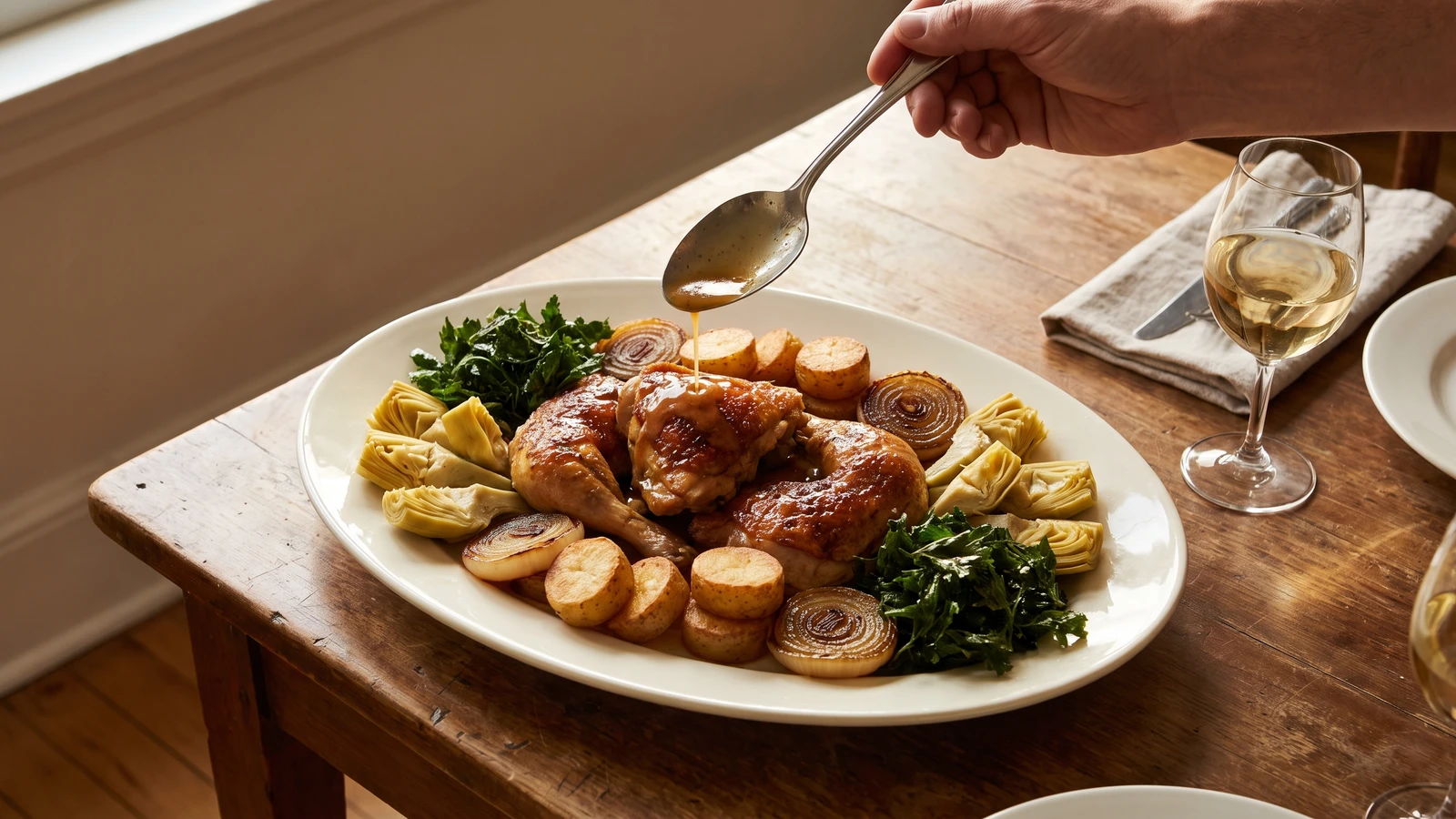
Bordeaux’s name belongs to the garnish here: butter-sautéed chicken ringed with artichokes, potatoes, fried onion and parsley, finished with only enough pan gravy to make it gleam.
Poulet Sauté Bordelaise (butter-sautéed chicken with the Bordeaux garnish) teaches the discipline of garniture, the composed border around a principal ingredient. Each element must keep its own texture and shape, then meet on the platter at the last moment. The one true thing to know before touching the pan is that Bordeaux’s name belongs to the garnish here, not to a wine sauce.
The original entry assumed a saucier with chicken gravy ready, a stockpot never off the fire, and another pair of hands tending artichokes, potatoes, onions, and parsley while the chicken sautéed. At home, one strong unsalted stock reduced against the chicken’s fond, a second skillet, and a warmed platter do the same work. I’ve scaled the brigade dish to one market chicken for four and clarified part of the butter so it can take frying heat without turning bitter. The equipment changed because one cook has only two hands; the flavor did not. One cook, one stove, one evening.
The ready gravy and spare garnish cook were scaffolding. They can go. What must stay is the separate butter cooking, the little heaps arranged around the bird, the fried parsley between them, and only a few spoonfuls of gravy over the chicken. Control the butter while the skin takes its deep bronze color. That browning decides the dish.
The title points to Bordeaux and the Gironde, yet this particular Poulet Sauté Bordelaise belongs to the codified French dining-room repertoire, where a place-name could identify a composed garnish as readily as a sauce. Its artichoke bottoms, buttered potatoes, fried onion roundels, and fried parsley traveled through professional recipe books as a formal border around sautéed poultry. The common misconception is to reach for red wine, but this entry calls for none: Bordeaux’s name sits on the garnish.
Quantity
1 chicken (about 3½ lb / 1.6 kg)
cut into 8 serving pieces
Quantity
1 cup (240 ml / 225 g)
divided
Quantity
8 bottoms, about 2 cups (475 ml / 300 g)
thawed, quartered, and thoroughly dried
Quantity
4 potatoes, about 3 cups (710 ml / 450 g)
peeled and sliced ¼ inch (6 mm) thick
Quantity
1 onion, about 2 cups (475 ml / 250 g)
sliced crosswise into ¼-inch (6 mm) roundels
Quantity
1 packed cup (240 ml / 25 g)
washed and completely dried
Quantity
¾ cup (180 ml / 180 g)
Quantity
2 teaspoons (10 ml / 12 g)
divided
Quantity
1 teaspoon (5 ml / 2 g)
| Ingredient | Quantity |
|---|---|
| whole chickencut into 8 serving pieces | 1 chicken (about 3½ lb / 1.6 kg) |
| unsalted butterdivided | 1 cup (240 ml / 225 g) |
| small frozen artichoke bottomsthawed, quartered, and thoroughly dried | 8 bottoms, about 2 cups (475 ml / 300 g) |
| small waxy potatoespeeled and sliced ¼ inch (6 mm) thick | 4 potatoes, about 3 cups (710 ml / 450 g) |
| large yellow onionsliced crosswise into ¼-inch (6 mm) roundels | 1 onion, about 2 cups (475 ml / 250 g) |
| flat-leaf parsley sprigswashed and completely dried | 1 packed cup (240 ml / 25 g) |
| strong unsalted chicken stock | ¾ cup (180 ml / 180 g) |
| fine sea saltdivided | 2 teaspoons (10 ml / 12 g) |
| freshly ground black pepper | 1 teaspoon (5 ml / 2 g) |
Take the chicken from the cold 30 minutes before cooking, pat every piece dry, and season it with 1½ teaspoons of the salt and all the pepper. Put a large oval platter and a rimmed tray in a 200°F (95°C) oven for 10 minutes, then turn the oven off. Reserve 4 tablespoons of the butter whole. Melt the remaining 12 tablespoons gently, skim away the foam, and pour the clear butterfat into a bowl, leaving the milky sediment behind; you should have about 10 tablespoons of clarified butter. Clarified butter is still butter, but it tolerates the heat needed for the onions and parsley without scorching.
Heat 3 tablespoons of clarified butter with 1 tablespoon of the reserved whole butter in the large skillet over medium-high heat. When the foam subsides, brown the thighs and drumsticks skin-side down for 6 to 8 minutes, then turn them for 3 minutes. Remove them and brown the breasts and wings the same way, allowing about 5 minutes on the skin and 2 minutes on the other side. Return the dark meat, lower the heat, cover with the lid slightly ajar, and cook for 8 minutes. Add the breasts and wings, then continue gently for 6 to 10 minutes, turning once, until the breasts reach 165°F (74°C) and the thighs reach about 175°F (79°C). Begin the next step on a second burner during this gentle finish. Transfer each piece to the warmed platter as it is ready, skin-side up.
While the chicken finishes, heat 1 tablespoon of clarified butter and 1 tablespoon of whole butter in the second skillet over medium-low heat. Add the artichoke quarters with a pinch of salt, cover, and stew them gently for 5 minutes. Uncover and turn them until their edges are pale gold and their centers tender, then move them to the warm tray. Add 2 tablespoons of clarified butter and the remaining 2 tablespoons of whole butter. Lay in the potato slices, season lightly, cover, and cook over medium-low heat for 6 minutes. Uncover, turn the slices, and cook for another 8 to 10 minutes until tender within and butter-gold on both faces. If they brown before the centers soften, add 1 tablespoon of the measured stock and cover for 2 minutes; uncover again and let the moisture cook away. Ça se rattrape. Transfer the potatoes to the warm tray.
Pour the remaining clarified butter into the garnish skillet and raise the heat to medium. Fry the onion roundels in batches, keeping their rings nested where possible, until deep gold and tender, about 2 to 3 minutes per side. Drain them on absorbent paper and season lightly. Add the bone-dry parsley in small batches and cover immediately with a splatter screen. Fry each batch for 10 to 15 seconds, just until the leaves turn dark green, crisp, and glassy, then lift them out with tongs and drain. If an onion roundel breaks, stack its rings into a little heap; the platter forgives what the ruler would not.
Bring the chicken platter from the switched-off oven and arrange the pieces compactly in the center, keeping the browned skin visible. Make 4 small heaps each of artichoke quarters, potato slices, and fried onion roundels around the chicken, alternating them rather than mixing them. Set a small tuft of fried parsley between each heap. This distinct border is the Bordelaise garniture, and it must look abundant, not fussy.
Pour away excess fat from the chicken skillet, leaving about 1 tablespoon and every sound brown trace of fond. Add the remaining stock, bring it to a lively simmer, and scrape the pan clean with a wooden spoon. Reduce to about ¼ cup (60 ml / 60 g), glossy and concentrated but still fluid. If it remains thin, reduce it further; if it tightens or tastes too salty, loosen it with a spoonful of unsalted stock or water. If the fond burned, use a clean saucepan and add the juices collected beneath the resting chicken instead. Spoon this quick chicken gravy over the chicken only, keeping the fried garnish crisp. This is a glaze, not a moat. Serve at once. À table!
1 serving (about 480g)
Culinary guides, cultural storytelling, and the editorial depth that makes cooking meaningful.
Discover Culinary ExplorerChef Juliette
John Dory has the delicacy of sole and the firmness of turbot. A light flouring, a quick butter sauté, and nut-brown beurre noisette show exactly why looks never mattered.

Chef Juliette
Fresh haddock proves its delicacy in the meunière pan: a fine flour crust, moist pearly flakes, and beurre noisette sharpened with lemon and parsley, ready from one skillet in half an hour.
Chef Juliette
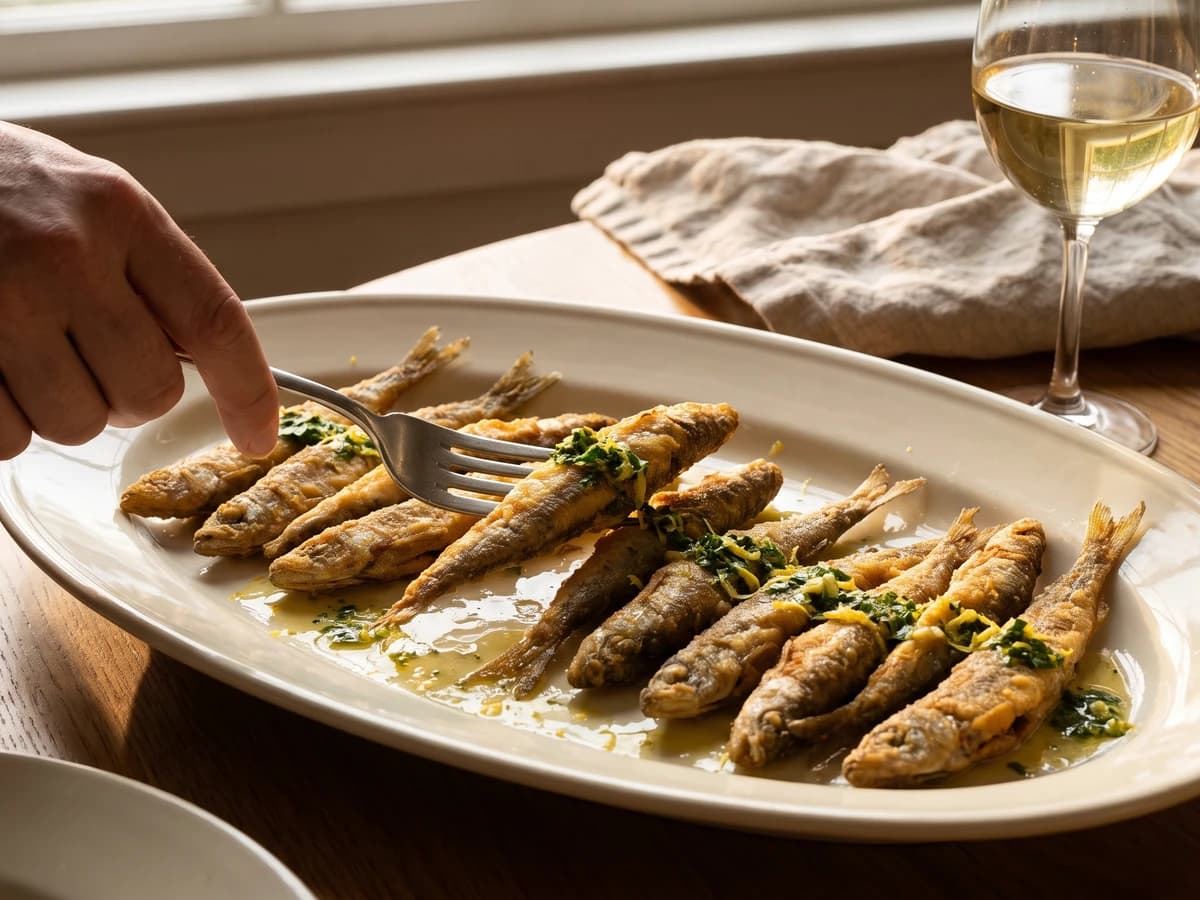
Éperlans à l’Anglaise turns small fish into a lesson in disciplined coating: boned smelts under a close, crisp crumb, pan-fried in clarified butter and finished with bright, half-melted maître d’hôtel butter.

Chef Juliette
Tiny smelts, shallot, mushrooms, white wine, gratin sauce, and fine bread raspings meet a fierce oven, where the fish must turn tender in the same breath the buttered crust bronzes.