
Chef Juliette
John Dory (St. Pierre)
John Dory has the delicacy of sole and the firmness of turbot. A light flouring, a quick butter sauté, and nut-brown beurre noisette show exactly why looks never mattered.
A cooking platform built around craft, culture, and the stories behind what we eat.
Created by Chef Juliette
Based on No. 1537, Poulet Sauté Beaulieu, from Le Guide Culinaire (1907) by Auguste Escoffier
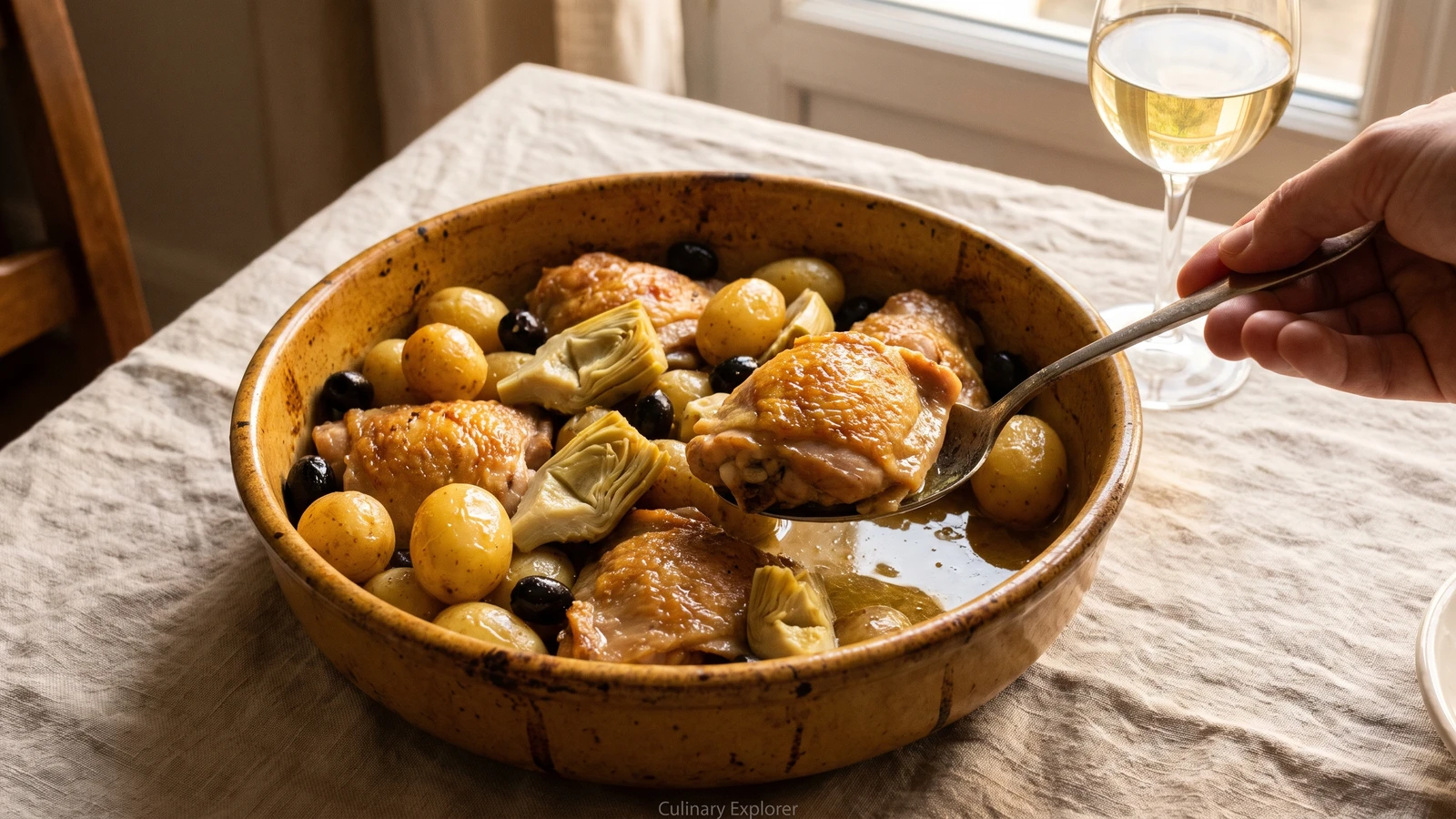
Butter-sautéed chicken, hazelnut-sized potatoes, artichoke bottoms, and black olives meet in earthenware, while white wine, lemon, veal stock, and the copper fond become the only sauce the dish needs.
Poulet Sauté Beaulieu (chicken browned briskly in butter with hazelnut potatoes, artichoke bottoms, and black olives) teaches the first law of a sauté: the fond is the sauce. Brown the bird without scorching the butter, and three spoonfuls of white wine, a touch of lemon, and one spoonful of veal stock will lift that copper glaze into something bright, glossy, and complete.
The book assumed a sauté pan, a separate earthenware cocotte, a saucier to deglaze the first while the chicken waited in the second, and veal stock never off the fire. At home, one wide flameproof casserole does both jobs, and a measured spoonful of prepared veal stock replaces the stockpot. The separate transfer was brigade scaffolding, so it goes; the ten-minute covered oven finish, equal five-ounce measures of potato and artichoke, exactly twelve olives, and the final five-minute simmer stay because they are the dish. I have fixed the elastic “few spoonfuls” of wine at three tablespoons and the “little lemon juice” at one teaspoon, enough to lift the fond without flooding it.
This is one cook, one stove, one evening, and the finished chicken comes straight to the table in its pot. The step that decides everything is the browning: keep the fond copper-brown, never black.
Poulet Sauté Beaulieu belongs to the classical grand-kitchen repertory, and its name points toward Beaulieu-sur-Mer on the Côte d’Azur through a garnish of artichokes and black olives. Like many geographic titles in the canon, it records a style of garnish more securely than a documented local household origin; the butter sauté and veal-enriched deglazing are classical technique, not a generic olive-oil southern stew. Earthenware service makes the formula equally at home on a bourgeois table, with the pan juices kept beside the chicken rather than presented as a separate formal sauce.
Quantity
1, about 3½ lb (1.6 kg)
cut into 8 pieces
Quantity
5 tablespoons (75 ml / 71 g)
divided
Quantity
1 cup (5 oz / 142 g)
scrubbed and cut to hazelnut size if necessary
Quantity
1 cup (5 oz / 142 g)
drained well and quartered
Quantity
12 (about ¼ cup / 35 g)
drained
Quantity
3 tablespoons (45 ml / 44 g)
Quantity
1 teaspoon (5 ml / 5 g)
Quantity
1 tablespoon (15 ml / 15 g)
Quantity
1¼ teaspoons (6 ml / 7 g)
divided
Quantity
½ teaspoon (2.5 ml / 1 g)
| Ingredient | Quantity |
|---|---|
| small chickencut into 8 pieces | 1, about 3½ lb (1.6 kg) |
| unsalted butterdivided | 5 tablespoons (75 ml / 71 g) |
| peewee new potatoesscrubbed and cut to hazelnut size if necessary | 1 cup (5 oz / 142 g) |
| water-packed artichoke bottomsdrained well and quartered | 1 cup (5 oz / 142 g) |
| small black olivesdrained | 12 (about ¼ cup / 35 g) |
| dry white wine | 3 tablespoons (45 ml / 44 g) |
| fresh lemon juice | 1 teaspoon (5 ml / 5 g) |
| gelatin-rich veal stock | 1 tablespoon (15 ml / 15 g) |
| fine sea saltdivided | 1¼ teaspoons (6 ml / 7 g) |
| freshly ground black pepper | ½ teaspoon (2.5 ml / 1 g) |
Heat the oven to 400°F (200°C). Pat every chicken piece completely dry, then season with 1 teaspoon of the salt and all the pepper. Dry skin is essential: moisture turns a sauté into a steam bath, while a dry surface browns quickly enough to protect the meat beneath.
Melt 1½ tablespoons of the butter in a wide, lidded flameproof casserole over medium-low heat. Add the potatoes and the remaining ¼ teaspoon salt, then roll them through the butter for 8 to 10 minutes, covering the pot for the middle 5 minutes, until pale gold and nearly tender at the centre. Add the quartered artichoke bottoms and cook uncovered for 2 minutes, turning gently so their cut faces take a little colour without breaking. Lift the potatoes and artichokes onto a plate.
Add 2½ tablespoons of butter to the casserole, keeping the final tablespoon cold and ready to refresh the pan. When the foam subsides, sauté the chicken in two batches, skin-side down first, for 5 to 6 minutes, then for 2 to 3 minutes on the bone side. Add portions of the reserved butter as the pan needs them. The skin should be deep butter-gold and the fond underneath copper-brown. If the butter produces black flecks before the chicken colours, stop. Ça se rattrape: lift out the chicken, pour away the burnt fat, wipe out the black crumbs without scrubbing the pot, and restart with the reserved butter over gentler heat.
Return all the chicken to the casserole, skin-side up, and tuck the potatoes and artichoke quarters around it. Cover and place in the oven for exactly 10 minutes. The covered heat finishes the sauté gently and lets the garnish drink in the butter without drying. Transfer the chicken and vegetables briefly to the upturned lid or a warm plate, leaving every browned trace in the casserole.
Set the casserole over medium heat and pour in the white wine, lemon juice, and veal stock. Scrape the floor with a wooden spoon while the liquid bubbles for 60 to 90 seconds, dissolving the fond completely. The result should be a scant, glossy pan juice, not a bowlful of gravy. If it tastes bitter, a blackened patch escaped notice and cannot be hidden; pour the liquid away, wipe the pot, and rebuild it with the same measures of wine, lemon, and stock. Never apologize at your own table. Fix it.
Return the chicken, potatoes, and artichokes to the casserole and add the twelve black olives. Hold everything at a bare simmer for 5 minutes, spooning the pan juices over the chicken once or twice, until the thickest pieces reach 165°F (74°C). If the breast is ready before the legs, lift it out and let the legs finish. If the sauce tightens too far, loosen it with a tablespoon of water; if it remains watery, remove the solids and reduce it for another minute before returning them.
Taste the pan juices for salt, remembering that the olives bring their own. Arrange the chicken skin-side up, spoon the potatoes, artichokes, and olives around it, and carry the casserole straight to the table. No separate sauceboat and no stray herbs. The dish is its own sauce. À table!
1 serving (about 300g)
Culinary guides, cultural storytelling, and the editorial depth that makes cooking meaningful.
Discover Culinary ExplorerChef Juliette
John Dory has the delicacy of sole and the firmness of turbot. A light flouring, a quick butter sauté, and nut-brown beurre noisette show exactly why looks never mattered.

Chef Juliette
Fresh haddock proves its delicacy in the meunière pan: a fine flour crust, moist pearly flakes, and beurre noisette sharpened with lemon and parsley, ready from one skillet in half an hour.

Chef Juliette
Éperlans à l’Anglaise turns small fish into a lesson in disciplined coating: boned smelts under a close, crisp crumb, pan-fried in clarified butter and finished with bright, half-melted maître d’hôtel butter.

Chef Juliette
Tiny smelts, shallot, mushrooms, white wine, gratin sauce, and fine bread raspings meet a fierce oven, where the fish must turn tender in the same breath the buttered crust bronzes.