
Chef Juliette
John Dory (St. Pierre)
John Dory has the delicacy of sole and the firmness of turbot. A light flouring, a quick butter sauté, and nut-brown beurre noisette show exactly why looks never mattered.
A cooking platform built around craft, culture, and the stories behind what we eat.

Created by Chef Juliette
Based on No. 1530, Poularde Washington, from Le Guide Culinaire (1907) by Auguste Escoffier
Green maize and sausage perfume this gently braised poularde, while a separate bowl of creamed maize makes the garnish generous. The final glaze comes late, keeping the skin tender beneath its burnished shine.
Poularde Washington (braised pullet stuffed with sweet corn and sausage) teaches one discipline above all: glaze late. The bird must cook gently before its reduced juices touch the skin. Brush them on too soon and repeated heat toughens the surface; wait until the final minutes and the skin takes on a supple, burnished shine.
The entry assumes a saucier on staff, a stockpot never off the fire, and a salamander ready for service. At home, one covered cocotte braises the bird, good unsalted chicken stock supplies the liquor, and that same liquor reduces while the poularde rests; your broiler gives the final flash. Separate braising and holding pans were brigade scaffolding, so they go. The maize, onion, and sausage stuffing, the gentle braise, the creamed maize served apart, and the last-minute glaze are the dish, so they stay. One cook, one stove, one evening.
For four, a plump 4½-pound young chicken holds the source ratio of 10 ounces green maize to 3 ounces sausage meat. Frozen sweet corn, already blanched before freezing, is the honest equivalent of three-parts cooked green maize when excellent fresh corn is absent. Keep the stuffing loose, bring its centre safely to temperature, and do not glaze until the table is nearly ready. That last restraint decides the dish.
Poularde Washington belongs not to a French region but to the Parisian classical repertoire, where geographical names often announced a garnish or ingredient rather than a birthplace. Washington signals green maize, which French grand kitchens associated with America, while the structure remains thoroughly French: a stuffed poularde, braised, glazed, and accompanied by its garnish in a separate serving dish. It is sometimes mistaken for an American chicken preparation, but its identity lies in this French naming practice and in the discipline of its last-minute glaze.
Quantity
1 (about 4½ lb / 2 kg)
giblets removed and skin patted dry
Quantity
1¾ cups (415 ml / 285 g)
Quantity
1 medium, about 1 cup (240 ml / 150 g)
finely chopped
Quantity
⅓ cup (80 ml / 85 g)
Quantity
2 tablespoons (30 ml / 28 g)
Quantity
2 tablespoons (30 ml / 28 g)
Quantity
2 cups (480 ml / 480 g)
divided
Quantity
3 cups (710 ml / 480 g)
Quantity
¾ cup (180 ml / 180 g)
Quantity
1 tablespoon (15 ml / 14 g)
Quantity
1 tablespoon (15 ml / 14 g)
Quantity
2¼ teaspoons (11 ml / 13 g)
divided
Quantity
¾ teaspoon (3.75 ml / 1.5 g)
divided
| Ingredient | Quantity |
|---|---|
| whole young roasting chickengiblets removed and skin patted dry | 1 (about 4½ lb / 2 kg) |
| fresh or frozen sweet corn kernels (green maize), for the stuffing | 1¾ cups (415 ml / 285 g) |
| yellow onionfinely chopped | 1 medium, about 1 cup (240 ml / 150 g) |
| plain fresh pork sausage meat | ⅓ cup (80 ml / 85 g) |
| unsalted butter, for the stuffing | 2 tablespoons (30 ml / 28 g) |
| unsalted butter, for the braise | 2 tablespoons (30 ml / 28 g) |
| unsalted chicken stockdivided | 2 cups (480 ml / 480 g) |
| fresh or frozen sweet corn kernels, for the creamed maize | 3 cups (710 ml / 480 g) |
| heavy cream | ¾ cup (180 ml / 180 g) |
| unsalted butter, for the creamed maize | 1 tablespoon (15 ml / 14 g) |
| cold unsalted butter, for the glaze | 1 tablespoon (15 ml / 14 g) |
| fine sea saltdivided | 2¼ teaspoons (11 ml / 13 g) |
| freshly ground white pepperdivided | ¾ teaspoon (3.75 ml / 1.5 g) |
Heat the oven to 350°F (175°C). If using fresh maize for the stuffing, blanch the kernels in lightly salted boiling water for 3 to 4 minutes, until three-quarters tender, then drain them thoroughly. If using frozen maize, thaw it under cool running water and drain it well; it was blanched before freezing and has already reached the source recipe's three-parts cooked stage. Spread the kernels on a towel and dry them. Water left clinging to the maize would dilute the stuffing rather than perfume the bird.
Melt 2 tablespoons butter in a wide skillet over medium-low heat. Add the onion with ¼ teaspoon salt and cook for 5 to 7 minutes, stirring, until translucent and sweet but not browned. Add the sausage meat and break it into small pieces, frying it with the onion for only 60 to 90 seconds, just until its surface loses the raw pink colour. This brief frying preserves the source's sequence; the sausage finishes cooking inside the poularde. Fold in the prepared stuffing maize and ¼ teaspoon white pepper, then spread the mixture on a plate until no longer hot.
Season the chicken inside and out with 1¼ teaspoons salt and another ¼ teaspoon white pepper. Spoon the cooled stuffing loosely into the cavity, leaving enough room for heat to circulate, then tie the legs together with kitchen twine and tuck the wing tips underneath. Do not ram the cavity full. If your bird is smaller and some stuffing remains, put the excess into a buttered ramekin, cover it, and bake it beside the chicken during the final 25 minutes.
Melt 2 tablespoons butter in a heavy oval cocotte over medium heat. Set in the chicken and turn it carefully for 6 to 8 minutes, giving the skin a pale golden foundation without trying to roast it dark. Keep the breast uppermost, pour in 1½ cups of the chicken stock, and bring the liquid just to a simmer. Cover tightly and transfer the cocotte to the oven. Braise for 1 hour 25 minutes to 1 hour 45 minutes, basting once halfway through, until the thickest part of the thigh and the centre of the stuffing both register at least 165°F (74°C). If the chicken is cooked but the stuffing remains below temperature, remove the stuffing to a saucepan with 2 tablespoons of the reserved stock and heat it gently to 165°F (74°C) while the bird rests. Ça se rattrape, and the breast need not be sacrificed.
While the poularde braises, combine the 3 cups maize, heavy cream, 1 tablespoon butter, ½ teaspoon salt, and the remaining ¼ teaspoon white pepper in a saucepan. Bring the cream to the gentlest simmer, cover, and cook for 5 minutes. Uncover and continue for 6 to 10 minutes, crushing roughly one-quarter of the kernels against the pan with a wooden spoon, until the cream clings to the maize but still pools softly around it. If it tightens too far, loosen it with a spoonful of reserved stock or cream; if it remains thin, simmer it uncovered a little longer. Hold it over very low heat.
Lift the cooked poularde onto a rimmed heatproof platter and let it rest for 15 minutes. Strain the braising liquid into a saucepan, skim away excess fat, and boil it steadily until reduced to about ⅓ cup (80 ml), glossy and syrupy enough to coat a spoon. If the reduction catches at the edge, pour the clean liquid into another pan without scraping the scorched patch, add a spoonful of reserved stock, and resume over gentler heat. Ça se rattrape. Remove the pan from the heat and whisk in the cold tablespoon of butter.
Heat the broiler to high and place a rack about 6 inches (15 cm) below it. Blot any moisture from the rested chicken, then brush the skin with one thin coat of the reduced glaze. Broil for 2 to 3 minutes, watching without distraction, brush with a second coat, and return it for another minute or two, just until the surface is evenly burnished. The fierce heat belongs only here. Glaze earlier and the skin toughens; glaze now and it stays tender beneath its shine. If one patch colours too quickly, turn the platter rather than lowering the heat.
Spoon the creamed maize into a warmed deep serving bowl or timbale and take it to the table separately, exactly as the entry directs. Remove the twine, present the glazed poularde whole, then carve it and spoon some of the maize, onion, and sausage stuffing beside each portion. Pass the remaining glaze and creamed maize at the table. À table!
1 serving (about 580g)
Culinary guides, cultural storytelling, and the editorial depth that makes cooking meaningful.
Discover Culinary ExplorerChef Juliette
John Dory has the delicacy of sole and the firmness of turbot. A light flouring, a quick butter sauté, and nut-brown beurre noisette show exactly why looks never mattered.

Chef Juliette
Fresh haddock proves its delicacy in the meunière pan: a fine flour crust, moist pearly flakes, and beurre noisette sharpened with lemon and parsley, ready from one skillet in half an hour.
Chef Juliette
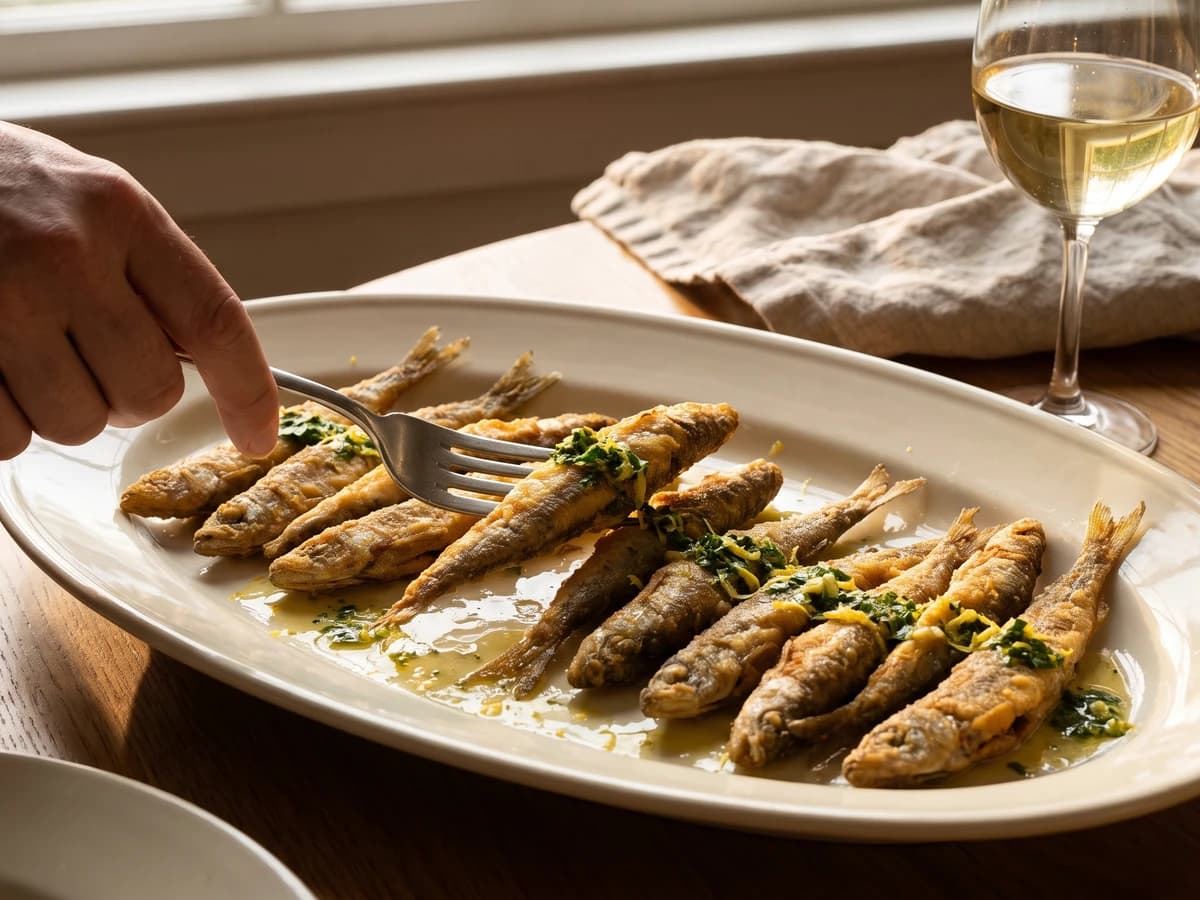
Éperlans à l’Anglaise turns small fish into a lesson in disciplined coating: boned smelts under a close, crisp crumb, pan-fried in clarified butter and finished with bright, half-melted maître d’hôtel butter.

Chef Juliette
Tiny smelts, shallot, mushrooms, white wine, gratin sauce, and fine bread raspings meet a fierce oven, where the fish must turn tender in the same breath the buttered crust bronzes.