
Chef Juliette
John Dory (St. Pierre)
John Dory has the delicacy of sole and the firmness of turbot. A light flouring, a quick butter sauté, and nut-brown beurre noisette show exactly why looks never mattered.
A cooking platform built around craft, culture, and the stories behind what we eat.

Created by Chef Juliette
Based on No. 1529, Poularde Victoria, from Le Guide Culinaire (1907) by Auguste Escoffier
Poularde Victoria encloses foie gras and black truffle in a butter-poêlé bird, then finishes it en cocotte with large potato dice, teaching how a covered pot turns timing into perfume.
Poularde Victoria (a fattened young hen stuffed with truffle and foie gras, then finished in a covered pot with potatoes) teaches controlled perfume. Foie gras gives richness, truffle gives its deep woodland scent, and the potatoes absorb both beneath the cocotte lid. The one true thing is timing: the poularde must enter the cocotte roughly three-quarters cooked, so bird and potatoes reach tenderness together.
The original formula assumed a separate poëling pan, a cocotte waiting hot, hands available for basting and potato work, and brown stock never off the fire for the poëling juices. At home, the linked Poëlings (No. 250) is scaled to one bird, and one cook finishes its sauce extraction while the potatoes and poularde share the oven. The extra hands are brigade scaffolding and can go. The truffle and foie gras stuffing, butter-rich poëling, three-parts transfer, and lidded finish are the dish, so every one stays.
Expect butter-gold skin, dark truffle tucked among melting pieces of foie gras, and large potato dice glazed with the juices gathered beneath the bird. Stop the first cooking when the breast reaches about 55 to 57°C and the thigh 60 to 63°C. That transfer point matters more than the clock.
Poularde Victoria belongs to the named poulardes of the Parisian classical table, where a familiar poultry method acquired a distinct identity through its stuffing and garnish. Its honorific name does not indicate a British roasting method or a regional French larder: the character comes from foie gras and black truffle sealed inside the bird, followed by potatoes cooked beside it en cocotte. The modest potato is deliberate, absorbing the perfume of ingredients once reserved for the formal table and carrying it into every serving.
Quantity
1 bird, 3½ to 4 pounds (1.6 to 1.8 kg)
giblets removed
Quantity
1 home-scale application (No. 250)
prepared for one 3½ to 4-pound (1.6 to 1.8 kg) poularde
Quantity
⅔ cup (160 ml / 100 g)
preserved truffles drained; cut into large dice
Quantity
¾ cup (180 ml / 150 g)
cut into 1-inch dice
Quantity
3 cups (710 ml / 454 g)
peeled and cut into 1¼-inch dice
Quantity
3 tablespoons (45 ml / 42 g)
Quantity
2 teaspoons (10 ml / 12 g)
divided
Quantity
½ teaspoon (2.5 ml / 1 g)
divided
| Ingredient | Quantity |
|---|---|
| oven-ready poulardegiblets removed | 1 bird, 3½ to 4 pounds (1.6 to 1.8 kg) |
| Poëlingsprepared for one 3½ to 4-pound (1.6 to 1.8 kg) poularde | 1 home-scale application (No. 250) |
| fresh black truffles, or whole preserved black trufflespreserved truffles drained; cut into large dice | ⅔ cup (160 ml / 100 g) |
| chilled raw foie grascut into 1-inch dice | ¾ cup (180 ml / 150 g) |
| firm yellow potatoespeeled and cut into 1¼-inch dice | 3 cups (710 ml / 454 g) |
| unsalted butter | 3 tablespoons (45 ml / 42 g) |
| fine sea saltdivided | 2 teaspoons (10 ml / 12 g) |
| finely ground white pepperdivided | ½ teaspoon (2.5 ml / 1 g) |
Heat the oven to 325°F (165°C). Remove the poularde from the cold about 30 minutes before cooking, then dry the skin and cavity thoroughly. Season inside and out with 1½ teaspoons (7.5 ml / 9 g) of the salt and ¼ teaspoon (1.25 ml / 0.5 g) of the white pepper. A dry bird takes color; a damp one traps water beneath the butter.
Mix the diced truffles and chilled foie gras gently, keeping the pieces distinct. Spoon them loosely into the cavity, close the opening with a small skewer or trussing needle, and tie the legs together. Do not pack the cavity tight: compressed stuffing slows the heat and squeezes out the foie gras. If it will not all fit comfortably, put the excess in a buttered ramekin and cook it beside the cocotte during the final 15 minutes. Ça se rattrape.
Carry out Poëlings (No. 250) with the stuffed poularde, scaled to this single bird, but stop the poultry phase at three-parts completion rather than cooking it through. Begin checking after 45 minutes. The breast should register about 130 to 135°F (55 to 57°C), the thigh about 140 to 145°F (60 to 63°C), and the skin should be lightly butter-gold. Keep liquid out of the covered cooking phase, as the referenced method directs; moistening now would turn poêlé into a braise.
While the poularde completes its first cooking, dry the potato dice thoroughly. Melt the 3 tablespoons (45 ml / 42 g) butter in a 5 to 6-quart cocotte over medium heat, add the potatoes, and season with the remaining ½ teaspoon (2.5 ml / 3 g) salt and ¼ teaspoon (1.25 ml / 0.5 g) white pepper. Toss for 6 to 8 minutes, until butter coats every face and a few edges show pale gold. They should remain firm inside; their cooking finishes beneath the lid.
Set the three-parts-cooked poularde breast-side up in the cocotte and arrange the potatoes around it rather than underneath. Cover tightly and return it to the 325°F (165°C) oven for 25 minutes without lifting the lid. Check the bird and potatoes, then uncover for 5 to 15 minutes if the skin needs more color. The poularde is ready when the thickest part of the thigh and the center of the stuffing both reach at least 165°F (74°C), while the potatoes yield cleanly to a knife.
While the cocotte is in the oven, finish the sauce phase of Poëlings (No. 250) exactly as written, using the vegetables, butter, and stock belonging to that preparation. Strain and degrease the resulting juices, then keep them hot without boiling. If they look oily, let them stand for a minute and spoon away the fat; if they have reduced too far, loosen them with a spoonful of the stock allotted to the referenced preparation. The sauce should be clear, savory, and light enough to pass separately.
Lift the poularde to a warm board and rest it loosely covered for 15 to 20 minutes. If the potatoes need longer, return the uncovered cocotte to the oven; if they finish first, lift them into a warm dish and hold them while the bird rests. Carve the poularde, making certain each serving receives foie gras, truffle, and potatoes, then spoon over a little of the strained poëling juice and pass the rest at the table. À table!
1 serving (about 340g)
Culinary guides, cultural storytelling, and the editorial depth that makes cooking meaningful.
Discover Culinary ExplorerChef Juliette
John Dory has the delicacy of sole and the firmness of turbot. A light flouring, a quick butter sauté, and nut-brown beurre noisette show exactly why looks never mattered.

Chef Juliette
Fresh haddock proves its delicacy in the meunière pan: a fine flour crust, moist pearly flakes, and beurre noisette sharpened with lemon and parsley, ready from one skillet in half an hour.
Chef Juliette
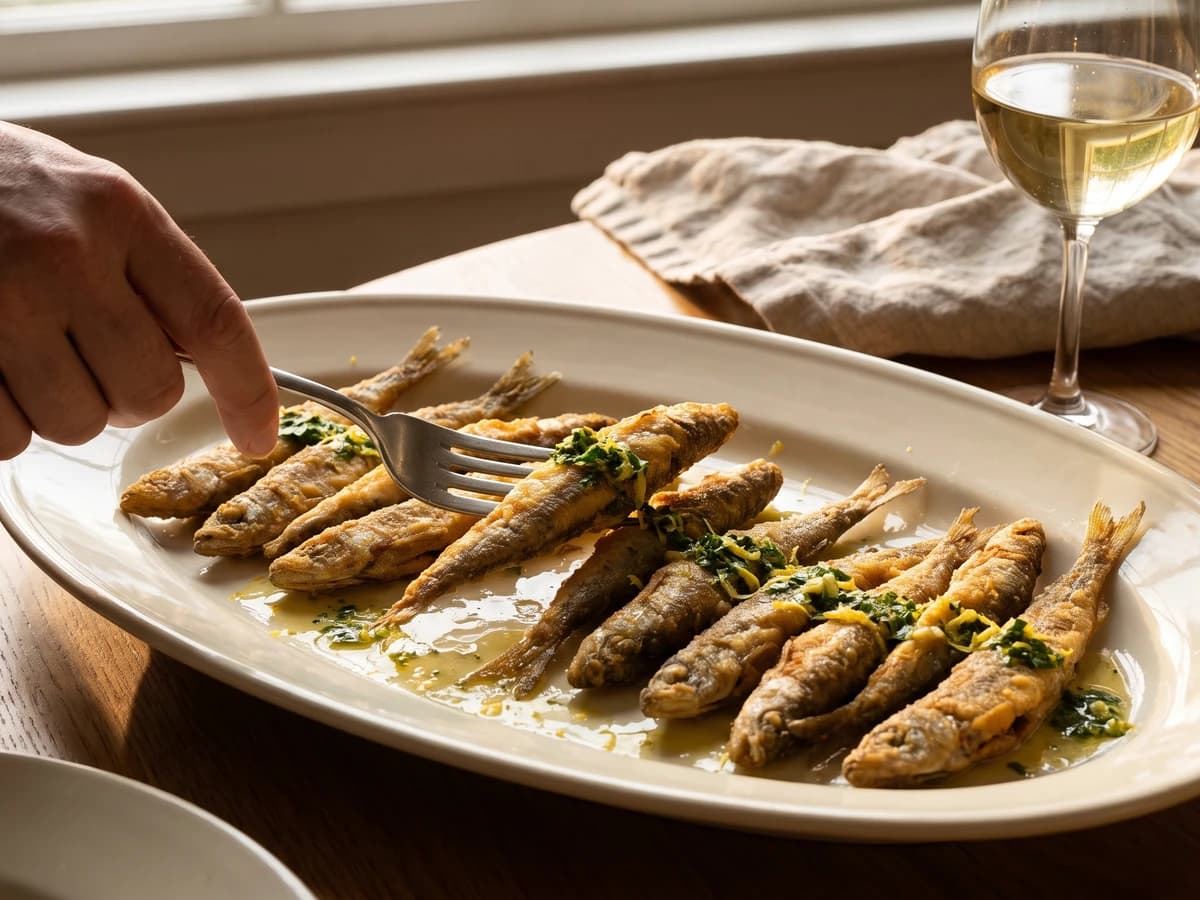
Éperlans à l’Anglaise turns small fish into a lesson in disciplined coating: boned smelts under a close, crisp crumb, pan-fried in clarified butter and finished with bright, half-melted maître d’hôtel butter.

Chef Juliette
Tiny smelts, shallot, mushrooms, white wine, gratin sauce, and fine bread raspings meet a fierce oven, where the fish must turn tender in the same breath the buttered crust bronzes.