
Chef Juliette
John Dory (St. Pierre)
John Dory has the delicacy of sole and the firmness of turbot. A light flouring, a quick butter sauté, and nut-brown beurre noisette show exactly why looks never mattered.
A cooking platform built around craft, culture, and the stories behind what we eat.

Created by Chef Juliette
Based on No. 1528, Poularde Vichy, from Le Guide Culinaire (1907) by Auguste Escoffier
Poularde Vichy brings a pale, tender bird filled with ordinary pilaff rice, cloaked in sauce suprême sharpened by its own braising liquor, and ringed with crisp carrot-filled tartlets.
Poularde Vichy (Vichy-style stuffed pullet) teaches the discipline of cuisson à blanc, white braising. The one true thing to know before touching the pan is this: white braising forbids browning, not flavour. Gentle sweating, concentrated stock, and the bird's own reduced juices must do the work that a dark fond usually carries.
The compact original assumed a saucier on staff, a stockpot never off the fire, finished pilaff and carrot garnishes arriving from separate stations, and pastry shells ready by the tray. It required no salamander because nothing here is gratinéed. At home, one covered cocotte replaces the braising station, a small saucepan replaces the saucier, and eight tartlet shells replace brigade trays. The divided labour is scaffolding and can go; the white braise, pilaff stuffing, reduced liquor folded into suprême sauce, and carrot-filled tartlets are the dish and must stay. One cook, one stove, one evening.
When it is right, the poularde arrives pale and tender beneath an ivory gloss, with butter-gold rice inside and bright carrot tartlets around it. The decisive moment comes after braising: reduce the strained liquor until it tastes complete before it meets the suprême sauce. Weak liquor makes weak sauce, and cream cannot hide it.
Poularde Vichy belongs to France's codified grand-kitchen repertoire, while its name points specifically to Vichy in the Bourbonnais through the carrot garnish rather than the bird itself. Carottes à la Vichy are sliced carrots gently glazed with butter, sugar, and traditionally the mineral water associated with the spa town, and classical kitchens carried that garnish into composed poultry dishes. The common misconception is that Vichy describes the white braise; here it identifies the bright, buttery carrot tartlets surrounding the finished poularde.
Quantity
1 (4 to 4½ lb / 1.8 to 2 kg)
giblets removed and cavity dried
Quantity
1¾ cups (415 ml / 340 g)
completely cooled
Quantity
1½ tsp (7.5 ml / 9 g)
Quantity
½ tsp (2.5 ml / 1 g)
Quantity
3 tbsp (45 ml / 42 g)
divided
Quantity
1 cup (240 ml / 150 g)
thinly sliced
Quantity
½ cup (120 ml / 65 g)
thinly sliced
Quantity
1
Quantity
2 cups (475 ml / 480 g)
Quantity
1½ cups (355 ml / 360 g)
Quantity
2 tbsp (30 ml / 30 g)
only if needed to rescue the sauce
Quantity
8 (about 3 inches / 7.5 cm each)
Quantity
2 cups (475 ml / 360 g)
warm
| Ingredient | Quantity |
|---|---|
| plump pullet or young roasting chickengiblets removed and cavity dried | 1 (4 to 4½ lb / 1.8 to 2 kg) |
| finished ordinary pilaff ricecompletely cooled | 1¾ cups (415 ml / 340 g) |
| fine sea salt | 1½ tsp (7.5 ml / 9 g) |
| ground white pepper | ½ tsp (2.5 ml / 1 g) |
| unsalted butterdivided | 3 tbsp (45 ml / 42 g) |
| yellow onionthinly sliced | 1 cup (240 ml / 150 g) |
| carrotthinly sliced | ½ cup (120 ml / 65 g) |
| bouquet garni of parsley stems, thyme, and bay leaf | 1 |
| unsalted light chicken stock | 2 cups (475 ml / 480 g) |
| finished suprême sauce | 1½ cups (355 ml / 360 g) |
| heavy cream (optional)only if needed to rescue the sauce | 2 tbsp (30 ml / 30 g) |
| small baked unsweetened tartlet crusts | 8 (about 3 inches / 7.5 cm each) |
| finished carrots à la Vichywarm | 2 cups (475 ml / 360 g) |
Heat the oven to 325°F (165°C). Have the finished ordinary pilaff rice cold, the finished suprême sauce ready to reheat, the carrots à la Vichy separate from their tartlet crusts, and the crusts dry and crisp. Keep these preparations intact; this entry brings them together rather than remaking them. Take the pullet from the cold about 30 minutes before cooking, but do not stuff it until the cocotte and oven are ready.
Season the cavity with one-third of the salt and a little white pepper. Spoon in the ordinary pilaff rice loosely, leaving space for heat to travel through it; packing the cavity hard gives heavy rice and delays safe cooking at the centre. Close the opening with a small skewer, tie the legs together, and tuck the wing tips underneath. Season the outside with the remaining salt and pepper, then rub it with 1 tbsp (15 ml / 14 g) of the butter.
Melt the remaining 2 tbsp (30 ml / 28 g) butter in a snug, heavy cocotte over low heat. Add the onion and sliced carrot and sweat them for 8 to 10 minutes until supple and fragrant, stirring often and allowing no browning. Set the pullet breast-side up over the vegetables, add the bouquet garni, and pour the warm chicken stock around it until the liquid reaches roughly one-third of the way up the bird. Bring the liquid only to a quiet simmer, cover with a round of parchment and the lid, then transfer to the oven. Braise for 80 to 100 minutes, basting every 25 minutes, until both the centre of the rice stuffing and the thickest part of the thigh reach 165°F (74°C).
Lift the cooked pullet onto a warm platter and tent it loosely while it rests for 20 minutes. Strain the braising liquor through a fine sieve into a wide saucepan without pressing the vegetables, which would cloud the sauce. Skim away excess fat, then boil the liquor steadily until reduced to about ¾ cup (180 ml / 185 g) and full-flavoured enough to taste like the bird in one spoonful. If it becomes properly concentrated before reaching that volume, stop; flavour governs the reduction, not the measuring jug.
Warm the finished suprême sauce over low heat. Whisk in the reduced braising liquor gradually, then hold the sauce at the barest tremble until it naps the back of a spoon in an even ivory coat. If it is thin, simmer it gently for another minute or two; if it tightens too far, loosen it with a spoonful of warm stock. If hard heat makes it grainy or separated, stop. Ça se rattrape: place 1 tbsp (15 ml / 15 g) cold heavy cream in a clean saucepan and whisk in the troubled sauce a spoonful at a time over low heat until smooth, adding the second tablespoon only if needed. Do not boil it again.
Warm the empty tartlet crusts in the oven for 4 to 5 minutes while the sauce is finished. Reheat the finished carrots à la Vichy gently, preserving their buttery glaze, and spoon them into the hot crusts only at the last moment so the pastry stays crisp. If the carrots have released extra liquid, lift them out and reduce their glaze separately before spooning it back over them.
Remove the trussing string and skewer, then coat the whole poularde generously with the finished suprême sauce, letting it pool beneath the bird. Arrange the eight carrot-filled tartlets around the platter and pour the remaining sauce into a warm sauceboat. Bring the poularde to the table whole, carve it there, and make certain each plate receives rice, sauce, and a tartlet. À table!
1 serving (about 540g)
Culinary guides, cultural storytelling, and the editorial depth that makes cooking meaningful.
Discover Culinary ExplorerChef Juliette
John Dory has the delicacy of sole and the firmness of turbot. A light flouring, a quick butter sauté, and nut-brown beurre noisette show exactly why looks never mattered.

Chef Juliette
Fresh haddock proves its delicacy in the meunière pan: a fine flour crust, moist pearly flakes, and beurre noisette sharpened with lemon and parsley, ready from one skillet in half an hour.
Chef Juliette
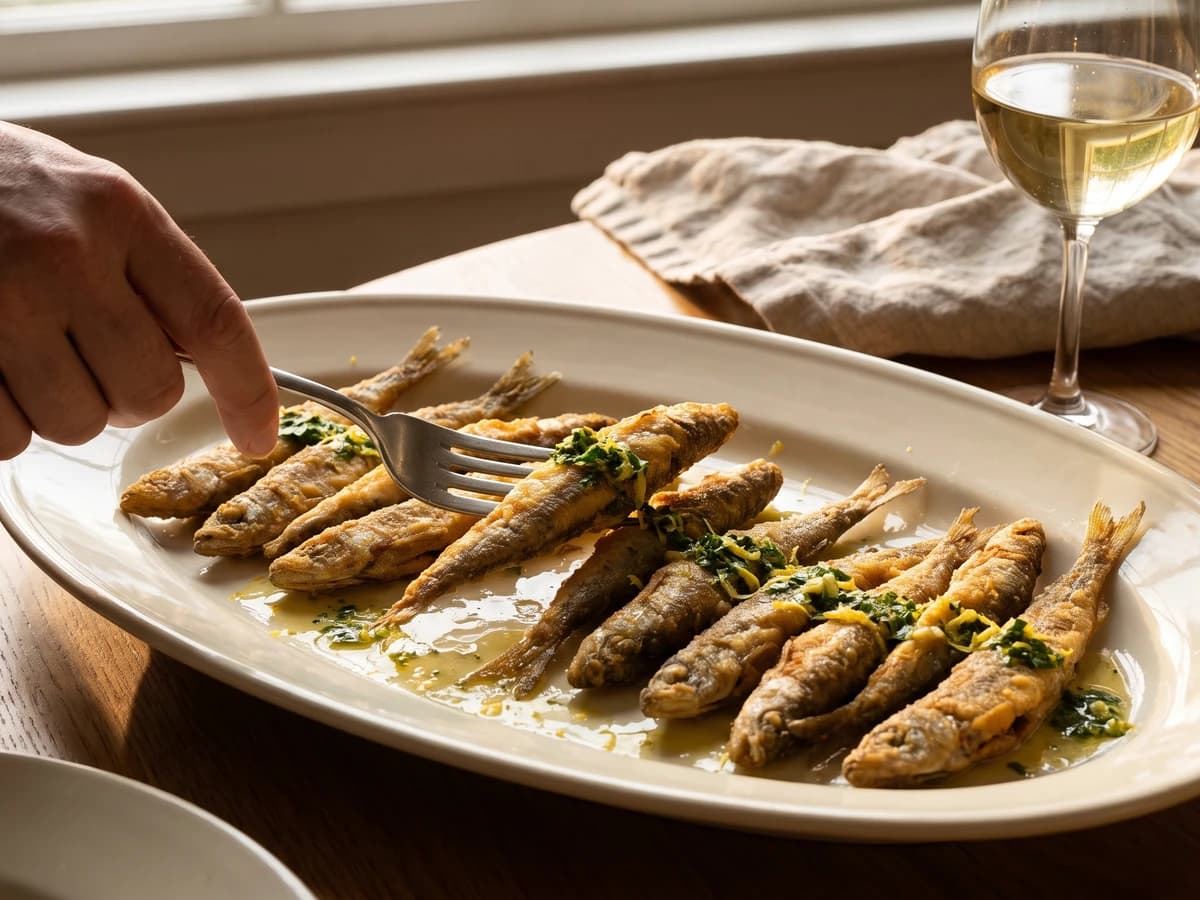
Éperlans à l’Anglaise turns small fish into a lesson in disciplined coating: boned smelts under a close, crisp crumb, pan-fried in clarified butter and finished with bright, half-melted maître d’hôtel butter.

Chef Juliette
Tiny smelts, shallot, mushrooms, white wine, gratin sauce, and fine bread raspings meet a fierce oven, where the fish must turn tender in the same breath the buttered crust bronzes.