
Chef Juliette
John Dory (St. Pierre)
John Dory has the delicacy of sole and the firmness of turbot. A light flouring, a quick butter sauté, and nut-brown beurre noisette show exactly why looks never mattered.
A cooking platform built around craft, culture, and the stories behind what we eat.
Created by Chef Juliette
Based on No. 1527, Poularde au Vert-pré, from Le Guide Culinaire (1907) by Auguste Escoffier
Poached poultry teaches restraint: keep the broth at a tremble, build a true sauce suprême, then fold in green butter off the heat so its color and freshness live.
Poularde au Vert-pré (poached pullet with a spring-green sauce) teaches the last restraint of sauce-making: once Printanier Butter (No. 157) turns the sauce suprême green, heat becomes the enemy. The butter goes in off the heat, in small pieces, and the sauce never returns to a boil. That is the one true thing to know before touching a pan.
The book's entry assumed a saucier on staff, a stock never off the fire, a poaching vessel scaled for service, and a tammy already used to prepare the vegetable butter. At home, one snug stockpot poaches one young chicken; its clear liquor becomes the foundation of the sauce, a fine-mesh sieve handles the straining, and the finished Printanier Butter (No. 157) remains the separate canonical component the book intended. The bulk stockpot and brigade handoffs are scaffolding, so they go. The gentle poach, true sauce suprême, exact two ounces of green butter to one pint of sauce, and separately cooked spring vegetables are the dish, so they stay. One cook, one stove, one evening.
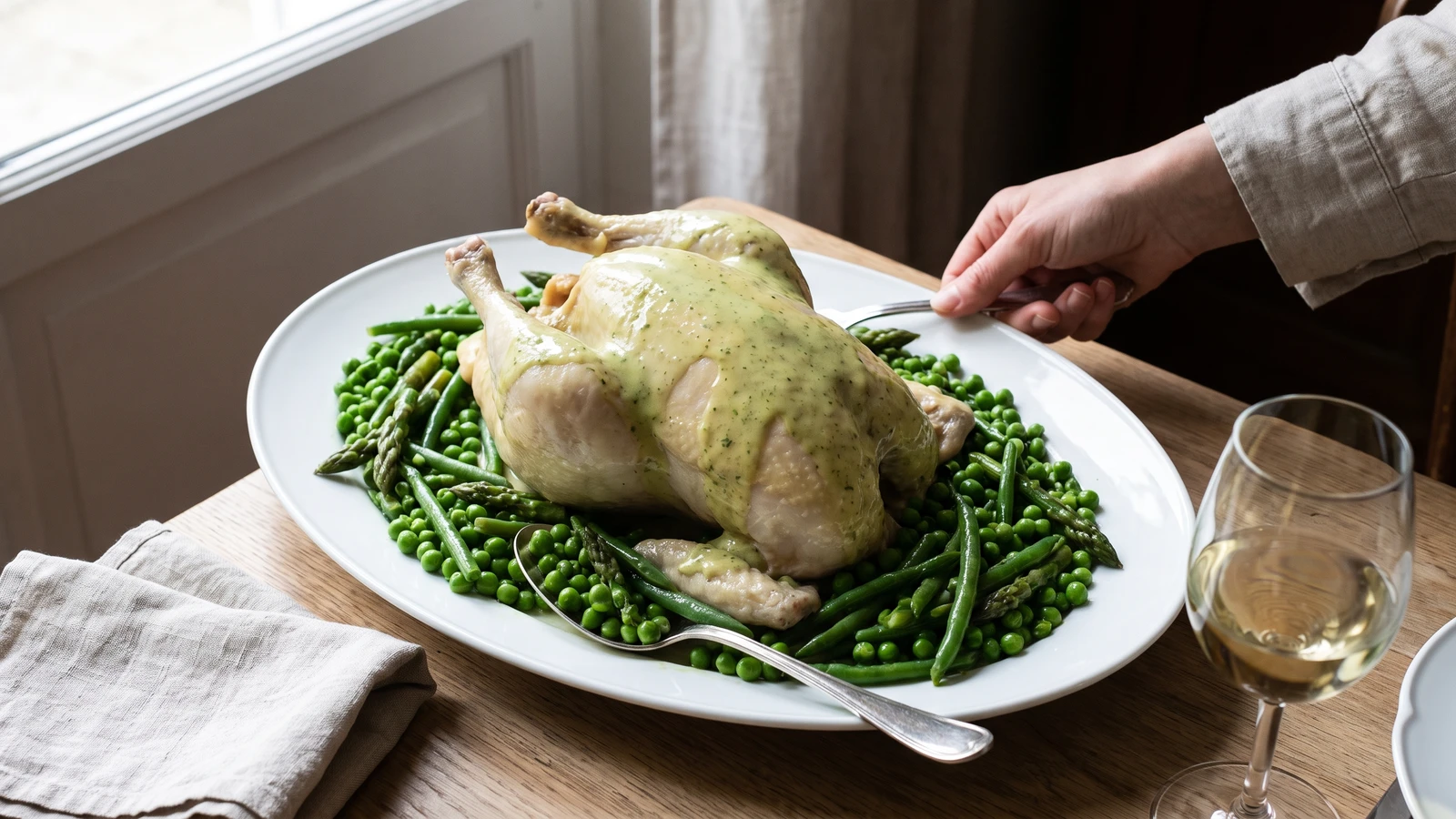
The finished poularde is pale and tender beneath a glossy, faintly green coat, with peas, French beans, and asparagus tips gathered around it in butter. Hold the poaching liquid at a tremble, never a boil, then take the sauce completely off the heat before the first piece of green butter goes in. Keep those two moments calm and the dish will give you everything it promises.
Poularde au Vert-pré belongs to the Parisian classical repertoire, where a gently poached young hen was dressed in sauce suprême and ringed with the first green vegetables of the market. Its name, meaning green meadow, refers not to an herb sauce or a Provençal seasoning, but to the vegetable butter and the printanier garnish of peas, French beans, and asparagus tips. The dish passed from grand dining rooms to bourgeois spring tables because its luxury lies in control: a tender bird, a pale sauce, and vegetables cooked separately so each keeps its color and character.
Quantity
1, 3½ to 4 lb (1.6 to 1.8 kg)
giblets removed
Quantity
8 to 10 cups (1.9 to 2.4 L / 1.9 to 2.4 kg)
enough to cover the chicken by 1 inch
Quantity
2 teaspoons (10 ml / 12 g), plus more as needed
Quantity
1, about 5 oz (140 g)
white and pale green parts split and thoroughly rinsed
Quantity
1, about 4 oz (115 g)
scrubbed and cut into chunks
Quantity
1, about 6 oz (170 g)
peeled and halved
Quantity
2, about 3 oz (85 g)
cut into chunks
Quantity
1
2 parsley stems, 1 thyme sprig, and 1 bay leaf
Quantity
1 teaspoon (5 ml / 3 g)
lightly crushed
Quantity
2 tablespoons (30 ml / 28 g)
Quantity
¼ cup (60 ml / 30 g)
Quantity
2¼ cups (540 ml / 540 g)
Quantity
¾ cup (180 ml / 180 g)
Quantity
¼ cup (60 ml / 56 g) Printanier Butter (No. 157)
chilled and cut into small pieces
Quantity
¼ teaspoon (1.25 ml / 0.5 g)
Quantity
1 cup (240 ml / 145 g)
Quantity
2 cups (480 ml / 150 g)
trimmed and cut into 2-inch pieces
Quantity
1½ cups (360 ml / 180 g)
cut about 2 inches long
Quantity
2 tablespoons (30 ml / 28 g)
Quantity
2 tablespoons (30 ml / 30 g)
for glazing the vegetables
| Ingredient | Quantity |
|---|---|
| whole poularde or plump young chickengiblets removed | 1, 3½ to 4 lb (1.6 to 1.8 kg) |
| cold waterenough to cover the chicken by 1 inch | 8 to 10 cups (1.9 to 2.4 L / 1.9 to 2.4 kg) |
| fine sea salt | 2 teaspoons (10 ml / 12 g), plus more as needed |
| medium leekwhite and pale green parts split and thoroughly rinsed | 1, about 5 oz (140 g) |
| medium carrotscrubbed and cut into chunks | 1, about 4 oz (115 g) |
| medium onionpeeled and halved | 1, about 6 oz (170 g) |
| celery stalkscut into chunks | 2, about 3 oz (85 g) |
| bouquet garni2 parsley stems, 1 thyme sprig, and 1 bay leaf | 1 |
| white peppercornslightly crushed | 1 teaspoon (5 ml / 3 g) |
| unsalted butter for the roux | 2 tablespoons (30 ml / 28 g) |
| all-purpose flour | ¼ cup (60 ml / 30 g) |
| hot strained chicken poaching liquor | 2¼ cups (540 ml / 540 g) |
| heavy cream | ¾ cup (180 ml / 180 g) |
| Printanier Butter (No. 157)chilled and cut into small pieces | ¼ cup (60 ml / 56 g) Printanier Butter (No. 157) |
| ground white pepper | ¼ teaspoon (1.25 ml / 0.5 g) |
| shelled peas | 1 cup (240 ml / 145 g) |
| thin French beanstrimmed and cut into 2-inch pieces | 2 cups (480 ml / 150 g) |
| asparagus tipscut about 2 inches long | 1½ cups (360 ml / 180 g) |
| unsalted butter for the vegetable garnish | 2 tablespoons (30 ml / 28 g) |
| reserved chicken poaching liquorfor glazing the vegetables | 2 tablespoons (30 ml / 30 g) |
Tuck the wing tips behind the chicken and tie the legs loosely together so the bird cooks evenly without being squeezed into a parcel. Set it breast-side up in a snug 5 to 6-quart pot with the leek, carrot, onion, celery, bouquet garni, peppercorns, salt, and enough cold water to cover it by about 1 inch. A snug pot matters because too much water gives you a thin liquor and a weak sauce. Bring the liquid up slowly over medium heat, skimming away the grey foam as it gathers.
As soon as small bubbles begin to collect around the edge, lower the heat. Partially cover the pot and hold the liquid between 175 and 185°F (80 and 85°C), with only an occasional bubble breaking the surface. Poach for 45 to 60 minutes, depending on the bird, until the thickest part of the breast reaches 165°F (74°C) and the inner thigh reaches at least 170°F (77°C), without the thermometer touching bone. If the pot breaks into a boil, lift it off the heat and stir in ½ cup (120 ml / 120 g) cold water from the measured allowance, then return it over lower heat. Ça se rattrape. A brief boil won't ruin the chicken, but a sustained one tightens the flesh and clouds the liquor.
Turn off the heat and leave the chicken in its liquor for 10 minutes, then lift it carefully onto a rimmed tray. Tip the bird over the pot to drain the cavity, cover it loosely, and keep it warm. Strain the poaching liquor through a fine-mesh sieve, skim off the surface fat, and measure 3 cups (720 ml / 720 g) into a clean saucepan. Boil this down to 2¼ cups (540 ml / 540 g) so the sauce begins with a real chicken foundation rather than flavored water. Reserve another 2 tablespoons (30 ml / 30 g) for the garnish.
Bring a wide saucepan of well-salted water to a full boil and set a bowl of iced water beside it. Cook the French beans first until vivid green and just tender, 3 to 4 minutes; lift them into the iced water. Cook the asparagus tips for 2 to 3 minutes and chill them the same way, then cook fresh peas for 60 to 90 seconds or frozen peas for about 2 minutes. Drain everything thoroughly and spread the vegetables on a clean towel to dry. They have different clocks, so cooking them separately is not brigade fuss. It is what keeps the beans supple, the asparagus intact, and the peas sweet.
Melt the 2 tablespoons butter in a heavy 2-quart saucepan over medium-low heat. Stir in the flour and cook this blond roux for 2 minutes, stirring constantly, without letting it color. Add the hot poaching liquor in four additions, whisking each one smooth before adding the next, then hold the sauce at a bare simmer for 12 minutes. Stir in the cream and simmer gently until the sauce naps the back of a spoon and measures exactly 2 cups (about 475 ml), roughly 8 to 12 minutes more. If it becomes too thick, loosen it with poaching liquor one tablespoon at a time; if it remains thin, keep it at the bare simmer. Lumps are no tragedy: pass the sauce through the fine-mesh sieve and continue.
Take the sauce completely off the heat and wait until all bubbling stops. Monter au beurre means to mount with butter: whisk in the chilled Printanier Butter (No. 157), one small piece at a time, using the source proportion of 2 oz (56 g) for the finished pint of sauce. The sauce should become glossy and softly green. Do not return it to the burner or let it boil, because high heat dulls the vegetable color and loosens the emulsion. If the first butter makes the surface look oily, set the pan in a shallow bowl of cool water for 10 seconds and whisk in 1 tablespoon (15 ml / 15 g) cold poaching liquor before continuing. Ça se rattrape. Season with white pepper and salt only after the butter is incorporated.
Melt the remaining 2 tablespoons butter with the reserved 2 tablespoons poaching liquor in a wide skillet over medium-low heat. When the two form a glossy emulsion, add the dried peas, French beans, and asparagus tips. Turn them gently for 2 to 3 minutes, just until hot and evenly coated. Do not brown them or let the liquid boil away into plain fat; the book's instruction that they be cohered with butter means they should arrive as one glistening garnish, not three dry piles.
Warm a deep oval platter with hot water, then dry it thoroughly. Remove the string from the poularde, drain the cavity once more, and place the bird breast-side up on the platter. Spoon enough sauce suprême over it to coat the breast, legs, and wings in an even glossy layer, then arrange the butter-bound peas, French beans, and asparagus tips generously around the bird. Serve the remaining sauce in a warmed sauceboat and bring the poularde to the table at once. À table!
1 serving (about 465g)
Culinary guides, cultural storytelling, and the editorial depth that makes cooking meaningful.
Discover Culinary ExplorerChef Juliette
John Dory has the delicacy of sole and the firmness of turbot. A light flouring, a quick butter sauté, and nut-brown beurre noisette show exactly why looks never mattered.

Chef Juliette
Fresh haddock proves its delicacy in the meunière pan: a fine flour crust, moist pearly flakes, and beurre noisette sharpened with lemon and parsley, ready from one skillet in half an hour.

Chef Juliette
Éperlans à l’Anglaise turns small fish into a lesson in disciplined coating: boned smelts under a close, crisp crumb, pan-fried in clarified butter and finished with bright, half-melted maître d’hôtel butter.

Chef Juliette
Tiny smelts, shallot, mushrooms, white wine, gratin sauce, and fine bread raspings meet a fierce oven, where the fish must turn tender in the same breath the buttered crust bronzes.