
Chef Juliette
John Dory (St. Pierre)
John Dory has the delicacy of sole and the firmness of turbot. A light flouring, a quick butter sauté, and nut-brown beurre noisette show exactly why looks never mattered.
A cooking platform built around craft, culture, and the stories behind what we eat.
Created by Chef Juliette
Based on No. 1526, Poularde Valencienne, from Le Guide Culinaire (1907) by Auguste Escoffier
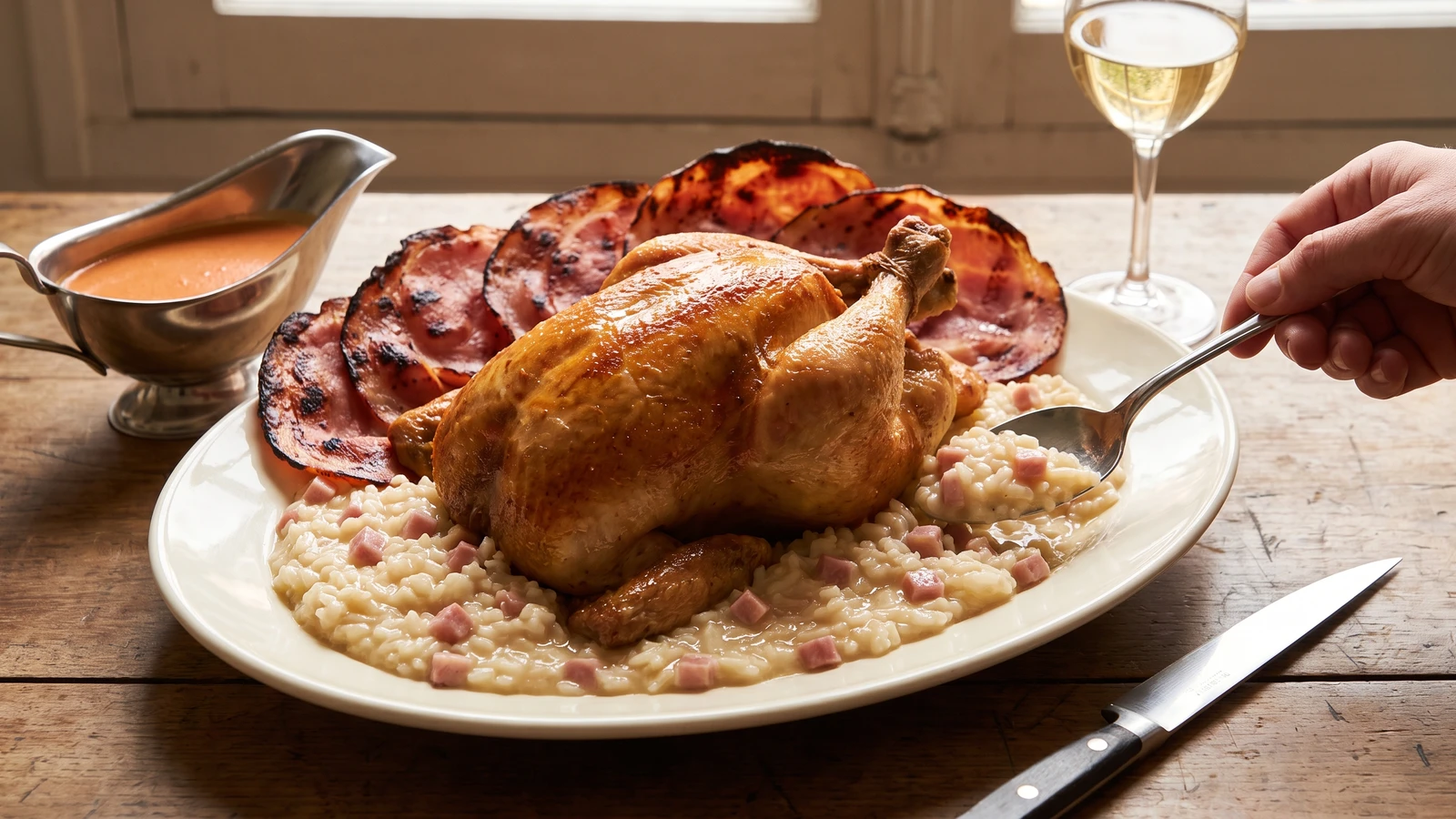
Butter-poëled poultry, creamy ham-studded risotto, grilled ham with dark edges, and coral sauce suprême: a grand-kitchen composition brought home for one cook, one stove, one evening.
Poularde Valencienne (young hen gently roasted in butter with ham risotto and a tomato-tinted cream sauce) teaches orchestration. Four preparations share the platter, but the one true thing to know before touching a pan is that the risotto owns your final twenty minutes. Bring the poultry to its rest, the sauce to a warm hold, and the broiler to readiness before the first ladle meets the rice.
The original formula assumed Poëlings (No. 250) arriving from one station, a saucier beside stock never off the fire, and a salamander waiting to blister the ham. Your honest equivalents are the linked home-scale poëling in a snug covered casserole, one saucepan of sauce built from good stock, and an ordinary broiler. A plump young chicken stands in for the difficult-to-source fattened poularde, and the brigade garnish becomes a generous ring for four. The paper wrapping of the original poëling practice and its extra hands are scaffolding; butter-poëled poultry, ham folded through the rice, a hard-grilled crown, and tomatéd sauce suprême are the dish and must stay.
The finished platter is all contrast: burnished poultry, pearly rice carrying salty dice of ham, grilled slices dark at their edges, and coral sauce gleaming in its boat alongside. Judge the risotto one grain at a time before you build the platter; that final texture is the step that decides the dish.
Poularde Valencienne belongs to the Parisian grand-kitchen repertoire, where a geographical adjective often defined a composed garnish rather than recording a local household dish. The spelling is the clue: Valencienne is the feminine form associated with Valencia, while a dish from Valenciennes in northern France would be called valenciennoise; rice, tomato, and ham make the Spanish reference legible through French technique. The formula traveled as service grammar, poëled poultry at the center, risotto around it, grilled ham above, and sauce separately.
Quantity
1, 3½ to 4 pounds (1.6 to 1.8 kg), prepared according to Poëlings (No. 250)
Quantity
5 cups (1.2 liters / 1.2 kg)
divided and kept hot
Quantity
6 tablespoons (90 ml / 85 g)
divided
Quantity
1 small, about ¾ cup (180 ml / 110 g)
finely diced
Quantity
1¼ cups (300 ml / 250 g)
Quantity
½ cup (120 ml / 120 g)
Quantity
¾ cup (180 ml / 115 g)
cut into ¼-inch dice
Quantity
⅓ cup (80 ml / 30 g)
finely grated
Quantity
8 thin slices, about 6 ounces (170 g)
reserved for grilling
Quantity
2 tablespoons (30 ml / 16 g)
Quantity
½ cup (120 ml / 120 g)
Quantity
¼ cup (60 ml / 60 g)
Quantity
1½ teaspoons (7.5 ml / 9 g), plus more to taste
divided
Quantity
½ teaspoon (2.5 ml / 1 g)
divided
| Ingredient | Quantity |
|---|---|
| whole oven-ready poularde or plump young chicken | 1, 3½ to 4 pounds (1.6 to 1.8 kg), prepared according to Poëlings (No. 250) |
| unsalted or low-sodium chicken stockdivided and kept hot | 5 cups (1.2 liters / 1.2 kg) |
| unsalted butterdivided | 6 tablespoons (90 ml / 85 g) |
| yellow onionfinely diced | 1 small, about ¾ cup (180 ml / 110 g) |
| Arborio or Carnaroli rice | 1¼ cups (300 ml / 250 g) |
| dry white wine | ½ cup (120 ml / 120 g) |
| Jambon de Pariscut into ¼-inch dice | ¾ cup (180 ml / 115 g) |
| Parmesanfinely grated | ⅓ cup (80 ml / 30 g) |
| Jambon de Parisreserved for grilling | 8 thin slices, about 6 ounces (170 g) |
| all-purpose flour | 2 tablespoons (30 ml / 16 g) |
| heavy cream | ½ cup (120 ml / 120 g) |
| smooth tomato purée or passata | ¼ cup (60 ml / 60 g) |
| fine sea saltdivided | 1½ teaspoons (7.5 ml / 9 g), plus more to taste |
| freshly ground white pepperdivided | ½ teaspoon (2.5 ml / 1 g) |
Bring the chicken stock to a bare simmer, then measure 1½ cups (360 ml / 360 g) for the sauce and reserve the remainder for the risotto. Arrange the diced ham, sliced ham, tomato purée, cream, cheese, and divided butter where you can reach them. The final twenty minutes move quickly, and mise en place is how one cook replaces three.
Prepare the poularde or young chicken according to Poëlings (No. 250), keeping that referenced preparation whole rather than rebuilding it inside this recipe. Begin checking the bird at the time specified there; remove it when the thickest part of the breast reaches 160°F (71°C) and the thigh reaches about 170°F (77°C). Rest it covered for 20 minutes and verify that the breast reaches 165°F (74°C) before serving.
While the poultry cooks, melt 2 tablespoons (30 ml / 28 g) of the butter in a 2-quart saucepan over medium-low heat. Stir in the flour and cook for 2 minutes without letting it brown. Whisk in the reserved 1½ cups (360 ml / 360 g) hot stock gradually, scraping into every corner, then simmer gently for 15 minutes until the velouté coats the back of a spoon. If it forms lumps, take it off the heat and whisk firmly, then pass it through a fine sieve. Ça se rattrape.
Whisk the cream into the velouté and simmer gently for 5 minutes. Add the tomato purée and continue cooking until its color and flavor are distinctly perceptible, which is precisely what tomatéd means; the sauce should be coral rather than red. Season with a little salt and white pepper, strain it, and hold it over the gentlest heat with parchment touching the surface. If it tightens, loosen it with hot stock. If oily beads appear, remove it from the heat and whisk in a spoonful of cold cream.
When the poultry begins its rest, melt 2 tablespoons (30 ml / 28 g) butter in a wide, heavy saucepan. Add the onion with a small pinch of salt and cook gently until soft and translucent, never browned. Stir in the rice and nacrer it, coating and heating the grains until they look pearly and their edges turn translucent. Pour in the white wine and stir until the pan is nearly dry.
Add the remaining hot stock about ½ cup (120 ml / 120 g) at a time, stirring steadily and waiting until each addition is nearly absorbed before adding the next. Keep the pan at a lively simmer, not a boil, for 18 to 22 minutes. The rice is ready when each grain is tender around a minute core and the whole moves as one creamy mass. If it becomes stiff before the rice is done, add more hot stock or hot water; if it is loose when the grains are ready, stir over the heat for another minute.
Take the risotto off the heat and fold in the diced Jambon de Paris, Parmesan, and 1 tablespoon (15 ml / 14 g) butter. Taste before adding more salt because the ham and cheese have already spoken. Season with white pepper, cover, and rest for 2 minutes. For this garnish the risotto should be supple but moundable, not flowing; if it tightens while waiting, loosen it with one spoonful of hot stock.
Turn the broiler to high and arrange the ham slices in one layer on a rack set over a rimmed tray. Broil close to the heat for 1 to 2 minutes per side, watching without wandering, until the meat blisters and its edges take dark char. Grill the ham hard. Those edges are the seasoning, not decoration.
Reheat the tomatéd sauce suprême without boiling and whisk in the final 1 tablespoon (15 ml / 14 g) butter off the heat until it gleams. Set the rested poultry in the center of a warmed oval platter and spoon the ham risotto around it in a generous ring. Overlap the grilled ham slices across the risotto to form a loose crown, leaving their charred edges visible. Pour the sauce into a warmed sauceboat and serve it separately, as the formula requires. À table!
1 serving (about 600g)
Culinary guides, cultural storytelling, and the editorial depth that makes cooking meaningful.
Discover Culinary ExplorerChef Juliette
John Dory has the delicacy of sole and the firmness of turbot. A light flouring, a quick butter sauté, and nut-brown beurre noisette show exactly why looks never mattered.

Chef Juliette
Fresh haddock proves its delicacy in the meunière pan: a fine flour crust, moist pearly flakes, and beurre noisette sharpened with lemon and parsley, ready from one skillet in half an hour.

Chef Juliette
Éperlans à l’Anglaise turns small fish into a lesson in disciplined coating: boned smelts under a close, crisp crumb, pan-fried in clarified butter and finished with bright, half-melted maître d’hôtel butter.

Chef Juliette
Tiny smelts, shallot, mushrooms, white wine, gratin sauce, and fine bread raspings meet a fierce oven, where the fish must turn tender in the same breath the buttered crust bronzes.