
Chef Juliette
John Dory (St. Pierre)
John Dory has the delicacy of sole and the firmness of turbot. A light flouring, a quick butter sauté, and nut-brown beurre noisette show exactly why looks never mattered.
A cooking platform built around craft, culture, and the stories behind what we eat.
Created by Chef Juliette
Based on No. 1515, Poularde Sainte Alliance, from Le Guide Culinaire (1907) by Auguste Escoffier
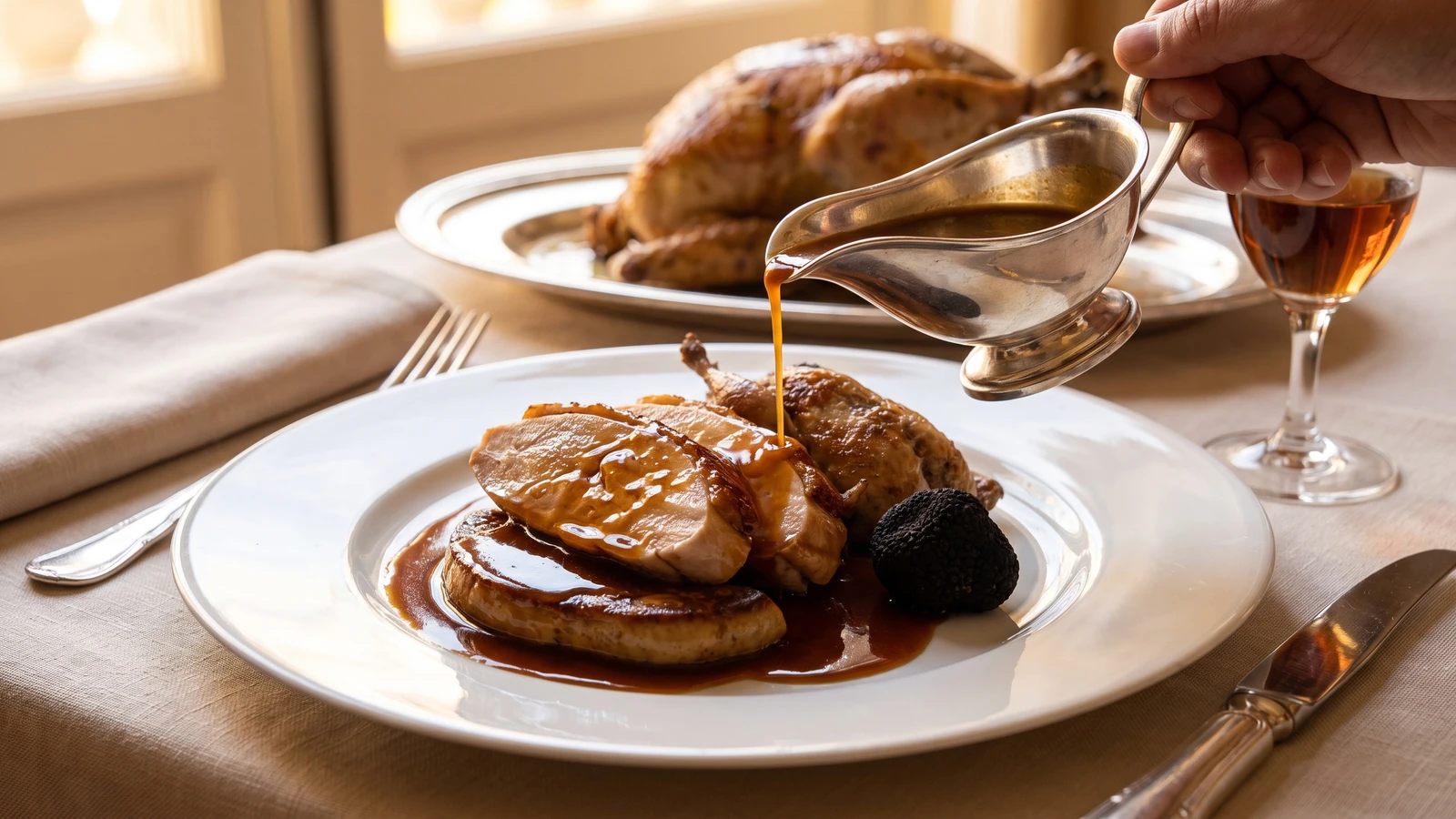
Poularde Sainte Alliance unites butter-poêled chicken, Madeira-soaked truffles, foie gras, and quail on one generous plate, with glossy poëling liquor binding the whole splendid celebration together.
Poularde Sainte Alliance (Sainte Alliance pullet with truffles, foie gras, and quail) teaches one severe, useful lesson: perfume must be contained. The truffles are warmed in butter and Madeira, then cooled under a true seal so not a breath of their fragrance escapes. Lift the lid repeatedly and the finest part of the dish leaves before the bird reaches the oven.
The original service assumed a saucier, brown stock never off the fire, a dining-room carving station, a hot chafer, and three assistants moving plates hand to hand. At home, a deep cocotte, prepared Poëlings (No. 250), four warmed plates, and an orderly carving board do the work. A salamander has no place here because the final uncovered poêlage, gentle covered roasting in butter, gives the bird its color. The brigade choreography is scaffolding and goes; the sealed truffle steep, the poêlage, the foie gras, and the swift hot assembly are the dish and must stay. One cook, one stove, one evening.
Ortolan cannot remain: it is a protected wild bird with no legitimate place in a modern kitchen. Farmed quail preserves the role of a small butter-roasted game bird, though it is larger and gentler in flavor, and four replace the original banquet quantity honestly. When everything lands correctly, sliced suprêmes, the breast fillets, rest on bronzed foie gras beside black truffles and quail, while the poëling liquor gleams around them. Before the poularde touches its cocotte, let the Madeira truffles cool completely under seal.
Poularde Sainte Alliance belongs not to a French region but to London's French grand-hotel table, where classical cooking and dining-room service worked as a single discipline. Its title invokes a celebrated gastronomic alliance, uniting four prized elements on each plate: poularde, foie gras, black truffles, and ortolan. The protected ortolan makes the original impossible to reproduce lawfully, so farmed quail is the honest modern translation rather than a claim that nothing has changed.
Quantity
4 small (about 2½ ounces / 70 grams total)
gently scrubbed and thoroughly dried
Quantity
6 tablespoons (90 ml / 85 g)
divided into three equal portions
Quantity
⅓ cup (80 ml / 80 g)
Quantity
2 teaspoons (10 ml / 12 g)
divided
Quantity
1 teaspoon (5 ml / 2 g)
divided
Quantity
1 bird, about 4½ pounds (2 kg)
giblets removed and bird patted dry
Quantity
4 birds, about 4 ounces / 115 g each (1 pound / 460 g total)
patted dry
Quantity
4 slices, about 6½ ounces / 180 g total
cut ½ inch (1.25 cm) thick and kept thoroughly chilled
| Ingredient | Quantity |
|---|---|
| fresh black trufflesgently scrubbed and thoroughly dried | 4 small (about 2½ ounces / 70 grams total) |
| unsalted butterdivided into three equal portions | 6 tablespoons (90 ml / 85 g) |
| dry or medium-dry Madeira | ⅓ cup (80 ml / 80 g) |
| fine sea saltdivided | 2 teaspoons (10 ml / 12 g) |
| freshly ground black pepperdivided | 1 teaspoon (5 ml / 2 g) |
| poularde or plump young hengiblets removed and bird patted dry | 1 bird, about 4½ pounds (2 kg) |
| Poëlingssized for the poularde | 1 home-scale application (No. 250) |
| semi-boneless farmed quailpatted dry | 4 birds, about 4 ounces / 115 g each (1 pound / 460 g total) |
| foie gras collopscut ½ inch (1.25 cm) thick and kept thoroughly chilled | 4 slices, about 6½ ounces / 180 g total |
Melt 2 tablespoons of the butter in a small, heavy saucepan over gentle heat. Add the truffles, season them lightly with some of the measured salt and pepper, and roll them through the foaming butter for 2 minutes without browning them. Pour in the Madeira and let it give one lively bubble, about 30 seconds, then remove the pan from the heat. Lay a small round of parchment directly over the truffles, close the pan with its tight-fitting lid, and crimp foil around the seam. Leave it untouched until completely cool, about 30 to 40 minutes. If the lid shifts, reseal it immediately and resist reducing the liquor to compensate, which would drive away more aroma. Ça se rattrape, provided you stop there.
Heat the oven to 325°F (165°C). Season the poularde inside and out with most of the remaining salt and pepper. Open the cooled truffle pan only when the bird is ready, then tip every truffle and every drop of Madeira butter into the cavity. Close the opening with two small metal skewers and tie the legs snugly with kitchen twine. The closure needn't be beautiful, but it must hold the truffles and their liquor inside while the bird cooks.
Prepare the Poëlings (No. 250) in a deep, heavy cocotte according to its own entry, scaled to this bird. Set the stuffed poularde breast-side up in the prepared vessel, cover closely, and cook for about 50 minutes, basting with its butter every 15 minutes. Do not add stock or water during this stage: moisture would turn the poêlage into a braise and flatten the concentrated flavor. Uncover and continue cooking for 25 to 35 minutes, basting twice more, until the skin is deeply burnished, the breast registers at least 162°F (72°C), and the thickest part of the thigh reaches 170°F (77°C). If the base threatens to scorch, lower the oven by 25°F (15°C) and transfer the bird with any unblackened cooking base to a clean hot cocotte; don't drown the problem with stock. Ça se rattrape.
Move the poularde to a warm carving platter and rest it loosely covered for 15 to 20 minutes, verifying that the breast reaches 165°F (74°C). Tilt the cavity over the cooking vessel to reclaim its Madeira-scented liquor, then remove the truffles to a small covered bowl. Complete the poëling liquor as directed in Poëlings (No. 250), keeping the stock in contact with the flavored butter for the full prescribed simmer before straining and degreasing it. Reduce the strained liquor until about 1 cup (240 ml) remains and it coats a spoon with a light gloss. If it is greasy, let it settle for a minute and skim again; if it becomes too strong or tight, loosen it with a little hot stock.
Fill four heatproof dinner plates with hot water so they warm while the garnishes cook. Season the quail lightly with salt and pepper. Melt 2 tablespoons of butter in a wide skillet over medium-high heat, and when the foam subsides, lay in the quail breast-side down. Cook for 4 minutes until well bronzed, turn, and cook for another 3 minutes. Roll them briefly onto each side while spooning over the butter, 1 to 2 minutes more, until the thickest part reaches 165°F (74°C). Hold them loosely covered on a warm tray. If the butter races from brown to black, lift the pan from the heat at once and lower the burner; butter may be nutty, never bitter.
Wipe the skillet clean and heat it over medium-high heat. Add the final 2 tablespoons of butter, then lay the cold foie gras collops into the foaming butter without crowding them. Sear for 45 to 60 seconds on each side, just until the surfaces are caramel-brown and the centers yield gently when pressed. Move them directly to the drained, thoroughly dried warm plates. If a collop begins melting before it colors, lift it out, chill the remaining slices for 5 minutes, clean and reheat the pan, then continue. Set the softened piece beneath the sliced chicken, where its shape matters less and its flavor remains. Ça se rattrape.
Remove the two suprêmes from the poularde in whole lobes and slice each crosswise into thick, even pieces. Divide the slices among the four plates, arranging them directly over the foie gras. Add one warm truffle and one quail to each plate, then spoon over enough hot poëling liquor to gloss the chicken without flooding the foie. Arrange the legs and wings on the warm carving platter for second helpings, and pour the remaining liquor into a heated sauceboat. Work calmly but without delay. This union is at its best the moment it is assembled. À table!
1 serving (about 500g)
Culinary guides, cultural storytelling, and the editorial depth that makes cooking meaningful.
Discover Culinary ExplorerChef Juliette
John Dory has the delicacy of sole and the firmness of turbot. A light flouring, a quick butter sauté, and nut-brown beurre noisette show exactly why looks never mattered.

Chef Juliette
Fresh haddock proves its delicacy in the meunière pan: a fine flour crust, moist pearly flakes, and beurre noisette sharpened with lemon and parsley, ready from one skillet in half an hour.
Chef Juliette
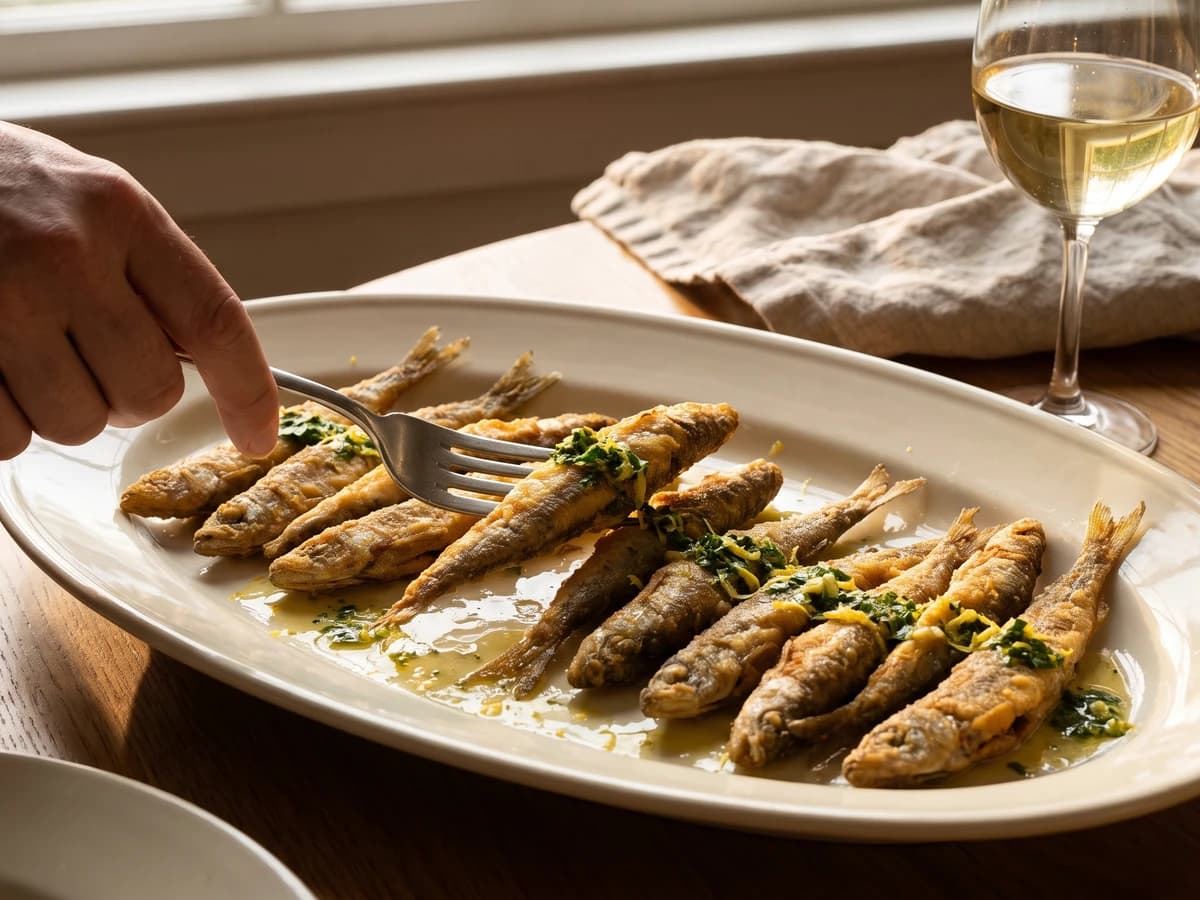
Éperlans à l’Anglaise turns small fish into a lesson in disciplined coating: boned smelts under a close, crisp crumb, pan-fried in clarified butter and finished with bright, half-melted maître d’hôtel butter.

Chef Juliette
Tiny smelts, shallot, mushrooms, white wine, gratin sauce, and fine bread raspings meet a fierce oven, where the fish must turn tender in the same breath the buttered crust bronzes.