
Chef Juliette
John Dory (St. Pierre)
John Dory has the delicacy of sole and the firmness of turbot. A light flouring, a quick butter sauté, and nut-brown beurre noisette show exactly why looks never mattered.
A cooking platform built around craft, culture, and the stories behind what we eat.

Created by Chef Juliette
Based on No. 1505, Poularde à la Piémontaise, from Le Guide Culinaire (1907) by Auguste Escoffier
A truffle-rich risotto fills a butter-poêlé poularde, while its reduced roasting liquor deepens a glossy chicken gravy: grand French abundance translated for four, with the truffle kept tender and fragrant.
Poularde à la Piémontaise (butter-roasted pullet filled with white-truffle risotto) teaches a severe little truth: the truffle must be warmed by the bird, never punished by fierce heat. Shave it into risotto that has cooled to warm, then let the enclosed stuffing carry its perfume through the meat. That is the one true thing to know before you touch the pan.
The original kitchen assumed Poëlings (No. 250) ready as a standing preparation, a saucier attending the thickened chicken gravy, stock never off the fire, and enough hands to baste while the risotto was made. At home, a snug lidded cocotte takes the poêlon's place, and one saucepan builds the gravy. No salamander is needed; the original method colors the bird by uncovering it, and the home oven does that cleanly. Repeated strainings and a separate hot-holding station are brigade scaffolding, so they go. The butter-rich poêlage, the reduced cooking liquor, and the exact four-parts-risotto-to-three-parts-truffle ratio stay because they are the dish. The finished stuffing is reduced to 200 grams of risotto and 150 grams of truffle so it fits one home-sized poularde without changing that ratio. One cook, one stove, one evening.
Bring it to the table with bronze skin, fragrant rice spilling from the cavity, and tawny gravy gleaming around each carved piece. The decisive moment comes before stuffing: let the risotto fall to body temperature, fold in the truffle, fill the bird loosely, and put it straight into the oven.
In the French classical vocabulary, à la Piémontaise signals the rice and celebrated white truffles of Piedmont, particularly those traded around Alba. This is not a Piedmontese farmhouse preparation transplanted whole, but a French grand-kitchen composition that joins the Piedmontese larder to the French technique of poêlage. Its extravagance lies less in ornament than in proportion: nearly as much truffle as rice, enclosed inside the bird so the perfume reaches every carving.
Quantity
1 bird, 4 lb (1.8 kg)
giblets removed and skin patted dry
Quantity
2½ teaspoons (12.5 ml / 15 g)
divided
Quantity
1 teaspoon (5 ml / 2 g)
divided
Quantity
2 tablespoons (30 ml / 28 g)
Quantity
2 tablespoons (30 ml / 20 g)
very finely minced
Quantity
⅓ cup (80 ml / 65 g)
Quantity
4 cups (960 ml / 960 g)
kept warm and divided
Quantity
2 to 3 whole truffles (150 g total)
gently brushed clean
Quantity
1 home-scale batch, sized for one 4 lb (1.8 kg) poularde
Quantity
2 tablespoons (30 ml / 28 g)
Quantity
2 tablespoons (30 ml / 16 g)
| Ingredient | Quantity |
|---|---|
| poularde or plump roasting pulletgiblets removed and skin patted dry | 1 bird, 4 lb (1.8 kg) |
| fine sea saltdivided | 2½ teaspoons (12.5 ml / 15 g) |
| finely ground white pepperdivided | 1 teaspoon (5 ml / 2 g) |
| unsalted butter for the risotto | 2 tablespoons (30 ml / 28 g) |
| shallotvery finely minced | 2 tablespoons (30 ml / 20 g) |
| Carnaroli or Arborio rice | ⅓ cup (80 ml / 65 g) |
| rich unsalted chicken stockkept warm and divided | 4 cups (960 ml / 960 g) |
| fresh Piedmont white trufflesgently brushed clean | 2 to 3 whole truffles (150 g total) |
| Poëlings (No. 250) | 1 home-scale batch, sized for one 4 lb (1.8 kg) poularde |
| unsalted butter for the gravy | 2 tablespoons (30 ml / 28 g) |
| all-purpose flour | 2 tablespoons (30 ml / 16 g) |
Melt the risotto butter in a small heavy saucepan over gentle heat. Add the shallot and cook without coloring until supple, about 3 minutes. Add the rice and nacrez it, coating each grain in butter until its outer edge looks translucent while the center stays white. Add about 1¼ cups (300 ml / 300 g) of the warm chicken stock a ladle at a time, stirring and allowing each addition to be nearly absorbed before adding the next. Cook until creamy but still faintly firm at the center, about 16 to 18 minutes. Season lightly with some of the salt and white pepper. Weigh out exactly 7 ounces (200 g) of finished risotto and spread it in a shallow dish to cool for 10 to 15 minutes. If it tightens while cooling, loosen it with one spoonful of warm stock. Ça se rattrape.
While the risotto cools, melt the gravy butter in a clean saucepan. Stir in the flour to make a roux blond, a pale butter-and-flour thickener, and cook it gently for 2 minutes without letting it brown. Whisk in 2½ cups (600 ml / 600 g) of the warm chicken stock in several additions, making each one smooth before adding the next. Bring to a bare simmer and cook for 18 to 20 minutes, skimming as needed, until the gravy lightly coats a spoon and measures about 1⅔ cups (400 ml). Season modestly and set it aside. If the gravy forms lumps, don't fight them in the pan; pass it through a fine sieve and continue.
Heat the oven to 325°F (165°C) and have the home-scale Poëlings (No. 250) prepared in a snug lidded cocotte before cutting the truffles. Season the poularde inside and out with most of the remaining salt and white pepper. When the risotto has fallen to about 95 to 105°F (35 to 40°C), shave all 5⅓ ounces (150 g) of white truffle into thin, flexible slices and fold them through the 7 ounces (200 g) of risotto. Fill the cavity loosely, without compressing the rice, then truss the legs and put the bird into its prepared vessel at once. If the cavity is smaller than expected, don't force the stuffing; place the remainder in a covered buttered ramekin and cook it beside the bird for the final 25 minutes.
Cook the stuffed bird with Poëlings (No. 250), following that preparation's covered, butter-rich method and basting rhythm. Do not add wine, water, or stock during this stage. Poêler means roasting gently in butter under cover before uncovering for color; moisture added now would turn the method into a braise. Cook covered for about 60 minutes, basting quickly every 20 minutes, then uncover and raise the oven to 400°F (200°C). Continue for 25 to 40 minutes, until the skin is deeply butter-gold, the center of the stuffing reaches 165°F (74°C), and the thickest part of the thigh reaches at least 170°F (77°C). If the skin colors before the stuffing is safe, lay a loose piece of foil over the breast and continue. If the vegetables beneath threaten to catch, lower the heat and add a little butter from the preparation, never stock.
Transfer the poularde to a warm platter, tent it loosely with foil, and rest it for 20 minutes. Complete the finishing phase of Poëlings (No. 250) exactly as its own entry directs. Measure the strained and degreased poëling liquor it produces, then boil that liquor in a small clean saucepan until concentrated, glossy, and reduced to about ⅓ cup (80 ml). Watch the final minutes closely; a broad pan can take it from savory to scorched very quickly.
Return the thickened chicken gravy to a bare simmer and whisk in the reduced poëling liquor a spoonful at a time. Simmer for 2 to 3 minutes, until the sauce naps the back of a spoon in a glossy veil, then taste and correct the seasoning. If it becomes too thick, loosen it with some of the reserved chicken stock. If a buttery slick separates at the surface, skim the excess, add a tablespoon of warm stock, and whisk gently until the sauce comes together. Ça se rattrape.
Remove the trussing string. Take off the legs, carve the breast into broad slices, and spoon the truffle risotto from the cavity onto the center of the platter. Arrange the poultry around it without fuss. Spoon a little gravy over the meat and send the rest in a warm sauceboat so each guest can help themselves. The first cut releases the truffle perfume, which is why the bird comes whole to the table. À table!
1 serving (about 470g)
Culinary guides, cultural storytelling, and the editorial depth that makes cooking meaningful.
Discover Culinary ExplorerChef Juliette
John Dory has the delicacy of sole and the firmness of turbot. A light flouring, a quick butter sauté, and nut-brown beurre noisette show exactly why looks never mattered.

Chef Juliette
Fresh haddock proves its delicacy in the meunière pan: a fine flour crust, moist pearly flakes, and beurre noisette sharpened with lemon and parsley, ready from one skillet in half an hour.
Chef Juliette
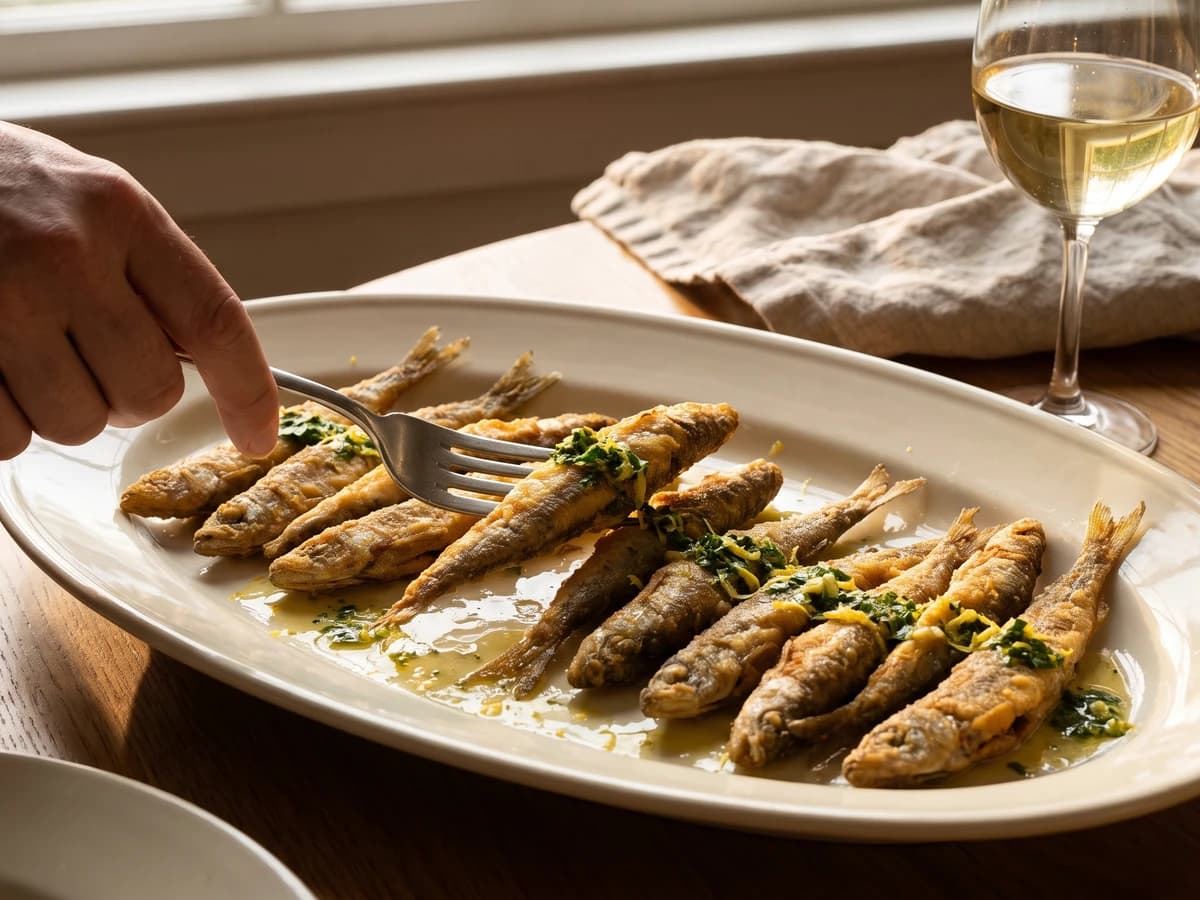
Éperlans à l’Anglaise turns small fish into a lesson in disciplined coating: boned smelts under a close, crisp crumb, pan-fried in clarified butter and finished with bright, half-melted maître d’hôtel butter.

Chef Juliette
Tiny smelts, shallot, mushrooms, white wine, gratin sauce, and fine bread raspings meet a fierce oven, where the fish must turn tender in the same breath the buttered crust bronzes.