
Chef Juliette
John Dory (St. Pierre)
John Dory has the delicacy of sole and the firmness of turbot. A light flouring, a quick butter sauté, and nut-brown beurre noisette show exactly why looks never mattered.
A cooking platform built around craft, culture, and the stories behind what we eat.

Created by Chef Juliette
Based on No. 1504, Poularde Petite Mariée, from Le Guide Culinaire (1907) by Auguste Escoffier
A snug cocotte teaches the lesson: less stock gives a stronger liquor, and that liquor, reduced and married into Sauce Suprême, coats the tender bird and its spring vegetables with ivory gloss.
Poularde Petite Mariée (young hen with spring vegetables in Sauce Suprême) teaches the economy of a classical poach: the reduced cooking liquor is the point. Keep the cocotte snug and the little white stock captures the bird's juices instead of diluting them; later, that liquor is reduced and married into the sauce. A broad pot gives you pale broth and a long, joyless reduction.
The original entry assumed white stock never off the fire, a saucier ready with excellent Sauce Suprême, and enough hands to watch the poularde and each young vegetable at once. At home, have those two finished foundations ready, use a 5- to 6-quart cocotte and a gentle oven, then lift the vegetables as each becomes tender. A true poularde can be difficult to find, so a plump young chicken of the same home-scale weight is the honest equivalent. The garnish count and its order remain untouched.
Separate hands, decorative vegetable turning, and an oversized poaching vessel are brigade scaffolding; they can go. The snug poach, reduced liquor, and Sauce Suprême must stay, because they are the dish. Done well, the bird arrives whole under ivory sauce, with sweet onions, carrots, potatoes, and peas gathered close. The one step that decides it is the reduction: take the cooking liquor down until one spoonful tastes richly of chicken, then stop before it turns salty or sticky.
Poularde Petite Mariée belongs to the Parisian grand-kitchen repertory of named poultry garnishes, where a title identified the sauce and vegetables completing the bird. Its new onions, carrots, potatoes, and peas place it at the spring table, while the reduced poaching liquor married into Sauce Suprême demonstrates the classical practice of returning every drop of the bird's flavor to the finished dish. Despite the bridal title, it is not securely tied to a regional wedding custom; the covered cocotte carried it naturally from the grand kitchen into cuisine bourgeoise.
Quantity
1, 3½ to 4 pounds (1.6 to 1.8 kg)
giblets removed
Quantity
6 (about 5 ounces / 150 g)
peeled and root ends trimmed
Quantity
6 (about 10 ounces / 285 g)
peeled and trimmed
Quantity
6 (about 1 pound / 450 g)
scrubbed
Quantity
1/4 Imperial pint, about 1/2 cup plus 1 tablespoon (140 ml / 90 g)
Quantity
3 cups (710 ml / 710 g)
Quantity
1½ cups (355 ml / 360 g)
Quantity
1½ teaspoons (7.5 ml / 9 g)
divided
| Ingredient | Quantity |
|---|---|
| poularde or plump young chickengiblets removed | 1, 3½ to 4 pounds (1.6 to 1.8 kg) |
| small new onionspeeled and root ends trimmed | 6 (about 5 ounces / 150 g) |
| small new carrotspeeled and trimmed | 6 (about 10 ounces / 285 g) |
| small new potatoesscrubbed | 6 (about 1 pound / 450 g) |
| freshly shelled peas | 1/4 Imperial pint, about 1/2 cup plus 1 tablespoon (140 ml / 90 g) |
| unsalted white chicken stock | 3 cups (710 ml / 710 g) |
| prepared Sauce Suprême | 1½ cups (355 ml / 360 g) |
| fine sea saltdivided | 1½ teaspoons (7.5 ml / 9 g) |
Heat the oven to 325°F (165°C). Pat the poularde dry, tuck the wing tips underneath, and tie the legs together loosely so the bird sits compactly. Season the cavity and exterior with 1 teaspoon of the salt. Leave the onions, carrots, and potatoes whole; matching their sizes matters, but turning them into decorative little footballs does not. That was brigade labor, not flavor.
Set the poularde breast-up in a snug 5- to 6-quart cocotte, with the thighs sitting low. Arrange the six onions, six carrots, six potatoes, and peas closely around it, preserving the source entry's order by putting every vegetable in at the beginning. Pour 2½ cups (590 ml) of the white chicken stock around the bird, reserving the remaining 1/2 cup (120 ml). The liquid should reach between one-third and halfway up the bird. Bring it slowly to a frémissement, the barest tremble, then cover tightly.
Transfer the covered cocotte to the oven and maintain the frémissement for 50 to 70 minutes. Check the peas after 8 minutes and lift them into a covered warm bowl as soon as they are sweet and tender. Begin checking the onions, carrots, and potatoes after 25 minutes, removing each with a skimmer when a small knife enters without force; moisten them with a spoonful of cooking liquor so they do not dry. Baste the breast twice during cooking. If the liquid breaks into a hard boil, pull the cocotte from the oven, uncover it for 2 minutes, and add a splash of the reserved cool stock before continuing at 300°F (150°C). Ça se rattrape. The bird is ready when the breast and innermost thigh both register at least 165°F (74°C), with the thigh preferably reaching 170 to 175°F (77 to 80°C).
Lift the poularde onto a warm rimmed platter and cover it loosely for 15 minutes. Transfer any remaining vegetables to the covered bowl. Pour the cooking liquor through a fine-mesh strainer into a heatproof jug, skim away the surface fat, and return the liquor to the cocotte. A bare poach leaves the liquor clean and fragrant; a rolling boil clouds it and tightens the meat.
Boil the strained cooking liquor uncovered until only 3/4 cup (180 ml) remains, usually 12 to 18 minutes. Watch the final minutes closely and taste from a cooled spoon: it should be strongly chicken-scented and rounded, not salty or sticky. If it goes too far, loosen it with the reserved unsalted stock, 1 tablespoon at a time. This reduction is not scaffolding. It is the flavor that distinguishes the dish from chicken merely served with cream sauce.
Lower the heat and whisk the prepared Sauce Suprême into the reduced liquor in three additions. Bring the mixture only to a gentle simmer and cook for 2 to 4 minutes, until it is nappant, meaning it coats the back of a spoon in a smooth ivory layer. If it remains thin, simmer it a little longer; if it tightens too much, add reserved stock by the teaspoon. Should the surface look greasy after too much heat, pull the cocotte off the burner and whisk in a teaspoon of cool stock until the sauce comes together again.
Taste the sauce and use the remaining salt only if needed. Return the poularde to the center of the warm cocotte and arrange the six onions, carrots, and potatoes around it, with the peas scattered among them. Spoon the Sauce Suprême generously over the bird and vegetables, leaving the shapes visible beneath their glossy coat. Warm everything over the lowest heat for 2 minutes without allowing the sauce to boil, then carry the cocotte to the table and carve the bird there. À table!
1 serving (about 590g)
Culinary guides, cultural storytelling, and the editorial depth that makes cooking meaningful.
Discover Culinary ExplorerChef Juliette
John Dory has the delicacy of sole and the firmness of turbot. A light flouring, a quick butter sauté, and nut-brown beurre noisette show exactly why looks never mattered.

Chef Juliette
Fresh haddock proves its delicacy in the meunière pan: a fine flour crust, moist pearly flakes, and beurre noisette sharpened with lemon and parsley, ready from one skillet in half an hour.
Chef Juliette
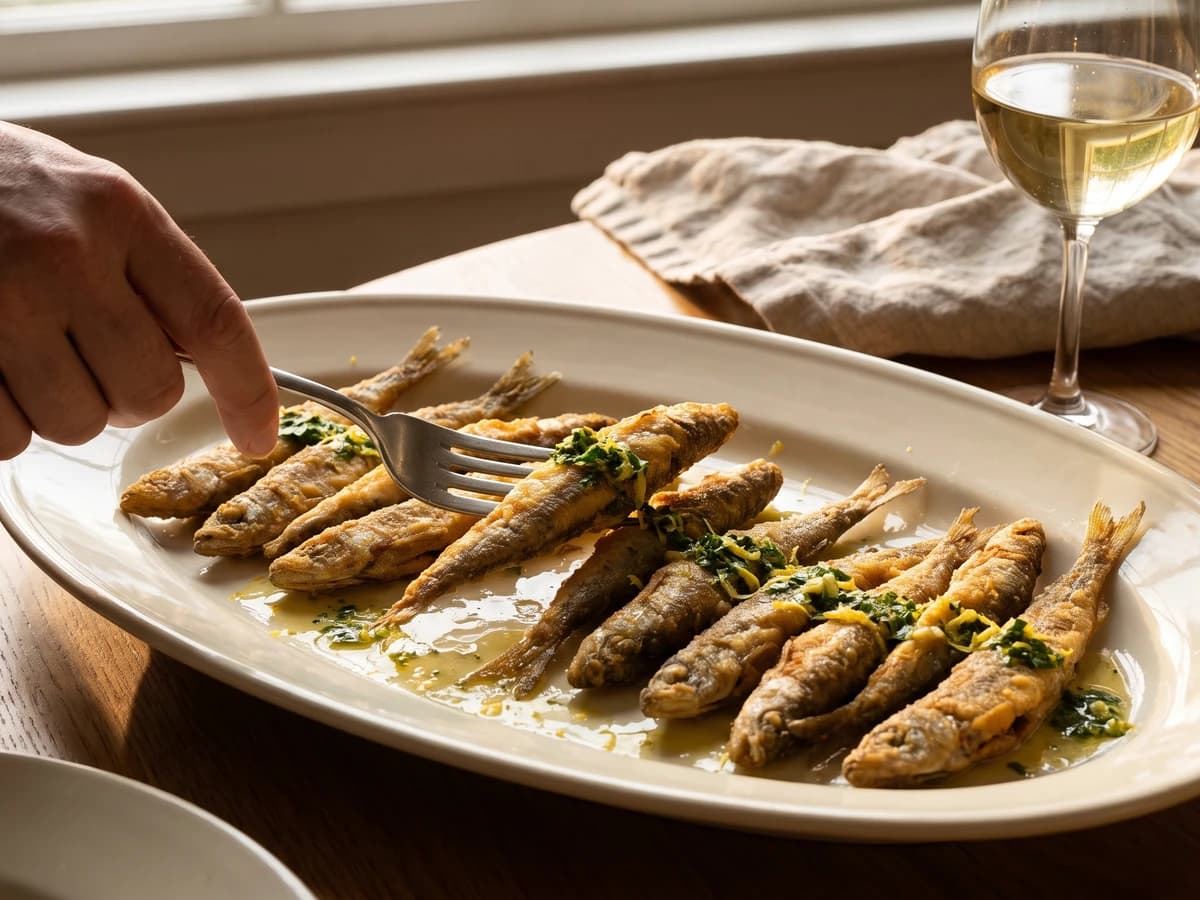
Éperlans à l’Anglaise turns small fish into a lesson in disciplined coating: boned smelts under a close, crisp crumb, pan-fried in clarified butter and finished with bright, half-melted maître d’hôtel butter.

Chef Juliette
Tiny smelts, shallot, mushrooms, white wine, gratin sauce, and fine bread raspings meet a fierce oven, where the fish must turn tender in the same breath the buttered crust bronzes.