
Chef Juliette
John Dory (St. Pierre)
John Dory has the delicacy of sole and the firmness of turbot. A light flouring, a quick butter sauté, and nut-brown beurre noisette show exactly why looks never mattered.
A cooking platform built around craft, culture, and the stories behind what we eat.

Created by Chef Juliette
Based on No. 1497, Poularde à la Nantua, from Le Guide Culinaire (1907) by Auguste Escoffier
Poularde à la Nantua teaches the last discipline of sauce work: poach gently, reduce the suprême until it coats, then mount the crayfish butter off the heat and serve at once.
Poularde à la Nantua (poached fattened young hen with crayfish sauce) teaches the last discipline of a built sauce: knowing when to stop the heat. The bird is poached until tender, its cooking liquor becomes sauce suprême, and the crayfish butter carries Nantua's red-gold shellfish perfume through the ivory cream. One true thing before you touch a pan: the butter goes in off the heat. Boil it afterward and the sauce loses its emulsion, its gloss, and much of its delicate crayfish character.
The original entry assumed a saucier on staff, a stock never off the fire, prepared quenelle forcemeat, crayfish butter waiting, and a serving poularde large enough for a grand table. It asks for no salamander because nothing here is gratinéed. At home, one plump bird poaches in an ordinary stockpot; its liquor becomes the fond for the suprême; a food processor replaces the mortar and tamis, or fine sieve, for twelve small quenelles; and shells from the garnish make the butter. These are brigade scaffolds removed, not flavors surrendered. The gentle poach, the roux and reduction, and the off-heat mounting remain because they are the dish. One cook, one stove, one evening.
The final platter should be generous rather than fussy: the whole bird glazed in blush-ivory suprême, with little heaps of quenelles, coral tails, and black truffle around it. Keep your nerve at the finish. If the sauce separates, ça se rattrape, but the easiest rescue is prevention: pan off the fire, crayfish butter whisked in piece by piece, then straight to the table.
Nantua sits in the Bugey country of Ain, between Lyon and the Jura, where the lake's crayfish gave the town's name to a classical preparation built on crayfish butter and tails. Sauce Nantua is most closely joined to pike quenelles, but grand kitchens also carried its crayfish finish onto poultry, as in this poularde, using sauce suprême rather than treating Nantua as one fixed sauce base. The defining mark is not simply cream or a pink color, but crayfish shells worked into real butter, with the tails returned as garnish.
Quantity
1 (3½ to 4 lb / 1.6 to 1.8 kg)
giblets removed
Quantity
8 cups (1.9 L / 1.9 kg)
Quantity
4 to 6 cups (950 ml to 1.4 L / 950 g to 1.4 kg)
as needed to cover
Quantity
1 medium (about 1 cup / 150 g)
quartered
Quantity
1 large (about ¾ cup / 100 g)
sliced
Quantity
1 small (about 1 cup / 100 g)
rinsed and sliced
Quantity
1
2 parsley stems, 2 thyme sprigs, and 1 bay leaf
Quantity
1 teaspoon (5 ml / 2 g)
Quantity
1 tablespoon (15 ml / 18 g), divided, plus more to taste
Quantity
24 (about 2 lb / 900 g)
Quantity
½ cup (120 ml / 113 g)
softened
Quantity
¾ cup loosely packed (175 ml / 115 g)
diced and very cold
Quantity
1
Quantity
¼ cup (60 ml / 60 g)
very cold
Quantity
⅛ teaspoon (0.6 ml / 0.3 g), plus more to taste
Quantity
3 tablespoons (45 ml / 42 g)
Quantity
3 tablespoons (45 ml / 24 g)
Quantity
2 cups (475 ml / 475 g)
Quantity
1 cup (240 ml / 240 g)
Quantity
1 small (about 2 tablespoons thin slices / 20 g)
preserved truffle drained, if using
| Ingredient | Quantity |
|---|---|
| poularde or plump young roasting chickengiblets removed | 1 (3½ to 4 lb / 1.6 to 1.8 kg) |
| unsalted or low-sodium chicken stock | 8 cups (1.9 L / 1.9 kg) |
| cold wateras needed to cover | 4 to 6 cups (950 ml to 1.4 L / 950 g to 1.4 kg) |
| yellow onionquartered | 1 medium (about 1 cup / 150 g) |
| carrotsliced | 1 large (about ¾ cup / 100 g) |
| leek, white and pale green parts onlyrinsed and sliced | 1 small (about 1 cup / 100 g) |
| bouquet garni2 parsley stems, 2 thyme sprigs, and 1 bay leaf | 1 |
| black peppercorns | 1 teaspoon (5 ml / 2 g) |
| fine sea salt | 1 tablespoon (15 ml / 18 g), divided, plus more to taste |
| whole cooked unseasoned freshwater crayfish | 24 (about 2 lb / 900 g) |
| unsalted butter for the crayfish buttersoftened | ½ cup (120 ml / 113 g) |
| boneless skinless chicken breastdiced and very cold | ¾ cup loosely packed (175 ml / 115 g) |
| large egg white | 1 |
| heavy cream for the quenellesvery cold | ¼ cup (60 ml / 60 g) |
| ground white pepper | ⅛ teaspoon (0.6 ml / 0.3 g), plus more to taste |
| unsalted butter for the roux | 3 tablespoons (45 ml / 42 g) |
| all-purpose flour | 3 tablespoons (45 ml / 24 g) |
| hot reserved poultry poaching liquor | 2 cups (475 ml / 475 g) |
| heavy cream for sauce suprême | 1 cup (240 ml / 240 g) |
| fresh black truffle or whole preserved black trufflepreserved truffle drained, if using | 1 small (about 2 tablespoons thin slices / 20 g) |
Twist the tails from the crayfish, remove the meat and dark intestinal vein, then cover and refrigerate the tails. Put the shells, heads, and claws in a sturdy bag and crush them firmly with a rolling pin. Melt the softened butter over medium-low heat, add the crushed shells, and cook for 10 to 12 minutes, stirring and pressing often, until the butter turns coral and smells deeply of crayfish. Keep the heat gentle so the milk solids don't brown. Strain through a fine sieve lined with cheesecloth, pressing hard to recover the butter. Reserve 1 tablespoon for the quenelles and keep the remainder soft for finishing the sauce.
Set the poularde breast-side up in an 8 to 10-quart stockpot. Add the stock, onion, carrot, leek, bouquet garni, peppercorns, and 2 teaspoons of the salt, then add enough cold water to cover the bird by about 1 inch. Bring the liquid slowly to 180°F to 185°F (82°C to 85°C), skimming away any grey foam. Hold it at that bare tremble for 50 to 65 minutes, turning the bird once if it floats unevenly, until both the thickest breast and inner thigh register at least 165°F (74°C). Never let the pot boil. If it does, pull it from the burner, add a cup of cold water, and resume over gentler heat. Ça se rattrape. Lift the poularde onto a rack over a tray and cover loosely while you finish the garniture and sauce.
While the poularde poaches, make a farce mousseline, a cream-lightened forcemeat. Process the cold diced chicken with ½ teaspoon of the salt and a pinch of white pepper until smooth and tacky. Add the egg white and process again. With the machine running, pour in the cold cream in a thin stream, stopping as soon as the mixture is smooth, then pulse in the reserved tablespoon of crayfish butter. Scrape the mousseline into a chilled bowl, cover, and refrigerate for at least 20 minutes. If the processor bowl begins to feel warm, stop and chill everything before continuing; warmth loosens the emulsion before it ever reaches the water.
Strain the poultry poaching liquor through a fine sieve and discard the aromatics. Measure 2 cups for sauce suprême and keep another 4 cups for poaching the quenelles and warming the crayfish tails. Reserve a little extra in case the finished sauce needs loosening. Taste the liquor now. If it is already distinctly salty, dilute it with water before reduction, because reduction concentrates everything.
Bring the reserved poaching liquor to 175°F to 180°F (79°C to 82°C). Shape one teaspoon of chilled mousseline between two wet teaspoons and lower it into the liquor as a test. It should hold its oval shape and rise gently as it cooks. If it feathers or spreads, chill the mousseline for another 15 minutes and test again. Ça se rattrape. Shape 12 small quenelles and poach them without boiling for 6 to 8 minutes, turning once, until firm and cooked to 165°F (74°C) at the center. Lift them into a covered warm dish. Add the crayfish tails to the liquor for 30 seconds, just long enough to warm them, then drain and keep them beside the quenelles.
Melt the roux butter in a medium saucepan over gentle heat. Stir in the flour and cook this roux blanc, or white roux, for 2 minutes without letting it color. Whisk in the 2 cups of hot poaching liquor gradually, making each addition smooth before the next. Simmer gently for 10 minutes, skimming if needed. Reserve 1 tablespoon of the cream for a possible rescue, add the rest, and reduce for another 10 to 15 minutes until the sauce reaches a nappant consistency and coats the back of a spoon in an even veil. If it is lumpy, strain it. If it is too thick, loosen it with reserved liquor. Get the texture right now, before the crayfish butter enters.
Remove the sauce completely from the heat and wait 30 seconds. Whisk in the remaining crayfish butter a teaspoon at a time, letting each addition disappear before adding the next. Taste and correct the salt and white pepper. The sauce should be glossy, blush-ivory, and fluid enough to fall from the spoon in a broad ribbon. Do not boil it again. If the sauce turns oily or separates, put the reserved tablespoon of cold cream in a clean bowl and whisk in the broken sauce one spoonful at a time until the emulsion returns. Ça se rattrape. Hold the finished suprême over barely warm water for no more than 10 minutes.
Warm a large oval platter with hot water and dry it well. Set the whole poularde in the center and coat it generously with sauce suprême. Arrange the quenelles in four small groups around the bird, three to a group, then place the warm crayfish tails and thin truffle slices between them. Spoon over enough additional sauce to gloss the garniture, serving the remainder in a warm sauceboat. Bring the poularde whole to the table and carve it there. À table!
1 serving (about 490g)
Culinary guides, cultural storytelling, and the editorial depth that makes cooking meaningful.
Discover Culinary ExplorerChef Juliette
John Dory has the delicacy of sole and the firmness of turbot. A light flouring, a quick butter sauté, and nut-brown beurre noisette show exactly why looks never mattered.

Chef Juliette
Fresh haddock proves its delicacy in the meunière pan: a fine flour crust, moist pearly flakes, and beurre noisette sharpened with lemon and parsley, ready from one skillet in half an hour.
Chef Juliette
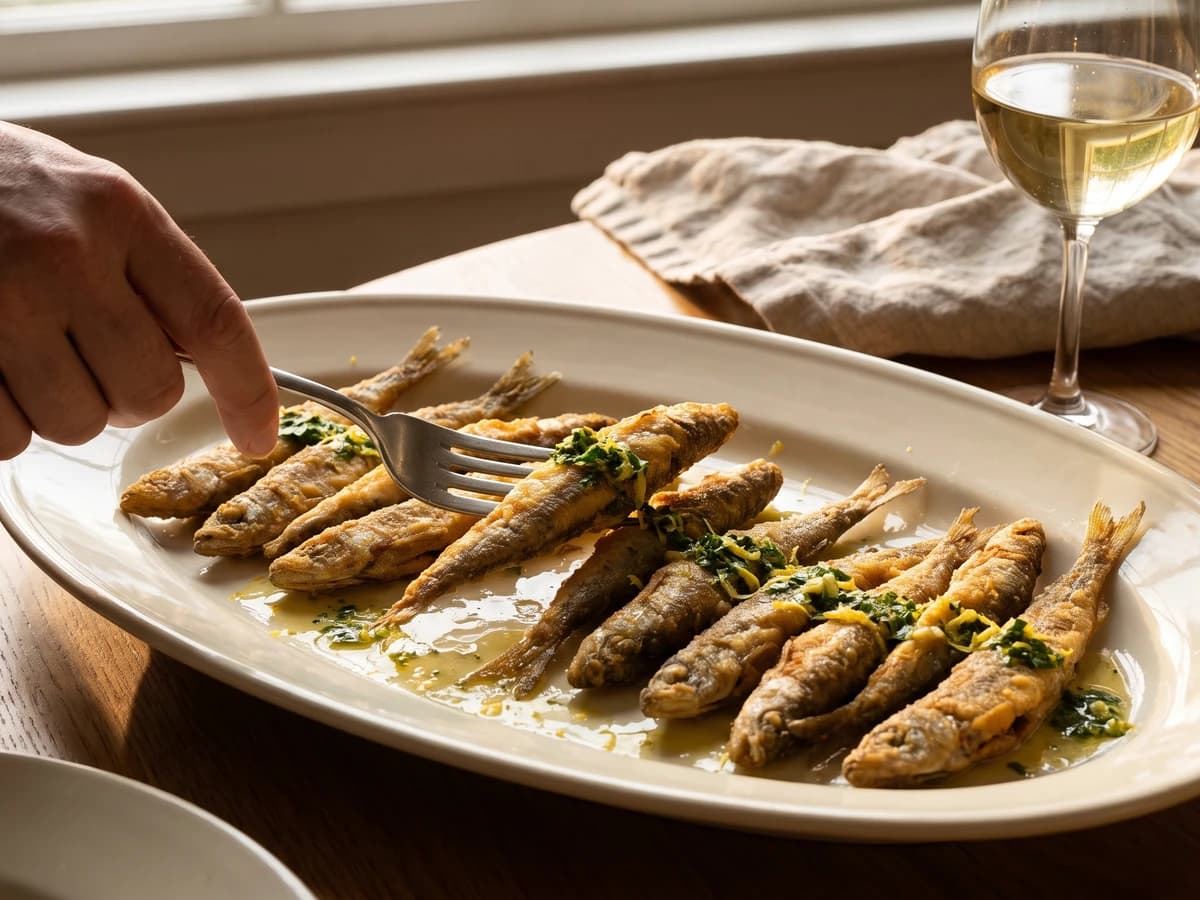
Éperlans à l’Anglaise turns small fish into a lesson in disciplined coating: boned smelts under a close, crisp crumb, pan-fried in clarified butter and finished with bright, half-melted maître d’hôtel butter.

Chef Juliette
Tiny smelts, shallot, mushrooms, white wine, gratin sauce, and fine bread raspings meet a fierce oven, where the fish must turn tender in the same breath the buttered crust bronzes.