
Chef Juliette
John Dory (St. Pierre)
John Dory has the delicacy of sole and the firmness of turbot. A light flouring, a quick butter sauté, and nut-brown beurre noisette show exactly why looks never mattered.
A cooking platform built around craft, culture, and the stories behind what we eat.
Created by Chef Juliette
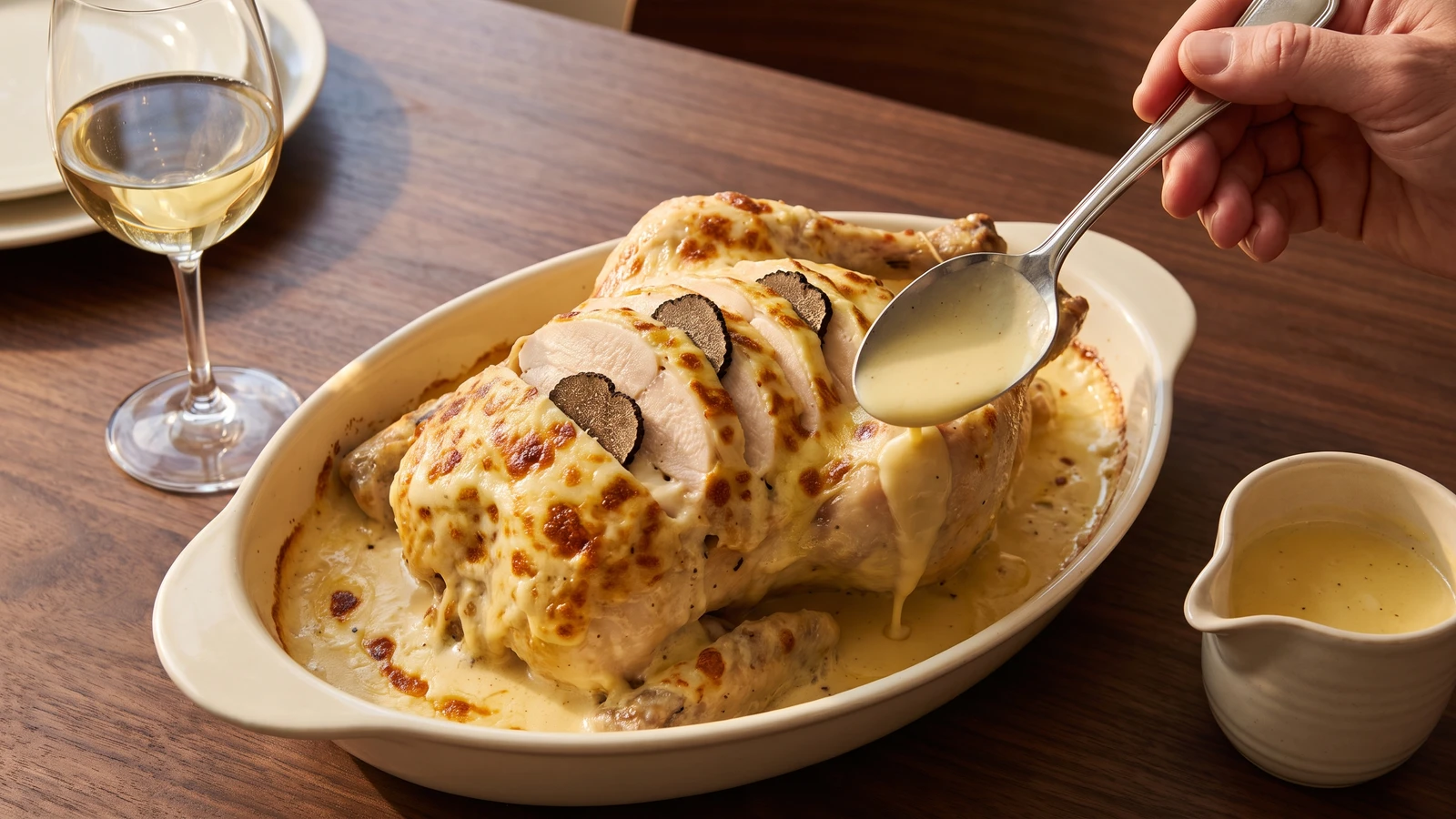
Based on No. 1490, Poularde à la Mancini, from Le Guide Culinaire (1907) by Auguste Escoffier
A whole poached pullet, opened and refilled with macaroni bound in cream and cheese, foie gras, and truffle, then reconstructed and flashed beneath fierce heat until its glaze blisters.
Poularde à la Mancini (poached pullet filled with creamy macaroni, foie gras, and truffle) teaches one uncompromising thing: the glaze is a finish, not a reheating method. The bird, filling, and sauce must all be properly hot before they approach the broiler. Those fierce thirty seconds only bronze the cheese and set the glossy coat.
The original kitchen assumed a saucier on staff, stock never off the fire, several related sauces waiting in their pans, and a salamander blazing above the pass. At home, a good unsalted stock begins the poach, then the enriched poaching liquor becomes one roux-built cream sauce divided and finished to two consistencies: stiff and unctuous for coating, supple as sauce suprême, a cream-finished chicken velouté, for the table. A fully heated broiler replaces the salamander, and one small poularde feeds four. One cook, one stove, one evening.
The book permits a low cushion of bread or rice. Bread steadies the bird without asking you to cook another pot of garnish, so the rice pedestal goes as brigade scaffolding. The intact wings and legs, macaroni cohered with cream and cheese, foie gras, truffle, reconstructed suprêmes, separate sauce, and sudden glaze are the dish itself, and every one stays. Have every component hot before assembly. That is the step that decides the evening.
Poularde à la Mancini belongs to the grand Parisian repertoire of composed poultry dishes named for patrons and courtly families, rather than to a regional farmhouse table. The Mancini name came to France with an Italian family established around the royal court, and the macaroni makes that connection visible within thoroughly French service of poached poultry, foie gras, truffle, and sauce suprême. The precise dedicatee is not securely settled, but the dish corrects a useful misconception: macaroni has long held a place inside the French classical canon.
Quantity
1, 3½ to 4 lb (1.6 to 1.8 kg)
neck and giblets removed
Quantity
10 cups (2.4 L / about 2.4 kg)
Quantity
Up to 2 cups (480 ml / 480 g)
only if needed to cover the bird
Quantity
1
peeled and cut into 3 pieces
Quantity
1
white and pale green parts split and thoroughly washed
Quantity
1
cut into 3 pieces
Quantity
1
peeled and halved
Quantity
1
Quantity
1 tablespoon (15 ml / 18 g), plus more to taste
Quantity
1 teaspoon (5 ml / 2 g)
Quantity
1½ cups (360 ml / 150 g)
Quantity
2 cups (480 ml / about 480 g)
divided
Quantity
1½ cups (360 ml / 150 g)
divided
Quantity
½ cup (120 ml / 85 g; 3 oz)
cut into small dice
Quantity
1 small, 1 oz (28 g)
half cut in fine julienne and half sliced tissue-thin
Quantity
6 tablespoons (90 ml / 85 g)
divided
Quantity
½ cup (120 ml / 60 g)
Quantity
¼ teaspoon (1.25 ml / 0.6 g), plus more to taste
Quantity
1 thick slice, about 2 oz (55 g)
cut into a low oval cushion
| Ingredient | Quantity |
|---|---|
| poularde or small plump roasting chickenneck and giblets removed | 1, 3½ to 4 lb (1.6 to 1.8 kg) |
| unsalted chicken stock | 10 cups (2.4 L / about 2.4 kg) |
| cold wateronly if needed to cover the bird | Up to 2 cups (480 ml / 480 g) |
| large carrotpeeled and cut into 3 pieces | 1 |
| leekwhite and pale green parts split and thoroughly washed | 1 |
| celery stalkcut into 3 pieces | 1 |
| medium yellow onionpeeled and halved | 1 |
| bouquet garni of parsley stems, thyme, and bay leaf | 1 |
| fine salt | 1 tablespoon (15 ml / 18 g), plus more to taste |
| white peppercorns | 1 teaspoon (5 ml / 2 g) |
| dry small macaroni | 1½ cups (360 ml / 150 g) |
| heavy creamdivided | 2 cups (480 ml / about 480 g) |
| finely grated Gruyèredivided | 1½ cups (360 ml / 150 g) |
| chilled cooked foie gras terrine or bloccut into small dice | ½ cup (120 ml / 85 g; 3 oz) |
| black truffle, fresh or whole preservedhalf cut in fine julienne and half sliced tissue-thin | 1 small, 1 oz (28 g) |
| unsalted butterdivided | 6 tablespoons (90 ml / 85 g) |
| all-purpose flour | ½ cup (120 ml / 60 g) |
| ground white pepper | ¼ teaspoon (1.25 ml / 0.6 g), plus more to taste |
| sturdy country breadcut into a low oval cushion | 1 thick slice, about 2 oz (55 g) |
Tuck the wing tips beneath the bird and tie the legs loosely so the poularde keeps its shape. Set it breast-side up in a snug 7 to 8-quart stockpot with the stock, carrot, leek, celery, onion, bouquet garni, salt, and peppercorns. Add only enough water to cover by about 1 inch. Bring the liquid slowly to its first tremble, skimming away any grey foam, then lower the heat and hold it between 175°F and 185°F (79°C and 85°C). Poach gently for 40 to 50 minutes, until the deepest part of the breast holds 160°F (71°C) for at least 15 seconds and the thigh reaches about 170°F (77°C). If the liquid boils hard, lower the heat and add a small ladle of cold water. Ça se rattrape. A hard boil toughens the breast and shakes apart the shape needed later.
Lift the poularde carefully with two broad spoons and let the cavity drain back into the pot. Set the bird on a rack in a shallow roasting pan, spoon ½ cup of poaching liquor underneath, cover loosely with foil, and hold it in a 200°F (95°C) oven for no more than 30 minutes. Strain the poaching liquor, discard the aromatics, and keep 4 cups hot for the sauce. Leave the remainder in the stockpot for cooking the macaroni.
Melt 4 tablespoons of the butter in a medium saucepan over gentle heat. Add the flour and stir for 2 minutes without letting the roux color. Whisk in the 4 cups of hot poaching liquor gradually, making the first additions small so the roux opens smoothly, then simmer for 12 minutes until the sauce coats the back of a spoon. Add 1½ cups of the cream and simmer gently until glossy and full-bodied, about 8 minutes. Season with white pepper and salt only after reducing. If the sauce seizes, take it off the heat and whisk in a little hot liquor at a time; if stubborn lumps remain, pass it through a fine sieve. Divide it between two saucepans. Keep about 1½ cups supple for the sauce suprême, and reduce the remainder until stiff and unctuous enough to cling to the bird without sliding.
Bring the remaining poaching liquor to a boil and cook the macaroni until tender but still holding its shape. Drain it thoroughly, return it to the warm pot, and add the remaining ½ cup cream with 1 cup of the Gruyère. Stir over low heat until the cream reduces and the cheese coheres the macaroni into a spoonable filling with no liquid pooling underneath. Remove the pot from the heat and wait 1 minute, then fold in all 3 oz of diced foie gras and the ½ oz of truffle cut julienne-fashion into fine matchsticks. If the mixture is loose, reduce it before adding the foie gras and truffle; once those are in, hard heat will melt their character away. Cover and keep warm.
Transfer the warm poularde to a cutting board and remove the twine. Make a shallow cut through the skin along the breastbone, peel the skin aside, and use a small sharp knife to lift each suprême whole from the keel and ribs. Cover the suprêmes so they stay warm. With poultry shears, cut through the breast ribs close to the backbone and carefully lift out the breastbone and rib cage through the opening, leaving the back, wings, and legs attached. Feel inside for sharp fragments and remove them. If the skin tears, keep going calmly; the cream coating will cover the repair.
Remove the bird from the low oven and turn the broiler to its highest setting, placing a rack 4 to 5 inches below the element. Set the bread cushion in the center of a broiler-safe oval gratin dish, then settle the hollowed carcass over it so the wings and legs retain the outline of the bird. Pack the hot macaroni filling generously into the breast cavity and mound it slightly. Slice each suprême crosswise on a shallow angle, keeping the slices in order, and reconstruct the breasts over the macaroni with one tissue-thin truffle slice between each piece. If the chicken has cooled, cover the sliced suprêmes with a few spoonfuls of hot poaching liquor for 2 minutes before arranging them. The broiler colors the dish; it cannot warm a cold center.
Bring the stiff coating sauce back to a gentle bubble and spoon it over the reconstructed poularde, covering the breast, wings, and upper legs in an even ivory coat. If the sauce slips off, reduce it for another minute and try again. Sprinkle the remaining ½ cup Gruyère evenly over the sauce. Slide the dish beneath the fully heated broiler and watch without looking away. Glaze for about 30 seconds, just until the cheese freckles bronze and the sauce bubbles at the edges. If one side colors first, rotate the dish and continue in 10-second bursts. This flash of fierce top heat is the dish, not decorative theater.
Warm the reserved sauce suprême over gentle heat until it flows in a broad ribbon. Whisk in the remaining 2 tablespoons cold butter, one piece at a time, and loosen with a spoonful of hot poaching liquor if it has tightened beyond a soft coating consistency. Do not boil it after the butter goes in. Taste once more for salt and white pepper, then pour it into a warmed sauceboat.
Let the glazed poularde stand for 2 minutes, no longer. Carry the whole dish to the table and serve each guest a portion of suprême, macaroni, foie gras, truffle, and one of the limbs, passing the sauce suprême separately. The bread cushion will have caught the poultry juices and cream beneath the bird; divide it among anyone wise enough to ask. À table!
1 serving (about 680g)
Culinary guides, cultural storytelling, and the editorial depth that makes cooking meaningful.
Discover Culinary ExplorerChef Juliette
John Dory has the delicacy of sole and the firmness of turbot. A light flouring, a quick butter sauté, and nut-brown beurre noisette show exactly why looks never mattered.

Chef Juliette
Fresh haddock proves its delicacy in the meunière pan: a fine flour crust, moist pearly flakes, and beurre noisette sharpened with lemon and parsley, ready from one skillet in half an hour.
Chef Juliette
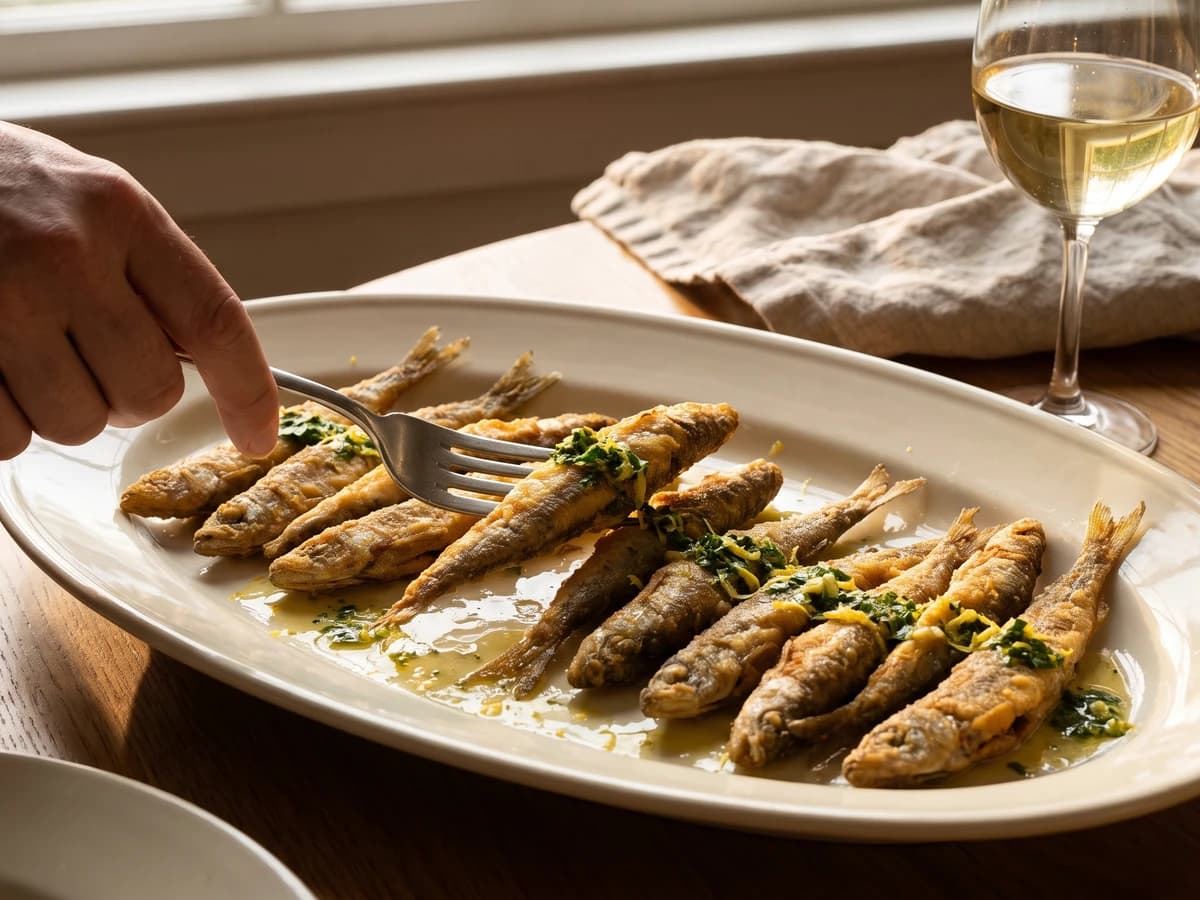
Éperlans à l’Anglaise turns small fish into a lesson in disciplined coating: boned smelts under a close, crisp crumb, pan-fried in clarified butter and finished with bright, half-melted maître d’hôtel butter.

Chef Juliette
Tiny smelts, shallot, mushrooms, white wine, gratin sauce, and fine bread raspings meet a fierce oven, where the fish must turn tender in the same breath the buttered crust bronzes.