
Chef Juliette
John Dory (St. Pierre)
John Dory has the delicacy of sole and the firmness of turbot. A light flouring, a quick butter sauté, and nut-brown beurre noisette show exactly why looks never mattered.
A cooking platform built around craft, culture, and the stories behind what we eat.
Created by Chef Juliette
Based on No. 1470, Poularde en Estouffade, from Le Guide Culinaire (1907) by Auguste Escoffier
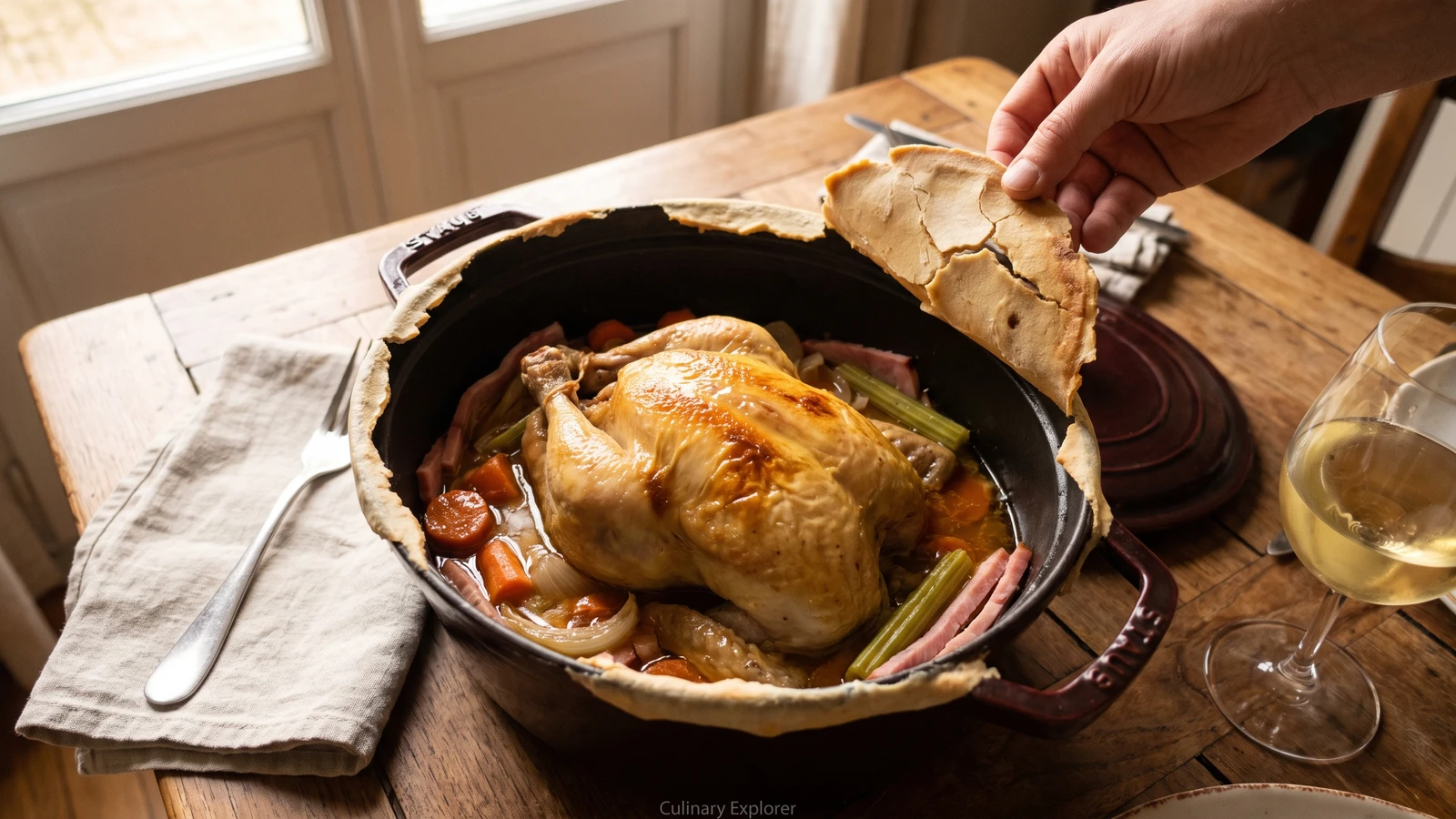
Half poêling bathes the pullet in butter, then a paste-sealed, ham-lined cocotte captures every drop of stock, vegetable perfume, and poultry juice until the bird reaches the table succulent.
Poularde en Estouffade (pullet finished in a paste-sealed cocotte) teaches the discipline of enclosed cooking. Half poêling gives the bird its buttered savor, but the luting seal captures the ham, vegetables, stock, and poultry perfume. The one true thing before you touch a pan is this: the seal is not theater. It is the dish.
The original assumed Poëlings (No. 250) already familiar to the cook, a saucier working beside a stockpot never off the fire, and an oval cocotte sized precisely to the bird. It needed no salamander. At home, use a deep, heavy pan for the first cooking, a snug Dutch oven for the finish, and good strong veal stock. The exact oval vessel and extra pair of hands are brigade scaffolding, so they go. The half poêling, ham lining, reduction, and flour-paste luting stay because they make the Estouffade what it is. One cook, one stove, one evening.
Once the lid is sealed, don't lift it to peek. Patch any crack with damp paste before the cocotte enters the oven, and if the bird is not cooked through when you finally break the crust, ça se rattrape: cover it tightly and return it to the oven for ten minutes. The step that matters most is a complete seal around a genuinely snug lid.
Poularde en estouffade belongs to the French classical dining room and bourgeois table rather than to a single province; estouffade describes tightly enclosed cooking that keeps the meat's aroma captive. The method carries the matignon-wrapped, fat-barded logic of Poëlings (No. 250) into the cocotte, where thin ham and a ring of paste reinforce that enclosure. It is often mistaken for an ordinary braise, but the bird is first half-poêled without its finishing liquid, and only then does a small measure of reduced stock enter for the sealed cooking.
Quantity
1 bird (4 to 4½ lb / 1.8 to 2 kg), brought halfway through cooking using Poëlings (No. 250)
Quantity
8 very thin slices (about 6 oz / 170 g)
Quantity
About 4 cups (960 ml / 454 g total)
equal weights of each vegetable, thinly sliced
Quantity
3 tablespoons (45 ml / 42 g)
Quantity
¾ cup plus 1 tablespoon (190 ml / 190 g)
Quantity
1 cup (240 ml / 125 g)
for the luting paste
Quantity
5 tablespoons (75 ml / 75 g), plus more if needed
for the luting paste
Quantity
1 teaspoon (5 ml / 6 g)
divided
Quantity
½ teaspoon (2.5 ml / 1 g)
| Ingredient | Quantity |
|---|---|
| poularde or plump roasting chicken | 1 bird (4 to 4½ lb / 1.8 to 2 kg), brought halfway through cooking using Poëlings (No. 250) |
| mild unsmoked ham, preferably jambon de Paris | 8 very thin slices (about 6 oz / 170 g) |
| mixed carrots, yellow onions, and celeryequal weights of each vegetable, thinly sliced | About 4 cups (960 ml / 454 g total) |
| unsalted butter | 3 tablespoons (45 ml / 42 g) |
| strong veal stock | ¾ cup plus 1 tablespoon (190 ml / 190 g) |
| all-purpose flourfor the luting paste | 1 cup (240 ml / 125 g) |
| cold waterfor the luting paste | 5 tablespoons (75 ml / 75 g), plus more if needed |
| fine sea saltdivided | 1 teaspoon (5 ml / 6 g) |
| freshly ground black pepper | ½ teaspoon (2.5 ml / 1 g) |
Mix the flour with the cold water until it forms a firm, smooth paste, adding another teaspoon of water only if dry flour remains. Knead it briefly, roll it into a rope long enough to circle the cocotte, then wrap it so it cannot dry. The paste is not pastry and nobody will eat it; its whole duty is to close the seam without cracking.
Prepare the poularde to the halfway point using Poëlings (No. 250), treating that referenced preparation as its own complete component and stopping halfway through its prescribed cooking period. Set the bird aside and preserve the saucepan with all its butter, juices, and fond. As the poularde approaches that halfway point, heat the oven to 400°F (200°C).
Melt the butter in the cocotte over medium heat. Add the sliced carrots, onions, and celery with most of the salt and all the pepper, then cook for 8 to 10 minutes, turning frequently, until glossy and beginning to soften at the edges. They should smell sweet and buttery without taking dark color. Transfer them to a bowl and wipe the cocotte only if a vegetable fragment has caught.
Let the cocotte cool just enough to handle, then overlap the ham slices across its bottom and sides, leaving as few gaps as possible. The lining should form a savory inner jacket around the bird, not a decorative layer perched on top.
Pour the strong veal stock into the saucepan used for the half poêling, without first discarding its aromatic butter. Bring it to a lively simmer and scrape the pan floor until every browned deposit dissolves. Reduce the liquid by half, to about ⅜ cup (95 ml). If it goes too far and turns sticky, ça se rattrape: add enough veal stock to restore the measured volume, bring it back to a simmer, and stop there. Water would thin the foundation you have just built.
Set the half-poêled poularde breast-side up in the ham-lined cocotte and arrange the buttered vegetables closely around it. Pour the reduced stock around the bird rather than over the skin. Fit the lid, lay the paste rope over the entire joint between lid and pot, and press it firmly against both surfaces. Smooth the ends together so no opening remains. If the paste cracks, dampen the crack and press on a small patch. Ça se rattrape, but seal it before the pot reaches the oven.
Bake the sealed cocotte for 45 minutes. Do not open the lid, and don't mistake curiosity for technique. The enclosed butter, ham, vegetables, stock, and poultry juices must circulate together without escaping. The flour ring may harden and color deeply at its thinnest points; that is exactly right.
Rest the cocotte for 10 minutes with the seal intact, then crack away the paste and lift the lid carefully. Check the thickest part of the breast and inner thigh without touching bone; both must reach at least 165°F (74°C), with the thigh ideally nearer 175°F (80°C). If either falls short, replace the lid and cook for another 5 to 10 minutes. Taste the cooking liquor and correct the remaining salt only if needed. Carry the opened cocotte to the table, carve the poularde, and spoon the ham, vegetables, and glossy juices beside each serving. À table!
1 serving (about 425g)
Culinary guides, cultural storytelling, and the editorial depth that makes cooking meaningful.
Discover Culinary ExplorerChef Juliette
John Dory has the delicacy of sole and the firmness of turbot. A light flouring, a quick butter sauté, and nut-brown beurre noisette show exactly why looks never mattered.

Chef Juliette
Fresh haddock proves its delicacy in the meunière pan: a fine flour crust, moist pearly flakes, and beurre noisette sharpened with lemon and parsley, ready from one skillet in half an hour.

Chef Juliette
Éperlans à l’Anglaise turns small fish into a lesson in disciplined coating: boned smelts under a close, crisp crumb, pan-fried in clarified butter and finished with bright, half-melted maître d’hôtel butter.

Chef Juliette
Tiny smelts, shallot, mushrooms, white wine, gratin sauce, and fine bread raspings meet a fierce oven, where the fish must turn tender in the same breath the buttered crust bronzes.