
Chef Juliette
John Dory (St. Pierre)
John Dory has the delicacy of sole and the firmness of turbot. A light flouring, a quick butter sauté, and nut-brown beurre noisette show exactly why looks never mattered.
A cooking platform built around craft, culture, and the stories behind what we eat.

Created by Chef Juliette
Based on No. 1468, Poularde à l’Écossaise, from Le Guide Culinaire (1907) by Auguste Escoffier
Poularde à l’Écossaise proves that poaching need not mean pale flavor: pearl barley and sausage perfume the bird from within, while reduced poaching liquor becomes an ivory Allemande bright with a precise vegetable brunoise.
Poularde à l’Écossaise (Scottish-style stuffed pullet) teaches one quiet rule: a stuffing must carry flavor without surrendering its shape. Here pearl barley and fine sausage meat share the cavity in equal cooked weight, then perfume a gently poached bird while its liquor becomes sauce Écossaise. Drain the barley carelessly and the filling goes to paste; drain it until the grains feel dry and separate, and the whole dish stands upright.
The classical entry assumed a saucier on staff, a stockpot never off the fire, brigade portions, and a salamander waiting elsewhere, though no browning fire belongs near this poularde. At home, a snug stockpot, good unsalted chicken stock, one saucepan, and an instant-read thermometer replace that apparatus. Clear stock takes the place of separately clarified white consommé, while the reduced poaching liquor becomes the Allemande, a velouté enriched with egg yolks and cream.
Clarifying litres of consommé is brigade scaffolding and can go. The equal barley and sausage, the barely trembling poach, the reduction, and the liaison (yolk-and-cream binding) are the dish and must stay. One cook, one stove, one evening. Before you touch the bird, give the cooked barley time to drain and cool completely; that is the step that decides everything.
Within the French classical canon, Poularde à l’Écossaise belongs to the Parisian grand-kitchen repertory, where geographical names often identified a garnish as much as a birthplace. Here Écossaise points to pearl barley, long associated with Scotland by French cooks, while the Allemande and careful poaching are entirely French; the dish traveled readily to the bourgeois dinner table because a whole stuffed bird could be carved generously and its poaching liquor paid for its own sauce. It is not a Scottish household roast translated into French, but a French composition using Scotland as a culinary signal.
Quantity
1 (3¾ to 4 lb / 1.7 to 1.8 kg)
giblets removed
Quantity
10 cups (2.4 L / 2.4 kg)
divided
Quantity
Up to 2 cups (480 ml / 480 g)
only if needed to cover the bird
Quantity
⅓ cup (80 ml / 65 g)
Quantity
⅔ cup loosely packed (160 ml / 180 g)
equal in weight to the drained cooked barley
Quantity
½ medium onion (⅓ cup / 80 ml / 75 g)
finely chopped
Quantity
1 tablespoon (15 ml / 14 g)
Quantity
2½ teaspoons (12 ml / 12 g)
Quantity
¼ cup (60 ml / 35 g)
cut into ⅛-inch (3 mm) brunoise
Quantity
¼ cup (60 ml / 40 g)
cut into ⅛-inch (3 mm) brunoise
Quantity
¼ cup (60 ml / 30 g)
cut into ⅛-inch (3 mm) brunoise
Quantity
¼ cup (60 ml / 30 g)
cut into ⅛-inch (3 mm) brunoise
Quantity
1 tablespoon (15 ml / 14 g)
Quantity
2 tablespoons (30 ml / 28 g)
Quantity
¼ cup (60 ml / 30 g)
Quantity
2
Quantity
½ cup (120 ml / 120 g)
Quantity
1 tablespoon (15 ml / 15 g)
Quantity
5 cups loosely packed (1.2 L / 450 g)
trimmed
Quantity
½ cup (120 ml / 120 g)
Quantity
1 tablespoon (15 ml / 14 g)
Quantity
1 tablespoon (15 ml / 18 g)
divided
Quantity
½ teaspoon (2.5 ml / 1 g)
divided
| Ingredient | Quantity |
|---|---|
| poularde or plump young chickengiblets removed | 1 (3¾ to 4 lb / 1.7 to 1.8 kg) |
| white chicken consommé or clear unsalted chicken stockdivided | 10 cups (2.4 L / 2.4 kg) |
| cold water (optional)only if needed to cover the bird | Up to 2 cups (480 ml / 480 g) |
| pearled barley | ⅓ cup (80 ml / 65 g) |
| fine plain pork sausage meatequal in weight to the drained cooked barley | ⅔ cup loosely packed (160 ml / 180 g) |
| yellow onion for the stuffingfinely chopped | ½ medium onion (⅓ cup / 80 ml / 75 g) |
| unsalted butter for the stuffing | 1 tablespoon (15 ml / 14 g) |
| heavy cream for the stuffing | 2½ teaspoons (12 ml / 12 g) |
| carrotcut into ⅛-inch (3 mm) brunoise | ¼ cup (60 ml / 35 g) |
| yellow onion for the saucecut into ⅛-inch (3 mm) brunoise | ¼ cup (60 ml / 40 g) |
| white leekcut into ⅛-inch (3 mm) brunoise | ¼ cup (60 ml / 30 g) |
| celerycut into ⅛-inch (3 mm) brunoise | ¼ cup (60 ml / 30 g) |
| unsalted butter for the brunoise | 1 tablespoon (15 ml / 14 g) |
| unsalted butter for the Allemande | 2 tablespoons (30 ml / 28 g) |
| all-purpose flour | ¼ cup (60 ml / 30 g) |
| large egg yolks | 2 |
| heavy cream for the Allemande | ½ cup (120 ml / 120 g) |
| fresh lemon juice | 1 tablespoon (15 ml / 15 g) |
| slender green beanstrimmed | 5 cups loosely packed (1.2 L / 450 g) |
| heavy cream for the green beans | ½ cup (120 ml / 120 g) |
| unsalted butter for the green beans | 1 tablespoon (15 ml / 14 g) |
| fine sea saltdivided | 1 tablespoon (15 ml / 18 g) |
| ground white pepperdivided | ½ teaspoon (2.5 ml / 1 g) |
Bring 2 cups (480 ml) of the consommé or stock to a bare simmer. Add the barley and cook gently for 25 to 30 minutes, until the grains are tender but remain distinct. Drain through a fine-mesh sieve for 15 minutes, then spread the barley in a thin layer on a tray until completely cool. Weigh out 180 g of cooked barley so its weight precisely matches the sausage meat. This is the principle that decides the stuffing: if the barley still sheds moisture when pressed, toss it in a broad dry pan over low heat for a minute or two, then cool it again. Wet barley turns the filling to paste.
Melt 1 tablespoon (14 g) butter over low heat and cook the finely chopped onion for 7 to 9 minutes without coloring, until soft and sweet. Cool it completely. Combine the onion, 180 g drained barley, 180 g sausage meat, and 2½ teaspoons (12 ml) cream with ½ teaspoon salt and ¼ teaspoon white pepper. Mix only until evenly united, since hard mixing smears the barley. Fry a teaspoonful in a small pan, taste it, and correct the seasoning while you still can.
Pat the poularde dry inside and out. Season the cavity and skin lightly with salt, then spoon in the stuffing without packing it hard; the filling needs enough room to heat evenly. Close the cavity with kitchen twine or a small skewer and truss the legs against the body. Stuff the bird only when the filling is cold, and put it into the pot at once.
Place the poularde breast-side up in a snug stockpot and add the remaining 8 cups (1.9 L) consommé or stock. Add only enough cold water to cover it by about 1 inch (2.5 cm); if it floats, hold it beneath the liquid with a small heatproof plate. Bring the liquid up slowly, then maintain it between 180 and 190°F (82 and 88°C), with only an occasional bubble, for 1 hour 20 minutes to 1 hour 35 minutes. The center of the stuffing and the thickest part of the thigh must both reach 165°F (74°C). If the liquid begins to boil hard, pull the pot from the burner, add a small splash of cold water, and return it over lower heat. Boiling tightens the meat, but catching it promptly saves the poach.
Lift the poularde carefully, letting the cavity drain back into the pot. Set it on a warm ovenproof platter, tent loosely, and hold it in a 200°F (95°C) oven for no longer than 35 minutes. Strain 4 cups (960 ml) of the poaching liquor into a wide pan and skim away the surface fat. Boil it steadily until reduced to 2¼ cups (540 ml), about 20 to 30 minutes. Reserve ¼ cup (60 ml) for adjusting the sauce and use the remaining 2 cups (480 ml) for the Allemande. Taste before reducing further: if the liquor is already well salted, stop before concentration turns it harsh.
Melt 1 tablespoon (14 g) butter in a small saucepan. Add the carrot, onion, leek, celery, and a pinch of salt. Cover and cook over gentle heat for 8 to 10 minutes, stirring occasionally, until tender but still sharply cut and without browning. The brunoise should remain visible in the finished sauce, not collapse into it. Set the vegetables aside.
Melt 2 tablespoons (28 g) butter in a heavy saucepan, stir in the flour, and cook this white roux for 2 minutes without allowing it to color. Whisk in the 2 cups (480 ml) reduced poaching liquor gradually, taking care to scrape the corners of the pan. Simmer gently for 12 to 15 minutes, whisking often, until the sauce is smooth and coats the back of a spoon. If lumps appear, pass the sauce through a fine sieve and return it to the pan. If it remains thin, reduce it now, before the yolks arrive.
Whisk the egg yolks with 7 tablespoons (105 ml) of the cream, reserving the final tablespoon cold. Gradually whisk in ½ cup (120 ml) hot Allemande to temper the liaison, then remove the saucepan from the heat and whisk the tempered mixture back into it. Return to very low heat and stir constantly until the sauce thickens slightly, never allowing it to boil. If the first grains appear, remove it immediately, whisk in the reserved cold cream, and set the pan in cold water while whisking; pass it through a fine sieve if needed. Ça se rattrape. Stir in the lemon juice, correct the salt and white pepper, then fold in the brunoise. If the sauce is too tight, loosen it with the reserved poaching liquor.
Cook the French beans in generously salted boiling water for 4 to 6 minutes, until tender with a clean bite. Drain them thoroughly. In the dry pan, simmer the ½ cup (120 ml) cream until it lightly coats a spoon, then whisk in 1 tablespoon (14 g) butter. Add the beans, turn them through the cream, and correct the seasoning. Transfer them to a warm serving bowl and keep them separate, exactly as the dish requires.
Remove the twine and settle the whole poularde on its warm oval platter. Pour enough sauce Écossaise over the bird to coat it generously, allowing the ivory sauce and colored brunoise to pool around the base. Serve the remaining sauce in a warm boat and the French beans with cream in their separate bowl. The skin is softly pale by design; the sheen and flavor belong to the sauce. Carve at the table so every serving receives stuffing, meat, and sauce. À table!
1 serving (about 640g)
Culinary guides, cultural storytelling, and the editorial depth that makes cooking meaningful.
Discover Culinary ExplorerChef Juliette
John Dory has the delicacy of sole and the firmness of turbot. A light flouring, a quick butter sauté, and nut-brown beurre noisette show exactly why looks never mattered.

Chef Juliette
Fresh haddock proves its delicacy in the meunière pan: a fine flour crust, moist pearly flakes, and beurre noisette sharpened with lemon and parsley, ready from one skillet in half an hour.
Chef Juliette
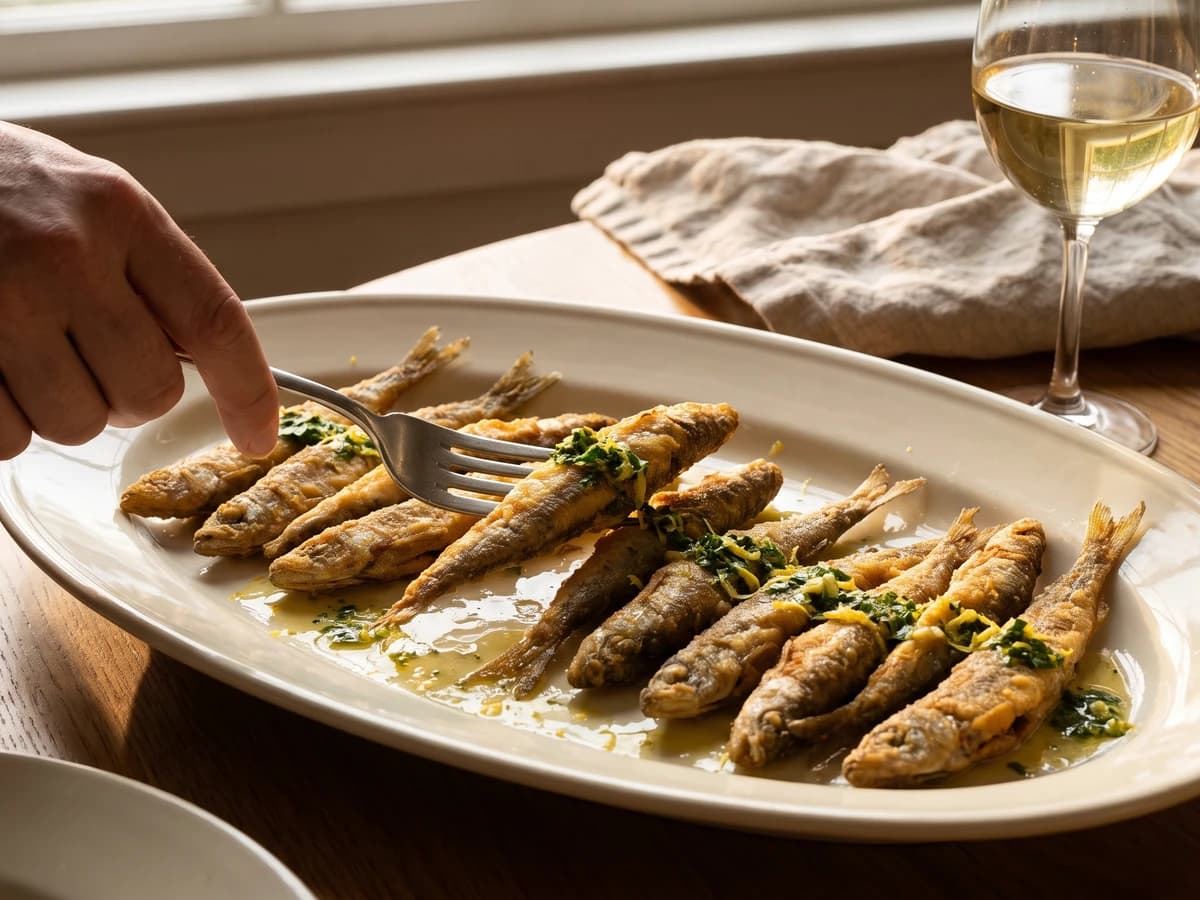
Éperlans à l’Anglaise turns small fish into a lesson in disciplined coating: boned smelts under a close, crisp crumb, pan-fried in clarified butter and finished with bright, half-melted maître d’hôtel butter.

Chef Juliette
Tiny smelts, shallot, mushrooms, white wine, gratin sauce, and fine bread raspings meet a fierce oven, where the fish must turn tender in the same breath the buttered crust bronzes.