
Chef Juliette
John Dory (St. Pierre)
John Dory has the delicacy of sole and the firmness of turbot. A light flouring, a quick butter sauté, and nut-brown beurre noisette show exactly why looks never mattered.
A cooking platform built around craft, culture, and the stories behind what we eat.
Created by Chef Juliette
Based on No. 1461, Poularde à la Chivry, from Le Guide Culinaire (1907) by Auguste Escoffier
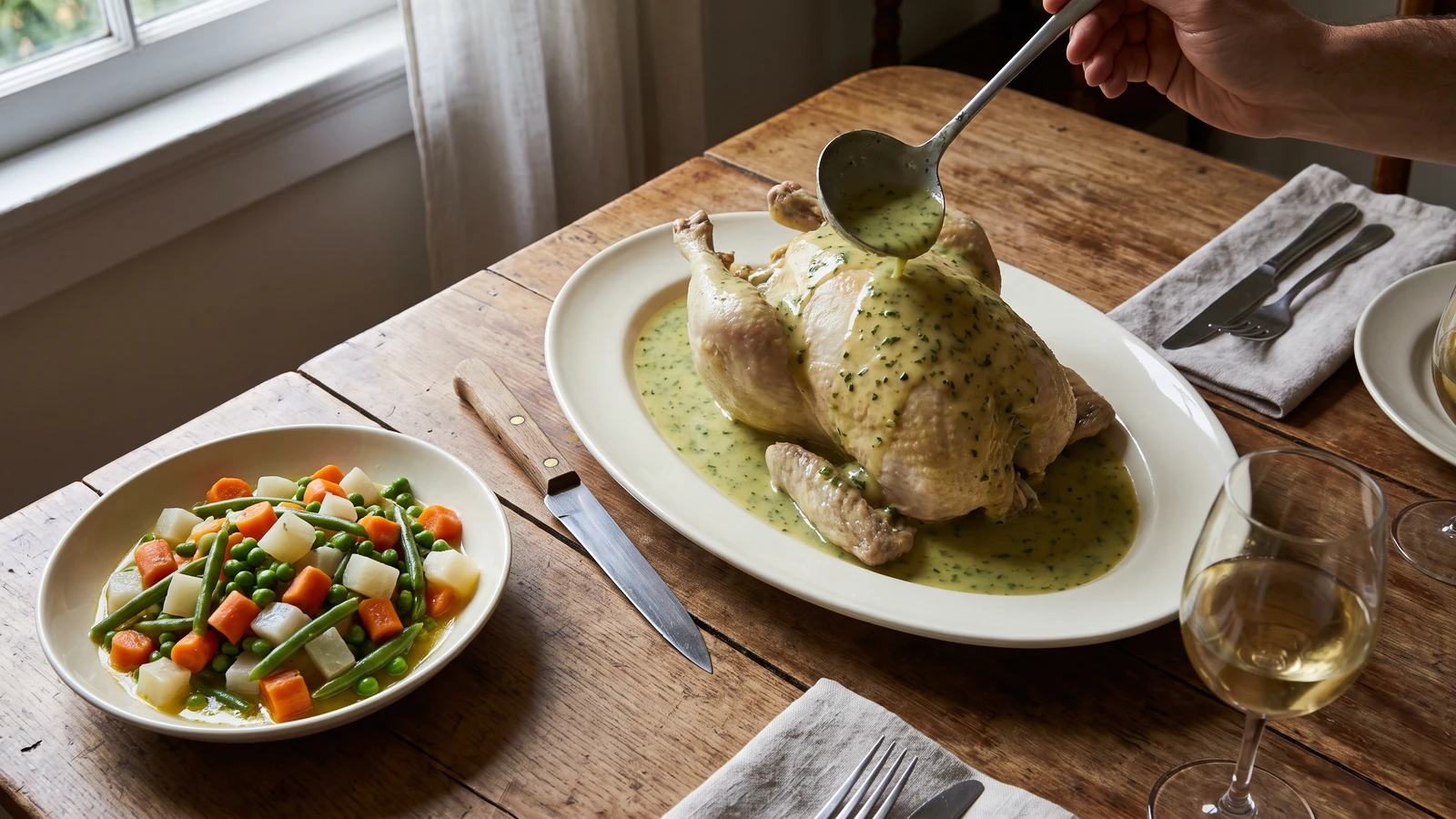
Poached poularde under a glossy herb-green Chivry sauce, with a separate butter-bound macédoine: a composed lesson in gentle heat, clean stock, and knowing when the sauce must leave the fire.
Poularde à la Chivry (poached young hen with herb-green velouté) teaches the discipline of gentle heat. The chicken must poach at a tremble, but the one true thing to know before touching a pan is this: once the green butter is in the finished sauce, that sauce must never boil. A boil steals its fresh color and presses the herbs flat.
The book assumed a saucier on staff, poultry stock never off the fire, Chivry Sauce (No. 78) ready to hand, and another cook tending a Macédoine (a small-cut mixture of young vegetables). Your equivalent is one plump bird for four, the finished sauce prepared from its own entry, and one vegetable pot into which the vegetables go in stages. Linen straining and a dedicated sauce station are brigade scaffolding and remain inside the separate sauce recipe. Gentle poaching, coating the bird, and serving the macédoine apart are the dish, so all three stay. One cook, one stove, one evening.
When it is right, the flesh is tender and juicy beneath a pale herb-green sauce that gleams rather than runs, while the vegetables remain bright and distinct under their film of butter. I use the book's butter option to bind the macédoine because the velouté already supplies ample richness. Reserve a little poaching liquid before the final warming. The step that matters most is the last one: low flame, patient spoon, no bubble.
Poularde à la Chivry belongs to the Parisian grand-kitchen table, where a gently poached bird was paired with a named derivative of velouté and a separate vegetable garnish rather than buried in one pot. In the canon, Chivry identifies an herb-infused poultry velouté enriched with green butter, and its insistence on young pimpernel is practical because mature leaves become bitter. The macédoine served apart is structural, preserving each vegetable's color and bite while the tender bird receives the sauce.
Quantity
1, about 4 lb (1.8 kg)
giblets removed
Quantity
4 cups (960 ml / about 960 g)
Quantity
4 to 6 cups (960 ml to 1.4 L / 960 g to 1.4 kg)
enough to cover the bird
Quantity
1 medium (about 8 oz / 225 g)
peeled and quartered
Quantity
2 medium (about 6 oz / 170 g)
cut into large pieces
Quantity
1 (about 5 oz / 140 g)
white and pale green parts washed and cut into large pieces
Quantity
1 stalk (about 2 oz / 55 g)
cut into large pieces
Quantity
1
Quantity
1 teaspoon (5 ml / 3 g)
Quantity
1 tablespoon (15 ml / 18 g)
divided
Quantity
2 cups (480 ml / about 480 g) Chivry Sauce (No. 78)
Quantity
4 (about 6 oz / 170 g)
peeled and cut into 1/4-inch dice
Quantity
1 small (about 6 oz / 170 g)
peeled and cut into 1/4-inch dice
Quantity
1 cup (240 ml / 120 g)
trimmed and cut into 1/4-inch pieces
Quantity
1 cup (240 ml / 145 g)
Quantity
3 tablespoons (45 ml / 42 g)
Quantity
1/2 teaspoon (2.5 ml / 1 g)
divided
| Ingredient | Quantity |
|---|---|
| poularde or plump whole chickengiblets removed | 1, about 4 lb (1.8 kg) |
| light, low-sodium chicken stock | 4 cups (960 ml / about 960 g) |
| waterenough to cover the bird | 4 to 6 cups (960 ml to 1.4 L / 960 g to 1.4 kg) |
| yellow onionpeeled and quartered | 1 medium (about 8 oz / 225 g) |
| carrots for poachingcut into large pieces | 2 medium (about 6 oz / 170 g) |
| leekwhite and pale green parts washed and cut into large pieces | 1 (about 5 oz / 140 g) |
| celerycut into large pieces | 1 stalk (about 2 oz / 55 g) |
| bouquet garni of parsley stems, thyme, and bay leaf | 1 |
| black peppercorns | 1 teaspoon (5 ml / 3 g) |
| fine sea saltdivided | 1 tablespoon (15 ml / 18 g) |
| Chivry Sauce | 2 cups (480 ml / about 480 g) Chivry Sauce (No. 78) |
| slender young carrotspeeled and cut into 1/4-inch dice | 4 (about 6 oz / 170 g) |
| young turnippeeled and cut into 1/4-inch dice | 1 small (about 6 oz / 170 g) |
| green beanstrimmed and cut into 1/4-inch pieces | 1 cup (240 ml / 120 g) |
| fresh or frozen peas | 1 cup (240 ml / 145 g) |
| unsalted butter | 3 tablespoons (45 ml / 42 g) |
| ground white pepperdivided | 1/2 teaspoon (2.5 ml / 1 g) |
Set the stock, 4 cups of the water, onion, poaching carrots, leek, celery, bouquet garni, peppercorns, and 2 teaspoons of the salt in a tall 6 to 8-quart pot. Bring them slowly to a bare simmer and cook for 15 minutes, just long enough for the vegetables and herbs to perfume the liquid. Meanwhile, tuck the chicken's wing tips beneath its back and tie the legs together. Trussing keeps the bird compact so the breast and legs cook at nearly the same pace.
Lower the poularde into the liquor, breast side up, and add enough hot water to cover it by about 1 inch. Press a cartouche, a round of parchment laid directly on the liquid, over the bird and cover the pot with the lid slightly ajar. Bring the liquid back only to a tremble, about 180 to 190°F (82 to 88°C), then poach for 50 to 60 minutes. The chicken is ready when the thickest part of the breast reaches at least 165°F (74°C) and the inner thigh reaches about 170°F (77°C), without the thermometer touching bone. If the liquid breaks into a boil, uncover the pot and pull it off the burner for two minutes, then resume over lower heat. The outer flesh may firm slightly, but the bird is not lost.
While the chicken poaches, check the diced carrots, turnip, and beans against one another. The pieces should be close to the same 1/4-inch size, not for decoration but so they become tender together. Bring a medium pot of water to a strong simmer and season it with the remaining teaspoon of salt.
Add the diced carrots and turnip to the salted water. After 2 minutes, add the beans; after another 2 minutes, add the peas and cook for 1 minute more. Taste a piece of carrot and turnip before draining. They should be tender under the teeth but still hold their shape. Drain thoroughly and spread the vegetables on a tray so trapped water can escape. If they sit in a wet heap, the butter will slide off instead of binding them.
Lift the cooked poularde with two sturdy spoons, tipping it over the pot so the cavity drains completely. Set it breast side up on a rack over a tray, cover loosely, and rest for 15 minutes. Strain and reserve at least 1 cup (240 ml / about 240 g) of the poaching liquid. That liquid is both your seasoning check and your sauce rescue, so don't send it down the sink.
Set the drained macédoine in a wide sauté pan over low heat for 30 seconds, tossing until no water gathers beneath it. Add the butter and half the white pepper, then turn the vegetables gently until every piece shines and the butter forms a light, cohesive glaze. Taste and adjust the salt. If liquid appears in the pan, lift out the vegetables, reduce the liquid until only a spoonful remains, and return them with a small piece of the measured butter.
Set the finished Chivry Sauce (No. 78) in a clean saucepan over the lowest heat and stir until it is fluid, glossy, and warm enough to serve. Never let a bubble break the surface. The green herb butter is already part of this finished component; boiling now turns its color dull olive and can drive the butter out of the velouté. If the sauce is too tight, whisk in hot reserved poaching liquid 1 tablespoon (15 ml / 15 g) at a time. If it looks oily, take it off the heat and whisk in 1 teaspoon of cold poaching liquid until it comes together again. Ça se rattrape.
Warm an oval platter and a separate serving bowl. Remove the trussing string, blot any moisture from the poularde, and settle it on the platter. Spoon over enough Chivry Sauce (No. 78) to coat the breast and legs generously, letting a little pool around the bird, then pour the remainder into a warm sauceboat. Transfer the butter-bound macédoine to its own bowl, as the book directs, rather than crowding it beneath the sauce. Finish with the remaining white pepper only if the vegetables need it. Carry both dishes to the table at once. À table!
1 serving (about 480g)
Culinary guides, cultural storytelling, and the editorial depth that makes cooking meaningful.
Discover Culinary ExplorerChef Juliette
John Dory has the delicacy of sole and the firmness of turbot. A light flouring, a quick butter sauté, and nut-brown beurre noisette show exactly why looks never mattered.

Chef Juliette
Fresh haddock proves its delicacy in the meunière pan: a fine flour crust, moist pearly flakes, and beurre noisette sharpened with lemon and parsley, ready from one skillet in half an hour.
Chef Juliette
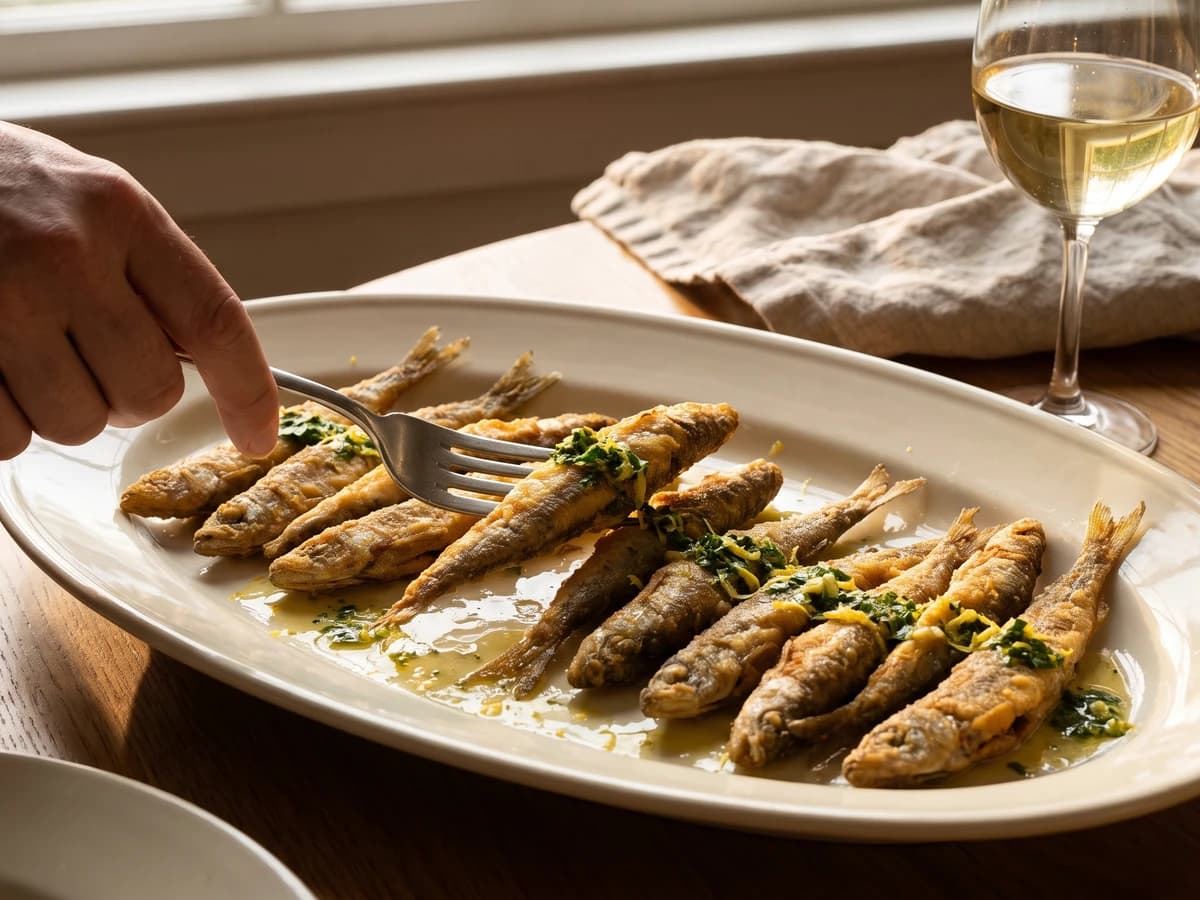
Éperlans à l’Anglaise turns small fish into a lesson in disciplined coating: boned smelts under a close, crisp crumb, pan-fried in clarified butter and finished with bright, half-melted maître d’hôtel butter.

Chef Juliette
Tiny smelts, shallot, mushrooms, white wine, gratin sauce, and fine bread raspings meet a fierce oven, where the fish must turn tender in the same breath the buttered crust bronzes.