
Chef Juliette
John Dory (St. Pierre)
John Dory has the delicacy of sole and the firmness of turbot. A light flouring, a quick butter sauté, and nut-brown beurre noisette show exactly why looks never mattered.
A cooking platform built around craft, culture, and the stories behind what we eat.
Created by Chef Juliette
Based on No. 1456, Poularde Chanoinesse, from Le Guide Culinaire (1907) by Auguste Escoffier
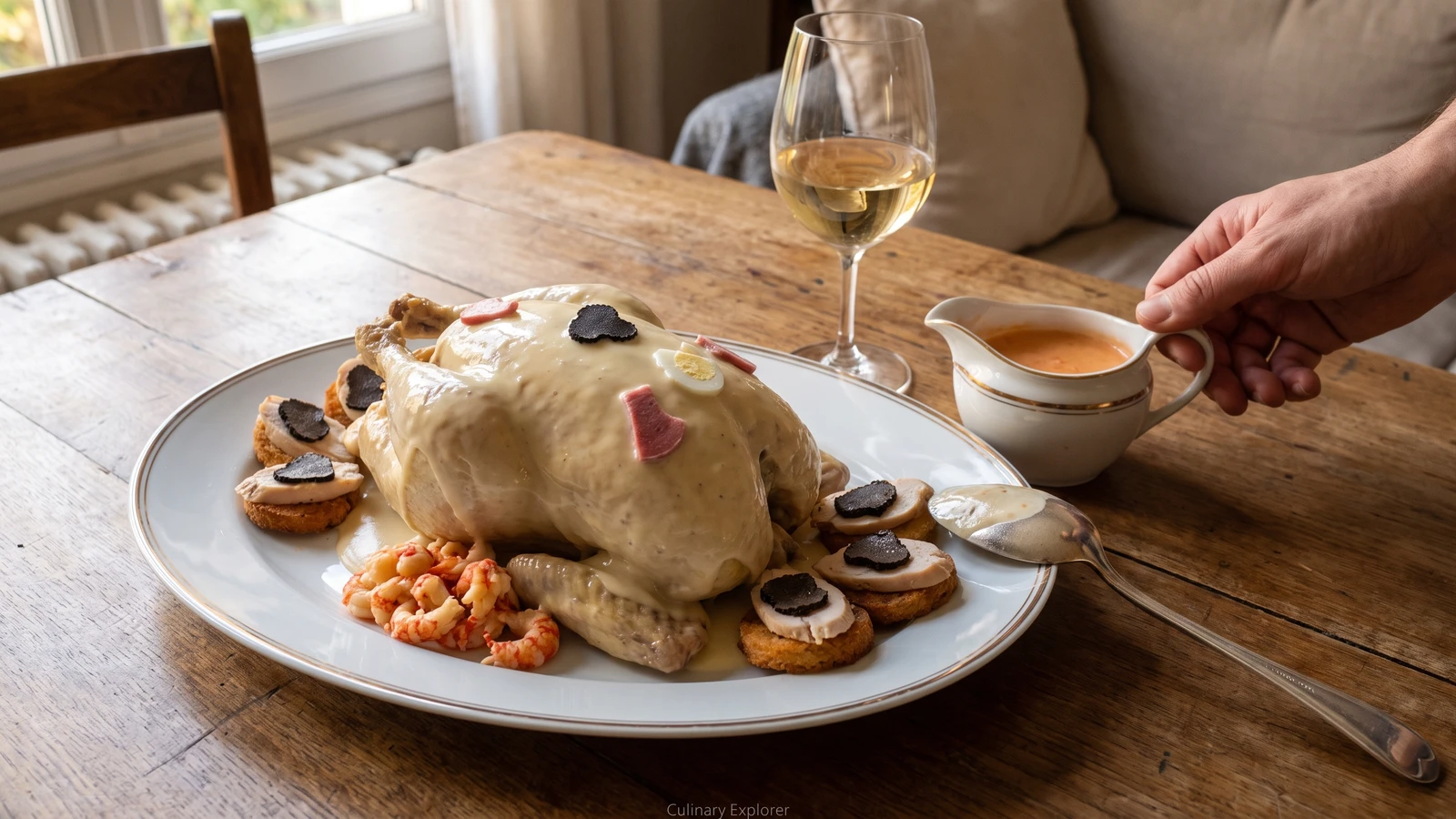
An ivory-coated Poularde Soufflée ringed with crayfish tails and butter-fried croûtons, each carrying suprême and truffle, with coral-tinted Mornay served separately for a grand dish made calmly at home.
Poularde Chanoinesse (a soufflé-filled pullet with crayfish and truffled chicken-breast croûtons) teaches that composure, not complication, holds a ceremonial dish together. Its one true thing is cold: the mousseline forcemeat inside the Poularde Soufflée (No. 1518) must be cold when it enters the bird, or the filling loosens before its proteins can set and the reconstructed poularde will slump. That condition is the dish, not an ornament.
The classical service assumed Poularde Soufflée arriving from one station, stock never off the fire for its coating, a saucier holding Mornay, crayfish butter ready in the cold pantry, and several hands building the border. At home, the linked preparation remains whole, a roasting tin becomes its bain-marie, or hot-water bath, one saucepan makes the sauce, and an ordinary skillet fries the croûtons. A salamander adds nothing because this dish is poached and sauced, not gratinéed. The separate stations are scaffolding and may disappear; the cold forcemeat, reconstructed bird, alternating crayfish and croûtons, and crayfish-butter Mornay must stay.
When it reaches the table, the coating should gleam ivory around the rounded poularde, the crayfish should glow coral against butter-gold bread, and every croûton should carry its thin suprême and black cap of truffle. Prepare the whole border before the poularde is ready, but chill that forcemeat completely before it enters the bird. Everything else can wait; that cannot.
Poularde Chanoinesse belongs to the Parisian grand-kitchen repertory of named poulardes, where a recognized base preparation acquired a distinct identity through its garnish and accompanying sauce. Chanoinesse is the feminine word for a canoness, reflecting the canon's habit of giving formal dishes clerical or honorific names rather than proving any origin in a convent or one French region. Linked formulas carried such dishes from professional brigades to ambitious bourgeois tables, with Poularde Soufflée supplying the architecture and crayfish, truffle, croûtons, and Mornay defining this particular service.
Quantity
1, scaled to 4 servings (No. 1518)
with 8 thin collops of suprême reserved
Quantity
16
tails removed intact and shells reserved
Quantity
6 tablespoons (90 ml / 85 g)
Quantity
¼ cup (60 ml / 60 g)
divided
Quantity
4 slices
cut into 8 small oval croûtons
Quantity
3 tablespoons (45 ml / 42 g)
Quantity
1 small
cut into 8 thin slices
Quantity
2 tablespoons (30 ml / 28 g)
Quantity
2 tablespoons (30 ml / 16 g)
Quantity
1¼ cups (300 ml / 305 g)
with 2 tablespoons reserved cold
Quantity
⅓ cup (80 ml / 35 g)
finely grated
Quantity
2 tablespoons (30 ml / 12 g)
finely grated
Quantity
¼ teaspoon (1.25 ml / 1.5 g), plus more if needed
Quantity
⅛ teaspoon (0.6 ml / 0.25 g)
Quantity
1 small pinch
| Ingredient | Quantity |
|---|---|
| prepared Poularde Souffléewith 8 thin collops of suprême reserved | 1, scaled to 4 servings (No. 1518) |
| medium whole cooked crayfishtails removed intact and shells reserved | 16 |
| unsalted butter for the crayfish butter | 6 tablespoons (90 ml / 85 g) |
| waterdivided | ¼ cup (60 ml / 60 g) |
| firm white sandwich breadcut into 8 small oval croûtons | 4 slices |
| clarified butter for frying | 3 tablespoons (45 ml / 42 g) |
| black truffle, fresh or preservedcut into 8 thin slices | 1 small |
| unsalted butter for the roux | 2 tablespoons (30 ml / 28 g) |
| all-purpose flour | 2 tablespoons (30 ml / 16 g) |
| whole milkwith 2 tablespoons reserved cold | 1¼ cups (300 ml / 305 g) |
| Gruyèrefinely grated | ⅓ cup (80 ml / 35 g) |
| Parmesanfinely grated | 2 tablespoons (30 ml / 12 g) |
| fine salt | ¼ teaspoon (1.25 ml / 1.5 g), plus more if needed |
| ground white pepper | ⅛ teaspoon (0.6 ml / 0.25 g) |
| freshly grated nutmeg | 1 small pinch |
Have the Poularde Soufflée (No. 1518) finished as its own entry directs, scaled for four and timed to be ready about fifteen minutes before service. When preparing that linked component, reserve eight thin collops of suprême, the breast fillet, before reconstructing the bird. Its mousseline forcemeat must remain refrigerator-cold; if it has softened or become glossy, spread it in a shallow chilled bowl and refrigerate it until firm before stuffing. Ça se rattrape. Keep the finished poularde warm while you complete the garnish, but do not leave it waiting longer than twenty minutes.
Set the sixteen intact tails aside in the cold. Break the reserved shells into coarse pieces, then melt the six tablespoons of butter in a small saucepan over medium-low heat. Add the shells and cook for eight minutes, pressing them firmly with a wooden spoon, until the butter turns coral and smells distinctly of crayfish without browning. Add three tablespoons of the measured water and simmer gently for five minutes. Strain through a fine sieve into a narrow bowl, pressing hard, then set the bowl over ice until the beurre d'écrevisse, or crayfish butter, separates and begins to firm. Spoon off two generous tablespoons for the Mornay.
Cut the bread into eight oval croûtons, small bread pieces fried in butter, each about five centimetres long. Heat the clarified butter in a wide skillet over medium heat and fry the croûtons on both sides until evenly butter-gold, crisp at the edges, and still substantial enough to carry the chicken. Drain them briefly on a clean towel and keep them uncovered so they remain crisp.
Melt the two tablespoons of butter in a small saucepan, add the flour, and stir for two minutes without allowing it to colour. This roux blanc, a pale butter-and-flour base, must cook long enough to lose its raw taste. Whisk in all but the reserved cold milk in three additions, smoothing each one before adding the next, then simmer gently for five minutes until the sauce nappes the spoon, coating it in a clean ivory layer. Remove the pan from the heat, whisk in the Gruyère and Parmesan, then add two tablespoons of crayfish butter a little at a time. Season with salt, white pepper, and nutmeg. Never boil the sauce after the cheese and crayfish butter enter. If it turns oily at the rim, set the pan in cool water and whisk in the reserved cold milk one spoonful at a time until the emulsion closes again.
Put the remaining tablespoon of measured water in a clean skillet and add the crayfish tails and reserved suprême collops. Cover and warm over the lowest heat for thirty to forty-five seconds, just until they lose their chill. Drain immediately. They are already cooked, and simmering would turn the crayfish firm and the delicate chicken dry.
Transfer the warm Poularde Soufflée (No. 1518) to the centre of a heated oval platter, keeping its truffle-scented coating and decoration intact. Arrange eight small heaps of two crayfish tails around it, alternating each heap with a fried croûton. Place one warm collop of suprême on every croûton, then finish each collop with one thin slice of black truffle. Work neatly but promptly; this is generous food, not plating theater.
Pour the warm crayfish-butter Mornay into a heated sauceboat and serve it separately, exactly as the dish requires. Do not blanket the border before it reaches the table, because the croûtons must remain crisp and each guest should spoon the sauce over their own portion. Bring the poularde in whole, carve through the soft filling with a broad spoon, and give everyone crayfish, croûton, suprême, and truffle. À table!
1 serving (about 365g)
Culinary guides, cultural storytelling, and the editorial depth that makes cooking meaningful.
Discover Culinary ExplorerChef Juliette
John Dory has the delicacy of sole and the firmness of turbot. A light flouring, a quick butter sauté, and nut-brown beurre noisette show exactly why looks never mattered.

Chef Juliette
Fresh haddock proves its delicacy in the meunière pan: a fine flour crust, moist pearly flakes, and beurre noisette sharpened with lemon and parsley, ready from one skillet in half an hour.

Chef Juliette
Éperlans à l’Anglaise turns small fish into a lesson in disciplined coating: boned smelts under a close, crisp crumb, pan-fried in clarified butter and finished with bright, half-melted maître d’hôtel butter.

Chef Juliette
Tiny smelts, shallot, mushrooms, white wine, gratin sauce, and fine bread raspings meet a fierce oven, where the fish must turn tender in the same breath the buttered crust bronzes.