
Chef Juliette
John Dory (St. Pierre)
John Dory has the delicacy of sole and the firmness of turbot. A light flouring, a quick butter sauté, and nut-brown beurre noisette show exactly why looks never mattered.
A cooking platform built around craft, culture, and the stories behind what we eat.

Created by Chef Juliette
Based on No. 1451, Poularde à la Beaufort, from Le Guide Culinaire (1907) by Auguste Escoffier
Foie gras and sausage inside, truffle through the flesh, and barely enough braising liquor below: Poularde à la Beaufort is the celebration bird that teaches restraint.
Poularde à la Beaufort (foie gras and truffle-stuffed hen) teaches braiser à court mouillement (braising with a short moistening), the discipline of cooking a bird with very little liquid. The one true thing to know before touching the pan is this: the stock must rise no higher than the lower third of the poularde. More liquid gives you poultry broth; short liquor gathers the bird's savour and returns it as sauce.
The original formula assumed a saucier on staff to clear the liquor, a stock never off the fire, and an entremettier to tend lambs' tongues, artichokes, and purée Soubise (silky onion-and-rice purée). Its low cushion was service scaffolding for height, so it goes; the alternating garnish and its Soubise rosettes are part of the dish, so they stay. A salamander has no task here, and your broiler remains cold. One compact cocotte, prepared unsalted stock, a fine sieve, and a pastry bag give one cook the honest equivalents. One cook, one stove, one evening.
The finished poularde comes out burnished and abundant, with foie gras and sausage at its heart, truffle scenting each slice, ivory Soubise rising from the artichoke bottoms, and a clear liquor glossy with the bird's own gelatin. Measure the moistening by the bird, not by habit: no higher than one-third of its depth. That restraint decides the dish.
Poularde à la Beaufort belongs to the Parisian grand-kitchen repertoire, where named garnishes classified dishes by their stuffing, sauce, and elaborate entourage rather than by a single village pantry. The title can mislead a modern cook toward Savoie or Beaufort cheese, but the formula contains neither cheese nor mountain flavours; its identity lies in foie gras, truffle, lambs' tongues, artichoke bottoms, and Soubise. As the dish moved to the celebration table, the decorative cushion could disappear, but short moistening remained essential: the bird seasons the liquor, not the reverse.
Quantity
1 bird, 4 to 4½ pounds (1.8 to 2 kg)
neck, gizzard, and heart reserved if included
Quantity
5 ounces (140 g)
kept in one compact piece
Quantity
2 tablespoons (30 ml / 30 g)
Quantity
7 ounces (200 g)
well chilled
Quantity
1 small truffle, about ¾ ounce (20 g)
cut into 12 slender batons
Quantity
1 tablespoon (15 ml / 18 g)
divided
Quantity
¾ teaspoon (3.75 ml / 1.5 g)
divided
Quantity
6 tablespoons (90 ml / 85 g)
divided
Quantity
4 cups (960 ml / 960 g)
divided
Quantity
4 tongues, about 1 to 1¼ pounds (450 to 560 g) total
Quantity
2 cups (480 ml / 480 g), or enough to barely cover the tongues
Quantity
1
1 bay leaf, 2 thyme sprigs, and 4 parsley stems
Quantity
2 medium onions, about 14 ounces (400 g)
thinly sliced
Quantity
3 tablespoons (45 ml / 35 g)
rinsed
Quantity
⅓ cup (80 ml / 80 g)
Quantity
4 whole bottoms, about 9 ounces (250 g) drained weight
drained if canned or jarred, thawed if frozen
| Ingredient | Quantity |
|---|---|
| poularde or plump roasting chickenneck, gizzard, and heart reserved if included | 1 bird, 4 to 4½ pounds (1.8 to 2 kg) |
| fresh raw duck foie graskept in one compact piece | 5 ounces (140 g) |
| Madeira | 2 tablespoons (30 ml / 30 g) |
| fine unsmoked pork sausage meatwell chilled | 7 ounces (200 g) |
| black trufflecut into 12 slender batons | 1 small truffle, about ¾ ounce (20 g) |
| fine sea saltdivided | 1 tablespoon (15 ml / 18 g) |
| finely ground white pepperdivided | ¾ teaspoon (3.75 ml / 1.5 g) |
| unsalted butterdivided | 6 tablespoons (90 ml / 85 g) |
| unsalted chicken stockdivided | 4 cups (960 ml / 960 g) |
| lambs' tongues | 4 tongues, about 1 to 1¼ pounds (450 to 560 g) total |
| cold water | 2 cups (480 ml / 480 g), or enough to barely cover the tongues |
| bouquet garni1 bay leaf, 2 thyme sprigs, and 4 parsley stems | 1 |
| yellow onionsthinly sliced | 2 medium onions, about 14 ounces (400 g) |
| long-grain white ricerinsed | 3 tablespoons (45 ml / 35 g) |
| heavy cream | ⅓ cup (80 ml / 80 g) |
| plain artichoke bottomsdrained if canned or jarred, thawed if frozen | 4 whole bottoms, about 9 ounces (250 g) drained weight |
Heat the oven to 325°F (160°C). Season the foie gras with ¼ teaspoon of the salt and a pinch of white pepper, place it in a snug ovenproof dish, and spoon over the Madeira. Cover loosely and bake for exactly 20 minutes, just until the outside firms while the centre remains yielding. This is raidir, to stiffen gently, not to roast until the foie surrenders all its fat. Drain it, cool for 20 minutes, then chill until firm enough to handle. If it breaks into soft pieces or renders heavily, do not discard it. Ça se rattrape: press the drained pieces together in a small dish and chill them into one firm block.
While the foie gras cooks and cools, rinse the lambs' tongues and place them in a saucepan with 2 cups of the chicken stock, the cold water, the bouquet garni, and ½ teaspoon salt. The liquid should barely cover them. Bring it to a gentle tremble, cover, and cook for 1½ to 2 hours, until a knife enters the thick end without resistance. Lift out one tongue at a time and peel away the coarse skin while it is still warm, then trim the root neatly. If the skin clings, the tongue is not ready; return it to the liquid for 10 minutes and try again. Hold the peeled tongues in a little strained cooking liquor.
Melt 2 tablespoons of the butter in a covered saucepan over low heat. Add the onions with ½ teaspoon salt and cook for about 20 minutes, stirring occasionally, until completely soft but still pale. Colour would make the finished Soubise muddy. Stir in the rice and ½ cup of the chicken stock, cover again, and cook gently for 25 minutes, until both rice and onion collapse beneath a spoon. Purée until smooth, press through a fine sieve, then return it to the pan with the cream and 1 tablespoon butter. Cook gently until it holds a piped ridge. If it becomes loose, keep stirring over low heat until the excess moisture leaves; if it becomes too tight, loosen it with hot stock one spoonful at a time.
Raise the oven to 350°F (175°C). Dry the poularde thoroughly inside and out, then season the cavity and skin with most of the remaining salt and white pepper. Working from the neck and cavity openings, use the tip of a narrow paring knife to make 12 short channels into the breast and thigh flesh without piercing the outer skin. Push a truffle baton into each channel with a metal skewer or chopstick. This is the home equivalent of the larding needle the old larder kept at hand. Place the chilled foie gras in the centre of the cavity and fit the sausage meat loosely around it. Do not ram the stuffing tight, which delays cooking and presses out the foie gras. Close the opening with two small skewers and truss the bird securely with kitchen twine.
Melt 2 tablespoons of butter in a snug heavy cocotte over medium heat. Brown the poularde patiently on its breast, back, and both sides, turning it with folded towels or broad tongs, until the skin is evenly butter-gold, about 12 to 15 minutes. Lift it out and brown the reserved neck, gizzard, and heart for 4 minutes, if the bird supplied them. The brown glaze left on the pot floor is the fond, the foundation of the final liquor. Keep it bronze, not black.
Return the poularde to the cocotte breast-side up. Pour 1¼ cups of the remaining chicken stock around it, scraping the fond into the liquid, and bring it only to a bare simmer. The stock must reach no higher than the lower third of the bird; if your cocotte is narrow and the liquid rises farther, hold some back. Cover and braise in the oven for 70 to 90 minutes, basting at 25-minute intervals. Add the reserved ¼ cup stock only if the pot threatens to dry. The poularde is ready when the centre of the sausage stuffing reaches 165°F (74°C) and the thickest thigh reaches at least 170°F (77°C). If the stuffing is below temperature, cover the bird again, add a spoonful of stock, and return it to the oven for 10 minutes before checking once more. Ça se rattrape, and the thermometer settles the argument.
Lift the poularde onto a warm tray, tipping any liquid from the cavity back into the cocotte. Remove the trussing string but leave the bird whole for presentation. Cover it loosely and rest for 20 to 25 minutes. Resting lets the stuffing settle into clean slices and returns the juices to the meat; carve too soon and both run across the platter.
Strain the braising liquor and resting juices through a fine sieve into a small saucepan, pressing lightly on the browned giblets before discarding them. Remove every visible trace of fat with a separator or shallow spoon, then reduce the liquor briskly until about 1 cup remains and it coats a spoon with a clear, light gloss. Do not thicken it with flour or cream; the bird's gelatin supplies its body. If the liquor looks greasy or cloudy, whisk in 1 tablespoon of cold water, let it stand for 30 seconds, and skim again. Ça se rattrape. If it tastes too strong or salty, add a little unsalted stock and stop reducing as soon as the balance returns.
Warm the peeled lambs' tongues gently in their reserved liquor, then drain them and glaze with half of the remaining tablespoon of butter and a spoonful of the reduced braising liquor. In the same pan, warm the artichoke bottoms with the remaining butter and another spoonful of liquor. Reheat the Soubise over low heat, adding a teaspoon of stock if it has tightened, then transfer it to a pastry bag fitted with a large star tip. Pipe a generous rosette of Soubise into each artichoke bottom.
Set the whole poularde directly on a warm low oval platter. The original cushion supplied height but no flavour, so it has done its work and may retire. Alternate the four glazed lambs' tongues with the four filled artichoke bottoms around the bird, spoon a little clear braising liquor at the base, and send the rest in a warm sauceboat. Carve at the table, giving each guest poularde, foie gras and sausage stuffing, one tongue, one Soubise-filled artichoke bottom, and plenty of liquor. À table!
1 serving (about 700g)
Culinary guides, cultural storytelling, and the editorial depth that makes cooking meaningful.
Discover Culinary ExplorerChef Juliette
John Dory has the delicacy of sole and the firmness of turbot. A light flouring, a quick butter sauté, and nut-brown beurre noisette show exactly why looks never mattered.

Chef Juliette
Fresh haddock proves its delicacy in the meunière pan: a fine flour crust, moist pearly flakes, and beurre noisette sharpened with lemon and parsley, ready from one skillet in half an hour.
Chef Juliette
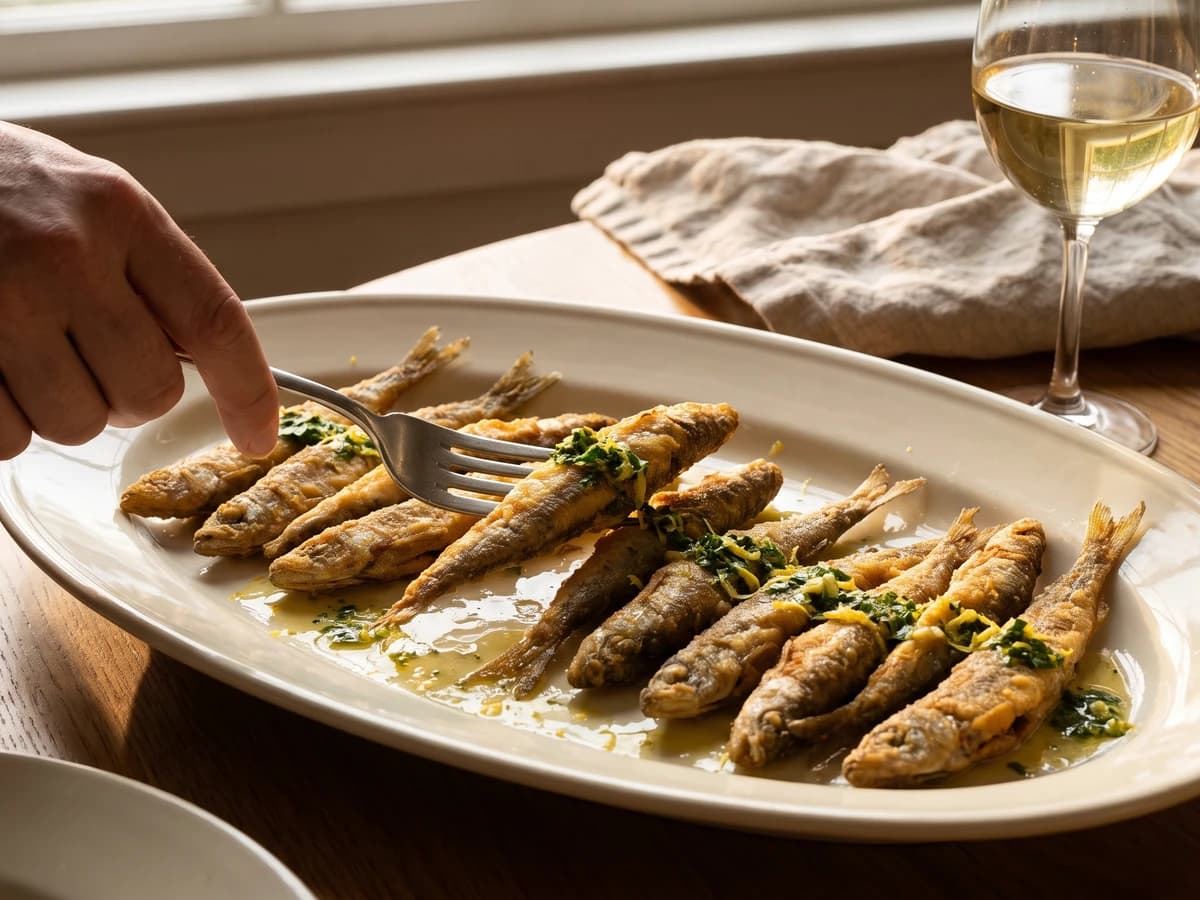
Éperlans à l’Anglaise turns small fish into a lesson in disciplined coating: boned smelts under a close, crisp crumb, pan-fried in clarified butter and finished with bright, half-melted maître d’hôtel butter.

Chef Juliette
Tiny smelts, shallot, mushrooms, white wine, gratin sauce, and fine bread raspings meet a fierce oven, where the fish must turn tender in the same breath the buttered crust bronzes.