
Chef Juliette
John Dory (St. Pierre)
John Dory has the delicacy of sole and the firmness of turbot. A light flouring, a quick butter sauté, and nut-brown beurre noisette show exactly why looks never mattered.
A cooking platform built around craft, culture, and the stories behind what we eat.

Created by Chef Juliette
Based on No. 1439, Mousse Froide de Jambon, from Le Guide Culinaire (1907) by Auguste Escoffier
Lean ham, cold Velouté, flowing aspic, and half-beaten cream become a pale, savory mousse with a clean slice. Keep every element cold and the aspic fluid, because temperature is the whole technique.
Mousse Froide de Jambon (cold ham mousse) teaches temperature before it teaches anything else. Lean ham, cold Velouté, fluid aspic, and crème à demi-fouettée (half-beaten cream) must meet while the purée is cold and the aspic is still loose. Let either condition slip and the mousse turns grainy or sets in the bowl instead of the mould. When it is right, the slice is pale rose, close and silky, light enough to yield under a fork yet firm enough to stand.
The original kitchen assumed a saucier on staff, a stockpot never off the fire, finished Velouté and clarified aspic waiting in the cold room, and enough hands to pound a pound of ham through a sieve. A salamander has no work in this cold dish. At home, a processor takes over the pounding, a fine sieve keeps the essential refinement, and a one-litre mould or four cassolettes, small straight-sided dishes, replace the banquet mould. The batch is reduced to 340 grams of ham for four, with the Velouté, aspic, and cream reduced by the same factor. The size changed; the grammar did not. One cook, one stove, one evening.
The elaborate truffle decoration is brigade scaffolding and may go. Sieving the ham, working it over ice, adding the aspic little by little, and folding in cream only half-beaten are the dish and must stay. The one step that matters most is the aspic: cool enough not to melt the cream, fluid enough not to seize. If it threads into jelly, don't panic. Ça se rattrape, and the method catches it before the mould.
Mousse froide de jambon belongs to the Parisian garde-manger and the formal cold buffet, where cooked meat was pounded smooth, lightened with cream, and stabilized with aspic for clean service. It moved from grand kitchens into bourgeois dining rooms through decorative communal moulds and small cassolettes, whose paper collars gave the appearance of a cold Soufflé. The common misconception is that this is merely whipped ham: Velouté gives body, aspic gives the clean slice, and cream gives the mousse its lift.
Quantity
About 2½ cups (590 ml / 340 g)
rind and visible fat removed, diced and chilled
Quantity
9½ tablespoons (142 ml / 145 g)
thick but spoonable
Quantity
7 tablespoons (about 106 ml / 106 g)
melted and cooled until fluid
Quantity
1 cup plus 3 tablespoons (285 ml / 283 g), for the half-beaten finish used in Mousse de Homard (No. 956)
Quantity
¼ teaspoon (1.25 ml / 1.5 g), only if needed
Quantity
⅛ teaspoon (0.6 ml / 0.3 g)
Quantity
1 small pinch
Quantity
¼ cup (60 ml / 60 g), for the mould-clothing method in Another Method of Preparing Aspics de Filets de Soles (No. 916)
Quantity
1 small truffle (about 20 g)
thinly sliced into simple lozenges
| Ingredient | Quantity |
|---|---|
| very lean, mild cooked hamrind and visible fat removed, diced and chilled | About 2½ cups (590 ml / 340 g) |
| prepared cold Veloutéthick but spoonable | 9½ tablespoons (142 ml / 145 g) |
| prepared clear meat aspicmelted and cooled until fluid | 7 tablespoons (about 106 ml / 106 g) |
| very cold heavy cream | 1 cup plus 3 tablespoons (285 ml / 283 g), for the half-beaten finish used in Mousse de Homard (No. 956) |
| fine salt | ¼ teaspoon (1.25 ml / 1.5 g), only if needed |
| finely ground white pepper | ⅛ teaspoon (0.6 ml / 0.3 g) |
| cayenne pepper | 1 small pinch |
| additional melted meat aspic (optional) | ¼ cup (60 ml / 60 g), for the mould-clothing method in Another Method of Preparing Aspics de Filets de Soles (No. 916) |
| black truffle (optional)thinly sliced into simple lozenges | 1 small truffle (about 20 g) |
Chill the ham, Velouté, cream, processor bowl and blade, fine sieve, mixing bowl, spatula, and mould for twenty minutes. Fill a larger bowl one-third full with ice and cold water, then nest the mixing bowl inside it. Melt the measured aspic over the gentlest heat only until fluid, never simmering, and cool it to about 20 to 22°C before use. It must pour freely without feeling warm.
For a single one-litre mould, chemiser, meaning clothe it with aspic, before making the mousse. Pour in the optional additional aspic and rotate the cold mould over ice until the inside carries a thin, even coat, then drain the excess. If using truffle, place the lozenges against the tacky coating and seal them with another spoonful of aspic. This is the mould-clothing technique named in Another Method of Preparing Aspics de Filets de Soles (No. 916). For four cassolettes, line the inside of each rim with a 3 cm strip of parchment and skip the coating and truffle.
Pulse the chilled ham alone until very finely minced. Add the cold Velouté a spoonful at a time, scraping down the bowl between additions, and process only until the mixture becomes a smooth, thick purée. The processor replaces the original mortar and heavy pounding, which was brigade labor rather than the heart of the dish. If the bowl begins to feel warm, stop and chill everything for ten minutes before continuing.
Rub the ham purée through the fine sieve into the chilled mixing bowl, working in small batches with a flexible scraper. Scrape every bit of smooth purée from the underside and discard the dry fibers left behind. This step stays. It removes the ham's stringy structure and gives the mousse its close, silken cut; no amount of extra processing produces quite the same result.
Nest the purée over the ice bath. Add the white pepper and cayenne, then taste from a chilled spoon before adding any salt, because the ham, Velouté, and aspic may already provide enough. Work the purée steadily with the spatula for three to four minutes, scraping the sides, until it is completely uniform, cold, and slightly elastic.
Add the cool, fluid aspic one tablespoon at a time, stirring each addition fully into the purée before the next. Keep the bowl over ice, but lift it away if the mixture begins setting against the sides. If the aspic forms rubbery threads, stop. Ça se rattrape: set the bowl over barely warm water and stir only until the threads disappear, then return it to the ice bath. Do not let the purée become warm.
Reserve two tablespoons of the measured cream. Beat the rest only until it thickens and the whisk leaves a faint trail that immediately relaxes, with no peaks. This is crème à demi-fouettée, the half-beaten cream also used in Mousse de Homard (No. 956). Fold one-third into the ham mixture to loosen it, then fold in the remainder in two additions. If the cream was taken too far, stir in the reserved liquid cream to soften it before folding. If the mousse tightens before the cream is incorporated, hold the bowl over barely warm water for a few seconds and fold from the edges until supple again.
Spoon the mousse into the prepared mould immediately. Press the first layer gently against the base and sides to prevent air pockets, then fill the remainder without beating out the lightness. Smooth the top, cover, and chill for at least four hours or overnight. For cassolettes, fill just above the rim inside the paper collars and level the tops like small cold Soufflés. Do not freeze the mousse, because thawed aspic weeps and the cream loses its fine texture.
Chill the serving platter. Dip the outside of the large mould in warm water for two to three seconds, dry it, cover it with the platter, and invert in one confident motion. If it clings, repeat the dip for one second rather than prying at the mousse. Peel the paper collars from cassolettes only after they are fully set. Serve well chilled, cutting the large mousse with a warm, dry knife. À table!
1 serving (about 240g)
Culinary guides, cultural storytelling, and the editorial depth that makes cooking meaningful.
Discover Culinary ExplorerChef Juliette
John Dory has the delicacy of sole and the firmness of turbot. A light flouring, a quick butter sauté, and nut-brown beurre noisette show exactly why looks never mattered.

Chef Juliette
Fresh haddock proves its delicacy in the meunière pan: a fine flour crust, moist pearly flakes, and beurre noisette sharpened with lemon and parsley, ready from one skillet in half an hour.
Chef Juliette
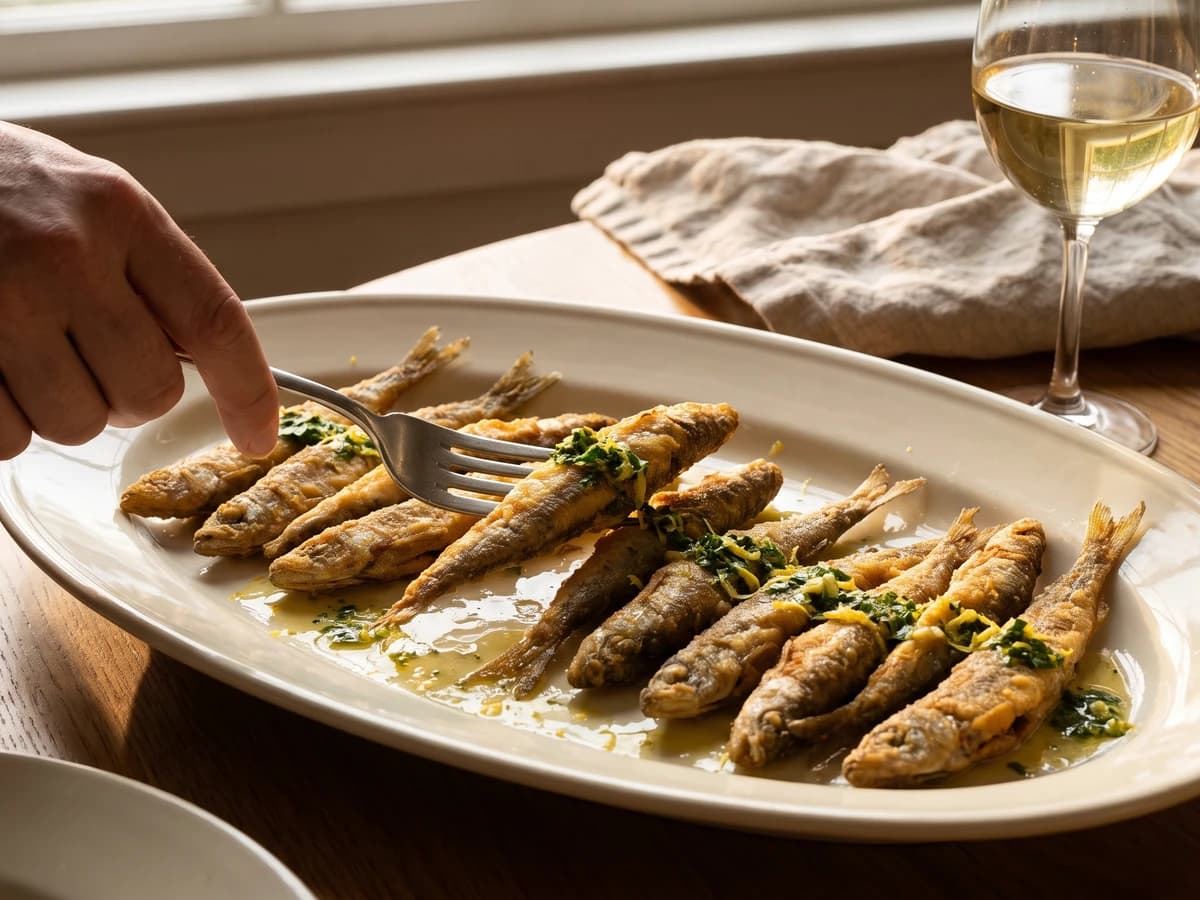
Éperlans à l’Anglaise turns small fish into a lesson in disciplined coating: boned smelts under a close, crisp crumb, pan-fried in clarified butter and finished with bright, half-melted maître d’hôtel butter.

Chef Juliette
Tiny smelts, shallot, mushrooms, white wine, gratin sauce, and fine bread raspings meet a fierce oven, where the fish must turn tender in the same breath the buttered crust bronzes.