
Chef Juliette
John Dory (St. Pierre)
John Dory has the delicacy of sole and the firmness of turbot. A light flouring, a quick butter sauté, and nut-brown beurre noisette show exactly why looks never mattered.
A cooking platform built around craft, culture, and the stories behind what we eat.

Created by Chef Juliette
Based on No. 1437, Jambon Froid à la Gelée, from Le Guide Culinaire (1907) by Auguste Escoffier
A chilled ham with a glass-clear coat and neat aspic dice: a lesson in patient cooling, firm pressing, and glazing only when both ham and gelée are cold enough to hold.
Jambon froid à la gelée (cold ham in aspic) teaches one exact lesson: temperature is an ingredient. The ham must be completely cold, its surface must be dry, and the melted gelée must be cool enough to cling. Miss that balance and the coating runs to the tray. Find it, and the ham takes on a smooth, savory glaze that catches the light like polished glass.
The original assumed a whole ham, a cook prepared to bone it while hot, a cold larder, and clear aspic waiting from the saucier. Your honest equivalent is a small boneless cured joint, already rolled by the butcher, pressed in a loaf tin beneath pantry tins, with its own cooking liquor clarified and strengthened with gelatin. The hot boning and paper frill were service scaffolding; firm pressure, skinning only when cold, and repeated coats of cold melted aspic are the dish and must stay. One cook, one stove, one evening of work, then the cold does its part.
Serve it whole, rosy beneath its clear coat, with the aspic cut into fine dice around it. The step that decides everything comes just before glazing: dry the chilled ham thoroughly, then cool the melted gelée until it pours like light syrup rather than water.
Jambon froid à la gelée belongs to the French cuisine classique tradition of the buffet froid, especially the Parisian traiteur counter and the cuisine bourgeoise table, where a whole cooked ham could feed a gathering without last-minute stove work. Professional cold kitchens turned the ham's cooking liquor into clear aspic, using it as both a savory protective glaze and a cut decoration around the platter. It should not be confused with Burgundy's jambon persillé, which sets pieces of ham and parsley inside a mold; here the ham remains whole, and the gelée is its coat and border.
Quantity
1 joint, 2½ pounds (1.1 kg)
rolled and tied
Quantity
About 10 cups (2.4 L / 2.4 kg), plus more as needed
enough to cover the ham or dilute its liquor
Quantity
2, about ¼ cup (60 ml / 60 g)
lightly beaten
Quantity
4 envelopes, about 3 tablespoons plus 1 teaspoon (50 ml / 28 g)
| Ingredient | Quantity |
|---|---|
| boneless, rind-on, uncooked mild-cured ham or gammon jointrolled and tied | 1 joint, 2½ pounds (1.1 kg) |
| cold waterenough to cover the ham or dilute its liquor | About 10 cups (2.4 L / 2.4 kg), plus more as needed |
| large egg whiteslightly beaten | 2, about ¼ cup (60 ml / 60 g) |
| unflavored powdered gelatin | 4 envelopes, about 3 tablespoons plus 1 teaspoon (50 ml / 28 g) |
Rinse the tied ham under cold water and place it in a narrow, heavy pot. Add enough cold water to cover it by 1 inch (2.5 cm), about 10 cups (2.4 L / 2.4 kg). Bring the water up slowly, skimming away any grey foam, then hold it between 180 and 185°F (82 and 85°C), where the surface barely trembles. Cook until the center reaches 150°F (66°C), or any higher temperature specified by the producer, about 1 hour 20 minutes to 1 hour 45 minutes. Never let it boil hard; violent heat tightens the meat and clouds the liquor you need for the gelée.
Lift the cooked ham from its liquor and let it stand for 5 minutes. Reserve the liquor. Remove the trussing, then roll the hot ham tightly in a clean, dampened, lint-free tea towel or doubled cheesecloth and tie it securely at several points. Set it seam-side down in a loaf tin, place a small board or second loaf tin over it, and add about 3 pounds (1.4 kg) of evenly distributed weight. Press for 45 minutes at room temperature, then refrigerate under the weight for at least 6 hours, preferably overnight. Do not leave the warm ham out for longer than 1 hour. Pressure replaces the shape once supplied by the bone and gives you close, even slices.
Strain the cooking liquor through a fine sieve and skim away as much fat as possible. Taste it cold enough not to burn you. It should be distinctly savory but pleasant by the spoonful; if it tastes aggressively salty, combine equal parts liquor and fresh water. Measure 5 cups (1.2 L) into a clean pot and cool it below 100°F (38°C). The ham supplies the flavor, so there is no need to disguise it with an improvised stock.
Whisk the egg whites into the cooled liquor. Set the pot over medium-low heat and stir gently, scraping the bottom, until pale curds rise and begin joining into a raft. Stop stirring as soon as the raft forms. Make a small opening through it with a spoon and hold the liquor at the gentlest simmer for 15 minutes. Ladle it carefully through a damp cloth set inside a fine sieve, without pressing the curds. If the liquor remains cloudy, pass it through a fresh damp cloth once more. Ça se rattrape. Measure 4 cups (960 ml) of the clarified liquor, adding a little boiled water if necessary.
Cool 1 cup (240 ml) of the clarified liquor completely, sprinkle the gelatin evenly over it, and leave it for 10 minutes to bloom. Warm the remaining 3 cups (720 ml) until hot but not boiling, then pour them over the bloomed gelatin and stir until every grain dissolves. Spoon a teaspoon onto a chilled saucer and refrigerate it for 5 minutes; it should set firmly enough to cut. Pour 2½ cups (600 ml) into an 8-inch (20 cm) square dish for the dice and the remaining 1½ cups (360 ml) into a bowl for glazing. Refrigerate both for at least 4 hours.
Remove the completely cold ham from its press and unwrap it. With a thin, sharp knife, lift away the rind without cutting deeply into the meat, then trim the fat to an even layer about ⅛ inch (3 mm) thick. Pat every surface thoroughly dry and place the ham on a wire rack over a chilled tray. Moisture makes aspic slide, and this surface must be dry before the first spoonful touches it.
Turn the bowl of set gelée into a small saucepan and warm it over the lowest heat only until melted. Set the pan over ice and stir until the gelée is cold and lightly syrupy, about 68°F (20°C). Spoon a thin coat over the chilled ham and refrigerate it for 8 to 10 minutes, then repeat until the surface is evenly covered and glossy, usually three or four coats. Collect any clean gelée from the tray and reuse it. If it runs off, cool it a little further; if it sets in ridges, warm it by a few degrees and smooth on another coat. Ça se rattrape.
Cut the aspic from the square dish into fine ¼-inch (6 mm) dice with a sharp knife. Transfer the glazed ham to a chilled oval platter and surround it generously with the dice. A paper ham frill may be fitted to the narrow end if you enjoy the old service dress, but it is decoration, not technique. Chill the finished platter for 30 minutes, then let it stand for 10 minutes before carving into thin slices. The gelée should remain cool, clear, and softly yielding. À table!
1 serving (about 290g)
Culinary guides, cultural storytelling, and the editorial depth that makes cooking meaningful.
Discover Culinary ExplorerChef Juliette
John Dory has the delicacy of sole and the firmness of turbot. A light flouring, a quick butter sauté, and nut-brown beurre noisette show exactly why looks never mattered.

Chef Juliette
Fresh haddock proves its delicacy in the meunière pan: a fine flour crust, moist pearly flakes, and beurre noisette sharpened with lemon and parsley, ready from one skillet in half an hour.
Chef Juliette
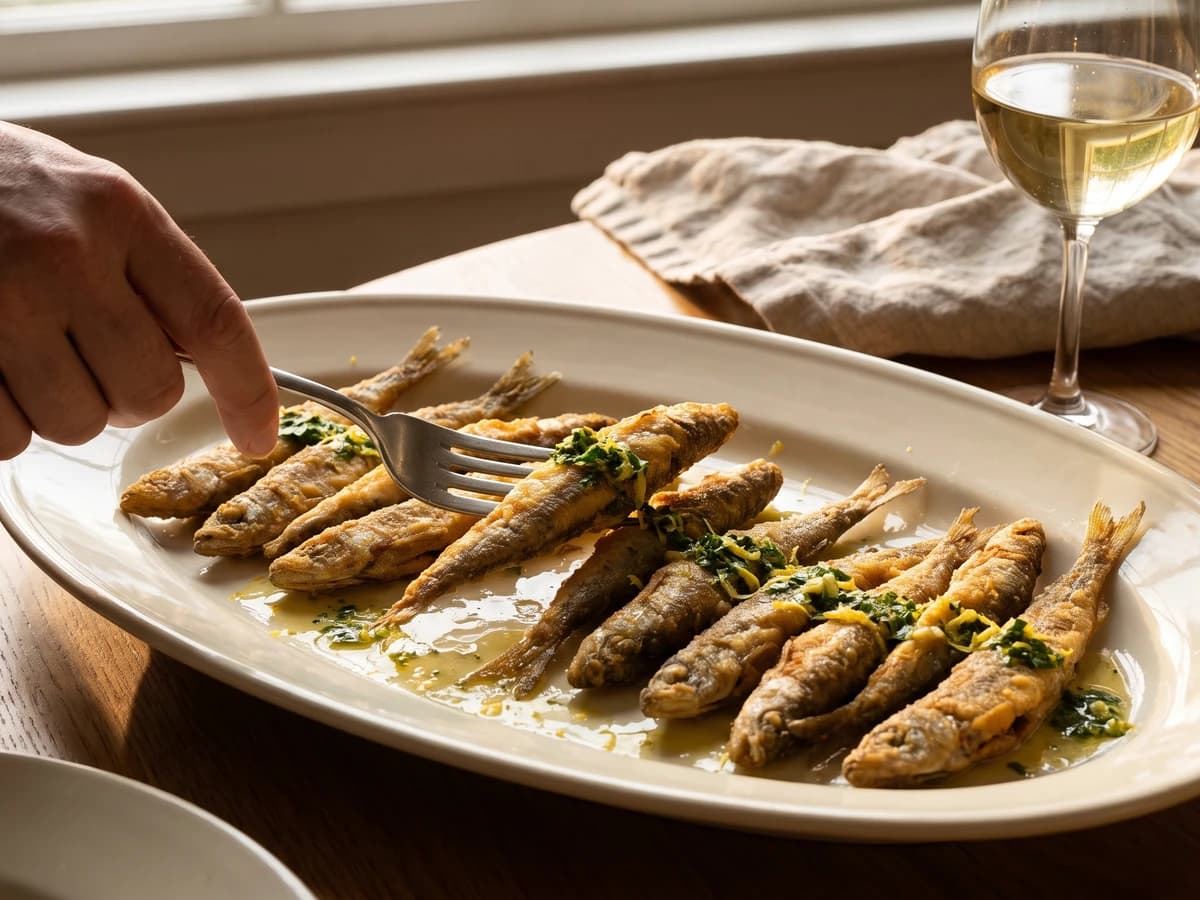
Éperlans à l’Anglaise turns small fish into a lesson in disciplined coating: boned smelts under a close, crisp crumb, pan-fried in clarified butter and finished with bright, half-melted maître d’hôtel butter.

Chef Juliette
Tiny smelts, shallot, mushrooms, white wine, gratin sauce, and fine bread raspings meet a fierce oven, where the fish must turn tender in the same breath the buttered crust bronzes.