
Chef Juliette
John Dory (St. Pierre)
John Dory has the delicacy of sole and the firmness of turbot. A light flouring, a quick butter sauté, and nut-brown beurre noisette show exactly why looks never mattered.
A cooking platform built around craft, culture, and the stories behind what we eat.

Created by Chef Juliette
Based on No. 1433, Mousselines de Jambon Alexandra, from Le Guide Culinaire (1907) by Auguste Escoffier
Silken ham mousselines crowned with truffle, napped in Parmesan-enriched Sauce Allemande, glazed in one fierce flash, and ringed around buttered asparagus: a lesson in giving delicate forcemeat exactly the heat it needs.
Mousselines de Jambon Alexandra (individual ham mousses Alexandra-style) teach the two temperatures of a mousseline: the forcemeat stays cold so the cream remains emulsified, then the molded portions poach gently so they set without surrendering their moisture. That is the one true thing to know before touching a pan. Cold builds the silk; gentle heat preserves it.
The entry assumed a mortar and tamis, rows of portion molds, a stockpot never off the fire, ham essence ready, a saucier holding Sauce Allemande, and a salamander waiting for the final glaze. For one cook, one stove, one evening, a chilled food processor and fine sieve make the mousseline, ham trimmings concentrate a small measure of stock in the sauce pan, four ramekins make the crown, and a fierce domestic broiler supplies the glaze. The separate holding pans were brigade scaffolding and can go. The chilled emulsion, gentle poach, Parmesan in the book's proportion, truffle lozenges, buttered asparagus heads, and lightning-fast glaze are the dish and stay.
Cooked ham cannot bind cream by itself, so a little raw chicken breast supplies the neutral protein structure a hot ham mousseline needs without changing its flavor. The final step decides the result: have the Sauce Allemande hot and the broiler fully fierce, then glaze only until the surface blisters pale gold. Linger and the mousselines dry; pull them promptly and they remain tender beneath their glossy sauce.
Mousselines belong to the Parisian grand-kitchen repertoire, where mousse and mousseline meant the same finely worked mixture but not the same service: the glossary defines a mousseline as an individual portion rather than a large mold. The title Alexandra follows the Parisian practice of giving composed dishes honorific names, and this formula defines it precisely through ham, truffle, cheese-enriched Sauce Allemande, and asparagus tips. The crown is practical as well as handsome, keeping the green garnish together while giving each guest one intact mousseline.
Quantity
2½ packed cups (600 ml / 380 g)
Divide into 300 g diced and chilled for the mousselines, 60 g chopped for the ham essence, and 20 g cut into 4 lozenges
Quantity
1 packed cup (240 ml / 150 g)
Diced and very cold
Quantity
2
Quantity
¾ cup (180 ml / 180 g)
Very cold
Quantity
As needed
Quantity
¼ teaspoon (1.25 ml / 0.6 g)
Quantity
1 tablespoon (15 ml / 14 g)
Softened
Quantity
1, about 15 g
Fresh or preserved, cut into 4 thin lozenges
Quantity
1¾ cups (420 ml / 420 g)
Quantity
2 tablespoons (30 ml / 28 g)
Quantity
2 tablespoons (30 ml / 16 g)
Quantity
2
Quantity
¼ cup (60 ml / 60 g)
Quantity
1 teaspoon (5 ml / 5 g)
Quantity
⅓ cup loosely packed (80 ml / 30 g)
Quantity
2 packed cups (475 ml / 250 g)
Cut 2½ to 3 inches long
Quantity
2 tablespoons (30 ml / 28 g)
| Ingredient | Quantity |
|---|---|
| good unsmoked cooked hamDivide into 300 g diced and chilled for the mousselines, 60 g chopped for the ham essence, and 20 g cut into 4 lozenges | 2½ packed cups (600 ml / 380 g) |
| boneless, skinless chicken breastDiced and very cold | 1 packed cup (240 ml / 150 g) |
| large egg whites | 2 |
| heavy cream for the mousselinesVery cold | ¾ cup (180 ml / 180 g) |
| fine sea salt | As needed |
| finely ground white pepper | ¼ teaspoon (1.25 ml / 0.6 g) |
| unsalted butter for the molds and platterSoftened | 1 tablespoon (15 ml / 14 g) |
| small black truffleFresh or preserved, cut into 4 thin lozenges | 1, about 15 g |
| unsalted light chicken or veal stock | 1¾ cups (420 ml / 420 g) |
| unsalted butter for the Sauce Allemande | 2 tablespoons (30 ml / 28 g) |
| all-purpose flour | 2 tablespoons (30 ml / 16 g) |
| large egg yolks | 2 |
| heavy cream for the Sauce Allemande | ¼ cup (60 ml / 60 g) |
| fresh lemon juice | 1 teaspoon (5 ml / 5 g) |
| finely grated Parmesan | ⅓ cup loosely packed (80 ml / 30 g) |
| asparagus tipsCut 2½ to 3 inches long | 2 packed cups (475 ml / 250 g) |
| unsalted butter for the asparagus | 2 tablespoons (30 ml / 28 g) |
Put the food processor bowl and blade in the freezer for 15 minutes. Keep the diced chicken, 300 g of diced ham, egg whites, and ¾ cup cream thoroughly cold but not frozen. Heat the oven to 325°F (160°C), bring a kettle of water nearly to a boil, and butter four 6-ounce ramekins plus a broiler-safe serving platter. Cold is not fuss here; it keeps the fat and cream held inside the mousseline instead of separating.
Process the chicken, egg whites, white pepper, and a small pinch of salt until the mixture becomes smooth and tacky, scraping the bowl twice. Add the 300 g chilled diced ham and process until very fine. With the motor pulsing, add the cold cream gradually, two spoonfuls at a time, stopping as soon as each addition disappears and the mixture looks satiny. If it becomes loose, shiny, or oily, stop immediately. Chill the entire bowl over ice for 10 minutes, then resume with brief pulses; ça se rattrape, provided you restore the cold before forcing in more cream. Press the finished mixture through a fine sieve into a chilled bowl.
Poach a teaspoon of the mixture in barely simmering water for 3 minutes, cut it through, and taste. The texture should be tender and close, never grainy; correct the salt now, remembering that the ham will vary. Place one ham lozenge and one truffle lozenge side by side on the buttered bottom of each ramekin. Divide the mousseline mixture evenly among the molds, filling them no more than three-quarters full, smooth the tops, and cover each with a buttered parchment round.
Set the ramekins in a roasting pan and pour the hot water around them until it reaches halfway up their sides. Poach in the oven for 22 to 28 minutes, until the centers feel softly resilient and register 160°F (71°C). The water should barely quiver. If it begins bubbling hard, lower the oven to 300°F (150°C) and add a little cool water to the bath; boiling squeezes moisture from the forcemeat, while gentle heat sets it evenly. Lift the molds from the bath and let them stand for 5 minutes while you finish the sauce.
While the mousselines poach, combine the 60 g chopped ham trimmings with the stock in a small saucepan. Bring it only to a bare simmer and cook for 12 minutes, until the stock smells distinctly of ham without turning harsh or salty. Strain, pressing the trimmings lightly, and measure 1½ cups (360 ml / 360 g) of ham essence. If you have less, add a little water; if you have more, reduce it briefly.
Melt the 2 tablespoons butter in a saucepan, stir in the flour, and cook this blond roux gently for 2 minutes without letting it color. Whisk in the warm ham essence little by little, then simmer gently, whisking often, until smooth and reduced to 1 cup (240 ml / 240 g). Whisk the yolks, ¼ cup cream, and lemon juice together, temper them with two ladlefuls of hot sauce, then return everything to the saucepan over the lowest heat. Stir until the Sauce Allemande naps the back of a spoon, but never let it boil. If fine curds appear, remove the pan at once, whisk in a teaspoon of cold water, and strain into a cool bowl. Ça se rattrape. Adjust the finished sauce to 1¼ cups (300 ml / 300 g), then stir in the 30 g Parmesan, preserving the source proportion of two ounces per imperial pint. Keep it hot over warm water.
Blanch the asparagus tips in generously salted water until brilliant green and just tender, 2 to 4 minutes depending on their thickness. Drain them thoroughly, then roll them over medium-low heat with the 2 tablespoons butter until the butter clings and no water remains in the pan. If a puddle forms, keep the pan moving over the heat before adding anything else; the asparagus should be cohered with butter, glossy but not swimming.
Heat the broiler fully and place a rack about 5 inches beneath it. Run a thin knife around each ramekin, invert the mousselines onto a folded clean towel, and leave them for 1 minute so excess liquid drains away. Blot their bases carefully, then arrange them decoration-side up in a close crown on the buttered heatproof platter. Wet mousselines dilute the sauce and resist glazing, so do not hurry this little pause.
Cover the mousselines generously with the hot Parmesan-enriched Sauce Allemande, letting a little pool around their bases. Place the platter beneath the fierce broiler for 45 to 90 seconds, only until the sauce takes scattered pale-gold blisters. If it has not colored by then, remove the platter and let the broiler heat further before trying again; leaving the mousselines under weak heat only dries them. Heap the buttered asparagus tips in the center of the crown and serve immediately. À table!
1 serving (about 370g)
Culinary guides, cultural storytelling, and the editorial depth that makes cooking meaningful.
Discover Culinary ExplorerChef Juliette
John Dory has the delicacy of sole and the firmness of turbot. A light flouring, a quick butter sauté, and nut-brown beurre noisette show exactly why looks never mattered.

Chef Juliette
Fresh haddock proves its delicacy in the meunière pan: a fine flour crust, moist pearly flakes, and beurre noisette sharpened with lemon and parsley, ready from one skillet in half an hour.
Chef Juliette
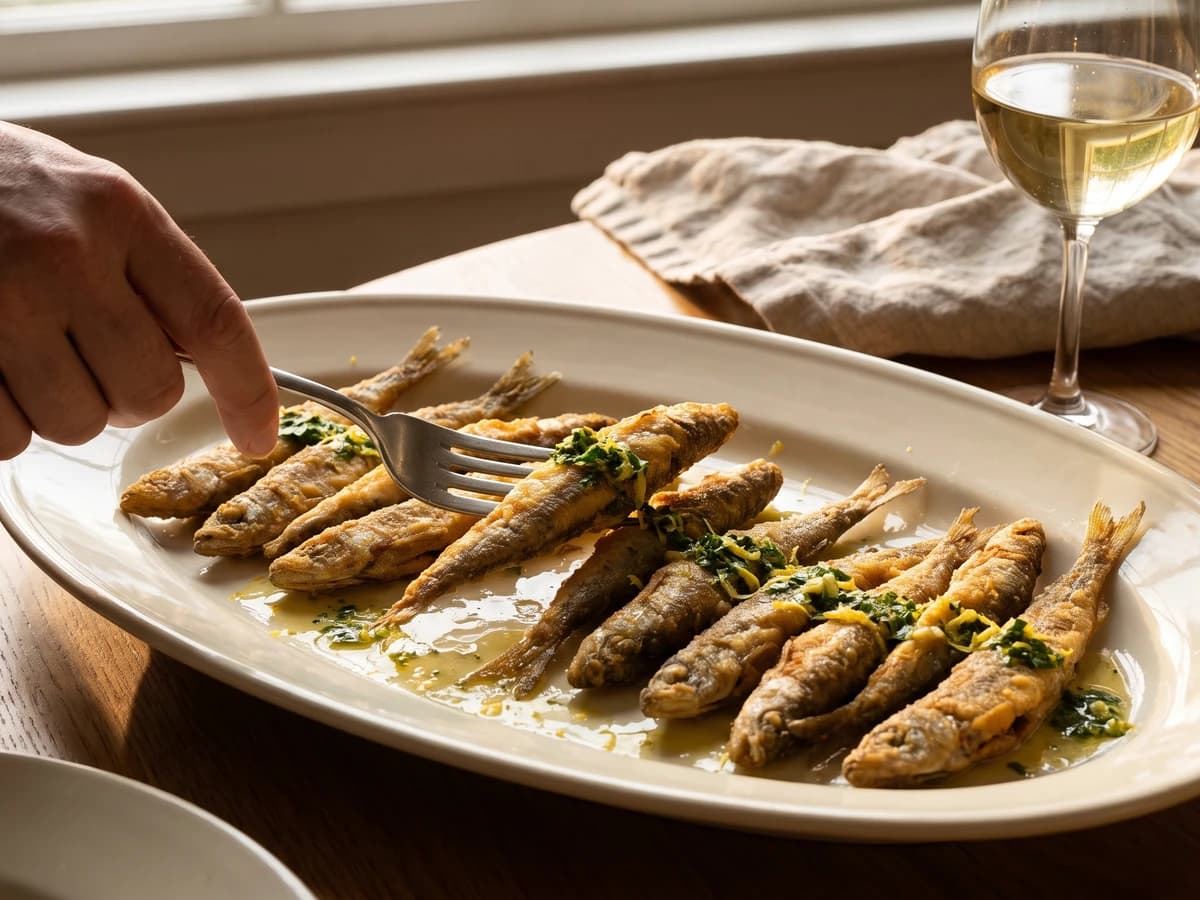
Éperlans à l’Anglaise turns small fish into a lesson in disciplined coating: boned smelts under a close, crisp crumb, pan-fried in clarified butter and finished with bright, half-melted maître d’hôtel butter.

Chef Juliette
Tiny smelts, shallot, mushrooms, white wine, gratin sauce, and fine bread raspings meet a fierce oven, where the fish must turn tender in the same breath the buttered crust bronzes.