
Chef Juliette
John Dory (St. Pierre)
John Dory has the delicacy of sole and the firmness of turbot. A light flouring, a quick butter sauté, and nut-brown beurre noisette show exactly why looks never mattered.
A cooking platform built around craft, culture, and the stories behind what we eat.

Created by Chef Juliette
Based on No. 1410, Crépinettes Truffées, from Le Guide Culinaire (1907) by Auguste Escoffier
Eight butter-bronzed crépinettes gathered around glossy Périgueux sauce, their truffled pork kept succulent by melting caul, with cream-rich potato purée alongside. A grand-kitchen composition brought intact to the home table.
Crépinettes truffées (truffled pork patties wrapped in pig's caul) teach one true thing: gentle heat can accomplish what fierce heat ruins. The caul must render slowly enough to baste the forcemeat, nearly disappearing as the pork cooks; scorch it, and the truffle is wasted beneath a bitter crust.
The original assumed brigade quantities, a saucier holding Périgueux sauce, a stockpot never cold, and a salamander whose heat could be judged by an experienced hand. Your honest equivalents are eight precisely weighed crépinettes, finished Périgueux sauce prepared from its own recipe, and a home broiler set low or kept well above the pan. The separate stockmaking and sauce station are brigade scaffolding and needn't be rebuilt here. The eight-to-one ratio of sausage to truffle, the truffle liquor, the 2½-ounce portions, the caul, butter, gentle grilling, sauce in the center, and potato purée alongside are the dish, so they all stay.
Shape the rectangles evenly and wrap them with one thin layer of caul, neither bundled nor bare. That wrapping, followed by patient grilling, is the step that decides everything. One cook, one stove, one evening.
Crépinettes belong to the charcuterie tradition practiced across France and take their name from crépine, the lace-like caul fat used to hold seasoned forcemeat as it cooks. This truffled form turns toward Périgord, where black truffles and Périgueux sauce carried country butchery into the classical dining room, while potato purée kept the composition generous at the table. Caul is not a sausage casing: under gentle heat it nearly disappears, basting the meat and leaving only a delicate browned web.
Quantity
About 2⅛ cups (505 ml / 490 g)
thoroughly chilled
Quantity
About ⅓ cup (80 ml / 61 g)
finely chopped
Quantity
1 tablespoon plus ¼ teaspoon (16 ml / 16 g)
Quantity
8 squares, each about 6 inches (15 cm) wide, about 3½ ounces (100 g) total
Quantity
2 tablespoons (30 ml / 28 g)
melted
Quantity
1¼ cups (300 ml / 315 g)
Quantity
3 cups (720 ml / 680 g)
| Ingredient | Quantity |
|---|---|
| very good plain pork sausage meatthoroughly chilled | About 2⅛ cups (505 ml / 490 g) |
| drained cooked black trufflesfinely chopped | About ⅓ cup (80 ml / 61 g) |
| truffle cooking liquor | 1 tablespoon plus ¼ teaspoon (16 ml / 16 g) |
| pig's caul | 8 squares, each about 6 inches (15 cm) wide, about 3½ ounces (100 g) total |
| unsalted buttermelted | 2 tablespoons (30 ml / 28 g) |
| prepared Périgueux sauce | 1¼ cups (300 ml / 315 g) |
| prepared potato purée with cream | 3 cups (720 ml / 680 g) |
Lay the caul in a bowl of very cold water for 15 minutes, gently separating its folds without pulling. Rinse it once more, spread it on a clean towel, and blot it carefully. Cut eight sound squares about 6 inches (15 cm) wide, keeping the thinner scraps nearby for repairs.
Put the cold sausage meat, chopped truffles, and truffle cooking liquor in a chilled bowl. Mix firmly with one hand just until the truffle is evenly distributed and the forcemeat becomes lightly tacky. Stop there. Overworking warms the fat and makes the finished texture tight; if the mixture softens, chill it for 10 minutes before continuing.
Weigh the mixture into eight portions of 2½ ounces (71 g) each. Shape every portion into a compact rectangle about 3 by 2 inches (8 by 5 cm) and ¾ inch (2 cm) thick. Set one on each caul square, fold the caul over in a single snug layer, and place it seam-side down. If the caul tears, don't start again. Ça se rattrape: lay a thin scrap over the opening and press it gently into the surrounding fat. Chill the wrapped crépinettes for 15 minutes so they hold their shape.
Set the prepared Périgueux sauce over low heat and warm it until it flows thickly from a spoon without boiling. Keep the prepared potato purée with cream covered and warm in a second saucepan. Position an oven rack about 8 inches (20 cm) below the broiler and heat the broiler on low; if yours has only one setting, this generous distance supplies the gentler heat the source intended.
Arrange the crépinettes seam-side down on a broiler pan and brush them lightly with half the melted butter. Broil for 6 to 7 minutes, until the caul has turned translucent at the edges and the upper surface is softly bronzed. Turn them carefully, brush with the remaining butter, and cook for another 6 to 8 minutes. They are ready when both sides are deep butter-gold and the centers register 160°F (71°C). If the caul darkens before the centers are cooked, lower the pan and finish them at 375°F (190°C). Ça se rattrape, and the gentler oven will protect the truffle.
Spoon the hot Périgueux sauce into the center of a warm round platter. Arrange the eight crépinettes around it in a close circle, their browned faces uppermost, and carry them to the table at once. Serve the potato purée with cream separately so each person can take a generous spoonful beside the sauce. À table!
1 serving (about 385g)
Culinary guides, cultural storytelling, and the editorial depth that makes cooking meaningful.
Discover Culinary ExplorerChef Juliette
John Dory has the delicacy of sole and the firmness of turbot. A light flouring, a quick butter sauté, and nut-brown beurre noisette show exactly why looks never mattered.

Chef Juliette
Fresh haddock proves its delicacy in the meunière pan: a fine flour crust, moist pearly flakes, and beurre noisette sharpened with lemon and parsley, ready from one skillet in half an hour.
Chef Juliette
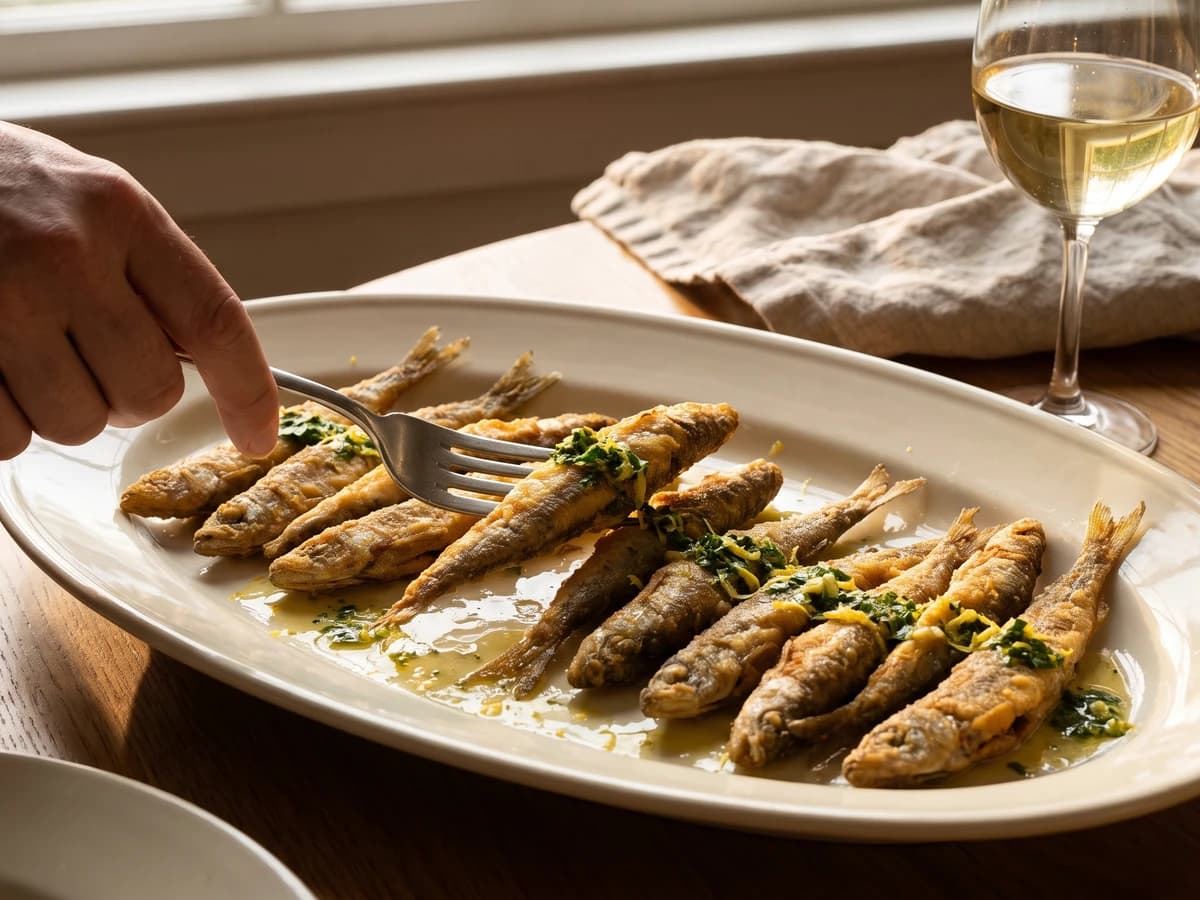
Éperlans à l’Anglaise turns small fish into a lesson in disciplined coating: boned smelts under a close, crisp crumb, pan-fried in clarified butter and finished with bright, half-melted maître d’hôtel butter.

Chef Juliette
Tiny smelts, shallot, mushrooms, white wine, gratin sauce, and fine bread raspings meet a fierce oven, where the fish must turn tender in the same breath the buttered crust bronzes.