
Chef Juliette
John Dory (St. Pierre)
John Dory has the delicacy of sole and the firmness of turbot. A light flouring, a quick butter sauté, and nut-brown beurre noisette show exactly why looks never mattered.
A cooking platform built around craft, culture, and the stories behind what we eat.

Created by Chef Juliette
Based on No. 1409, Boudins Noirs à la Flamande, from Le Guide Culinaire (1907) by Auguste Escoffier
Boudins Noirs à la Flamande teach the northern French appetite for sweet against savoury: tender blood sausage perfumed with fruit, poached without a tremor, then gently grilled and spooned with warm sugared apple sauce.
Boudins Noirs à la Flamande (Flemish-style black puddings) teach one thing before anything else: gentleness is structure. The brown sugar, raisins, currants, and apples are not dessert decorations. Their sweetness sets off the savoury, mineral richness of the boudin, but only if the casing remains whole and the filling tender.
The classical entry assumed the preparation for black boudins was already waiting in the charcuterie kitchen, along with cleaned gut and a grill held at exactly the right temper. A home kitchen needs none of that brigade scaffolding. Order the fresh, uncased preparation from a trusted butcher, use a small hand stuffer or wide piping bag, poach in a saucepan, and brown in a heavy skillet. The batch is reduced to four generous links, while the book's 3:2:2 proportion of brown sugar, raisins, and currants stays exact. Only the scale and equipment change.
Poaching is the dish, not scaffolding. Hold the water at a quiet 80 to 82°C, never a simmer, because that one restraint decides whether the filling stays supple or bursts into the pot. One cook, one stove, one evening.
Boudins Noirs à la Flamande belong to French Flanders, the northern country around Lille where orchard fruit, dried fruit, pork, and sugar readily meet in savoury dishes. The designation à la Flamande is not a loose synonym for rustic northern cooking: in this preparation it specifically means sugar, raisins, and currants folded into the boudin, with sugared apple sauce at the table. The grand repertoire preserved a borderland charcuterie habit in which sweetness sharpens, rather than conceals, the mineral depth of blood and pork.
Quantity
2½ cups (600 ml / 600 g)
thoroughly chilled
Quantity
2 tablespoons packed (30 ml / 30 g)
Quantity
2 tablespoons (30 ml / 20 g)
Quantity
2 tablespoons (30 ml / 20 g)
Quantity
2 cups (480 ml / 480 g)
for swelling the fruit
Quantity
1 length, 34 to 36 mm wide and about 36 inches (90 cm) long
Quantity
1 tablespoon (15 ml / 14 g)
melted
Quantity
4 medium (about 1½ pounds / 680 g)
peeled, cored, and sliced
Quantity
¼ cup (60 ml / 60 g)
for the apple sauce
Quantity
¼ cup (60 ml / 50 g)
for the apple sauce
| Ingredient | Quantity |
|---|---|
| fresh, uncased preparation as for black boudinsthoroughly chilled | 2½ cups (600 ml / 600 g) |
| soft light brown sugar | 2 tablespoons packed (30 ml / 30 g) |
| seedless raisins | 2 tablespoons (30 ml / 20 g) |
| dried currants | 2 tablespoons (30 ml / 20 g) |
| lukewarm waterfor swelling the fruit | 2 cups (480 ml / 480 g) |
| cleaned natural hog casing | 1 length, 34 to 36 mm wide and about 36 inches (90 cm) long |
| unsalted buttermelted | 1 tablespoon (15 ml / 14 g) |
| tart cooking applespeeled, cored, and sliced | 4 medium (about 1½ pounds / 680 g) |
| waterfor the apple sauce | ¼ cup (60 ml / 60 g) |
| superfine sugarfor the apple sauce | ¼ cup (60 ml / 50 g) |
Wash the raisins and currants, then cover them with the lukewarm water for 20 minutes. Drain them thoroughly and blot them dry. They should be plump, not dripping; water carried into the preparation loosens the filling and makes the casing harder to manage. Rinse the hog casing inside and out, then keep it in clean lukewarm water until needed.
Put the apples, water, and superfine sugar in a covered saucepan. Cook over gentle heat for 15 to 20 minutes, stirring occasionally, until the apples collapse under the spoon. Beat them into a soft sauce with a wooden spoon, or pass them through a food mill for a finer finish. If the sauce is loose, uncover it and reduce gently; if it tightens into a paste, loosen it with a tablespoon of water. Ça se rattrape. Keep it warm over the lowest heat.
Keep the preparation as for black boudins cold while you break up the brown sugar and fold it through with the drained raisins and currants. Mix only until the fruit is evenly distributed. Fit the casing to a small sausage stuffer or wide piping nozzle and fill it gently, leaving enough slack that the links bend without strain. Tie four equal links, each about 7 inches (18 cm) long, and pierce only visible air pockets with a clean fine needle. A tightly packed boudin splits in the poaching water, so restraint begins here.
Heat a wide pan of water to 80 to 82°C. Lower in the boudins and poach them for 25 to 30 minutes, regulating the heat so the water remains still, with no bubbles breaking the surface. The centres must reach 71°C. If the water begins to simmer, pull the pan off the heat and add a little cool water. If a casing splits, lift that link out at once, pack its filling into a buttered ramekin, cover it, and set the ramekin in the poaching water until the centre reaches 71°C. It will not be a link, but it will still be supper. Never apologize at your own table.
Lift the poached boudins onto a clean towel and leave them to settle for 10 minutes. Pat the casings completely dry and brush them lightly with the melted butter. Wet casings stick and tear in the skillet; dry ones take an even bronze.
Warm a heavy skillet or ridged grill pan over medium-low heat. Lay in the boudins and brown them gently for 2 to 3 minutes on each broad side, turning with a spatula rather than stabbing them with a fork. The poaching cooked the filling; this step gives the casing colour and a delicate bite. If the skin blisters quickly or pulls tight, lower the heat at once. Patience, not a hard sear.
Spoon the warm sugared apple sauce generously onto a heated platter and settle the browned boudins beside it, keeping the casings whole until they reach the table. Sweet against savoury is the point, so each forkful should catch both dark boudin and pale apple. À table!
1 serving (about 315g)
Culinary guides, cultural storytelling, and the editorial depth that makes cooking meaningful.
Discover Culinary ExplorerChef Juliette
John Dory has the delicacy of sole and the firmness of turbot. A light flouring, a quick butter sauté, and nut-brown beurre noisette show exactly why looks never mattered.

Chef Juliette
Fresh haddock proves its delicacy in the meunière pan: a fine flour crust, moist pearly flakes, and beurre noisette sharpened with lemon and parsley, ready from one skillet in half an hour.
Chef Juliette
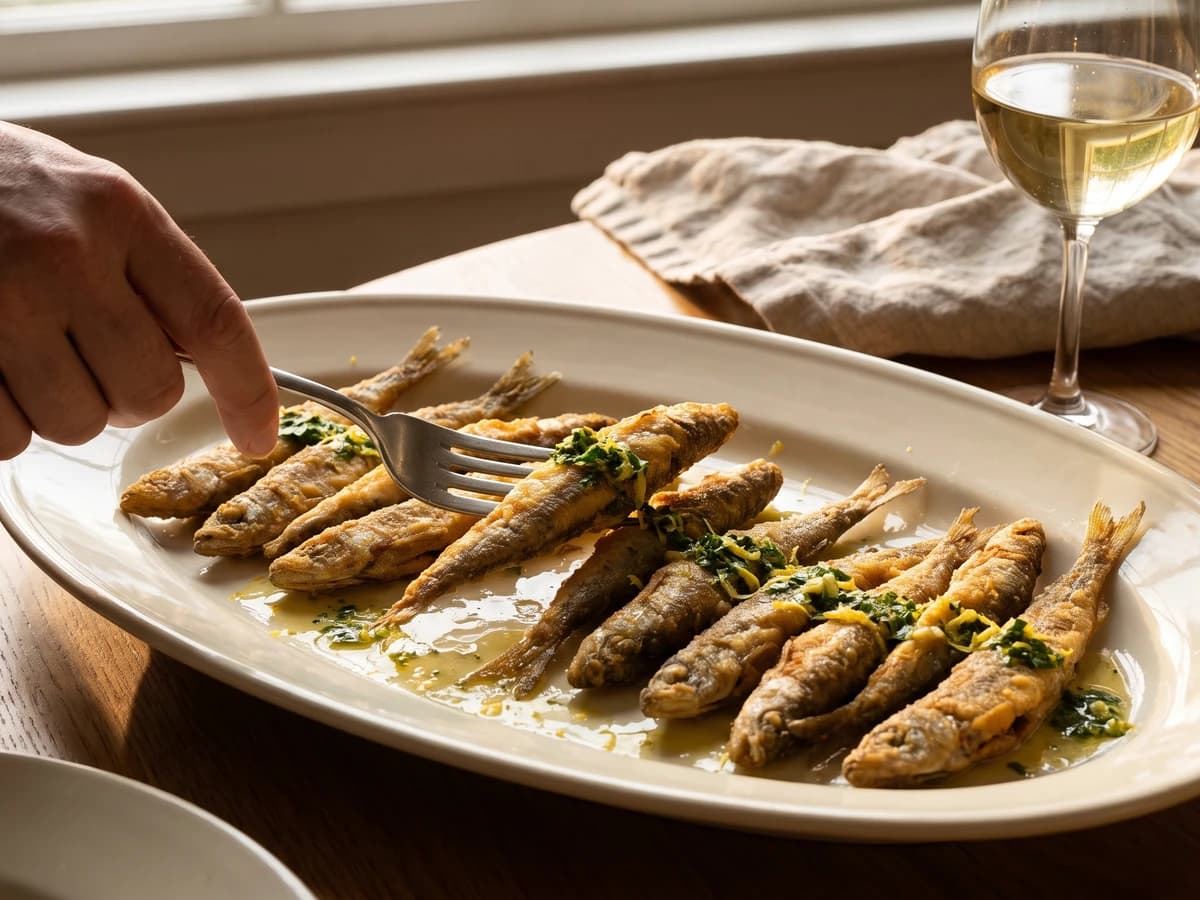
Éperlans à l’Anglaise turns small fish into a lesson in disciplined coating: boned smelts under a close, crisp crumb, pan-fried in clarified butter and finished with bright, half-melted maître d’hôtel butter.

Chef Juliette
Tiny smelts, shallot, mushrooms, white wine, gratin sauce, and fine bread raspings meet a fierce oven, where the fish must turn tender in the same breath the buttered crust bronzes.