
Chef Juliette
John Dory (St. Pierre)
John Dory has the delicacy of sole and the firmness of turbot. A light flouring, a quick butter sauté, and nut-brown beurre noisette show exactly why looks never mattered.
A cooking platform built around craft, culture, and the stories behind what we eat.

Created by Chef Juliette
Based on No. 1405, Boudin Blanc Ordinaire, from Le Guide Culinaire (1907) by Auguste Escoffier
Boudin blanc turns pork, cream, eggs, and foie gras into a pale, silken sausage, poached at a tremble, gently grilled in buttered paper, and set beside cream-rich potato purée.
Boudin blanc ordinaire (simple white pork sausage) teaches control of temperature. That is the one true thing to know before touching a pan: the forcemeat must stay cold enough to hold its emulsion, then the filled casings must poach just below a simmer. Hurry either stage with heat and the fat separates or the skins burst.
The original entry assumed a mortar for pounding, a fine sieve, practiced hands at the sausage funnel, and a willow lattice that lowered every link into the water together. A chilled food processor replaces the pounding, and a small wire rack replaces the willow. The rack is brigade scaffolding and can go; the fine sieving and twelve-minute poach are the dish and must stay. This quantity already lands neatly at eight boudins for four, so its proportions remain intact. One cook, one stove, one evening.
Properly made, the boudins are pale and tender inside, faintly bronzed beneath their buttered papers, with foie gras lending depth rather than announcing itself. Cool them completely before grilling, prick them with a pin, never cisel, or score, the casings, and hold the poaching water at 203°F (95°C). That quiet poach decides everything.
Boudin blanc belongs especially to the Christmas tables of northern France, with Rethel in the Ardennes celebrated for a fine pork forcemeat bound with eggs and dairy, without blood or coarse filler. Charcutiers and household cooks made it first as a pale counterpart to boudin noir, while classical kitchens enriched the formula with cream and foie gras without changing its delicate character. The name ordinaire marks the standard preparation, not an inferior one.
Quantity
6½ feet (2 m)
rinsed, soaked, and flushed
Quantity
8 oz (227 g)
chilled and cut into 1-inch (2.5 cm) cubes
Quantity
12 oz (340 g)
skin removed, chilled, and cubed
Quantity
1½ oz (43 g)
chilled and diced
Quantity
2
cold
Quantity
⅓ cup (1½ oz / 43 g)
finely chopped
Quantity
1 tablespoon (15 ml / 14 g)
Quantity
⅓ cup plus 1 tablespoon (95 ml / 95 g)
cold
Quantity
2⅓ teaspoons (½ oz / 14 g)
Quantity
⅛ teaspoon (0.6 ml / 0.3 g)
Quantity
1⁄16 teaspoon (0.3 ml / 0.1 g)
Quantity
2 tablespoons (30 ml / 28 g)
softened
Quantity
2 lb (900 g)
peeled and quartered
Quantity
1 tablespoon (15 ml / 18 g), plus more as needed
Quantity
½ cup (120 ml / 120 g)
Quantity
4 tablespoons (60 ml / 56 g)
| Ingredient | Quantity |
|---|---|
| natural hog casing, 28 to 30 mm widerinsed, soaked, and flushed | 6½ feet (2 m) |
| very lean fresh porkchilled and cut into 1-inch (2.5 cm) cubes | 8 oz (227 g) |
| fat fresh bacon, meaning uncured and unsmoked fatty pork bellyskin removed, chilled, and cubed | 12 oz (340 g) |
| raw foie graschilled and diced | 1½ oz (43 g) |
| large eggscold | 2 |
| onionfinely chopped | ⅓ cup (1½ oz / 43 g) |
| unsalted butter, for the onion | 1 tablespoon (15 ml / 14 g) |
| heavy cream, for the boudinscold | ⅓ cup plus 1 tablespoon (95 ml / 95 g) |
| fine sea salt, for the boudins | 2⅓ teaspoons (½ oz / 14 g) |
| ground white pepper | ⅛ teaspoon (0.6 ml / 0.3 g) |
| freshly grated nutmeg | 1⁄16 teaspoon (0.3 ml / 0.1 g) |
| unsalted butter, for the paperssoftened | 2 tablespoons (30 ml / 28 g) |
| floury potatoes, such as russets or Yukon Goldspeeled and quartered | 2 lb (900 g) |
| fine sea salt, for the potato water | 1 tablespoon (15 ml / 18 g), plus more as needed |
| heavy cream, for the potato purée | ½ cup (120 ml / 120 g) |
| unsalted butter, for the potato purée | 4 tablespoons (60 ml / 56 g) |
Melt 1 tablespoon (15 ml / 14 g) butter in a small pan over low heat. Add the chopped onion and cook for 8 to 10 minutes, stirring often, until completely tender and translucent without a trace of browning. Spread it on a plate, cool it, then refrigerate until cold. Warm onion would soften the pork fat before the forcemeat has formed.
Soak the casing in cool water for at least 30 minutes, then flush water through it and check for holes. Put the food processor bowl, blade, sieve, and mixing bowl in the cold. Spread the pork, fatty fresh bacon, and foie gras on a tray and chill them in the freezer for about 20 minutes, until firm at the edges but not frozen solid.
Pulse the lean pork and fatty fresh bacon in the chilled processor until finely chopped, working in two batches if the bowl is crowded. Add the foie gras and process just until the mixture becomes a smooth, cohesive paste, scraping down the bowl as needed. Keep it below 50°F (10°C); if the fat begins to look glossy or smeared, stop and chill everything for 10 minutes. Force the paste through a sturdy fine-mesh sieve with a flexible scraper. The processor replaces the mortar, but the sieve stays because it gives boudin blanc its fine, tender texture.
Set the bowl of sieved forcemeat over a larger bowl of ice. Beat in the cold eggs one at a time with a sturdy spoon, then mix in the chilled onion. Add the ⅓ cup plus 1 tablespoon (95 ml / 95 g) cold cream in three additions, followed by the salt, white pepper, and nutmeg. Beat only until the forcemeat is even, sticky, and faintly glossy. If beads of fat appear, stop immediately and refrigerate the bowl for 15 minutes, then resume over ice with the remaining cream. Ça se rattrape.
Fit the casing onto a sausage stuffer or a large piping bag fitted with a ½-inch (12 mm) plain tube. Tie the end with kitchen string and fill the casing loosely, guiding the forcemeat with one hand so no section grows taut. Tie the rope at regular intervals to make 8 boudins, each about 6 inches (15 cm) long. Do not overfill. If a casing tears, pinch it closed on both sides of the break and retie it into two shorter links.
Arrange the boudins on a small heatproof wire rack or shallow perforated insert that fits inside a wide pot. Add enough water to cover the sausages by 1 inch (2.5 cm), remove the loaded rack, and bring the water to a full boil. Lower the heat as you return the rack to the pot, then hold the water at 203°F (95°C) for 12 minutes. The surface may quiver, but it must never roll. If a casing begins to balloon, slide the pot off the heat and add a little cool water around the edge. At 12 minutes, prick the end of one boudin lengthwise with an instant-read thermometer; the centre must reach 160°F (71°C). If necessary, continue poaching minute by minute.
Lift out the rack so all the boudins leave the water together. Transfer them carefully to a tray and let them cool for 20 minutes, then refrigerate uncovered for at least 30 minutes, until completely cold and firm. Cooling sets the forcemeat and allows the casings to face the grill without bursting.
While the boudins cool, put the potatoes in a saucepan, cover with cold water, and add 1 tablespoon (15 ml / 18 g) salt. Bring to a gentle boil and cook until a knife passes through without resistance, about 20 minutes. Drain thoroughly, return them to the dry pan over low heat for a minute, then pass them through a ricer. Warm the ½ cup (120 ml / 120 g) cream with the 4 tablespoons (60 ml / 56 g) butter and fold most of it into the potatoes, adding the rest only as needed. If the purée tightens, loosen it with a spoonful of warm cream; if it is loose, fold it over low heat until it holds soft ridges.
Heat a ridged grill pan over medium-low heat. Prick each cold boudin three or four times with a clean pin. Do not cisel, or score, the casings: a cut invites the forcemeat to escape, while a pinhole merely releases pressure. Brush eight pieces of baking parchment with the softened butter, wrap one around each boudin, and grill gently for 8 to 10 minutes, turning every 2 minutes, until warmed through and delicately bronzed beneath the paper. If the paper blackens, lower the heat. If a casing splits, leave the boudin inside its paper so the filling and butter remain together, then spoon them over the purée. Ça se rattrape. Serve two boudins per person with the cream-rich potato purée and any melted butter from the papers. À table!
1 serving (about 470g)
Culinary guides, cultural storytelling, and the editorial depth that makes cooking meaningful.
Discover Culinary ExplorerChef Juliette
John Dory has the delicacy of sole and the firmness of turbot. A light flouring, a quick butter sauté, and nut-brown beurre noisette show exactly why looks never mattered.

Chef Juliette
Fresh haddock proves its delicacy in the meunière pan: a fine flour crust, moist pearly flakes, and beurre noisette sharpened with lemon and parsley, ready from one skillet in half an hour.
Chef Juliette
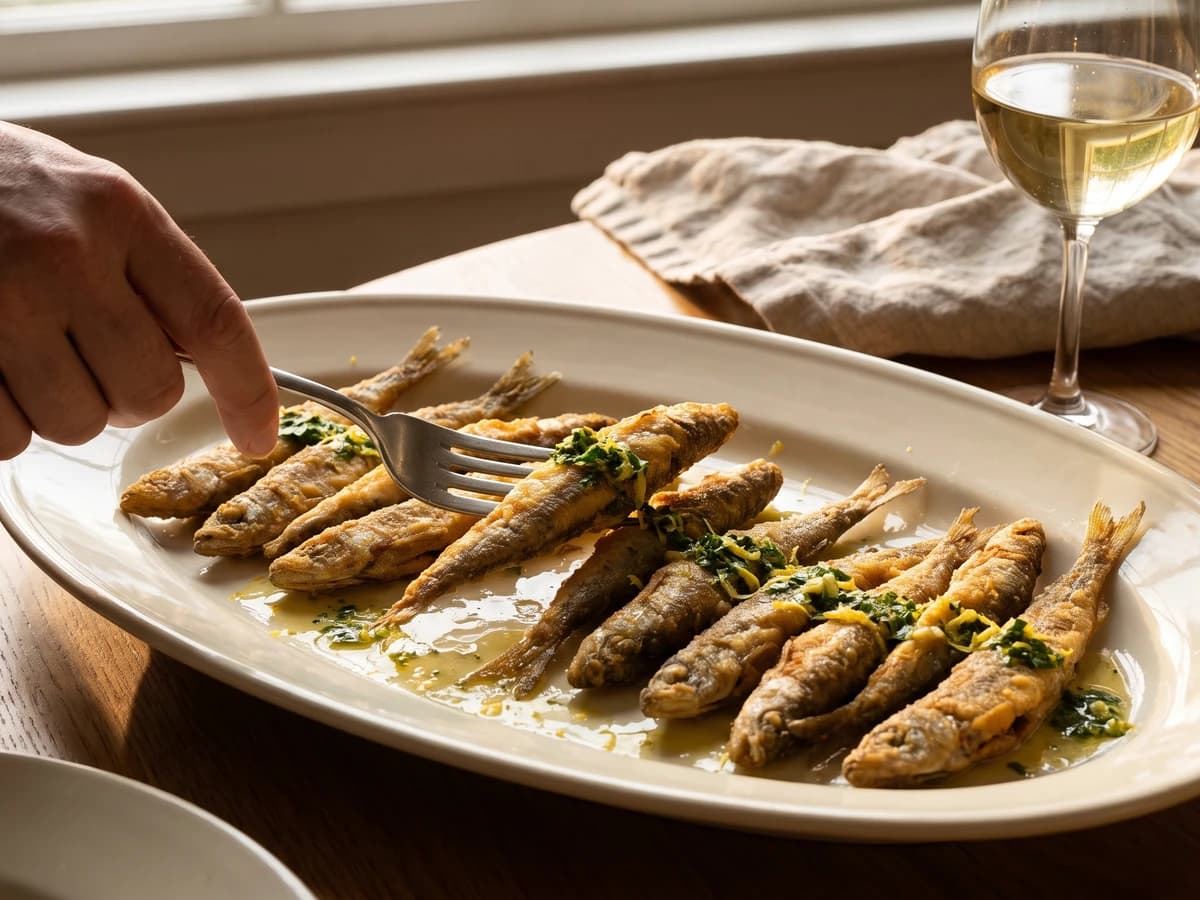
Éperlans à l’Anglaise turns small fish into a lesson in disciplined coating: boned smelts under a close, crisp crumb, pan-fried in clarified butter and finished with bright, half-melted maître d’hôtel butter.

Chef Juliette
Tiny smelts, shallot, mushrooms, white wine, gratin sauce, and fine bread raspings meet a fierce oven, where the fish must turn tender in the same breath the buttered crust bronzes.