
Chef Juliette
John Dory (St. Pierre)
John Dory has the delicacy of sole and the firmness of turbot. A light flouring, a quick butter sauté, and nut-brown beurre noisette show exactly why looks never mattered.
A cooking platform built around craft, culture, and the stories behind what we eat.
Created by Chef Juliette
Based on No. 1403, Pieds de Porc Truffés, from Le Guide Culinaire (1907) by Auguste Escoffier
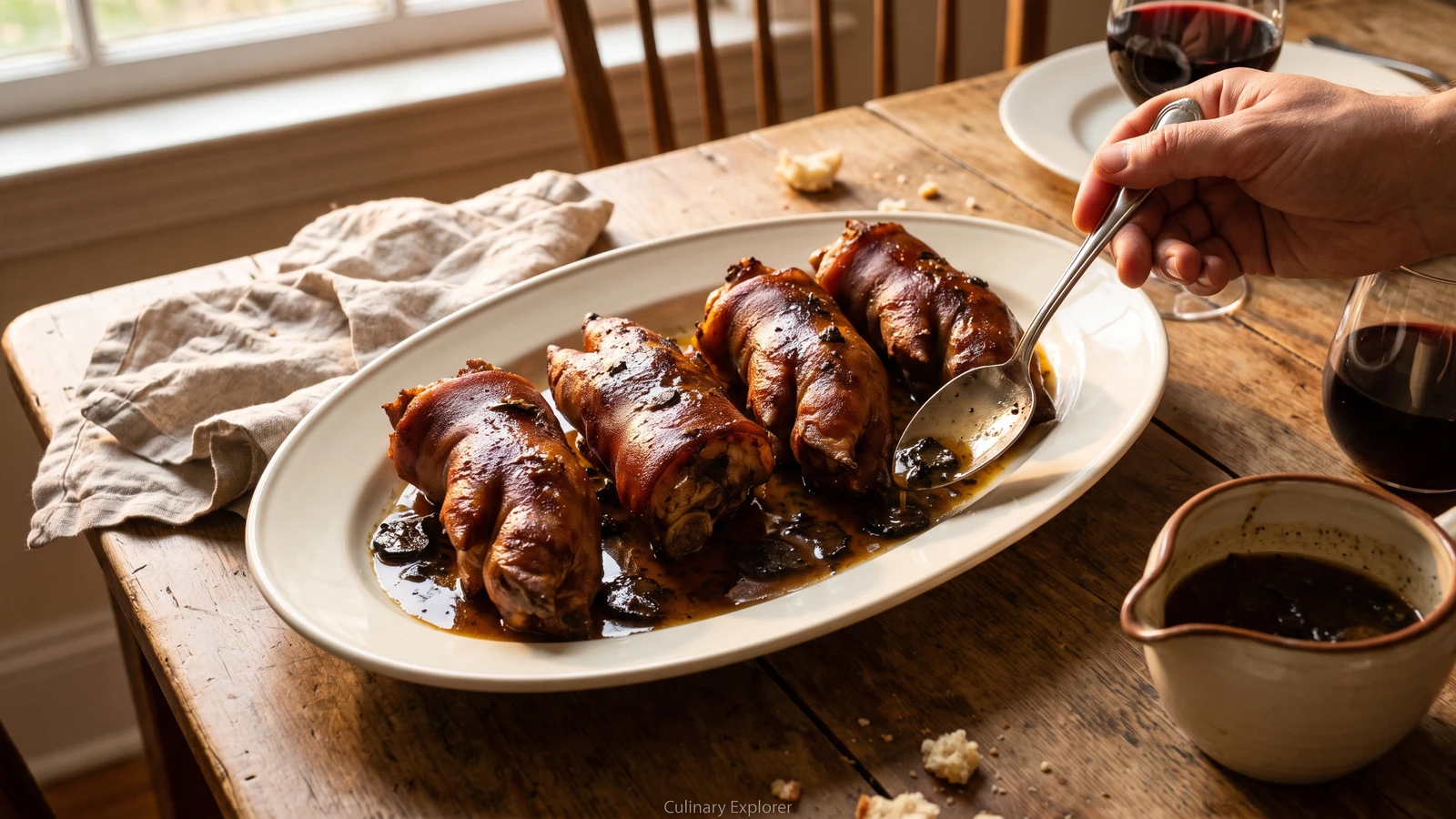
Pieds de Porc Truffés, prepared by the charcutier, meet gentle butter basting and glossy Sauce Périgueux: a rich lesson in patient grilling, where low heat warms the center before the exterior bronzes.
Pieds de Porc Truffés (truffled pig's trotters) teach the discipline of gentle finishing. Everything substantial has already been done by the charcutier; your task is not to improve the trotter, but to heat it through while butter bronzes the outside without bursting its delicate, gelatin-rich structure. The one true thing to know before touching the pan is simple: distance from the heat matters more than fierceness.
The original entry assumes a charcutier has simmered, boned, truffled, and shaped the trotters, a saucier is holding Sauce Périgueux, and a salamander can color each order under watch. At home, buy four fully cooked, ready-prepared trotters, warm a finished Sauce Périgueux in a small pan, and set a tray well below a low broiler. The brigade scale and constant basting hand are scaffolding, so they go; the prepared trotter, real butter, gentle grilling, repeated basting, and Sauce Périgueux are the dish, so they stay. One cook, one stove, one evening.
When they are right, the exterior is deep butter-gold, the center is thoroughly hot and yielding, and the sauce pools dark and glossy around them. The step that decides everything is the slow turn under overhead heat: baste often, move the tray before the butter scorches, and never force a fragile trotter with tongs.
Pig's trotters belong equally to the charcutier and the household pot across France, but the long-cooked then grilled form is closely associated with Sainte-Menehould in Champagne. Pieds de Porc Truffés move that thrift to the classical table by pairing the charcutier's prepared trotter with Sauce Périgueux, whose name and black-truffle character point to Périgord. The sauce's name does not make the whole dish Périgourdin; its identity comes from the meeting of specialist charcuterie, gentle grilling, and a finished classical sauce.
Quantity
4 (about 3 lb / 1.36 kg total)
Quantity
¼ cup (60 ml / 57 g)
melted
Quantity
1½ cups (360 ml / about 380 g)
fully prepared
Quantity
Up to 2 tablespoons (30 ml / 30 g)
only if needed to loosen the Sauce Périgueux
| Ingredient | Quantity |
|---|---|
| fully cooked, ready-prepared truffled pig's trotters | 4 (about 3 lb / 1.36 kg total) |
| unsalted buttermelted | ¼ cup (60 ml / 57 g) |
| Sauce Périgueuxfully prepared | 1½ cups (360 ml / about 380 g) |
| hot water (optional)only if needed to loosen the Sauce Périgueux | Up to 2 tablespoons (30 ml / 30 g) |
Take the prepared trotters from the refrigerator about 20 minutes before cooking. Remove any string, plastic, or other wrapping the charcutier identifies as inedible, but leave an edible caul, casing, or crumb coating intact. Set a broiler-safe rack 8 to 10 inches (20 to 25 cm) below the element and preheat the broiler on low. Arrange the trotters on a rimmed tray, seam-side down if they have a visible seam, then brush them generously with about one-quarter of the melted butter.
Put the fully prepared Sauce Périgueux in a small heavy saucepan and warm it over the gentlest heat, stirring along the bottom until small bubbles appear at the edge. Hold it warm without boiling. If it reduces too far and no longer flows slowly from the spoon, take it off the heat and stir in hot water one teaspoon at a time. Ça se rattrape. Keep the sauce whole and distinct; its construction belongs to its own preparation, just as the source intended.
Set the tray under the broiler and grill the trotters very gently for 10 to 12 minutes, rotating the tray once and basting every 3 minutes with more melted butter. You want a gradual butter-gold surface, not dark spots over a cold center. If the butter begins to smoke or the outside colors quickly, lower the tray at once or switch off the broiler for 2 minutes before continuing. Heat control is the technique here.
Turn each trotter with two broad spatulas, supporting its full length, and brush it again with butter. Continue grilling and basting for 10 to 15 minutes, rotating the tray as needed, until every side is bronzed and the center reaches 165°F (74°C). If a trotter opens, don't wrestle it with tongs. Spoon the filling gently back into place, support the opening with a loose collar of foil, and finish it farther from the heat. Ça se rattrape.
Spoon a shallow pool of hot Sauce Périgueux onto four warm plates and set one bronzed trotter on each, leaving part of the buttered surface exposed rather than drowning it. Pass the remaining sauce at the table. Serve immediately, while the exterior still carries its gentle crust and the center remains soft and yielding. À table!
1 serving (about 420g)
Culinary guides, cultural storytelling, and the editorial depth that makes cooking meaningful.
Discover Culinary ExplorerChef Juliette
John Dory has the delicacy of sole and the firmness of turbot. A light flouring, a quick butter sauté, and nut-brown beurre noisette show exactly why looks never mattered.

Chef Juliette
Fresh haddock proves its delicacy in the meunière pan: a fine flour crust, moist pearly flakes, and beurre noisette sharpened with lemon and parsley, ready from one skillet in half an hour.
Chef Juliette
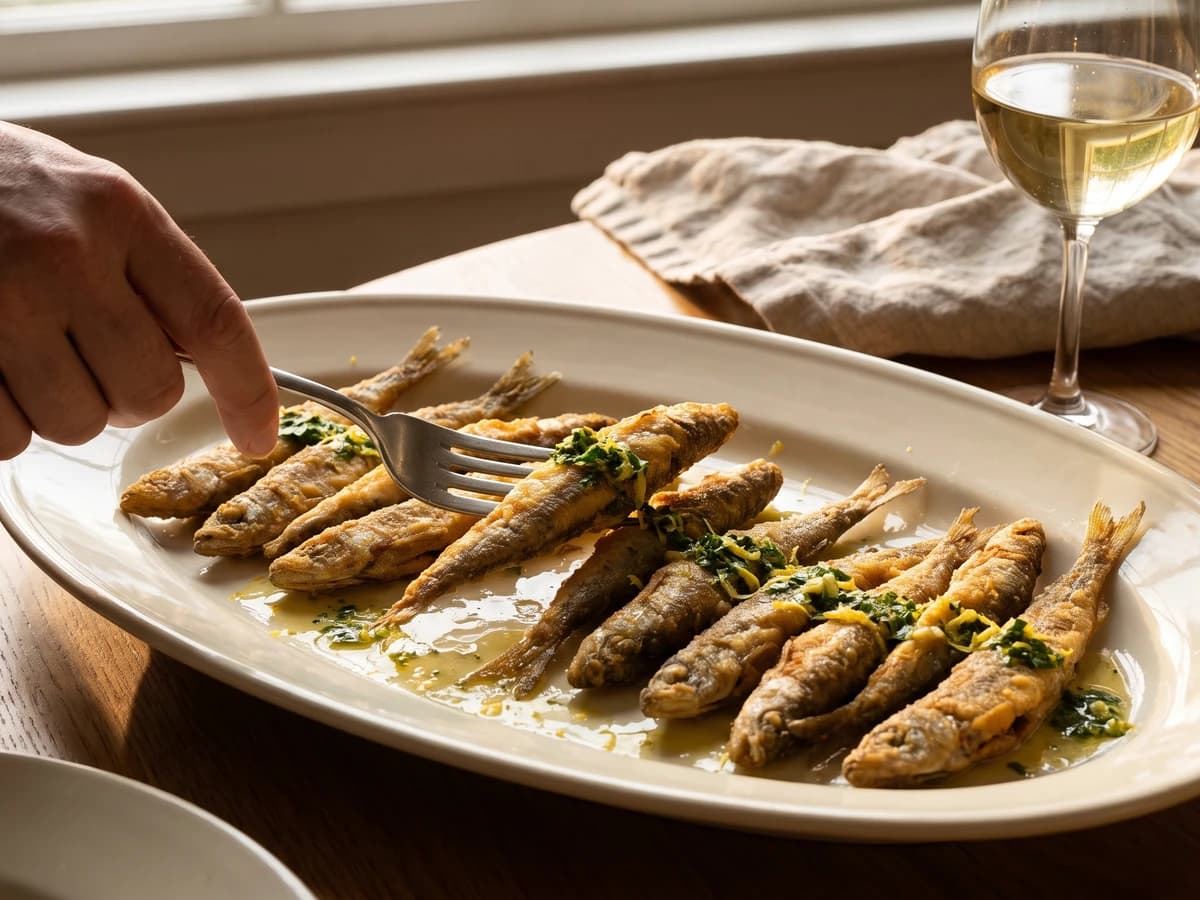
Éperlans à l’Anglaise turns small fish into a lesson in disciplined coating: boned smelts under a close, crisp crumb, pan-fried in clarified butter and finished with bright, half-melted maître d’hôtel butter.

Chef Juliette
Tiny smelts, shallot, mushrooms, white wine, gratin sauce, and fine bread raspings meet a fierce oven, where the fish must turn tender in the same breath the buttered crust bronzes.