
Chef Juliette
John Dory (St. Pierre)
John Dory has the delicacy of sole and the firmness of turbot. A light flouring, a quick butter sauté, and nut-brown beurre noisette show exactly why looks never mattered.
A cooking platform built around craft, culture, and the stories behind what we eat.
Created by Chef Juliette
Based on No. 1341, Rognons Brochette à l’Espagnole, from Le Guide Culinaire (1907) by Auguste Escoffier
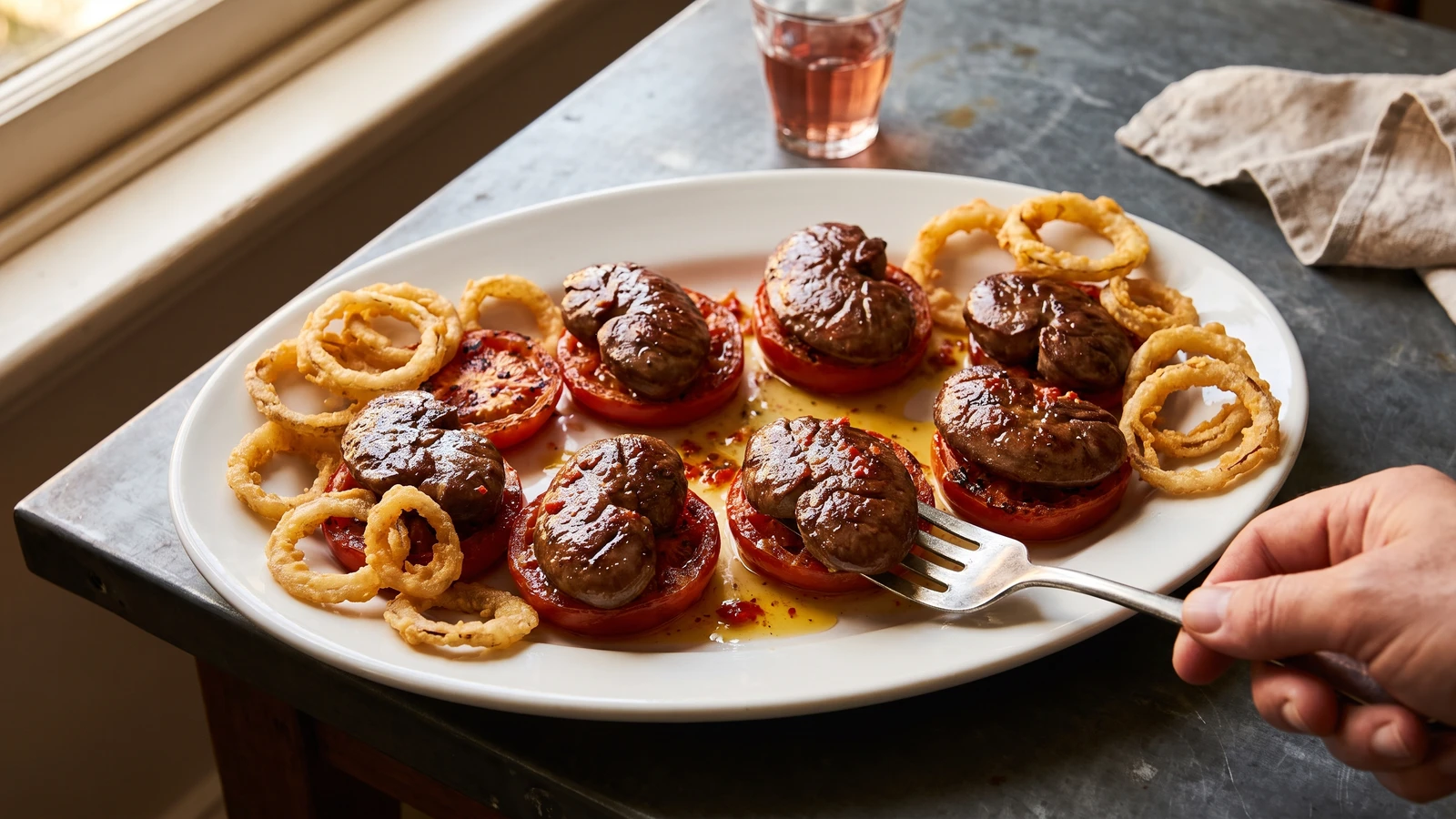
Skewered kidneys prove that offal rewards speed: lamb kidneys grilled just through, set over tomatoes melting with capsicum maître-d’hôtel butter, then circled with crisp fried onion.
Rognons Brochette à l’Espagnole (skewered kidneys with Spanish-style garnish) teaches one hard rule: a kidney must meet fierce heat and leave it quickly. Grill it timidly and it tightens while its juices escape; grill it fast and it stays springy, succulent, and clean-tasting beneath its browned surface.
The source entry assumed separate hands at the grill and fryer, with a salamander held hot for service. Your honest equivalent is simpler: fry the onion rings first and keep them on a rack, then use a fiercely heated broiler or outdoor grill for the tomatoes and kidneys. Simultaneous stations were brigade scaffolding. The quick grilling, pressed tomato halves, exact capsicum-butter proportion, and crisp onion border are the dish itself, so every one remains. One cook, one stove, one evening.
This home-scale preparation uses eight small kidneys, two per person. Mutton is the source material’s meat; when it cannot be had, lamb kidney is the practical equivalent, milder and usually smaller, which means it cooks even faster. The one step that matters most is judging that brief grilling time, so have the platter ready and the thermometer in your hand before the kidneys meet the heat.
Rognons Brochette à l’Espagnole belongs to the codified Parisian grill repertoire, where inexpensive offal received exact cooking and an architectural garnish fit for dining-room service. The qualifier à l’Espagnole names the garnish of tomato, capsicum, and onion, not a ladle of brown sauce, a common confusion caused by classical French nomenclature. Kidneys remained equally at home in bistros and Lyon bouchons, but the circle of buttered tomatoes and fried onion shows their journey from everyday offal to formal platter service.
Quantity
8 (about 1 lb / 450 g total)
outer membranes and white cores removed, butterflied
Quantity
4 (about 1 lb / 450 g total)
halved crosswise
Quantity
6 tablespoons (90 ml / 3 oz / 85 g)
softened
Quantity
2 tablespoons (30 ml / 2/3 oz / 19 g)
thoroughly drained and finely chopped
Quantity
1 tablespoon (15 ml / 4 g)
finely chopped
Quantity
2 teaspoons (10 ml / 10 g)
Quantity
2 tablespoons (30 ml / 28 g)
melted
Quantity
2 (about 12 oz / 340 g total)
sliced into 1/4-inch rings
Quantity
3/4 cup (180 ml / 90 g)
Quantity
3 cups (720 ml / 660 g)
Quantity
2 teaspoons (10 ml / 12 g)
divided
Quantity
1 teaspoon (5 ml / 2 g)
divided
| Ingredient | Quantity |
|---|---|
| mutton or lamb kidneysouter membranes and white cores removed, butterflied | 8 (about 1 lb / 450 g total) |
| small firm tomatoeshalved crosswise | 4 (about 1 lb / 450 g total) |
| unsalted buttersoftened | 6 tablespoons (90 ml / 3 oz / 85 g) |
| roasted red capsicum or jarred pimientothoroughly drained and finely chopped | 2 tablespoons (30 ml / 2/3 oz / 19 g) |
| flat-leaf parsleyfinely chopped | 1 tablespoon (15 ml / 4 g) |
| fresh lemon juice | 2 teaspoons (10 ml / 10 g) |
| unsalted buttermelted | 2 tablespoons (30 ml / 28 g) |
| medium yellow onionssliced into 1/4-inch rings | 2 (about 12 oz / 340 g total) |
| plain flour | 3/4 cup (180 ml / 90 g) |
| neutral frying oil | 3 cups (720 ml / 660 g) |
| fine sea saltdivided | 2 teaspoons (10 ml / 12 g) |
| freshly ground black pepperdivided | 1 teaspoon (5 ml / 2 g) |
Beat the softened butter with the capsicum, parsley, lemon juice, 1/4 teaspoon of the salt, and a pinch of pepper. This is maître-d’hôtel butter, parsley-and-lemon compound butter, carrying the source entry’s exact proportion of two-thirds ounce capsicum to three ounces butter. Divide it into eight walnut-sized pieces and chill them while you cook. If the butter grows greasy and refuses to hold the capsicum, it has become too warm. Chill it for five minutes and beat again. Ça se rattrape.
Pull away each kidney’s thin outer membrane. Split it lengthwise like a book, leaving a narrow hinge, then cut out the firm white core without severing the two halves. Thread a short skewer across the ends to hold the kidney open and flat. Pat every surface thoroughly dry, then keep the kidneys cold and uncovered while you prepare the garnish. Season only just before grilling, because early salt draws moisture onto the surface.
Gently squeeze each tomato half over the sink to press out the loose seeds and watery pulp, taking care not to crush its walls. Season the cut faces lightly with salt and pepper, then leave them cut-side down on a rack for ten minutes. Pat them dry. Pressing is what lets the tomatoes grill rather than collapse into their own water, and it leaves a shallow cup for the butter.
Heat the frying oil in a deep, heavy saucepan to 350°F (175°C). Separate the onion rings. Mix the flour with 1/2 teaspoon salt and 1/4 teaspoon pepper, dredge the rings lightly, and shake away every loose patch. Fry in small batches for 2 to 3 minutes, turning once, until deep gold and crisp. Drain on a wire rack and season at once. If the rings soften while the kidneys cook, refry them at 375°F (190°C) for 30 seconds. Ça se rattrape, and the second frying makes them crisper.
Set an oven rack about 4 inches from the broiler and heat it on high, or prepare an outdoor grill for fierce direct heat. Brush the tomato halves with half the melted butter. Broil them cut-side up, or grill them cut-side down and turn once, for 4 to 6 minutes, until browned at the edges and just tender while still holding their shape. Arrange them cut-side up in a circle on a warm oval platter and place one piece of capsicum maître-d’hôtel butter in each hollow.
Brush the kidneys with the remaining melted butter and season both sides with the remaining salt and pepper. Put them beneath the broiler or over the hottest part of the grill, leaving space between them. Cook for about 2 minutes on the first side and 1 to 2 minutes on the second, until well browned and the thickest part reaches 160°F (71°C). The clock is only a guide because mutton kidneys may be larger than lamb. If the centre is under temperature, return the kidneys to the heat in 30-second bursts. Once overcooked they cannot be made tender again, so fast heat and an instant-read thermometer are the honest guardrails.
Set one skewered kidney on each butter-capped tomato half as soon as it leaves the grill. The capsicum maître-d’hôtel butter should soften beneath it, glazing the kidney and pooling lightly over the tomato. Surround the circle with the crisp onion rings and carry the platter straight to the table. This dish waits for nobody. À table!
1 serving (about 305g)
Culinary guides, cultural storytelling, and the editorial depth that makes cooking meaningful.
Discover Culinary ExplorerChef Juliette
John Dory has the delicacy of sole and the firmness of turbot. A light flouring, a quick butter sauté, and nut-brown beurre noisette show exactly why looks never mattered.

Chef Juliette
Fresh haddock proves its delicacy in the meunière pan: a fine flour crust, moist pearly flakes, and beurre noisette sharpened with lemon and parsley, ready from one skillet in half an hour.
Chef Juliette
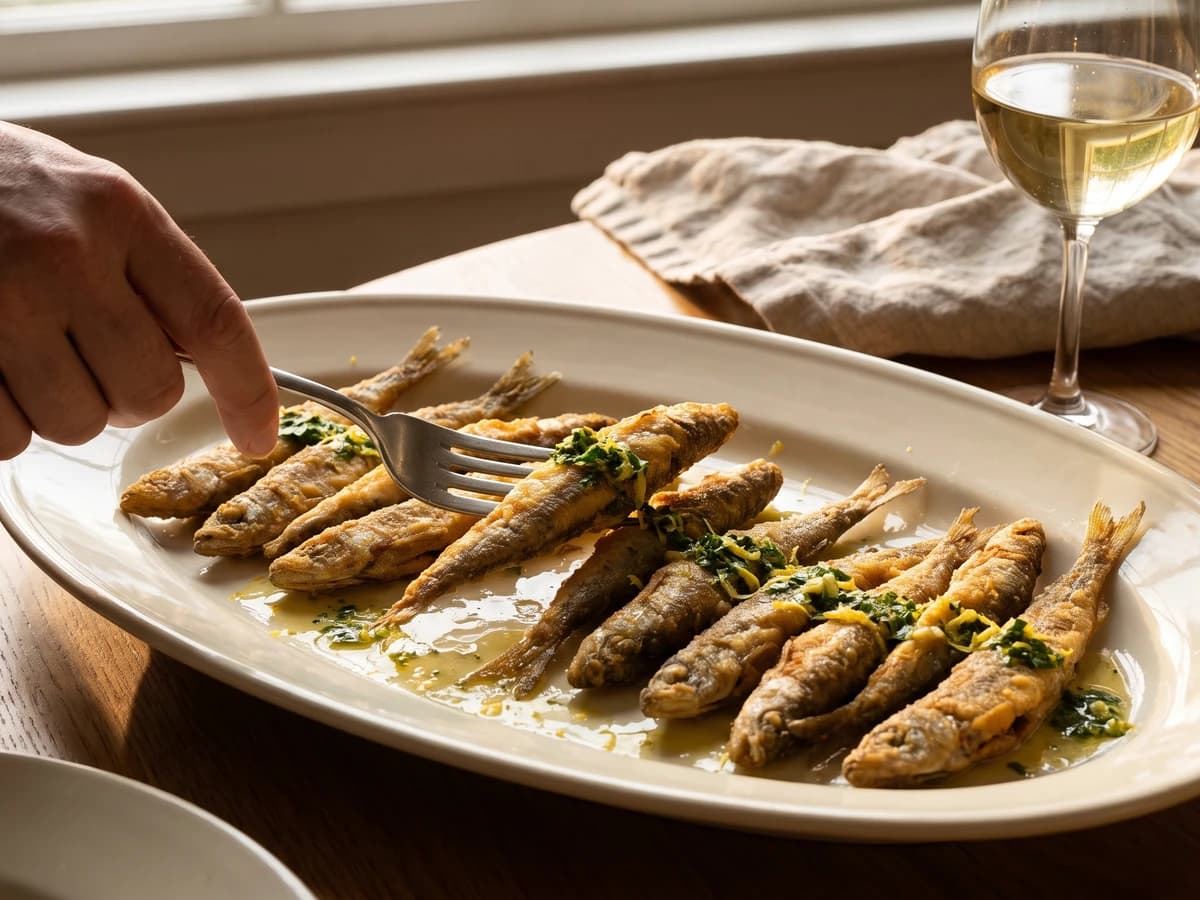
Éperlans à l’Anglaise turns small fish into a lesson in disciplined coating: boned smelts under a close, crisp crumb, pan-fried in clarified butter and finished with bright, half-melted maître d’hôtel butter.

Chef Juliette
Tiny smelts, shallot, mushrooms, white wine, gratin sauce, and fine bread raspings meet a fierce oven, where the fish must turn tender in the same breath the buttered crust bronzes.