
Chef Juliette
John Dory (St. Pierre)
John Dory has the delicacy of sole and the firmness of turbot. A light flouring, a quick butter sauté, and nut-brown beurre noisette show exactly why looks never mattered.
A cooking platform built around craft, culture, and the stories behind what we eat.
Created by Chef Juliette
Based on No. 1338, Croûte aux Rognons, from Le Guide Culinaire (1907) by Auguste Escoffier
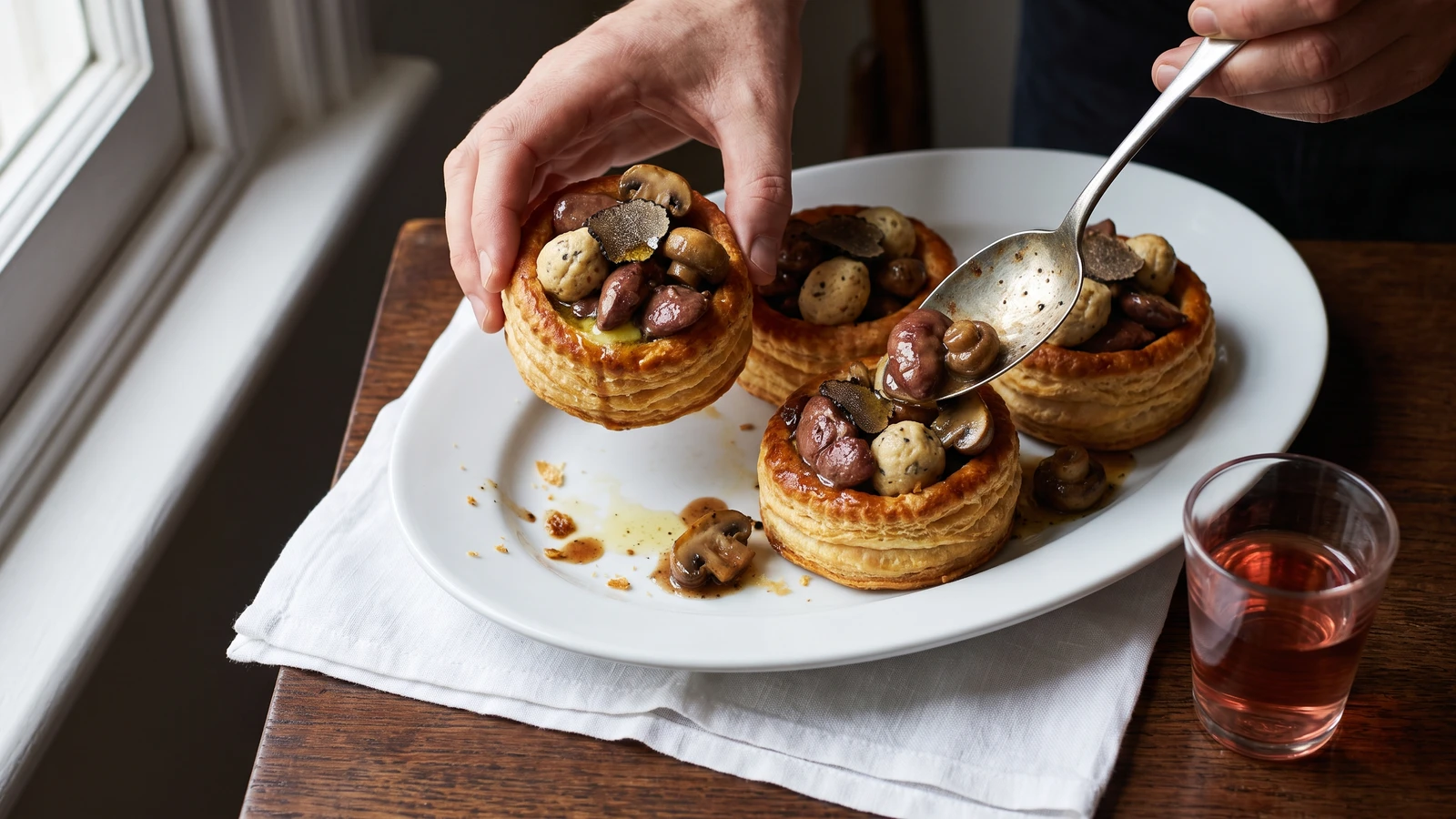
Croûte aux rognons turns a fast kidney Sauté into supper: crisp buttered bread cups, bronzed mushrooms, tender little forcemeat quenelles, and black truffle, all heaped high and carried to the table fiercely hot.
Croûte aux rognons (buttered bread cups with kidneys) teaches Sauté, cooking small pieces quickly in a broad hot pan with just enough fat to brown them. The one true thing to know before touching the pan is that kidneys won't wait. Dry them thoroughly, crowd nothing, and have every garnish ready before the heat goes on. A slow kidney becomes firm and grey; a fast one stays juicy beneath its bronze.
The book's kitchen assumed a tin loaf cut to service dimensions, ordinary forcemeat already waiting in the cold room, truffles in the pantry, and several hands to assemble the croûtes while the Sauté stayed hot. A saucier, a perpetual stockpot, and a salamander would be inventions here, because this entry calls for none of them. For one cook, one stove, one evening, butcher-made plain veal-and-pork forcemeat becomes 16 tiny quenelles, and four croûtes dry on an ordinary sheet pan. Making a separate brigade batch of forcemeat is scaffolding and can go; the quenelles themselves, with the hollowed buttered bread, mushrooms, kidneys, and truffle, are the dish and must stay. Mature mutton kidneys remain the first choice, but four lamb kidneys of the same total weight are the honest market equivalent when mutton is unavailable, with a slightly gentler flavour and a shorter Sauté.
At the table, the croûtes should crack cleanly beneath the fork, giving way to bronzed kidney, buttery mushrooms, pale little quenelles, and the dark perfume of truffle. Build every other element first. The final Sauté is the three minutes that decide the dish.
Croûte aux rognons belongs to the Parisian classical and bourgeois table rather than to one regional larder, joining the offal pan to the formal kitchen's habit of presenting small sautés in edible cases. Croûte here means a case cut from firm tin loaf, not pastry: buttering and drying the bread made it strong enough to carry the kidney juices while remaining crisp. The linen napkin beneath the individual croûtes was practical service, keeping them steady on the platter as they traveled hot from kitchen to table.
Quantity
1 loaf, enough for 4 rounds each 2½ inches (6.5 cm) in diameter and 1⅓ inches (3.5 cm) thick
Quantity
6 tablespoons (90 ml / 85 g)
divided
Quantity
3 medium mutton kidneys or 4 small lamb kidneys (about 10 ounces / 280 g total)
outer membranes and white cores removed
Quantity
2 cups (480 ml / 140 g)
wiped and quartered
Quantity
½ cup (120 ml / 115 g)
Quantity
1 tablespoon (15 ml / 15 g)
Quantity
1 small truffle (about ½ ounce / 15 g)
thinly sliced
Quantity
1¼ teaspoons (6 ml / 7 g)
divided
Quantity
½ teaspoon (2.5 ml / 1 g)
| Ingredient | Quantity |
|---|---|
| unsliced firm white tin loaf | 1 loaf, enough for 4 rounds each 2½ inches (6.5 cm) in diameter and 1⅓ inches (3.5 cm) thick |
| unsalted butterdivided | 6 tablespoons (90 ml / 85 g) |
| mutton kidneys or small lamb kidneysouter membranes and white cores removed | 3 medium mutton kidneys or 4 small lamb kidneys (about 10 ounces / 280 g total) |
| small button mushroomswiped and quartered | 2 cups (480 ml / 140 g) |
| plain, unseasoned veal-and-pork forcemeat or sausage meat | ½ cup (120 ml / 115 g) |
| heavy cream | 1 tablespoon (15 ml / 15 g) |
| black truffle, fresh or preserved wholethinly sliced | 1 small truffle (about ½ ounce / 15 g) |
| fine sea saltdivided | 1¼ teaspoons (6 ml / 7 g) |
| freshly ground black pepper | ½ teaspoon (2.5 ml / 1 g) |
Pull away every trace of the thin outer membrane while the kidneys are cold. Split them lengthwise, cut out the hard white core and branching tubes, then divide the flesh into pieces about 1 inch (2.5 cm) across. Pat them thoroughly dry and return them to the cold. Quarter the mushrooms and slice the truffle now as well. Once the Sauté begins, there is no useful pause.
Work the cream into the cold forcemeat until it looks smooth and slightly tacky. With two wet teaspoons, shape 16 small ordinary forcemeat quenelles. Bring a shallow saucepan of water seasoned with ¼ teaspoon of the salt to the barest tremble, slip in the quenelles, and poach gently for 5 to 6 minutes, turning once, until firm and cooked through to 160°F (71°C). Lift them out with a slotted spoon and drain well. If one begins to split, the water is too lively; pull the pan from the heat and add a spoonful of cold water. Ça se rattrape.
Heat the oven to 375°F (190°C). Cut four bread slabs exactly 1⅓ inches (3.5 cm) thick, then stamp out 2½-inch (6.5 cm) rounds. Score inside each round with a paring knife, leaving a wall about ¼ inch (6 mm) thick, and remove the crumb with a teaspoon while preserving a bottom of the same thickness. Melt 3 tablespoons of the butter and brush the croûtes generously inside, outside, and underneath. Bake open-side up for 12 to 15 minutes, until pale butter-gold, crisp at the rim, and dry inside. If a base still feels soft, lower the oven to 325°F (165°C) and give it another 3 to 5 minutes. A dry croûte carries the filling; a soft one collapses beneath it.
Melt the remaining 3 tablespoons of butter gently in the wide skillet. Pour the clear butterfat into a small bowl, leaving the milky sediment behind, then wipe the skillet clean. Heat about one-third of the clarified butter until it glistens. Add the mushrooms in one layer and Sauté over medium-high heat for 4 to 5 minutes, turning only after their first sides have bronzed. Season with ¼ teaspoon salt, lift them out, and keep them close to the stove.
Raise the heat to high and add most of the remaining clarified butter. Season the dry kidneys with the remaining salt and all the pepper just before they enter the pan. Lay them down in one uncrowded layer, leave them untouched for 45 seconds, then turn and Sauté briskly for 3 to 4 minutes, until bronze outside and just firm at the centre. Remove them the instant the thickest piece reaches 160°F (71°C). If the kidneys release enough liquid to begin boiling, lift them out at once, reduce that liquid hard until glossy, add a little reserved butter if the pan is dry, and return the kidneys for only 20 seconds. Ça se rattrape, but they must not stew.
Lower the heat to medium. Return the mushrooms to the skillet with the drained quenelles and two-thirds of the truffle slices. Toss for 30 to 45 seconds, just long enough to heat everything and coat it in the kidney juices and butter. Warm the truffle, don't fry it. If the filling looks dry, fold in the last teaspoon of clarified butter; don't add stock, wine, or cream, because liquid would soften the croûtes and the source calls for a Sauté, not a stew.
Arrange the hot croûtes on a warmed oval platter lined with a clean folded linen napkin. Divide the kidney mixture among them quickly, filling the cavities and heaping the remainder above the rims. Spoon the buttery pan juices over the filling, keeping the platter beneath dry, and lay the remaining truffle slices across the tops. Carry them straight to the table, very hot. À table!
1 serving (about 155g)
Culinary guides, cultural storytelling, and the editorial depth that makes cooking meaningful.
Discover Culinary ExplorerChef Juliette
John Dory has the delicacy of sole and the firmness of turbot. A light flouring, a quick butter sauté, and nut-brown beurre noisette show exactly why looks never mattered.

Chef Juliette
Fresh haddock proves its delicacy in the meunière pan: a fine flour crust, moist pearly flakes, and beurre noisette sharpened with lemon and parsley, ready from one skillet in half an hour.
Chef Juliette
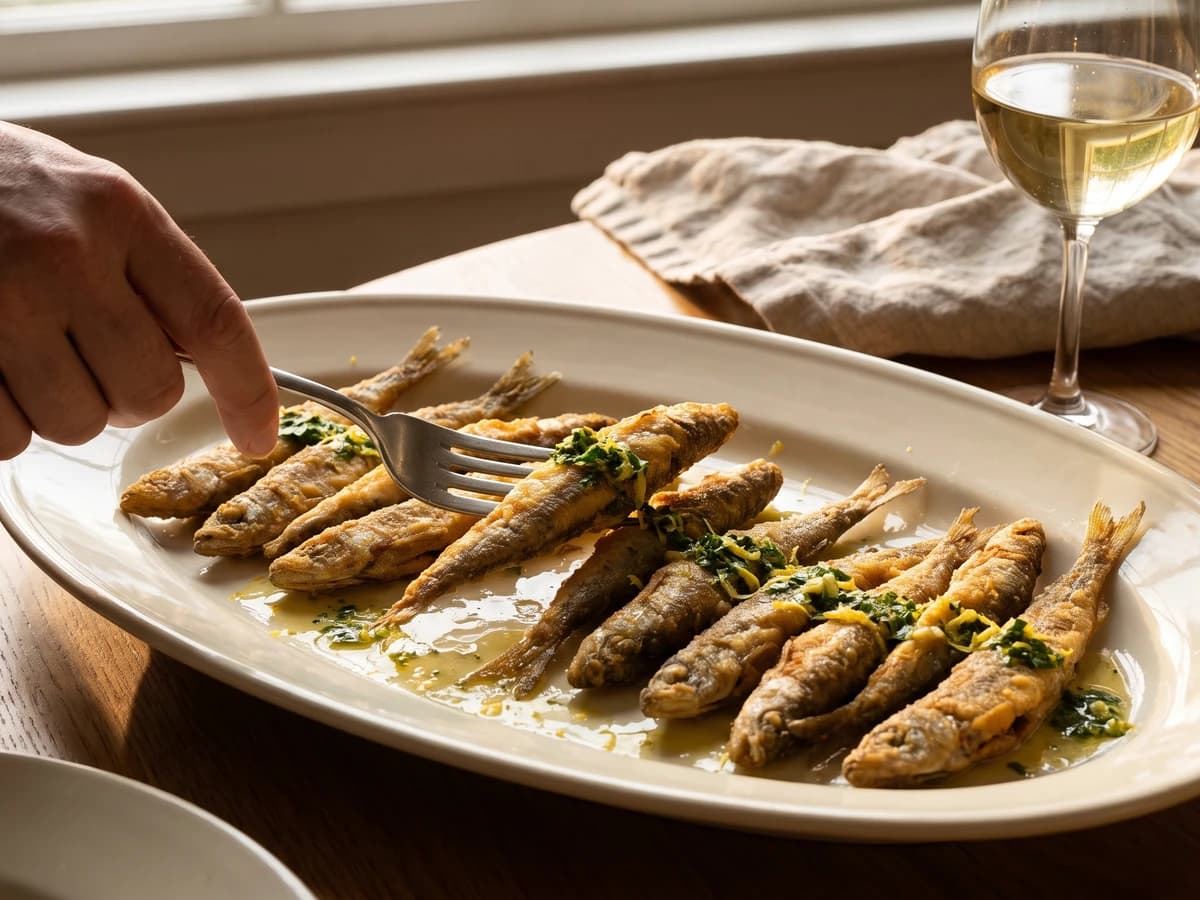
Éperlans à l’Anglaise turns small fish into a lesson in disciplined coating: boned smelts under a close, crisp crumb, pan-fried in clarified butter and finished with bright, half-melted maître d’hôtel butter.

Chef Juliette
Tiny smelts, shallot, mushrooms, white wine, gratin sauce, and fine bread raspings meet a fierce oven, where the fish must turn tender in the same breath the buttered crust bronzes.