
Chef Juliette
John Dory (St. Pierre)
John Dory has the delicacy of sole and the firmness of turbot. A light flouring, a quick butter sauté, and nut-brown beurre noisette show exactly why looks never mattered.
A cooking platform built around craft, culture, and the stories behind what we eat.

Created by Chef Juliette
Based on No. 1337, Rognons Sautés Turbigo, from Le Guide Culinaire (1907) by Auguste Escoffier
Mutton kidneys seared fast in butter, ringed with browned chipolatas and small mushrooms, then covered in a peppery tomatéd half-glaze: a lesson in fierce heat, swift hands, and proper timing.
Rognons sautés Turbigo (sautéed mutton kidneys with chipolatas and mushrooms) teaches one unforgiving, useful truth: kidneys must meet a properly hot pan and leave it quickly. They should brown outside while remaining tender within. Hesitation gives you grey juices and the texture of an eraser.
The original entry assumed a saucier with half-glaze ready, stock never off the fire, a salamander for the chipolatas, and enough hands to bring every garnish together hot. At home, gelatin-rich stock reduced with tomato purée gives the honest body and distinct tomato character of the tomatéd sauce, while your broiler handles the sausages and one skillet does the remaining work. The long mother-sauce preparation is brigade scaffolding and can go; the reduction, butter sear, small mushrooms, chipolatas, and circular timbale arrangement are the dish and must stay. One cook, one stove, one evening.
Prepare the sauce and both garnishes before the kidneys enter the pan. That order is not fussiness. It lets you serve the kidneys the instant they are ready, and that swift final sauté is the one step that decides the dish.
Rognons sautés Turbigo belongs to the Parisian classical table, although Turbigo is not a French region: the name recalls the Lombard town and battle commemorated by Paris's rue de Turbigo. The preparation carried modest bistro ingredients through grand-kitchen grammar, arranging quickly cooked offal formally in a timbale with a carefully finished sauce. What defines Turbigo in the canon is the combination preserved here: chipolatas, small mushrooms, and a distinctly tomatéd half-glaze poured over sautéed mutton kidney.
Quantity
4 (about 1 lb / 450 g total)
outer membranes removed, halved lengthwise, and central white cores trimmed
Quantity
8 (about 12 oz / 340 g total)
Quantity
about 24 (8 oz / 225 g)
wiped and stems trimmed
Quantity
2½ cups (600 ml / 600 g)
Quantity
3 tablespoons (45 ml / 50 g)
Quantity
1 teaspoon (5 ml / 3 g)
Quantity
6 tablespoons (90 ml / 85 g)
divided
Quantity
1¼ teaspoons (6 ml / 8 g)
divided
Quantity
1 teaspoon (5 ml / 2 g)
divided
Quantity
up to ¼ cup (60 ml / 60 g)
for loosening the sauce if necessary
| Ingredient | Quantity |
|---|---|
| mutton kidneysouter membranes removed, halved lengthwise, and central white cores trimmed | 4 (about 1 lb / 450 g total) |
| small plain pork chipolata sausages | 8 (about 12 oz / 340 g total) |
| very small button mushroomswiped and stems trimmed | about 24 (8 oz / 225 g) |
| unsalted gelatin-rich veal or beef stock | 2½ cups (600 ml / 600 g) |
| double-concentrated tomato purée | 3 tablespoons (45 ml / 50 g) |
| unflavored powdered gelatin (optional) | 1 teaspoon (5 ml / 3 g) |
| unsalted butterdivided | 6 tablespoons (90 ml / 85 g) |
| fine sea saltdivided | 1¼ teaspoons (6 ml / 8 g) |
| freshly ground black pepperdivided | 1 teaspoon (5 ml / 2 g) |
| hot water (optional)for loosening the sauce if necessary | up to ¼ cup (60 ml / 60 g) |
Pull away every trace of the thin outer membrane, split each kidney lengthwise, and cut out the hard white core with the point of a small knife without carving deeply into the lobes. Wipe the halves dry and keep them cold. Do not season yet; salt left sitting on kidney draws moisture to the surface, and moisture prevents the fast brown crust the sauté requires.
If the chilled stock does not set softly, take 3 tablespoons (45 ml) from it, sprinkle over the optional gelatin, and leave it for 5 minutes. Boil the remaining stock in a wide saucepan until reduced by half to about 1¼ cups (300 ml), then whisk in the tomato purée and bloomed gelatin. Simmer for 4 to 5 minutes, until the sauce naps the back of a spoon and the tomato is distinctly present in both colour and flavour. This is tomatéd, not merely tinted. Season with ½ teaspoon of the salt and ½ teaspoon of the pepper, then whisk in 1 tablespoon of the butter and hold the sauce over the gentlest heat. If it remains thin, reduce it further; if it tightens into a glaze, whisk in hot water one spoonful at a time. Ça se rattrape.
Heat the broiler and set a rack about 4 inches (10 cm) below it. Arrange the chipolatas on a small rimmed tray and broil for 8 to 12 minutes, turning every few minutes, until their skins are evenly bronzed and their centres reach 160°F (71°C). Keep them warm, loosely covered. The old salamander gave fierce overhead heat; the broiler is its honest home equivalent.
Melt 1 tablespoon of the butter in a large skillet over medium-high heat. Add the mushrooms in one layer and cook for 6 to 8 minutes, turning as their sides colour, until they are browned, tender, and still round rather than collapsed. Season with ¼ teaspoon salt and ⅛ teaspoon pepper, then transfer them to a warm bowl. Wipe the skillet clean so damp mushroom residue cannot interfere with the kidney sauté.
Season the kidney halves at the last moment with the remaining ½ teaspoon salt and ⅜ teaspoon pepper. Heat the clean skillet over high heat until thoroughly hot. Add 2 tablespoons of butter, and when its foam subsides, lay in half the kidneys cut-side down. Cook without moving for about 90 seconds, turn, and brown the rounded sides for another 1 to 2 minutes, rolling them briefly onto any pale edges. Transfer them to a warm plate and repeat with the remaining 2 tablespoons butter and kidneys. They should be deeply browned and just cooked through, reaching 160°F (71°C) at the thickest point, but still yielding under a finger. If the pan floods with grey liquid, lift the kidneys out immediately, pour away the liquid, wipe and reheat the pan, then return them for 30 seconds per side. Ça se rattrape. Leaving them to boil in that liquid does not.
Empty and dry a round serving dish warmed with hot water. Arrange the kidney halves in a close circle around its edge, then pile the whole mushrooms and grilled chipolatas in the middle. Bring the sauce back just to a tremble, taste for the forceful seasoning the entry demands, and pour it over the kidneys and garnish so everything gleams and a little sauce pools beneath. Serve immediately. À table!
1 serving (about 285g)
Culinary guides, cultural storytelling, and the editorial depth that makes cooking meaningful.
Discover Culinary ExplorerChef Juliette
John Dory has the delicacy of sole and the firmness of turbot. A light flouring, a quick butter sauté, and nut-brown beurre noisette show exactly why looks never mattered.

Chef Juliette
Fresh haddock proves its delicacy in the meunière pan: a fine flour crust, moist pearly flakes, and beurre noisette sharpened with lemon and parsley, ready from one skillet in half an hour.
Chef Juliette
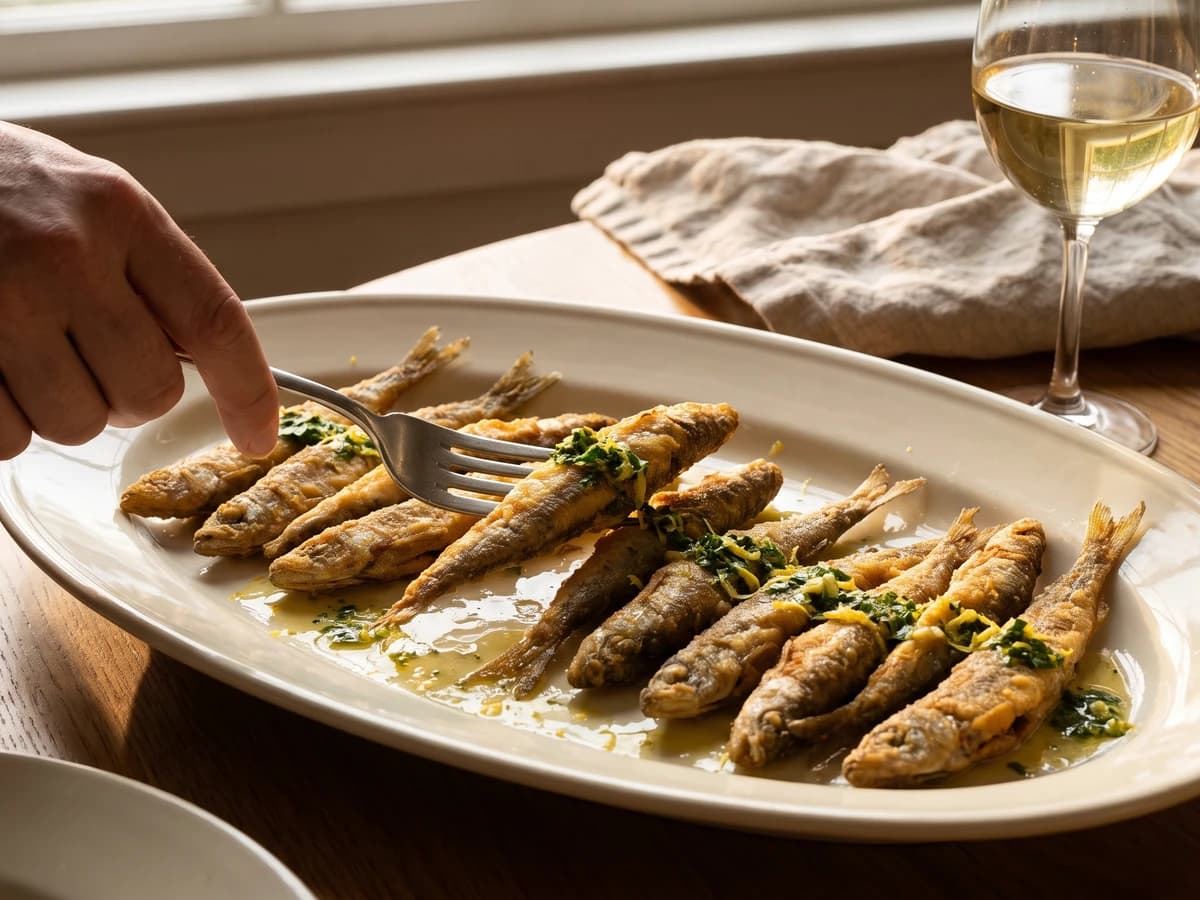
Éperlans à l’Anglaise turns small fish into a lesson in disciplined coating: boned smelts under a close, crisp crumb, pan-fried in clarified butter and finished with bright, half-melted maître d’hôtel butter.

Chef Juliette
Tiny smelts, shallot, mushrooms, white wine, gratin sauce, and fine bread raspings meet a fierce oven, where the fish must turn tender in the same breath the buttered crust bronzes.