
Chef Juliette
John Dory (St. Pierre)
John Dory has the delicacy of sole and the firmness of turbot. A light flouring, a quick butter sauté, and nut-brown beurre noisette show exactly why looks never mattered.
A cooking platform built around craft, culture, and the stories behind what we eat.

Created by Chef Juliette
Based on No. 1335, Rognons Sautés Chasseur, from Le Guide Culinaire (1907) by Auguste Escoffier
Rognons sautés chasseur teaches the clean rhythm of a sauté: brown the kidneys fast, reduce the wine nearly dry, then toss them once through glossy mushroom-and-tomato sauce. Heat, timing, and no boiling.
Rognons sautés chasseur (sautéed kidneys with hunter's sauce) teaches the clean rhythm of the sauté: hard heat, short contact, then sauce. The one true thing to know before you touch the pan is that kidney becomes tender through speed, not simmering. Dry it thoroughly, give every slice room, and take it out the moment it is browned and just cooked.
The source entry assumed a saucier had Sauce Chasseur warm beside the stove, backed by a stockpot that never went cold. At home, prepare that finished sauce ahead, measure the original one-third Imperial pint for six kidneys, and warm it in a small saucepan. A salamander has no work here, so there is no broiler to imitate. Mutton kidney is the source ingredient; lamb kidney is the honest modern equivalent when mutton cannot be found, gentler in flavour and quicker to cook. The ratio and sequence stay intact, and the six-kidney batch becomes four home servings. One cook, one stove, one evening.
Preparing and holding Sauce Chasseur was brigade scaffolding. The dish itself is the order of operations, and none of it goes: sauté in butter, drain, déglacer (deglaze) with white wine and reduce nearly dry, add Sauce Chasseur, then toss the kidneys for an instant. A warmed porcelain serving bowl replaces the timbale because its job is to hold heat, not perform ceremony. The decisive moment is the first sear; if the pan floods, lift the kidneys before they stew, then follow the rescue in the method.
Rognons sautés belong to the Parisian bistro and classical dining-room table, where fresh kidneys were treated as quick-cooking meat rather than hidden beneath a long braise. Chasseur means “hunter's style” and names the mushroom-and-tomato sauce that traveled from game cookery into the wider French canon; its presence here does not make kidney a game meat. The pairing endures because earthy mushrooms meet the mineral richness of kidney, while the nearly dry white-wine reduction keeps the sauce lively.
Quantity
6 (about 1 pound / 450 g total)
trimmed, cored, and sliced 1/2 inch / 1.25 cm thick
Quantity
3 tablespoons (45 ml / 42 g)
Quantity
3/4 teaspoon (3.75 ml / 4 g)
Quantity
1/2 teaspoon (2.5 ml / 1 g)
Quantity
1/2 cup (120 ml / 120 g)
Quantity
3/4 cup plus 1 tablespoon (190 ml / about 200 g)
heated to a bare simmer
Quantity
2 tablespoons (30 ml / 30 g)
for loosening the sauce if needed
Quantity
1 tablespoon (15 ml / 4 g)
finely chopped
| Ingredient | Quantity |
|---|---|
| mutton kidneys, or lamb kidneys if mutton is unavailabletrimmed, cored, and sliced 1/2 inch / 1.25 cm thick | 6 (about 1 pound / 450 g total) |
| unsalted butter | 3 tablespoons (45 ml / 42 g) |
| fine sea salt | 3/4 teaspoon (3.75 ml / 4 g) |
| freshly ground black pepper | 1/2 teaspoon (2.5 ml / 1 g) |
| dry white wine | 1/2 cup (120 ml / 120 g) |
| prepared Sauce Chasseurheated to a bare simmer | 3/4 cup plus 1 tablespoon (190 ml / about 200 g) |
| hot water (optional)for loosening the sauce if needed | 2 tablespoons (30 ml / 30 g) |
| flat-leaf parsleyfinely chopped | 1 tablespoon (15 ml / 4 g) |
Pull away any membrane and surface fat from the kidneys. Split each lengthwise, cut out the firm white core and branching tubes with a narrow V-shaped cut, then slice the lobes crosswise into even 1/2-inch / 1.25-cm pieces. Set the prepared Sauce Chasseur over low heat, bring it only to a bare simmer, and keep it warm.
Spread the slices between clean kitchen towels and press them thoroughly dry. Heat the serving bowl now, because rognons sautés chasseur waits for nobody once the final toss begins. Season the kidneys with the salt and pepper immediately before they enter the skillet; seasoning too early pulls moisture to the surface, and wet kidney stews instead of browning.
Heat half the butter in a 12-inch / 30-cm heavy skillet over medium-high heat until it foams briskly and the foam begins to subside. Add half the kidneys in one uncrowded layer. Leave them untouched for about 1 1/2 minutes, turn, and cook for about 1 minute more, until browned, just firm, and cooked through with no raw translucency; the thickest pieces should reach 160°F / 71°C. Repeat with the remaining butter and kidneys. If either batch releases a pool of liquid, lift the slices out at once, boil the liquid away until the pan is dry, then return them for 20 to 30 seconds to colour. Ça se rattrape.
Transfer each cooked batch to a fine-mesh sieve set over a bowl and let it drain for 2 minutes. Keep the kidneys near the stove but do not cover them tightly. Discard the drained liquid; this deliberate draining keeps the kidney juices from thinning the finished Sauce Chasseur.
Pour off any excess butter from the skillet, leaving the brown fond in place. Déglacer the hot pan with the white wine, scraping until every browned speck dissolves, then boil until the wine is almost entirely reduced and only about 1 tablespoon / 15 ml of syrupy liquid remains. If the glaze threatens to scorch, lower the heat and add 1 tablespoon / 15 ml of the hot water, scrape it free, then reduce again. Add the hot Sauce Chasseur and bring it just to the first bubble. It should coat the back of a spoon; reduce it now if thin, or loosen it with the remaining hot water a teaspoon at a time if too tight. Make the correction before the kidneys return.
Return the drained kidneys to the skillet and toss them through the Sauce Chasseur for 20 to 30 seconds, only until every slice is glazed and hot. Do not simmer them in the sauce. If a strong boil starts, pull the skillet off the heat and finish tossing there. Spoon everything into the warmed serving bowl, sprinkle with the chopped parsley, and carry it straight to the table. À table!
1 serving (about 155g)
Culinary guides, cultural storytelling, and the editorial depth that makes cooking meaningful.
Discover Culinary ExplorerChef Juliette
John Dory has the delicacy of sole and the firmness of turbot. A light flouring, a quick butter sauté, and nut-brown beurre noisette show exactly why looks never mattered.

Chef Juliette
Fresh haddock proves its delicacy in the meunière pan: a fine flour crust, moist pearly flakes, and beurre noisette sharpened with lemon and parsley, ready from one skillet in half an hour.
Chef Juliette
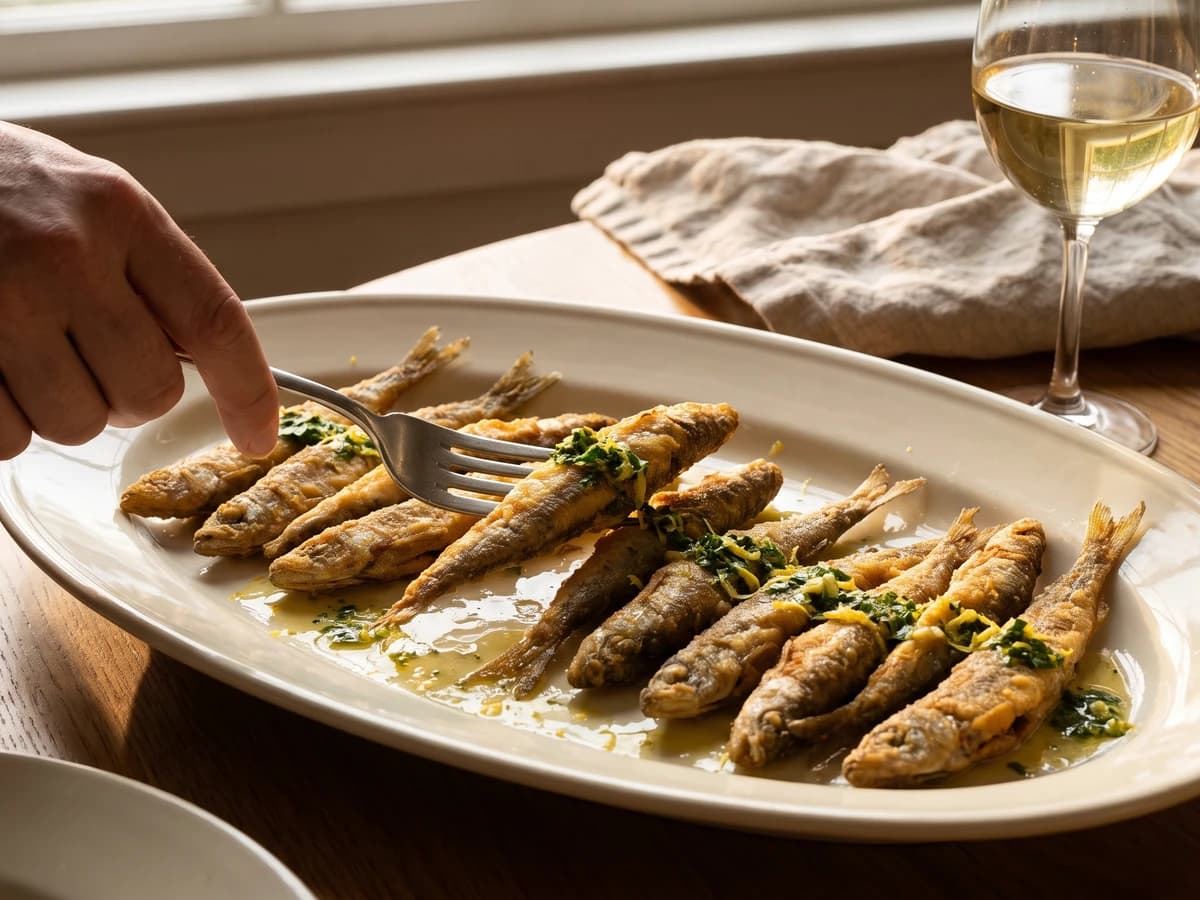
Éperlans à l’Anglaise turns small fish into a lesson in disciplined coating: boned smelts under a close, crisp crumb, pan-fried in clarified butter and finished with bright, half-melted maître d’hôtel butter.

Chef Juliette
Tiny smelts, shallot, mushrooms, white wine, gratin sauce, and fine bread raspings meet a fierce oven, where the fish must turn tender in the same breath the buttered crust bronzes.