
Chef Juliette
John Dory (St. Pierre)
John Dory has the delicacy of sole and the firmness of turbot. A light flouring, a quick butter sauté, and nut-brown beurre noisette show exactly why looks never mattered.
A cooking platform built around craft, culture, and the stories behind what we eat.
Created by Chef Juliette
Based on No. 1328, Pieds de Mouton Tyrolienne, from Le Guide Culinaire (1907) by Auguste Escoffier
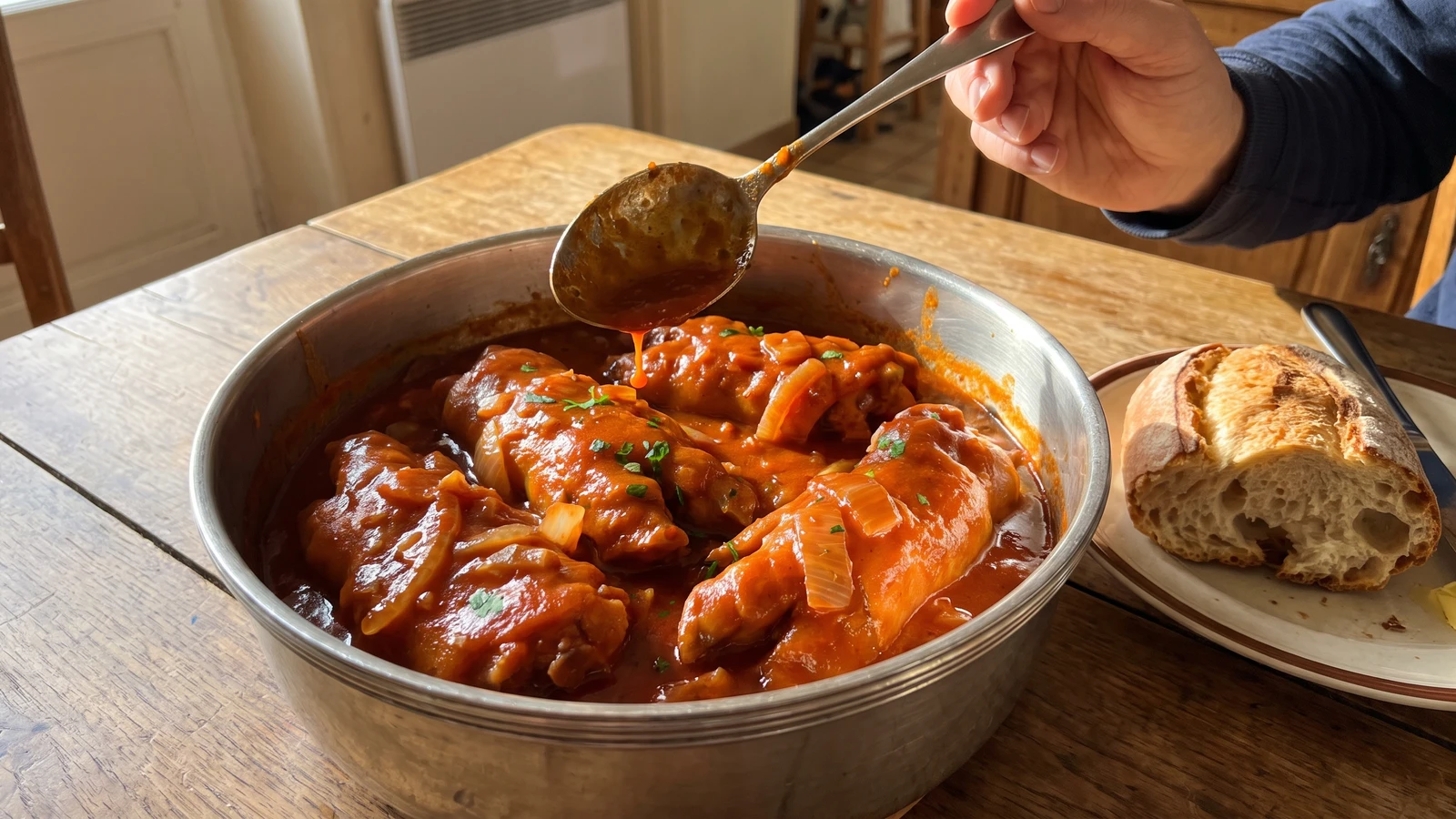
Tender sheep’s trotters, glossy with tomato, onion, garlic, and Poivrade, prove that the final ten-minute simmer is an exchange: gelatin enriches the sauce while pepper and acidity wake the meat.
Pieds de Mouton à la Tyrolienne (sheep’s trotters with tomato, onion, and Poivrade sauce) teach one precise lesson: when the meat is already tender, the final simmer is for exchanging flavours, not cooking it again. The trotters lend gelatin and richness to the sauce; the tomato, garlic, and Poivrade return sharpness and warmth. Boil them hard and the skin loosens while the sauce turns greasy. A bare simmer keeps everything whole and glossy.
The original kitchen began with twenty freshly cooked trotters, a saucier keeping Poivrade ready, and a timbale waiting for service. Here, eight trotters feed four, a butcher supplies them fully cooked, and a wide sauté pan replaces the brigade’s separate sauce station. The quantity and equipment changed because one cook doesn’t need twenty portions or a stockpot kept alive all day. The sequence and proportions remain: onion and tomato in butter, parsley and garlic, Poivrade, then exactly ten minutes with the trotters. One cook, one stove, one evening.
Cleaning and slowly cooking raw trotters is the brigade scaffolding, and this entry always assumed that work was finished. The dish itself is the reduced tomato-onion foundation and that brief final simmer, so neither gets cut. Before you touch the pan, drain the cooked trotters thoroughly and blot them dry. Excess cooking liquor is the one thing most likely to turn this compact sauce watery.
Pieds de mouton à la tyrolienne belongs to the Parisian classical table, where economical cuts from the triperie were given formal service through carefully built sauces and deep serving timbales. Despite its title, the preparation is not a dependable record of Tyrolean household cooking: à la tyrolienne is the French kitchen’s name here for the tomato, onion, garlic, and Poivrade treatment. The dish carried sheep’s trotters from market and bistro tables into the grand repertoire without disguising what made them valuable, their tenderness, gelatin, and ability to carry a sharp sauce.
Quantity
8 (about 2 lb / 900 g)
well drained and blotted dry
Quantity
1 tablespoon (15 ml / 14 g)
Quantity
1/3 cup (80 ml / 55 g)
chopped
Quantity
2/3 cup (160 ml / 150 g)
gently squeezed of watery seeds and roughly chopped
Quantity
1/4 teaspoon (1.25 ml / 1.5 g), plus more if needed
Quantity
1/8 teaspoon (0.6 ml / 0.3 g)
Quantity
1 teaspoon (5 ml / 1 g)
finely chopped
Quantity
1/2 teaspoon (2.5 ml / 2 g)
crushed
Quantity
2 tablespoons plus 1 1/2 teaspoons (38 ml / about 40 g)
Quantity
Up to 2 tablespoons (30 ml / 30 g)
only if needed to loosen the sauce
| Ingredient | Quantity |
|---|---|
| fully cooked sheep’s trotterswell drained and blotted dry | 8 (about 2 lb / 900 g) |
| unsalted butter | 1 tablespoon (15 ml / 14 g) |
| yellow onionchopped | 1/3 cup (80 ml / 55 g) |
| peeled tomatoesgently squeezed of watery seeds and roughly chopped | 2/3 cup (160 ml / 150 g) |
| fine salt | 1/4 teaspoon (1.25 ml / 1.5 g), plus more if needed |
| freshly ground black pepper | 1/8 teaspoon (0.6 ml / 0.3 g) |
| flat-leaf parsleyfinely chopped | 1 teaspoon (5 ml / 1 g) |
| garliccrushed | 1/2 teaspoon (2.5 ml / 2 g) |
| Poivrade sauce | 2 tablespoons plus 1 1/2 teaspoons (38 ml / about 40 g) |
| hot water (optional)only if needed to loosen the sauce | Up to 2 tablespoons (30 ml / 30 g) |
Set the cooked trotters in a colander for at least ten minutes, then blot them carefully with a clean towel. Remove any loose fragments of bone without tearing the skin. Have the Poivrade sauce measured and the serving timbale warming before you begin; once the trotters enter the pan, the dish moves quickly.
Melt the butter in a wide sauté pan over medium-low heat. Add the chopped onion and pressed tomato together, then season with the salt and pepper. Cook for 10 to 12 minutes, stirring often, until the onion is completely tender and the tomato has collapsed into a thick, moist foundation; a spatula drawn across the pan should leave a trail for a second before the sauce closes over it. Keep the onion pale. If the tomato begins catching before the onion softens, add one teaspoon of the hot water and lower the heat. Ça se rattrape.
Stir in the chopped parsley and crushed garlic for 30 seconds, just until the garlic smells warm but has taken no colour. Add the Poivrade sauce and scrape the pan thoroughly so the buttery tomato foundation becomes one sauce. Bring it only to a quiet simmer and taste before adding more salt, since the finished Poivrade may already be well seasoned.
Nestle the drained trotters into the sauce and turn them gently until coated. Once the sauce returns to a bare simmer, cook uncovered for exactly 10 minutes, turning the trotters once or twice so they warm evenly. Do not let the pan boil hard. The trotters are already tender, and a violent boil loosens their skin and throws fat into the sauce. If the sauce tightens enough to catch, add hot water one teaspoon at a time; if it remains loose, lift out the trotters and reduce the sauce alone for a minute or two before returning them. Both are recoverable.
Empty the hot water from the warmed timbale and dry it. Arrange the trotters snugly inside, preserving their shape, then spoon every bit of the glossy tomato and Poivrade sauce over them. Serve at once with bread close at hand for the sauce. Cooking well is not cooking fancy. À table!
1 serving (about 285g)
Culinary guides, cultural storytelling, and the editorial depth that makes cooking meaningful.
Discover Culinary ExplorerChef Juliette
John Dory has the delicacy of sole and the firmness of turbot. A light flouring, a quick butter sauté, and nut-brown beurre noisette show exactly why looks never mattered.

Chef Juliette
Fresh haddock proves its delicacy in the meunière pan: a fine flour crust, moist pearly flakes, and beurre noisette sharpened with lemon and parsley, ready from one skillet in half an hour.

Chef Juliette
Éperlans à l’Anglaise turns small fish into a lesson in disciplined coating: boned smelts under a close, crisp crumb, pan-fried in clarified butter and finished with bright, half-melted maître d’hôtel butter.

Chef Juliette
Tiny smelts, shallot, mushrooms, white wine, gratin sauce, and fine bread raspings meet a fierce oven, where the fish must turn tender in the same breath the buttered crust bronzes.