
Chef Juliette
John Dory (St. Pierre)
John Dory has the delicacy of sole and the firmness of turbot. A light flouring, a quick butter sauté, and nut-brown beurre noisette show exactly why looks never mattered.
A cooking platform built around craft, culture, and the stories behind what we eat.

Created by Chef Juliette
Based on No. 1318, Côtelettes à la Suédoise, from Le Guide Culinaire (1907) by Auguste Escoffier
Marinated lamb cutlets wear a butter-gold crumb and circle a tart apple purée, with fresh horseradish added at the last moment so its clean bite cuts every rich mouthful.
Côtelettes à la Suédoise (Swedish-style lamb cutlets) teaches one clean principle: a marinade may perfume meat, but a crust needs dryness. Lemon, onion, shallot, parsley stalks, thyme, and bay have thirty minutes to do their work. After that, every aromatic must come off and the cutlets must be dried until the paper comes away clean. Butter and crumbs cling to dry meat; on wet meat they slide, scorch, and sulk.
The original assumed a fierce service grill, a salamander near enough to correct the colour, and enough cutlets to build a regimented crown. It did not require a saucier or a stockpot because the apple purée is the entire accompaniment. At home, a fully heated broiler and a rack over a sheet pan give the same direct heat, while eight cutlets make a generous loose crown for four. The strict geometry is brigade scaffolding and can relax. The thirty-minute marinade, buttered crumb, swift apple purée, and bold apple-to-horseradish proportion are the dish and must stay. The book also points to Cooked Marinade for Venison (No. 168), preserved here as a separate finished component for the venison variation rather than re-derived inside the lamb recipe.
When the côtelettes are right, their crumbs are deep butter-gold, the lamb remains juicy, and the pale purée strikes first with tart apple and then with horseradish. Grate the horseradish only at the finish, but before you touch the broiler, remember the step that decides everything: dry the cutlets completely. One cook, one stove, one evening.
Côtelettes à la suédoise belongs to the French classical dining-room repertory codified in the grand kitchens of Paris, not to a particular French province or necessarily to a Swedish household table. In this vocabulary, à la suédoise signaled the alliance of apple and horseradish, northern flavors whose tartness and pungency cut the richness of lamb or venison. The crown of cutlets came from formal platter service, but the flavor pairing loses nothing when arranged with a freer hand at home.
Quantity
8, each about 1 inch (2.5 cm) thick, about 2¼ pounds (1 kg) total
Quantity
½ cup (120 ml / 75 g)
finely minced
Quantity
⅓ cup (80 ml / 70 g)
finely minced
Quantity
2 tablespoons (30 ml / 8 g)
finely chopped
Quantity
1 teaspoon (5 ml / 1 g)
Quantity
1
crumbled
Quantity
3 tablespoons (45 ml / 45 g)
Quantity
1 teaspoon (5 ml / 5 g)
Quantity
½ cup (120 ml / 120 g) Cooked Marinade for Venison (No. 168)
fully cooled
Quantity
6 tablespoons (90 ml / 85 g)
melted
Quantity
1¼ cups (300 ml / 100 g)
Quantity
1½ teaspoons (7.5 ml / 9 g)
Quantity
½ teaspoon (2.5 ml / 1 g)
Quantity
2 cups (475 ml / 225 g)
peeled and finely sliced
Quantity
2 tablespoons (30 ml / 30 g)
Quantity
⅔ cup loosely packed (160 ml / 70 g)
finely grated
| Ingredient | Quantity |
|---|---|
| lamb rib or loin cutlets | 8, each about 1 inch (2.5 cm) thick, about 2¼ pounds (1 kg) total |
| yellow onionfinely minced | ½ cup (120 ml / 75 g) |
| shallotsfinely minced | ⅓ cup (80 ml / 70 g) |
| parsley stalksfinely chopped | 2 tablespoons (30 ml / 8 g) |
| fresh thyme leaves | 1 teaspoon (5 ml / 1 g) |
| bay leafcrumbled | 1 |
| fresh lemon juice | 3 tablespoons (45 ml / 45 g) |
| neutral oil | 1 teaspoon (5 ml / 5 g) |
| Cooked Marinade for Venison (optional)fully cooled | ½ cup (120 ml / 120 g) Cooked Marinade for Venison (No. 168) |
| unsalted buttermelted | 6 tablespoons (90 ml / 85 g) |
| fine fresh breadcrumbs | 1¼ cups (300 ml / 100 g) |
| fine salt | 1½ teaspoons (7.5 ml / 9 g) |
| freshly ground black pepper | ½ teaspoon (2.5 ml / 1 g) |
| tart applespeeled and finely sliced | 2 cups (475 ml / 225 g) |
| dry white wine | 2 tablespoons (30 ml / 30 g) |
| fresh horseradishfinely grated | ⅔ cup loosely packed (160 ml / 70 g) |
Lay the lamb cutlets in one layer in a shallow dish. Scatter over the onion, shallots, parsley stalks, thyme, and bay, then sprinkle with the lemon juice and oil. Turn each cutlet so both sides meet the marinade, cover, and refrigerate for 30 minutes, turning twice. Do not extend this into an overnight bath; lemon left too long firms the surface and makes the meat chalky. For a venison variation, reach instead for the fully cooled Cooked Marinade for Venison (No. 168) and follow that preparation's own use, leaving it whole rather than rebuilding it here.
While the cutlets marinate, put the sliced apples and white wine in a small heavy saucepan. Cover and cook briskly over medium heat for 8 to 10 minutes, stirring once or twice, until the slices collapse under the spoon. Mash them to a smooth purée, or press them through a fine sieve for the classical texture. If the pan catches before the apples soften, add 1 tablespoon of water and lower the heat; ça se rattrape. If the purée looks watery, uncover it and stir over medium heat until it holds a soft mound. Keep it warm, but do not add the horseradish yet.
Set a broiler rack about 6 inches (15 cm) below the heat and preheat the broiler fully. Lift the cutlets from the marinade, scrape away every piece of onion and herb that might burn, and pat both sides thoroughly dry. Season with the salt and pepper. Dip each cutlet in the melted butter, let the excess drip away, then sprinkle and press the breadcrumbs over both sides in a thin, even coat. Leave them on the rack for 5 minutes so the crumb settles onto the butter.
Arrange the cutlets on a broiler-safe rack over a rimmed sheet pan without crowding them. Broil for 3 to 5 minutes per side, turning once, until the crumbs are deep gold and the lamb reaches 140°F (60°C) at its centre; rest it for at least 3 minutes so it finishes at 145°F (63°C). Watch the crumbs rather than the clock. If they darken before the meat is ready, move the pan lower and finish the cutlets in a 375°F (190°C) oven. The colour is not lost and the lamb needn't burn.
Just before serving, finely grate the fresh horseradish and fold the full ⅔ cup (70 g) into the warm apple purée. This is deliberately bold and keeps the source's proportion: about three parts apple to one part horseradish by weight. Do not boil the purée after the horseradish goes in because prolonged heat drives away the clean pungency that defines à la suédoise. If it has tightened while waiting, loosen it with a teaspoon of warm water or white wine.
Spoon the apple and horseradish purée into the centre of a warmed oval platter, or send it separately in a warm bowl. Arrange the rested cutlets around it in a loose crown, leaning the bones outward so the crumb remains visible and crisp. Serve at once. Cooking well is not cooking fancy. À table!
1 serving (about 270g)
Culinary guides, cultural storytelling, and the editorial depth that makes cooking meaningful.
Discover Culinary ExplorerChef Juliette
John Dory has the delicacy of sole and the firmness of turbot. A light flouring, a quick butter sauté, and nut-brown beurre noisette show exactly why looks never mattered.

Chef Juliette
Fresh haddock proves its delicacy in the meunière pan: a fine flour crust, moist pearly flakes, and beurre noisette sharpened with lemon and parsley, ready from one skillet in half an hour.
Chef Juliette
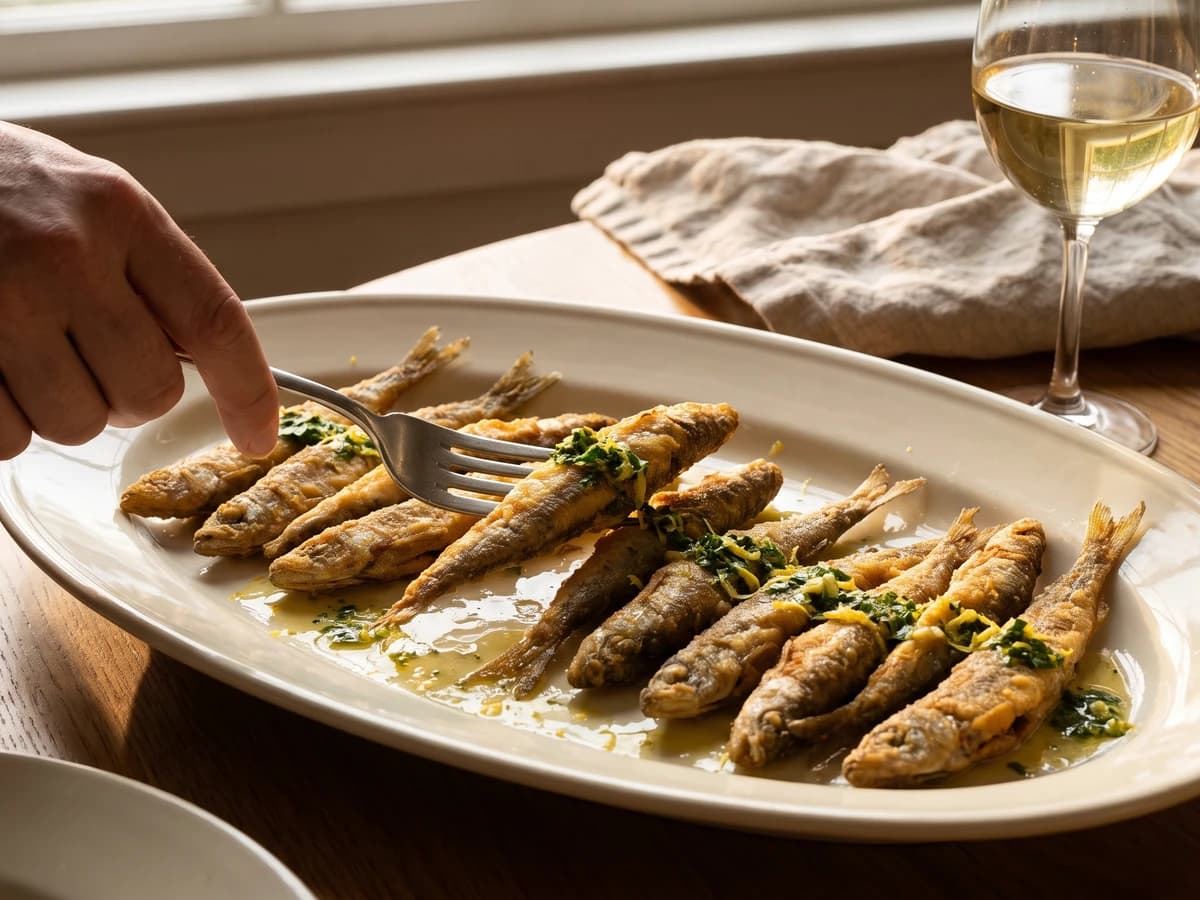
Éperlans à l’Anglaise turns small fish into a lesson in disciplined coating: boned smelts under a close, crisp crumb, pan-fried in clarified butter and finished with bright, half-melted maître d’hôtel butter.

Chef Juliette
Tiny smelts, shallot, mushrooms, white wine, gratin sauce, and fine bread raspings meet a fierce oven, where the fish must turn tender in the same breath the buttered crust bronzes.