
Chef Juliette
John Dory (St. Pierre)
John Dory has the delicacy of sole and the firmness of turbot. A light flouring, a quick butter sauté, and nut-brown beurre noisette show exactly why looks never mattered.
A cooking platform built around craft, culture, and the stories behind what we eat.
Created by Chef Juliette
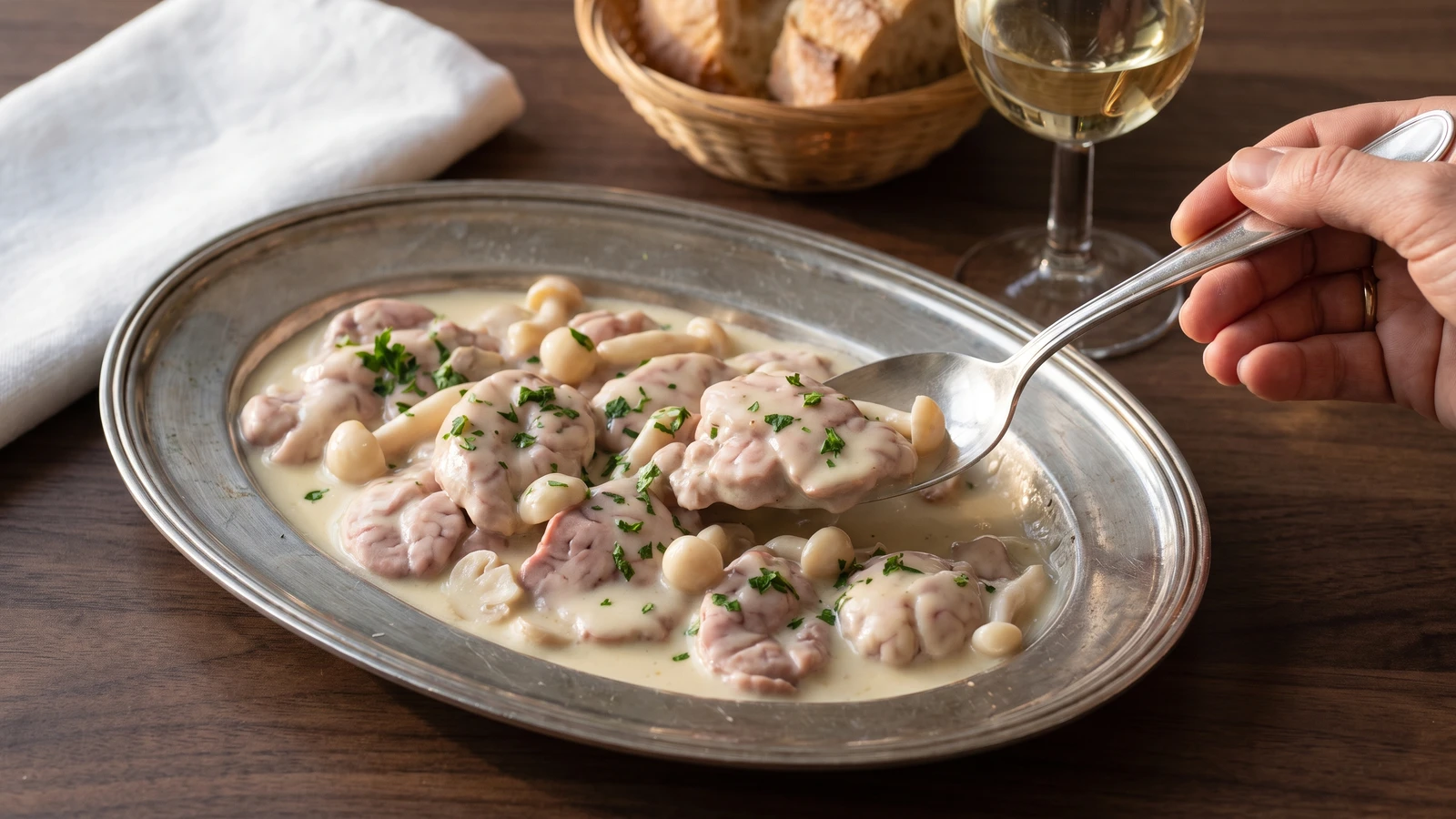
Based on No. 1294, Cervelle à la Poulette, from Le Guide Culinaire (1907) by Auguste Escoffier
Cervelle à la Poulette asks for a gentle hand: ivory slices of calf's brain, white mushrooms, and lemon-bright sauce turned together until glossy, then carried straight to the table before their tenderness is lost.
Cervelle à la Poulette (calf's brains in poulette sauce) teaches one principle above all: the sauce moves, the brains do not. Once poached, their tenderness is nearly custard-soft, so you turn them by rolling the pan until the glossy sauce folds around each slice. A spoon wielded with enthusiasm will make rubble.
The entry assumed a saucier, a stockpot never off the fire, Sauce Poulette (No. 101) already finished, and trays of cooked white mushrooms and prepared brains waiting for service. At home, you prepare that referenced sauce from its own entry, poach the brains and mushrooms yourself, and bring everything together in one wide pan. The book's half-pint of sauce and three ounces of cooked mushrooms already suit four rich portions, so their ratio remains unchanged. The brigade's holding pans are scaffolding and can go; the pale mushrooms, the finished sauce with its off-heat butter finish, and the gentle final turning are the dish and must stay.
Chill the poached brains before slicing, then warm them only long enough to take the sauce. If a slice fractures, stop moving the pan, tuck the pieces beneath the whole slices, and spoon sauce over them. Ça se rattrape. The step that matters most is the last one: lift and roll the pan, never stir.
Cervelle à la Poulette belongs to the Parisian cuisine bourgeoise and the classical dining-room repertoire, where delicate offal was paired with pale sauces rather than buried beneath heavy seasoning. Poulette does not mean chicken here; the name identifies Sauce Poulette (No. 101), a lemon-fresh sauce traditionally served with mild offal and vegetables. The dish traveled from the economical butcher's table into formal service through careful cleaning, clean slicing, and exact handling, proving that refinement often lies in touch rather than expense.
Quantity
2 whole brains (about 18 to 24 oz / 500 to 700 g total)
Quantity
5 quarts (4.7 liters / 4.7 kg)
divided
Quantity
1/4 cup (60 ml / 60 g)
Quantity
2 teaspoons (10 ml / 12 g)
Quantity
1 1/4 cups (300 ml / 100 g)
trimmed; use 3 oz (85 g) after cooking
Quantity
1 cup plus 3 tablespoons (285 ml / about 285 g) Sauce Poulette (No. 101)
Quantity
1 teaspoon (5 ml / 1 g)
finely chopped
Quantity
1 tablespoon (15 ml / 15 g)
| Ingredient | Quantity |
|---|---|
| whole calf's brains | 2 whole brains (about 18 to 24 oz / 500 to 700 g total) |
| cold waterdivided | 5 quarts (4.7 liters / 4.7 kg) |
| white wine vinegar | 1/4 cup (60 ml / 60 g) |
| fine sea salt | 2 teaspoons (10 ml / 12 g) |
| very small white button mushroomstrimmed; use 3 oz (85 g) after cooking | 1 1/4 cups (300 ml / 100 g) |
| prepared Sauce Poulette (No. 101) | 1 cup plus 3 tablespoons (285 ml / about 285 g) Sauce Poulette (No. 101) |
| flat-leaf parsleyfinely chopped | 1 teaspoon (5 ml / 1 g) |
| cold water for rescuing the sauce (optional) | 1 tablespoon (15 ml / 15 g) |
Set the brains in a nonreactive bowl and cover them with 2 quarts of the cold water. Refrigerate for 20 minutes, drain without splashing, then cover with another 2 quarts of fresh cold water and soak for 25 minutes more. Working with the brains submerged, lift away the thin outer membrane, dark veins, and any blood clots with your fingertips. Be patient, not forceful. A small tear will disappear beneath the sauce, but pulling at the lobes will break them before cooking.
Combine the remaining 1 quart water, the vinegar, and the salt in a 3-quart nonreactive saucepan. Bring it just to a simmer, add the mushrooms, and cook for 4 to 5 minutes, until barely tender and still clean white. Lift them out with a fine-mesh skimmer, drain well, and measure 3 oz (85 g) for the dish. The acidulated water keeps their color pale, exactly as the entry requires.
Lower the cleaned brains whole into the same acidulated liquid and adjust the heat until the surface barely trembles. Poach gently for 12 to 18 minutes, depending on their size, until the thickest part reaches 160°F (71°C). Do not judge by color and do not let the liquid boil hard; a rolling boil roughens the surface and can split the lobes. If that happens, lower the heat at once and leave the brains undisturbed until fully cooked. Let them stand in the liquid for 10 minutes off the heat, then lift them out carefully.
Set the brains on a small tray and refrigerate them uncovered for about 20 minutes, just until firm enough to cut cleanly. With a thin, very sharp knife, slice them crosswise about 1/2 inch (1.25 cm) thick. Draw the blade through in one motion rather than pressing downward, then blot the slices gently. Cold brains slice; warm brains collapse.
Pour the prepared Sauce Poulette (No. 101) into a wide 12-inch sauté pan and warm it over low heat until it loosens and gives the first lazy bubble. Add the cooked white mushrooms and warm them for 1 minute. Never boil the finished sauce. If it turns greasy at the edge, take the pan off the heat and whisk in the optional tablespoon of cold water before adding the brains. Ça se rattrape.
Lay the brain slices in the sauce in a loose single layer. Spoon a little sauce over the tops, then hold the pan by its handle and roll it in two or three small circles so the sauce turns the slices without a spoon touching them. Warm for 2 to 3 minutes, only until the centers are hot. If a slice fractures, stop moving the pan, slide the pieces beneath an intact slice with a thin spatula, and cover them with sauce. Never apologize at your own table.
Slide the slices into a warmed deep serving bowl or timbale, keeping the best-shaped pieces on top. Pour over every drop of sauce and mushrooms, then sprinkle with the finely chopped parsley. Serve immediately, while the sauce is glossy and the brains remain tender. À table!
1 serving (about 235g)
Culinary guides, cultural storytelling, and the editorial depth that makes cooking meaningful.
Discover Culinary ExplorerChef Juliette
John Dory has the delicacy of sole and the firmness of turbot. A light flouring, a quick butter sauté, and nut-brown beurre noisette show exactly why looks never mattered.

Chef Juliette
Fresh haddock proves its delicacy in the meunière pan: a fine flour crust, moist pearly flakes, and beurre noisette sharpened with lemon and parsley, ready from one skillet in half an hour.
Chef Juliette
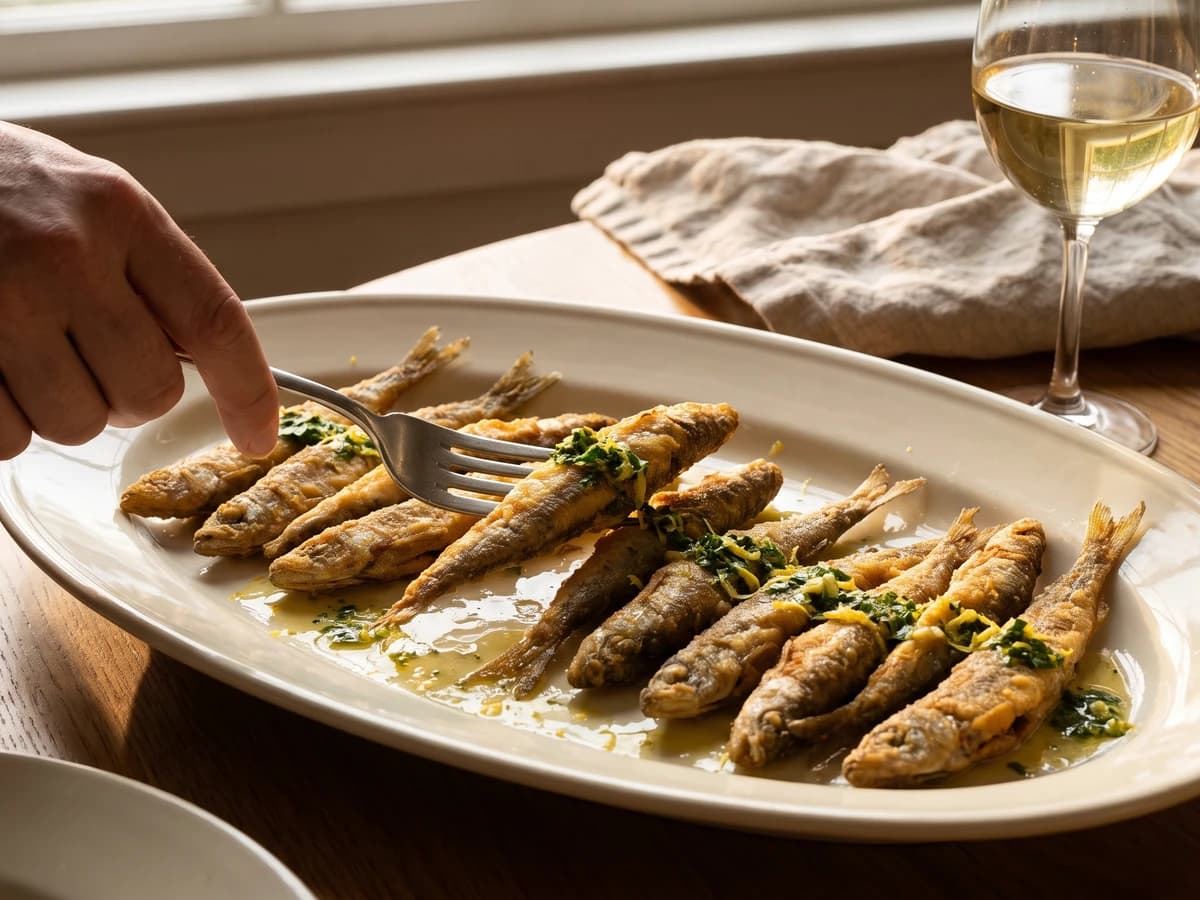
Éperlans à l’Anglaise turns small fish into a lesson in disciplined coating: boned smelts under a close, crisp crumb, pan-fried in clarified butter and finished with bright, half-melted maître d’hôtel butter.

Chef Juliette
Tiny smelts, shallot, mushrooms, white wine, gratin sauce, and fine bread raspings meet a fierce oven, where the fish must turn tender in the same breath the buttered crust bronzes.