
Chef Juliette
Bouillabaisse à la Marseillaise
Marseille's great fish stew, saffron-gold and garlic-scented, proves that a hard boil can be the careful choice: it binds olive oil into broth before the whole pot meets bread.
A cooking platform built around craft, culture, and the stories behind what we eat.

Created by Chef Juliette
Based on No. 1283, Sauté de Veau à la Catalane, from Le Guide Culinaire (1907) by Auguste Escoffier
A southern classical sauté where tender veal meets tomato, butter-glazed onions, mushrooms, chestnuts, and chipolata, all bound by a Marengo sauce reduced until it gleams.
Sauté de Veau à la Catalane (veal gently braised with tomato, glazed onions, mushrooms, chestnuts, and chipolata) teaches the classical meaning of sauté: brown first, then cook gently in a built sauce. The one true thing to know before touching the pan is this: reduce the sauce away from the veal. Boiling the meat while chasing thickness only trades tenderness for impatience.
The original formula assumed Sauté de Veau à la Marengo (No. 1280) already moving through the brigade, a saucier to manage the reduction, consommé never off the fire, and a timbale waiting for service. At home, half of that referenced preparation feeds four, good low-sodium consommé serves the chestnuts, and a warm deep bowl replaces the formal timbale. The brigade quantity and ceremonial dish are scaffolding; the separate reduction and final fifteen-minute simmer are the dish. One cook, one stove, one evening.
The finished pot is generous and composed rather than heavy: tender veal under a glossy tomato-brown sauce, with sweet onions, earthy chestnuts, mushrooms, and small sausages sharing every spoonful. Lift the veal before reducing its sauce, and the difficult part is already behind you.
Sauté de Veau à la Catalane belongs to the codified French classical table, where à la Catalane names a particular garnish more readily than a Catalan household stew. Its structure comes through Sauté de Veau à la Marengo (No. 1280): browned veal in a tomato-based sauce, recast with buttered tomatoes, small onions, raw quartered mushrooms, chestnuts cooked in consommé, and chipolata. The name’s surprise is its address, a French grand-kitchen and bourgeois-table formula whose southern character is carried by the garnish, not a claim that every Catalan kitchen cooked this exact pot.
Quantity
½ batch Sauté de Veau à la Marengo (No. 1280), made with 1 lb / 455 g veal
veal cut into eight 2 oz / 55 g pieces and cooked through the initial gentle braise
Quantity
¾ cup (180 ml / 180 g)
Quantity
5 chestnuts (about 2 oz / 55 g)
fresh or frozen
Quantity
2 tablespoons (30 ml / 28 g)
divided
Quantity
5 onions (about 2½ oz / 70 g)
peeled
Quantity
½ cup (120 ml / 120 g)
peeled, seeded, and quartered
Quantity
4 sausages (about 5 oz / 140 g)
Quantity
1¼ cups (300 ml / 85 g)
quartered
Quantity
as needed
| Ingredient | Quantity |
|---|---|
| prepared Sauté de Veau à la Marengo baseveal cut into eight 2 oz / 55 g pieces and cooked through the initial gentle braise | ½ batch Sauté de Veau à la Marengo (No. 1280), made with 1 lb / 455 g veal |
| low-sodium beef or veal consommé | ¾ cup (180 ml / 180 g) |
| peeled raw chestnutsfresh or frozen | 5 chestnuts (about 2 oz / 55 g) |
| unsalted butterdivided | 2 tablespoons (30 ml / 28 g) |
| small pearl onionspeeled | 5 onions (about 2½ oz / 70 g) |
| plum tomatoespeeled, seeded, and quartered | ½ cup (120 ml / 120 g) |
| small chipolata sausages | 4 sausages (about 5 oz / 140 g) |
| small button mushroomsquartered | 1¼ cups (300 ml / 85 g) |
| fine sea salt | as needed |
Prepare the half batch of Sauté de Veau à la Marengo (No. 1280) according to its own entry, using 1 lb (455 g) veal. Follow it through the initial one-and-one-half-hour gentle cook, then stop before its final transfer and Marengo garnish; the Catalane garnish below replaces that finish. Keep the veal in its sauce over the lowest heat while you prepare the remaining elements, and never let it boil.
Put the chestnuts in the smallest saucepan that holds them snugly and add the consommé. Bring it to a bare tremble and cook for 15 to 20 minutes, until a skewer enters the outer flesh easily but meets a little resistance at the centre. They should be three-quarters cooked, since the final simmer completes them. Lift them out carefully and reserve the consommé. If one chestnut splits, lower the heat and keep the pieces; they taste exactly as they should.
Melt 1 tablespoon of the butter in a small skillet. Add the pearl onions with 2 tablespoons of reserved consommé, cover, and cook gently for 10 to 12 minutes, rolling them occasionally, until tender and glossy without deep browning. If the butter colors before the onions soften, add another spoonful of consommé. Lift out the onions. Add the remaining butter, toss the tomato quarters for 1 to 2 minutes until they gleam and their edges relax, then remove them before they collapse. Brown the chipolatas lightly in the same skillet for 3 to 4 minutes; they will finish cooking in the sauce. Leave the quartered mushrooms raw, exactly as the formula intends.
Lift the veal pieces one by one from their Marengo sauce into a clean 3-quart (2.8-liter) heavy saucepan. Arrange the buttered tomatoes, glazed onions, raw mushrooms, chestnuts, and browned chipolatas among the meat without crushing the chestnuts. Leave the sauce behind in its original pan.
Bring the sauce to a lively simmer and reduce it to about ⅓ cup plus 1 tablespoon (95 ml / about 95 g), half the source formula’s finished quantity. It should napper, coating the back of a spoon in a thin glossy veil. Strain it through a fine-mesh sieve over the veal and garnish, pressing lightly on the solids. If it has tightened too far, whisk in reserved consommé a tablespoon at a time; if a slick of fat gathers, skim it rather than stirring it back. Ça se rattrape.
Bring everything to the barest simmer, cover slightly ajar, and cook for 15 minutes. Turn the veal and sausages once with a spoon, disturbing the chestnuts as little as possible. The mushrooms should be tender, the veal yielding, and the chipolatas cooked through to 160°F (71°C). If the mushrooms loosen the sauce too much, lift out the solids and reduce the sauce alone for 2 or 3 minutes; never boil the veal to repair a thin sauce. Taste before adding salt, then transfer everything to a warm deep serving bowl and spoon the gleaming sauce over the garnish. À table!
1 serving (about 260g)
Culinary guides, cultural storytelling, and the editorial depth that makes cooking meaningful.
Discover Culinary ExplorerChef Juliette
Marseille's great fish stew, saffron-gold and garlic-scented, proves that a hard boil can be the careful choice: it binds olive oil into broth before the whole pot meets bread.

Chef Juliette
Waterzoi asks fresh, bone-in river fish to thicken its own buttery broth, with parsley root and pepper for company. No flour, no stockpot, just a brisk simmer watched closely.
Chef Juliette
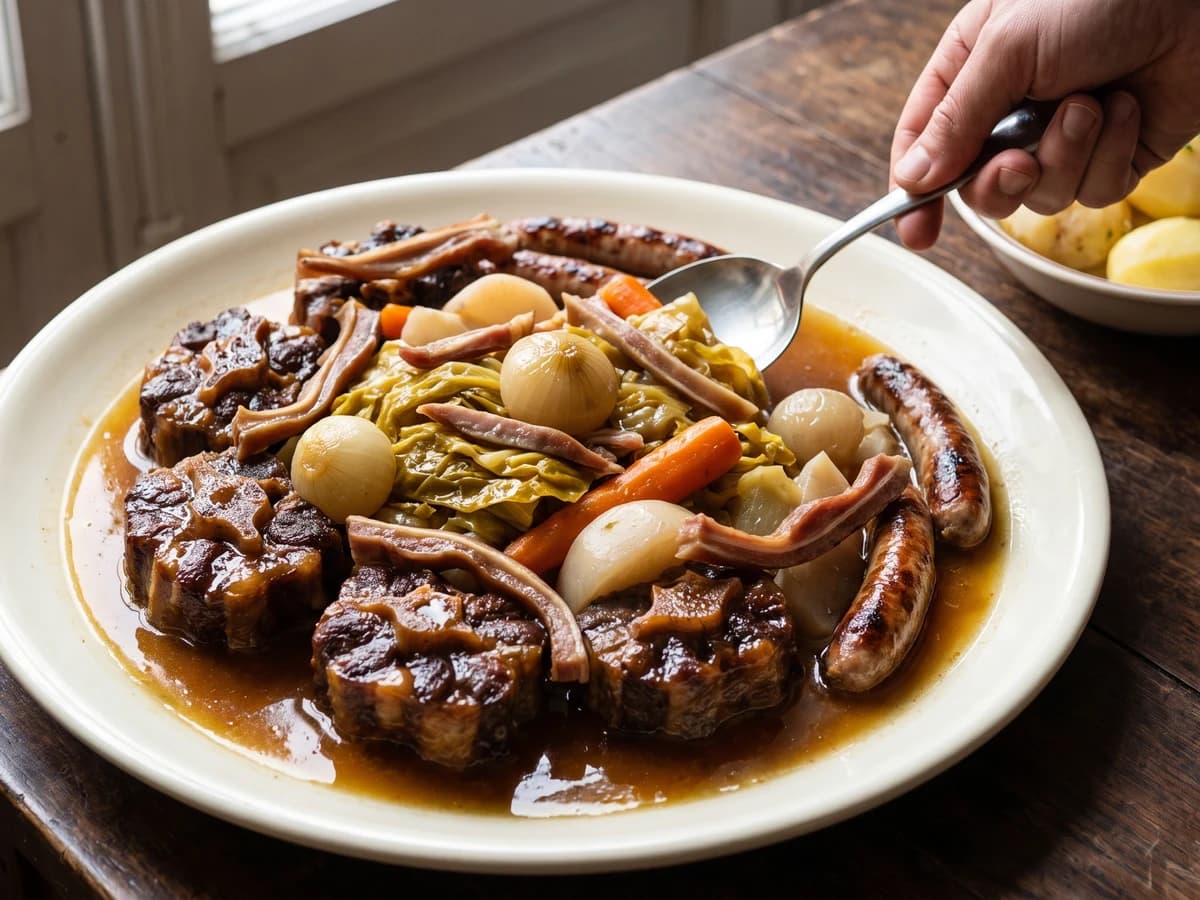
Queue de Bœuf en Hochepot gathers oxtail, pig's trotter and ear, cabbage, roots, and grilled chipolatas around a clear, gelatin-rich broth whose quiet simmer keeps every piece tender and distinct.

Chef Juliette
Beef shoulder larded with bacon, sharpened by red wine and vinegar, then sealed with garlic, vegetables, and dry lemon peel until the low oven turns it yielding and the gravy darkly glossy.