
Chef Juliette
John Dory (St. Pierre)
John Dory has the delicacy of sole and the firmness of turbot. A light flouring, a quick butter sauté, and nut-brown beurre noisette show exactly why looks never mattered.
A cooking platform built around craft, culture, and the stories behind what we eat.
Created by Chef Juliette
Based on No. 1278, Paupiettes de Veau, from Le Guide Culinaire (1907) by Auguste Escoffier
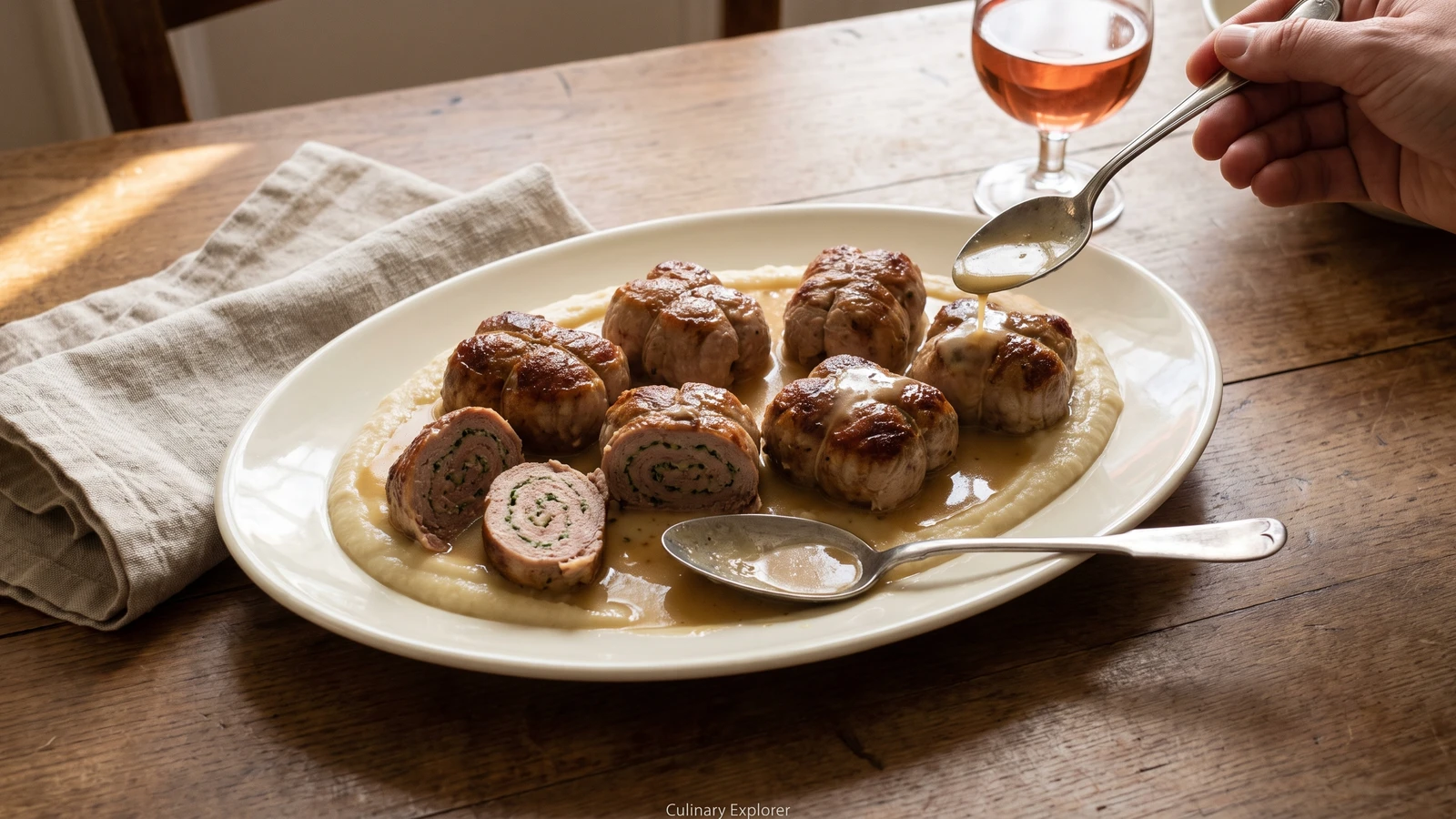
Thin veal spread with fine forcemeat, rolled into neat scrolls, tied snugly, and braised at a bare tremble until tender, with celery root purée to catch the glossy sauce.
Paupiettes de veau (braised veal scrolls) teach a useful truth: shape is part of technique. A slice evenly thin, coated lightly with forcemeat, rolled without gaps, and tied before browning braises as one compact piece. A loose scroll leaks its filling and cooks unevenly. The word carries the technique, and this one is wonderfully literal.
The classical entry assumed a butcher cutting extremely thin veal, prepared forcemeat within reach, a stockpot never off the fire, and a saucier on staff to finish the braising liquor. A salamander has no job here because paupiettes are braised, not gratinéed. At home, ask the butcher for eight small escalopes, make one bowl of fine veal forcemeat, and use the same casserole for browning, braising, and reducing. Brigade portions and a separate sauce station are scaffolding and can go. The thin veal, inner forcemeat, tight scroll, string, and long gentle braise are the dish, so every one stays. One cook, one stove, one evening.
Finished properly, each paupiette is Maillard bronze outside, tender within, and marked by a clear spiral when cut. Its braising liquor becomes a tawny, butter-glossed sauce, while purée de céleri-rave, celery root purée, waits underneath to catch every spoonful. Before any roll meets the pan, tie it snugly enough to hold its scroll but not so tightly that the filling is squeezed out. That knot decides the dish.
Paupiettes de veau belong both to the French cuisine bourgeoise table and the Parisian classical repertoire, where thin slices made a modest piece of veal generous by enclosing forcemeat and braising it slowly. The word paupiette names the scroll rather than the animal, so the same form has long been applied to poultry and fish as well as veal. What grand kitchens catalogued as a precise entrée or garnish remained practical household cooking: rolled, tied, gently braised, and served with a vegetable purée to receive the sauce.
Quantity
8, 4 × 2 inches (10 × 5 cm) each and 1½ pounds (680 g) total
pounded to ⅛ inch (3 mm)
Quantity
6 ounces (170 g)
kept very cold
Quantity
⅓ cup (80 ml / 20 g)
Quantity
3 tablespoons (45 ml / 45 g)
Quantity
1
Quantity
1 (2 tablespoons / 30 ml / 25 g)
very finely minced
Quantity
1 tablespoon (15 ml / 4 g)
finely chopped
Quantity
⅛ teaspoon (0.6 ml / 0.3 g)
Quantity
2½ teaspoons (12.5 ml / 15 g)
divided
Quantity
1 teaspoon (5 ml / 2 g)
divided
Quantity
4 (4 ounces / 115 g)
halved crosswise
Quantity
2 tablespoons (30 ml / 28 g)
Quantity
1 (¾ cup / 180 ml / 110 g)
finely diced
Quantity
1 (½ cup / 120 ml / 70 g)
finely diced
Quantity
¾ cup (180 ml / 180 g)
Quantity
2½ cups (600 ml / 600 g)
divided
Quantity
1
Quantity
1 (4½ cups / 1.1 L / 680 g)
peeled and cut into 1-inch (2.5 cm) cubes
Quantity
3 (3 cups / 710 ml / 450 g)
peeled and cut into 1-inch (2.5 cm) cubes
Quantity
½ cup (120 ml / 120 g)
Quantity
4 tablespoons (60 ml / 56 g)
softened
Quantity
1 tablespoon (15 ml / 14 g)
cold and cubed
| Ingredient | Quantity |
|---|---|
| thin veal escalopespounded to ⅛ inch (3 mm) | 8, 4 × 2 inches (10 × 5 cm) each and 1½ pounds (680 g) total |
| ground vealkept very cold | 6 ounces (170 g) |
| fresh fine white breadcrumbs | ⅓ cup (80 ml / 20 g) |
| whole milk | 3 tablespoons (45 ml / 45 g) |
| large egg yolk | 1 |
| small shallotvery finely minced | 1 (2 tablespoons / 30 ml / 25 g) |
| flat-leaf parsleyfinely chopped | 1 tablespoon (15 ml / 4 g) |
| freshly grated nutmeg | ⅛ teaspoon (0.6 ml / 0.3 g) |
| fine sea saltdivided | 2½ teaspoons (12.5 ml / 15 g) |
| freshly ground black pepperdivided | 1 teaspoon (5 ml / 2 g) |
| very thin unsmoked streaky bacon rashers (optional)halved crosswise | 4 (4 ounces / 115 g) |
| unsalted butter for browning | 2 tablespoons (30 ml / 28 g) |
| small yellow onionfinely diced | 1 (¾ cup / 180 ml / 110 g) |
| medium carrotfinely diced | 1 (½ cup / 120 ml / 70 g) |
| dry white wine | ¾ cup (180 ml / 180 g) |
| unsalted veal or chicken stockdivided | 2½ cups (600 ml / 600 g) |
| bouquet garni of parsley stems, thyme, and bay leaf | 1 |
| medium celery rootpeeled and cut into 1-inch (2.5 cm) cubes | 1 (4½ cups / 1.1 L / 680 g) |
| medium floury potatoespeeled and cut into 1-inch (2.5 cm) cubes | 3 (3 cups / 710 ml / 450 g) |
| heavy cream | ½ cup (120 ml / 120 g) |
| unsalted butter for the puréesoftened | 4 tablespoons (60 ml / 56 g) |
| unsalted butter for finishing the saucecold and cubed | 1 tablespoon (15 ml / 14 g) |
Lay each escalope between two sheets of parchment and pound from the centre outward until it is an even ⅛ inch (3 mm) thick and roughly 4 × 2 inches (10 × 5 cm). Trim ragged edges and add the trimmings to the ground veal. Season both sides of the slices with ¾ teaspoon of the salt and ¼ teaspoon of the pepper in total. If a slice tears, overlap the torn edges by ½ inch (1 cm) and tap them together gently through the parchment. Ça se rattrape. Even thinness matters more than perfect rectangles.
Stir the breadcrumbs and milk together and leave them for 5 minutes to make a panade, a milk-soaked bread binder. Add the cold ground veal, egg yolk, shallot, parsley, nutmeg, ½ teaspoon salt, and ¼ teaspoon pepper. Mix firmly with a wooden spoon until the forcemeat becomes slightly tacky and holds together. Fry a teaspoonful in a small dab of the browning butter until cooked through, then taste. If the raw mixture feels loose, chill it for 10 minutes; if it still slumps, work in another spoonful of breadcrumbs. If it feels stiff, mix in a teaspoon of milk. The filling must spread without running.
Divide the forcemeat into 8 equal portions. Set one portion on each veal slice and spread it in a thin, even coat, leaving a ¼-inch (6 mm) border. Roll from a short end into a compact scroll with the forcemeat inside. If using bacon, wrap one half-rasher around each roll. Tie each paupiette once around the middle and, if the ends flare, add a second loop. The string should hold the scroll without cutting into it. If filling pushes from an end, unwrap the paupiette, remove a spoonful, and roll again. Ça se rattrape, and it is better corrected here than in the casserole.
Melt the remaining browning butter in a heavy, lidded sauté pan or shallow casserole over medium heat. When the foam subsides, add the paupiettes seam-side down, working in two batches if necessary. Brown them patiently on every side until Maillard bronze, about 7 minutes per batch, then lift them to a plate. Keep the heat moderate if you used bacon so its fat renders without scorching. Leave the brown film on the pan floor. That fond is the beginning of the sauce.
Lower the heat and add the onion and carrot to the casserole. Cook for 6 to 8 minutes, stirring, until softened and lightly golden. Pour in the wine and scrape up every trace of fond with a wooden spoon. Reduce by half, until the wine smells round rather than sharp. Add 2 cups (480 ml / 480 g) of the stock and the bouquet garni, reserving the final ½ cup (120 ml / 120 g). Return the paupiettes seam-side down; the liquid should reach about halfway up their sides.
Bring the liquid only to a bare tremble, cover the casserole, and transfer it to a 325°F (160°C) oven. Braise for 60 to 70 minutes, turning the paupiettes once, until the veal yields easily to a knife and the centre of the forcemeat reaches 160°F (71°C). A hard boil contracts the veal and can split the scrolls. If the liquid has boiled fiercely, remove the casserole from the oven, add 2 tablespoons of the reserved cold stock, reduce the oven to 300°F (150°C), and continue gently. Ça se rattrape.
While the paupiettes braise, cover the celery root and potatoes with cold water in a saucepan. Add 1 teaspoon salt, bring to a gentle boil, and cook for 20 to 25 minutes, until both collapse readily beneath a knife. Drain thoroughly, return them to the dry pan for 1 minute, then pass them through a ricer or mash until smooth. Warm the cream, fold it into the vegetables, then beat in the softened butter and ¼ teaspoon pepper. If the purée is loose, stir it over low heat until it holds a soft mound; if it is tight, loosen it with a spoonful of warm cream.
Lift the cooked paupiettes to a warm plate and cover loosely. Discard the bouquet garni, then strain the braising liquid into the cleaned casserole, pressing the vegetables lightly before discarding them. Skim excess fat and boil the liquid steadily until about 1 cup (240 ml) remains and it naps the back of a spoon, meaning it coats without running off at once. Remove the casserole from the heat and monter au beurre, gloss the sauce with cold butter, by swirling in the cubes one at a time. If the butter separates into greasy beads, whisk in a teaspoon of cold reserved stock off the heat. Ça se rattrape. Taste and use the remaining salt and pepper only if needed.
Rest the paupiettes for 5 minutes, then cut away every loop of string without disturbing the scrolls. Spread the purée de céleri-rave across a warm oval platter, arrange the paupiettes over it, and spoon the glossy sauce generously across their tops and around the purée. Serve two per person. À table!
1 serving (about 580g)
Culinary guides, cultural storytelling, and the editorial depth that makes cooking meaningful.
Discover Culinary ExplorerChef Juliette
John Dory has the delicacy of sole and the firmness of turbot. A light flouring, a quick butter sauté, and nut-brown beurre noisette show exactly why looks never mattered.

Chef Juliette
Fresh haddock proves its delicacy in the meunière pan: a fine flour crust, moist pearly flakes, and beurre noisette sharpened with lemon and parsley, ready from one skillet in half an hour.
Chef Juliette
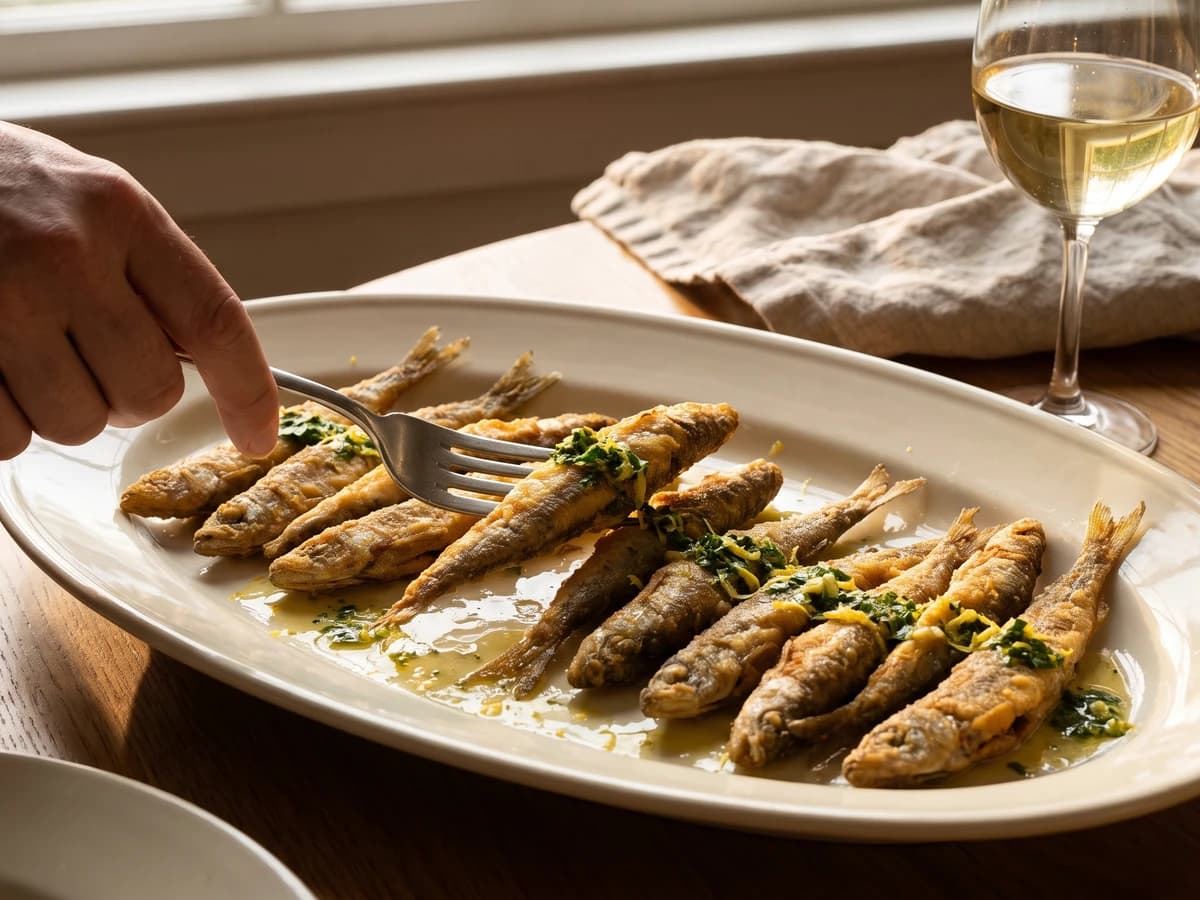
Éperlans à l’Anglaise turns small fish into a lesson in disciplined coating: boned smelts under a close, crisp crumb, pan-fried in clarified butter and finished with bright, half-melted maître d’hôtel butter.

Chef Juliette
Tiny smelts, shallot, mushrooms, white wine, gratin sauce, and fine bread raspings meet a fierce oven, where the fish must turn tender in the same breath the buttered crust bronzes.