
Chef Juliette
John Dory (St. Pierre)
John Dory has the delicacy of sole and the firmness of turbot. A light flouring, a quick butter sauté, and nut-brown beurre noisette show exactly why looks never mattered.
A cooking platform built around craft, culture, and the stories behind what we eat.

Created by Chef Juliette
Based on No. 1262, Côte de Veau Froide en Belle Vue, from Le Guide Culinaire (1907) by Auguste Escoffier
Côte de Veau Froide en Belle Vue turns four cold veal chops into a clear-jellied centerpiece, each patterned with vegetables and unmoulded onto chopped aspic, a precise lesson in timing rather than ornament.
Côte de Veau Froide en Belle Vue (cold veal cutlet set in clear aspic) teaches control of gelatin. The one true thing to know before touching the pan is this: the vegetable decoration must be fixed with aspic that is cool and half-melted, fluid enough to brush but thick enough to cling. Warm jelly loosens the pattern. Fully set jelly won't hold it.
The entry assumed cold cooked cutlets, a saucier tending clear jelly from a stockpot never off the fire, another pair of hands cutting minute vegetables, and metal cutlet moulds waiting by the dozen. The source begins after the veal is cooked and the jelly made, so this home version supplies a brief pan-cooking method and a firm aspic made from clear stock and gelatin. Shallow oval metal dishes replace the dedicated moulds, and four portions replace the brigade batch. Those moulds and extra hands were scaffolding. The upside-down assembly, the fixed decoration, and the chopped-jelly border are the dish, so they stay. One cook, one stove, one evening.
The finished Belle Vue should be cold, clear, and generous, with the vegetables visible beneath a smooth lens of aspic and the veal still tender inside. Work patiently when you decorate each chop, and don't turn it face-down until every little piece is firmly caught.
Côte de Veau Froide en Belle Vue belongs to Parisian cuisine froide, the classical cold-kitchen repertoire that presented cooked meat, poultry, fish, and eggs beneath clear aspic. It traveled from grand cold buffets to bourgeois celebration tables, where shaped household dishes stood in for professional moulds. Belle vue describes the presentation rather than a particular garnish: the decoration is assembled upside down, then revealed through the jelly when the mould is lifted.
Quantity
4, each 7 to 8 oz (200 to 225 g)
1 to 1 1/4 inches (2.5 to 3 cm) thick
Quantity
2 teaspoons (10 ml / 12 g)
divided
Quantity
1/2 teaspoon (2.5 ml / 1 g)
Quantity
2 tablespoons (30 ml / 28 g)
Quantity
6 cups (1.42 liters / 1.42 kilograms)
divided
Quantity
1/4 cup (60 ml / 36 g)
Quantity
1 medium, yielding about 1/2 cup (120 ml / 75 g)
cut into very thin slices and small decorative shapes
Quantity
1 cup (240 ml / 115 g)
trimmed and cut into small diamonds
Quantity
1/2 cup (120 ml / 70 g)
| Ingredient | Quantity |
|---|---|
| bone-in veal rib chops1 to 1 1/4 inches (2.5 to 3 cm) thick | 4, each 7 to 8 oz (200 to 225 g) |
| fine sea saltdivided | 2 teaspoons (10 ml / 12 g) |
| finely ground white pepper | 1/2 teaspoon (2.5 ml / 1 g) |
| clarified butter | 2 tablespoons (30 ml / 28 g) |
| clear, defatted, low-sodium veal or chicken stockdivided | 6 cups (1.42 liters / 1.42 kilograms) |
| unflavored powdered gelatin | 1/4 cup (60 ml / 36 g) |
| carrotcut into very thin slices and small decorative shapes | 1 medium, yielding about 1/2 cup (120 ml / 75 g) |
| green beanstrimmed and cut into small diamonds | 1 cup (240 ml / 115 g) |
| frozen peas | 1/2 cup (120 ml / 70 g) |
Dry the chops thoroughly and season them with 1 1/2 teaspoons of the salt and the white pepper. Heat the clarified butter in a broad skillet over medium-high heat, then brown the chops without crowding, about 3 minutes on each side. Lower the heat and continue cooking, turning and basting, until the centers reach 145°F (63°C). Rest them on a rack for 5 minutes, then refrigerate uncovered until no longer warm before covering and chilling completely, about 1 hour. Cold veal exposes every degree of overcooking, so stop at temperature rather than cooking until it feels firm.
Cut the carrot slices into small rounds, crescents, or diamonds, keeping the shapes no thicker than 1/8 inch (3 mm). Blanch the carrot until barely tender, about 2 minutes, the beans for 90 seconds, and the peas for 30 seconds. Chill each vegetable promptly in iced water, drain it, and pat it completely dry. Moisture trapped beneath the aspic makes pale spots and lets the decoration slide.
Pour 1 1/2 cups (360 ml / 360 g) of the cold stock into a bowl and sprinkle the gelatin evenly over it. Leave it for 10 minutes to bloom. Warm the remaining stock with the last 1/2 teaspoon of salt until hot but not boiling, then stir in the bloomed gelatin until completely dissolved. Strain through a damp cloth-lined sieve and cool the aspic until fluid but no longer warm. If it firms before you need it, set the bowl over lukewarm water and stir; if it runs like stock when you need it to grip, stir it over ice. Ça se rattrape.
Arrange four shallow oval metal moulds on a tray. Pour 1/4 cup (60 ml / 60 g) of fluid aspic into each, making a clear layer about 1/8 inch (3 mm) deep. Refrigerate until fully set, about 15 to 20 minutes. Keep the remaining aspic cool and fluid while this first layer firms.
Trim ragged fat and gristle from the cold chops while preserving the bones and a neat cutlet outline. Lay the chops rounded-side up and arrange the carrot, bean diamonds, and peas in a simple pattern over each one. Transfer about 1/2 cup (120 ml / 120 g) of aspic to a small bowl and stir it over ice until it reaches a half-melted consistency, like loose raw egg white. Brush or spoon it sparingly over the vegetables, then chill the chops for 10 minutes. This fixing coat is the step that decides the dish. If a piece shifts, move it back before the jelly sets and brush it again; don't flood the pattern.
Place each chop inside its mould with the decorated side undermost against the set jelly, allowing the clean end of the bone to project over the narrow rim. Pour 1 1/2 cups (360 ml / 360 g) of the remaining aspic into a separate shallow dish for the chopped-jelly border. Gently pour the rest down the sides of the moulds until the meat is covered, keeping the exposed bone clean. If the first layer begins to melt or the pattern moves, stop and pour off the loose aspic, chill the mould for 10 minutes, then continue with cooler jelly. Refrigerate the moulds and the reserved aspic until completely firm, at least 3 hours and preferably overnight.
Chop the reserved aspic into irregular pieces about 1/4 inch (6 mm) across and arrange them as a border on a chilled platter. Dip a small sharp knife in hot water, wipe it, and pass the blade carefully around the edge of each mould. Set the mould for 3 to 5 seconds on a folded napkin dipped in hot water, invert it over the platter, and lift gently. If it resists, warm the mould for another 2 seconds rather than pulling on the bone. If an edge tears, press the loose jelly back with a little half-set aspic and chill it for 10 minutes; the chopped border will cover the seam. Wrap a fringed parchment frill around each clean bone and serve the Belle Vue cold. À table!
1 serving (about 500g)
Culinary guides, cultural storytelling, and the editorial depth that makes cooking meaningful.
Discover Culinary ExplorerChef Juliette
John Dory has the delicacy of sole and the firmness of turbot. A light flouring, a quick butter sauté, and nut-brown beurre noisette show exactly why looks never mattered.

Chef Juliette
Fresh haddock proves its delicacy in the meunière pan: a fine flour crust, moist pearly flakes, and beurre noisette sharpened with lemon and parsley, ready from one skillet in half an hour.
Chef Juliette
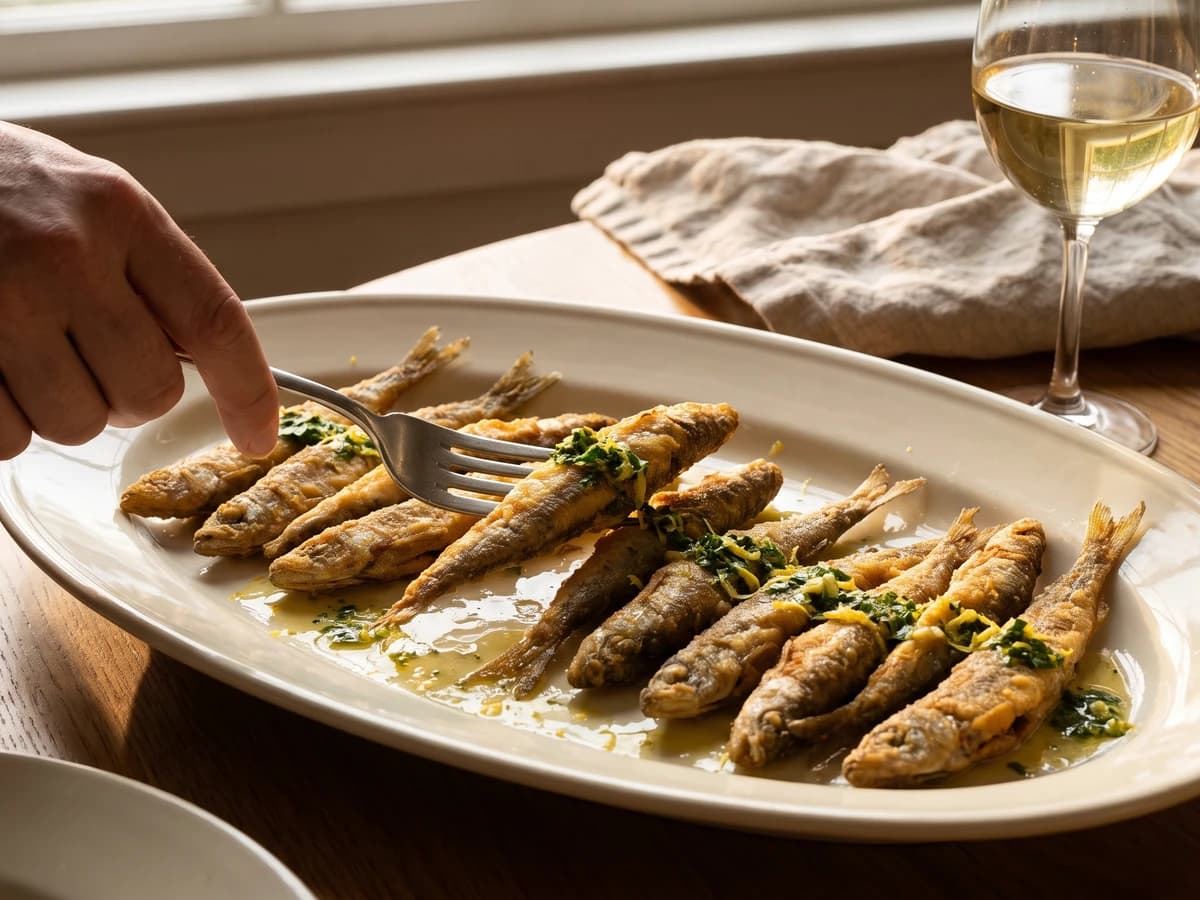
Éperlans à l’Anglaise turns small fish into a lesson in disciplined coating: boned smelts under a close, crisp crumb, pan-fried in clarified butter and finished with bright, half-melted maître d’hôtel butter.

Chef Juliette
Tiny smelts, shallot, mushrooms, white wine, gratin sauce, and fine bread raspings meet a fierce oven, where the fish must turn tender in the same breath the buttered crust bronzes.