
Chef Juliette
John Dory (St. Pierre)
John Dory has the delicacy of sole and the firmness of turbot. A light flouring, a quick butter sauté, and nut-brown beurre noisette show exactly why looks never mattered.
A cooking platform built around craft, culture, and the stories behind what we eat.
Created by Chef Juliette
Based on No. 1259, Côte de Veau Papillote, from Le Guide Culinaire (1907) by Auguste Escoffier
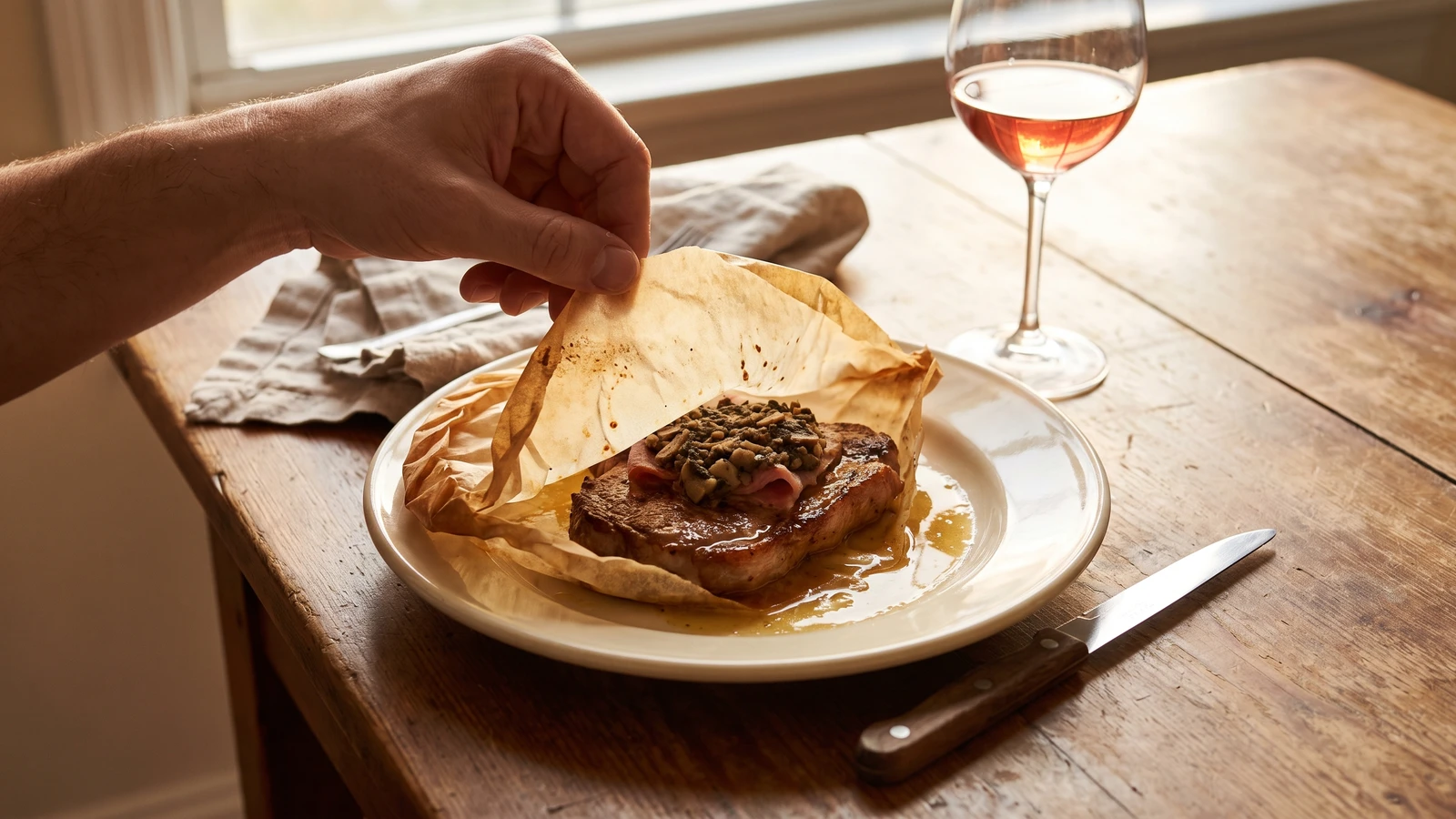
Côte de Veau en Papillote seals butter-browned veal, Duxelles, sliced mushroom, and ham inside oiled paper, then lets the hot oven inflate the parcel for its generous opening at the table.
Côte de Veau en Papillote (veal cutlet baked in a paper parcel) teaches one true thing: the seal is the technique. Butter-browned veal, Duxelles sauce, sliced mushroom, and ham are already splendid, but the pleated heart of paper holds their aromas together and rises in the oven. If the case cannot hold, the dish loses its particular magic.
The original entry assumed a saucier with Duxelles sauce ready, strong paper at hand, and another pair of hands shaping cases while the cutlet cooked. Its stockpot had already done its work inside the finished sauce, and no salamander was needed; a fairly hot oven supplied the final lift. At home, prepared Duxelles sauce, sturdy baking parchment, a skillet, and a rimmed sheet are the honest equivalents. We move the paper work ahead of the pan because one cook cannot pleat neatly while veal browns. That simultaneous service work was brigade scaffolding. The ratio of two tablespoons of Duxelles and two slices of ham per cutlet stays exactly where the source put it. One cook, one stove, one evening.
Brush the parchment, then layer ham, sauce, veal, sauce, and ham. The parchment is modern, but the fitted layers and sealed pleats are the dish itself, and they must stay. The step that matters most is the final crimp at the pointed end, because a handsome packet with an open seam is merely wrapping.
Côte de veau en papillote belongs to the Parisian classical table rather than to a single provincial larder, where individual veal cutlets were finished with sauce and garnish enclosed inside oiled paper. The method passed naturally into cuisine bourgeoise because the paper performed as both covered cooking vessel and service dish, keeping the juices close until the parcel reached the guest. Its puff is not decoration; it proves the pleats held, and opening the case at table releases the concentrated aroma that defines en papillote.
Quantity
4, each ¾ inch (2 cm) thick and about 6 oz (170 g)
Quantity
½ teaspoon (2.5 ml / 3 g)
Quantity
¼ teaspoon (1.25 ml / 0.6 g)
Quantity
3 tablespoons (45 ml / 42 g)
divided
Quantity
4 medium (about 3 oz / 85 g)
thinly sliced
Quantity
½ cup (120 ml / 120 g)
Quantity
8 thin slices (about 8 oz / 225 g)
trimmed into rounded hearts the size of the cutlets
Quantity
2 tablespoons (30 ml / 28 g)
for brushing the parchment
Quantity
1 teaspoon (5 ml / 5 g)
only if needed to loosen the Duxelles sauce
| Ingredient | Quantity |
|---|---|
| bone-in veal rib cutlets | 4, each ¾ inch (2 cm) thick and about 6 oz (170 g) |
| fine sea salt | ½ teaspoon (2.5 ml / 3 g) |
| freshly ground black pepper | ¼ teaspoon (1.25 ml / 0.6 g) |
| unsalted butterdivided | 3 tablespoons (45 ml / 42 g) |
| button mushroomsthinly sliced | 4 medium (about 3 oz / 85 g) |
| prepared Duxelles sauce | ½ cup (120 ml / 120 g) |
| unsmoked cooked hamtrimmed into rounded hearts the size of the cutlets | 8 thin slices (about 8 oz / 225 g) |
| neutral oilfor brushing the parchment | 2 tablespoons (30 ml / 28 g) |
| warm water (optional)only if needed to loosen the Duxelles sauce | 1 teaspoon (5 ml / 5 g) |
Set a rack in the centre of the oven and heat it to 425°F (220°C). Fold each 16 by 20 inch (40 by 50 cm) sheet of baking parchment in half, cut it into a broad half-heart, then unfold it. Each closed heart must leave at least 2 inches (5 cm) of paper around its cutlet. Brush the inner surface lightly but completely with the neutral oil, reserving a little for the tops. Trim the ham into eight rounded hearts roughly matching the meaty portion of the cutlets.
Melt 1 tablespoon (15 ml / 14 g) of the butter in a heavy skillet over medium-high heat. Add the sliced mushrooms and sauté until their released liquid has evaporated and their edges are lightly browned, 4 to 5 minutes. Fold them into the prepared Duxelles sauce and warm it gently. The sauce must sit in a soft mound rather than run across the spoon; if it is loose, reduce it over low heat until it holds, and if it tightens too far, take it off the heat and stir in the teaspoon of warm water. Transfer it to a bowl and wipe the skillet.
Pat the cutlets thoroughly dry and season both sides with the salt and pepper. Melt half the remaining butter in the skillet over medium-high heat, waiting until its foam subsides, then sauté two cutlets at a time for about 2 minutes per side. Give them a deep golden surface while leaving the centres underdone, about 125 to 130°F (52 to 54°C). Repeat with the remaining butter and cutlets. The source's instruction to toss the veal in butter means this quick sauté, not cooking it through before the parcel.
Open one parchment heart and place a ham heart in the centre of one half, close to the fold but clear of the outer border. Spread exactly 1 tablespoon (15 ml / 15 g) of Duxelles over the ham, set a warm cutlet on top, and aim the bone toward the central fold so it cannot pierce the outer edge. Cover with another tablespoon of Duxelles and finish with a second ham heart. Repeat with the remaining portions. Keep the sauce away from the paper border, because a greasy seam will not grip.
Fold the empty half of each heart over the filling and align the edges. Beginning at the rounded top, make tight 1 inch (2.5 cm) overlapping pleats around the curve, pressing each fold firmly before making the next. Fold the final pointed tail underneath the parcel, then brush the top lightly with the reserved oil. If the bone makes a tear or a pleat refuses to hold, don't discard the case. Ça se rattrape: cover the weak spot with the prepared oiled parchment scrap and crimp the neighbouring folds over it.
Arrange the parcels on a rimmed baking sheet without letting them touch. Bake for 6 to 8 minutes, until the cases rise into domes and the oiled parchment turns butter-gold around the pleats. Check the veal through the thick folded edge with an instant-read thermometer, avoiding the bone; it must reach 145°F (63°C). If it is short of that mark, return the parcels for 2 minutes. The veal was browned first, so the oven's work is brief: finish the meat, heat the layers together, and inflate the sealed case.
Transfer each closed papillote immediately to a warmed plate. Bring them to the table intact, then slit the upper paper away from faces and hands and peel it back to reveal the ham-covered cutlet and glossy Duxelles beneath. Do not open the parcels in the kitchen; the concentrated aroma released at the table is the final seasoning. À table!
1 serving (about 210g)
Culinary guides, cultural storytelling, and the editorial depth that makes cooking meaningful.
Discover Culinary ExplorerChef Juliette
John Dory has the delicacy of sole and the firmness of turbot. A light flouring, a quick butter sauté, and nut-brown beurre noisette show exactly why looks never mattered.

Chef Juliette
Fresh haddock proves its delicacy in the meunière pan: a fine flour crust, moist pearly flakes, and beurre noisette sharpened with lemon and parsley, ready from one skillet in half an hour.

Chef Juliette
Éperlans à l’Anglaise turns small fish into a lesson in disciplined coating: boned smelts under a close, crisp crumb, pan-fried in clarified butter and finished with bright, half-melted maître d’hôtel butter.

Chef Juliette
Tiny smelts, shallot, mushrooms, white wine, gratin sauce, and fine bread raspings meet a fierce oven, where the fish must turn tender in the same breath the buttered crust bronzes.