
Chef Juliette
John Dory (St. Pierre)
John Dory has the delicacy of sole and the firmness of turbot. A light flouring, a quick butter sauté, and nut-brown beurre noisette show exactly why looks never mattered.
A cooking platform built around craft, culture, and the stories behind what we eat.

Created by Chef Juliette
Based on No. 1248, Foie de Veau à l’Anglaise, from Le Guide Culinaire (1907) by Auguste Escoffier
Foie de Veau à l’Anglaise teaches the narrow timing of liver: thin slices, a whisper of flour, hot butter, crisp bacon, and a swift beurre noisette finish before tenderness slips away.
Foie de Veau à l’Anglaise (calf’s liver with bacon) teaches the narrowest timing in the sauté pan: liver waits for no one. Have the bacon, warm platter, and finishing butter ready before the liver meets heat, because a thin slice is tender one moment and leather the next.
The original entry assumed a grill or salamander already hot, a sauté pan at its station, and enough hands to send the bacon and liver together. It required neither a saucier nor a stockpot, because butter is the finish. At home, the broiler does the salamander’s work, the bacon cooks first, and the liver follows in two quick batches. What changed is the choreography and the scale for four, not the formula. One cook, one stove, one evening.
The separate staffed grill station was brigade scaffolding and can go. The equal count of bacon and liver, the light dredging, real butter, and immediate service are the dish itself and must stay. Finish with beurre noisette (hazelnut-browned butter), then bring it straight to the table. The one step that decides everything is removing each slice the moment it is safely cooked through; hesitation is what turns liver firm.
Foie de Veau à l’Anglaise belongs not to a single French region but to the classical French repertory’s habit of naming a garnish by the country it evoked; here, à l’anglaise identifies calf’s liver served with grilled bacon rashers. French kitchens took a familiar British pairing and disciplined its service: thin, floured liver sautéed in butter, an equal count of bacon, and the two arranged alternately on the platter. The name is easy to misread because à l’anglaise can signal an egg-and-crumb coating elsewhere in the canon, but this entry defines the style through bacon and arrangement, not breadcrumbs.
Quantity
8 slices, each 2½ to 3 oz (70 to 85 g), about 1⅜ lb (620 g) total
cut ¼ to ⅜ inch (6 to 10 mm) thick, membrane and firm tubes removed
Quantity
8 rashers, about 8 oz (225 g)
Quantity
½ cup (120 ml / 60 g)
for dredging
Quantity
¾ teaspoon (3.75 ml / 4.5 g)
Quantity
½ teaspoon (2.5 ml / 1 g)
Quantity
8 tablespoons (½ cup / 120 ml / 113 g)
divided between sautéing and beurre noisette
| Ingredient | Quantity |
|---|---|
| calf’s livercut ¼ to ⅜ inch (6 to 10 mm) thick, membrane and firm tubes removed | 8 slices, each 2½ to 3 oz (70 to 85 g), about 1⅜ lb (620 g) total |
| thin rashers bacon | 8 rashers, about 8 oz (225 g) |
| all-purpose flourfor dredging | ½ cup (120 ml / 60 g) |
| fine sea salt | ¾ teaspoon (3.75 ml / 4.5 g) |
| freshly ground black pepper | ½ teaspoon (2.5 ml / 1 g) |
| unsalted butterdivided between sautéing and beurre noisette | 8 tablespoons (½ cup / 120 ml / 113 g) |
Set an oven rack about 6 inches (15 cm) below the broiler and heat the broiler on high. Place a wire rack over a rimmed metal sheet pan. Warm an oval serving platter with hot water, dry it thoroughly, and keep it beside the stove. Trim any membrane or firm tubes from the liver, then dry every slice carefully. Wet liver steams and sheds its flour, while a dry surface takes an even, delicate coating.
Lay the eight bacon rashers on the rack without overlapping. Broil until the fat has rendered and the upper surface is bronzed, about 3 to 4 minutes, then turn and cook the second side for 2 to 3 minutes. Watch closely during the final minute, because thin rashers move quickly from crisp to burnt. Transfer them to the warm platter and hold them uncovered so they stay crisp. Save the bacon fat for another use, but do not substitute it for the butter here; the source is quite plain about the finish.
Spread the flour in a broad, shallow dish. Season both sides of the liver with the salt and pepper, then dredge the first four slices lightly in flour and shake off every loose patch. The flour is a veil, not a crust. Dredge only as the pan becomes ready, because floured liver left waiting turns damp and pasty.
Heat a large heavy skillet over medium-high heat and add 2 tablespoons (30 ml / 28 g) of the butter. When the foam subsides and the butter smells sweet but remains golden, lay in four liver slices without crowding. Cook for 60 to 90 seconds on the first side, turn once, and cook for another 45 to 75 seconds. Check the thickest slice by inserting an instant-read thermometer sideways; remove it as soon as the centre reaches 160°F (71°C). Transfer the slices to the warm platter, then dredge and cook the remaining four with another 2 tablespoons (30 ml / 28 g) butter. If the flour blackens before the liver cooks, the heat is too fierce. Move the pan off the burner, lift out the liver, discard the bitter fat, wipe away black crumbs with paper held in tongs, and continue over medium heat with 1 tablespoon taken from the finishing butter. Ça se rattrape.
Tip out any dark flour crumbs and wipe the skillet clean. Return it to medium heat and add the remaining 4 tablespoons (60 ml / 57 g) butter, or whatever remains if some was used to rescue the sauté. Swirl as it melts and foams. When the foam grows finer, the milk solids turn hazelnut-brown, and the butter smells toasted, immediately remove the pan from the heat. The hot skillet continues cooking the butter, so do not wait for a darker colour.
Arrange the eight slices of liver and eight bacon rashers alternately across the warm platter, preserving the equal count specified by the original entry. Spoon the beurre noisette over the liver, allowing some to pool beneath it, and serve immediately. This dish has no holding time and needs no decoration. À table!
1 serving (about 170g)
Culinary guides, cultural storytelling, and the editorial depth that makes cooking meaningful.
Discover Culinary ExplorerChef Juliette
John Dory has the delicacy of sole and the firmness of turbot. A light flouring, a quick butter sauté, and nut-brown beurre noisette show exactly why looks never mattered.

Chef Juliette
Fresh haddock proves its delicacy in the meunière pan: a fine flour crust, moist pearly flakes, and beurre noisette sharpened with lemon and parsley, ready from one skillet in half an hour.
Chef Juliette
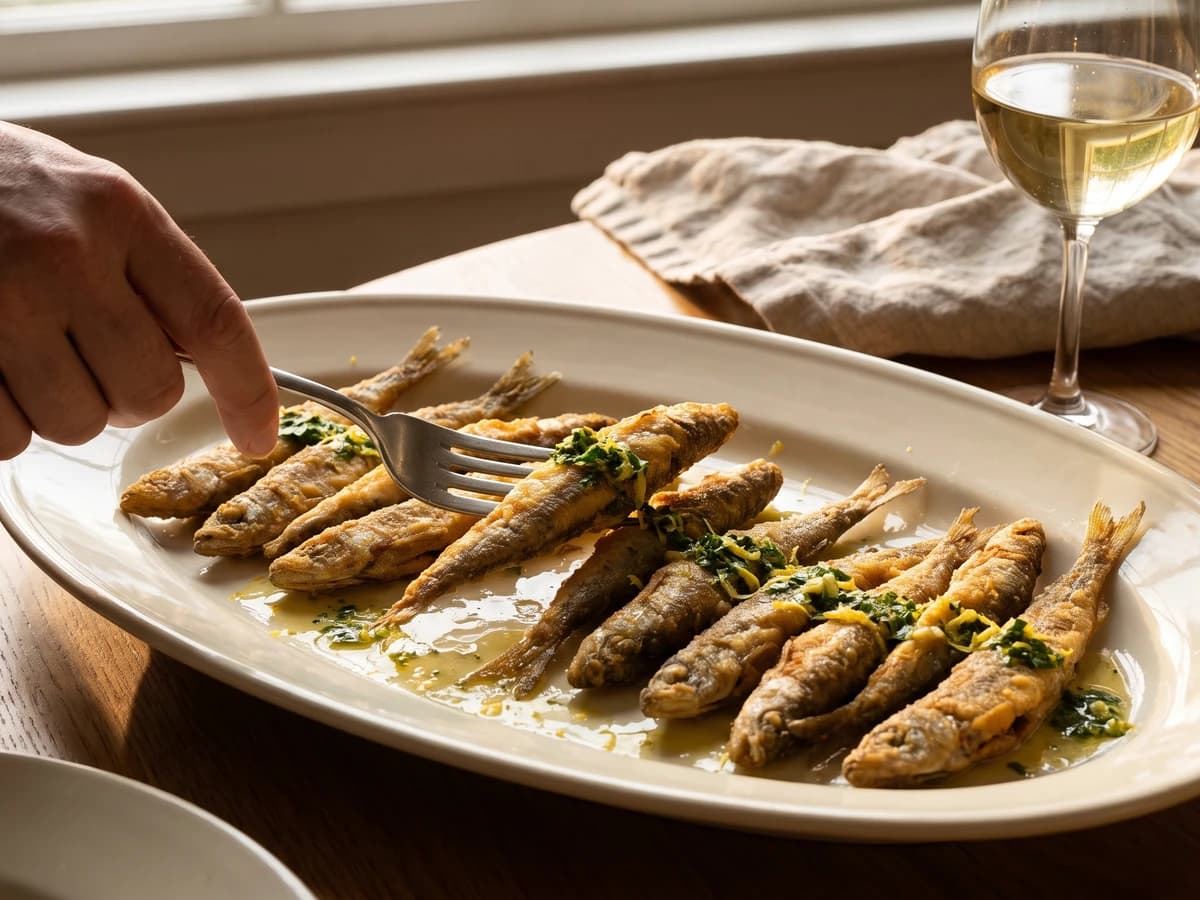
Éperlans à l’Anglaise turns small fish into a lesson in disciplined coating: boned smelts under a close, crisp crumb, pan-fried in clarified butter and finished with bright, half-melted maître d’hôtel butter.

Chef Juliette
Tiny smelts, shallot, mushrooms, white wine, gratin sauce, and fine bread raspings meet a fierce oven, where the fish must turn tender in the same breath the buttered crust bronzes.