
Chef Juliette
John Dory (St. Pierre)
John Dory has the delicacy of sole and the firmness of turbot. A light flouring, a quick butter sauté, and nut-brown beurre noisette show exactly why looks never mattered.
A cooking platform built around craft, culture, and the stories behind what we eat.

Created by Chef Juliette
Based on No. 1239, Ris de Veau à la Toulousaine, from Le Guide Culinaire (1907) by Auguste Escoffier
Pale-braised veal sweetbreads, studded with black truffle and ringed with the full Toulousaine garnish, teach the discipline of building richness without browning, then carrying it with a silken, mushroom-scented Sauce Allemande.
Ris de Veau à la Toulousaine (veal sweetbreads with the Toulousaine garnish) teaches the most demanding kind of restraint. Before you touch a pan, know the one true thing: pale is not timid. The depth must come from good stock, mushroom essence, truffle, and a properly finished Sauce Allemande, while the sweetbreads and garnish remain ivory and softly gleaming.
The original entry assumed a saucier on staff, a stockpot never off the fire, a garde-manger shaping quenelles, and a salamander waiting whenever color was wanted. Here the salamander stays idle because this braise is explicitly without colouration. A food processor replaces the mortar and drum sieve, prepared preserved combs and cocks' kidneys replace the brigade's long offal preparation, and one reduced cup of rich stock supplies the thread of Glace de Viande. The portions are scaled to four, and the Sauce Allemande grows from the sweetbread braising liquor. One cook, one stove, one evening.
Gallons of separate stocks and trays of garnish were brigade scaffolding, so those can go. Blanching and pressing the sweetbreads, studding them with truffle, keeping the braise pale, assembling the full Toulousaine garnish, and serving the mushroom-scented Sauce Allemande separately are the dish itself. The step that decides everything is the first sweating of butter and aromatics: keep them soft, moist, and pale, and the rest can follow.
Ris de Veau à la Toulousaine takes its name from Toulouse, whose prosperous poultry larder supplied the combs, so-called cocks' kidneys, and fine forcemeats that define the garnish. The arrangement traveled from regional abundance into the codified grand-kitchen repertoire, where à la Toulousaine came to mean a precise family of pale poultry offal, quenelles, mushrooms, and truffle rather than a general southwestern seasoning. Its lavish appearance can mislead: this is not a rustic Toulouse braise, but a composed classical service built around whole-bird thrift and the sauce station's discipline.
Quantity
4 (about 1½ pounds / 680 g total)
Quantity
5 quarts (4.7 L / 4.7 kg), divided, plus ice as needed for shocking
Quantity
4 teaspoons (20 ml / 24 g)
divided
Quantity
1 small (about 1½ ounces / 40 g)
fresh or whole preserved, drained
Quantity
2 teaspoons (10 ml / 10 g)
Quantity
7 tablespoons (105 ml / 100 g)
divided
Quantity
1 small (about 4 ounces / 115 g)
thinly sliced
Quantity
1 small (about 2 ounces / 60 g)
thinly sliced
Quantity
1 stalk (about 1½ ounces / 40 g)
thinly sliced
Quantity
1
Quantity
5 cups (1.2 L / 1.2 kg)
divided
Quantity
8 ounces (225 g)
diced and thoroughly chilled
Quantity
1
Quantity
1¼ cups (300 ml / 300 g)
divided
Quantity
½ teaspoon (2.5 ml / 1 g)
divided
Quantity
1 pinch
Quantity
12 (about 8 ounces / 225 g)
wiped, with stems trimmed and reserved
Quantity
4 (about 3½ ounces / 100 g)
drained and halved
Quantity
8 (about 3 ounces / 85 g)
drained
Quantity
1 medium
Quantity
¼ cup (60 ml / 30 g)
Quantity
2
Quantity
1 cup (240 ml / 240 g)
for reducing to 2 tablespoons Glace de Viande
| Ingredient | Quantity |
|---|---|
| veal heart sweetbreads | 4 (about 1½ pounds / 680 g total) |
| cold water | 5 quarts (4.7 L / 4.7 kg), divided, plus ice as needed for shocking |
| fine sea saltdivided | 4 teaspoons (20 ml / 24 g) |
| black trufflefresh or whole preserved, drained | 1 small (about 1½ ounces / 40 g) |
| reserved truffle liquor (optional) | 2 teaspoons (10 ml / 10 g) |
| unsalted butterdivided | 7 tablespoons (105 ml / 100 g) |
| yellow onionthinly sliced | 1 small (about 4 ounces / 115 g) |
| carrotthinly sliced | 1 small (about 2 ounces / 60 g) |
| celerythinly sliced | 1 stalk (about 1½ ounces / 40 g) |
| bouquet garni of parsley stems, thyme, and bay leaf | 1 |
| light unsalted veal or chicken stockdivided | 5 cups (1.2 L / 1.2 kg) |
| skinless chicken breastdiced and thoroughly chilled | 8 ounces (225 g) |
| large egg white | 1 |
| cold heavy creamdivided | 1¼ cups (300 ml / 300 g) |
| ground white pepperdivided | ½ teaspoon (2.5 ml / 1 g) |
| freshly grated nutmeg | 1 pinch |
| small white button mushroomswiped, with stems trimmed and reserved | 12 (about 8 ounces / 225 g) |
| prepared cooked cock's combsdrained and halved | 4 (about 3½ ounces / 100 g) |
| prepared cooked cocks' kidneysdrained | 8 (about 3 ounces / 85 g) |
| lemon | 1 medium |
| all-purpose flour | ¼ cup (60 ml / 30 g) |
| large egg yolks | 2 |
| rich unsalted brown veal or beef stockfor reducing to 2 tablespoons Glace de Viande | 1 cup (240 ml / 240 g) |
Put the sweetbreads in a nonreactive bowl, cover with 2 quarts of the cold water, and refrigerate for 1 hour. Drain, cover with another 2 quarts, and refrigerate for 1 hour more, until the water remains nearly clear. Transfer them to a saucepan with the remaining 1 quart water and 2 teaspoons of the salt. Bring slowly to a bare simmer, cook for 3 minutes, then lift them directly into ice water. This blanching firms the surface so the membranes can be removed without tearing the tender lobes.
While the sweetbreads are still slightly warm, pull away the thick outer membrane, visible veins, and loose fatty pieces with your fingers and a small knife. Preserve the connected lobes rather than worrying away every fine filament. Lay the cleaned sweetbreads between two towels on a rimmed tray, set a second tray over them, and add a 4-pound weight. Refrigerate for 45 minutes. Pressing gives them a compact, even shape that will braise and slice cleanly.
While the sweetbreads press, simmer the rich brown veal or beef stock in the smallest saucepan you own until only 2 tablespoons remain and the Glace de Viande coats a spoon like warm syrup. Watch closely as it nears the end. If it begins catching before it tastes scorched, add a tablespoon of water, dissolve the sticky glaze, and lower the heat. If it sets firmly before service, loosen it with drops of warm water.
Heat the oven to 325°F (165°C). Cut half the truffle into narrow batons and slice the rest thinly for the garnish. Make three or four slim incisions in each pressed sweetbread with a paring knife and slide in the truffle batons. Melt 1½ tablespoons of the butter in a snug casserole over low heat, add the onion, carrot, and celery, and sweat them for 5 minutes without color. If an edge begins turning gold, add a splash of stock immediately and lower the heat, ça se rattrape. Set the sweetbreads over the vegetables, add the bouquet garni and 2 cups of the light stock, then cover with buttered parchment and the lid. Braise for 25 to 30 minutes, turning once, until the lobes feel resilient rather than soft and reach 160°F (71°C) at the center. Lift them out, cover, and strain the pale braising liquid.
Chill the food-processor bowl and blade before beginning. Process the cold chicken with ¾ teaspoon salt, one-quarter of the white pepper, and the nutmeg until it becomes smooth and tacky. Add the egg white and process again, then pour in ½ cup of the cold cream in a thin stream, stopping as soon as the forcemeat is smooth and glossy. Poach a teaspoonful to test the seasoning. If the mixture looks grainy or oily, it has warmed too far; chill it for 15 minutes, then pulse in 1 tablespoon of cold cream. If it is merely soft, chill it until it holds the shape of a spoon.
Bring 2 cups of the light stock to a bare tremble in a wide saucepan. Using two teaspoons dipped in cold water, shape the forcemeat into 12 small oval quenelles and lower them into the stock in batches. Poach without boiling for 6 to 8 minutes, turning once, until they feel springy and reach 165°F (74°C) at the center. Lift them into a buttered dish and cover. Strain and reserve the poaching stock, which can top up the sweetbread liquor for the sauce.
Put the mushroom caps and reserved stems in a saucepan with 1 tablespoon butter, ½ cup light stock, 2 teaspoons lemon juice, and a pinch of salt. Cover and cook gently for 5 to 7 minutes, keeping the mushrooms very white. Remove the caps intact. Strain their cooking liquor, pressing the stems, then reduce it to 2 tablespoons; this concentrated liquor is the mushroom essence. In a separate small pan, warm the prepared cock's combs and cocks' kidneys gently in the remaining ½ cup light stock for about 5 minutes, then drain them. Keep every element covered so its surface does not dry.
Measure 2 cups of the strained sweetbread braising liquid, topping it up with strained quenelle-poaching stock if necessary. Melt 2 tablespoons butter over low heat, stir in the flour, and cook this pale roux for 2 minutes without letting it color. Whisk in the measured liquid gradually, bring to a gentle simmer, and cook for 12 to 15 minutes, whisking occasionally, until the velouté coats the back of a spoon. Whisk the yolks with ½ cup cream, temper them with a ladleful of hot velouté, then return the liaison to the pan. Heat gently until the Sauce Allemande thickens, but never let it boil. Stir in the mushroom essence, the reserved truffle liquor if using, a teaspoon of lemon juice, and salt and white pepper to taste, then strain. If the sauce begins to grain, take it off the heat, whisk 2 tablespoons cold cream with a fresh spoonful of sauce in a clean bowl, then incorporate the remaining sauce gradually. Ça se rattrape.
Rewarm the sweetbreads gently in a little reserved braising liquid. Melt 1 tablespoon butter in a broad sauté pan over the lowest heat, add the quenelles, mushroom caps, cock's combs, cocks' kidneys, and truffle slices, and turn them just until hot and lightly glossed. They must not brown. Hold the Sauce Allemande over warm water, thinning it with a spoonful of hot poaching stock if it loses its soft, spoon-coating consistency.
Arrange the four pale sweetbreads along the center of a heated oval platter. Make small, distinct heaps of quenelles, cock's combs, cocks' kidneys, white mushroom caps, and truffle slices all around them, generous but orderly. Warm the Glace de Viande and use the tip of a teaspoon to draw a fine thread around the garnish, never flooding it. Pour the mushroom-scented Sauce Allemande into a heated sauceboat and serve it separately, exactly as the dish requires. À table!
1 serving (about 500g)
Culinary guides, cultural storytelling, and the editorial depth that makes cooking meaningful.
Discover Culinary ExplorerChef Juliette
John Dory has the delicacy of sole and the firmness of turbot. A light flouring, a quick butter sauté, and nut-brown beurre noisette show exactly why looks never mattered.

Chef Juliette
Fresh haddock proves its delicacy in the meunière pan: a fine flour crust, moist pearly flakes, and beurre noisette sharpened with lemon and parsley, ready from one skillet in half an hour.
Chef Juliette
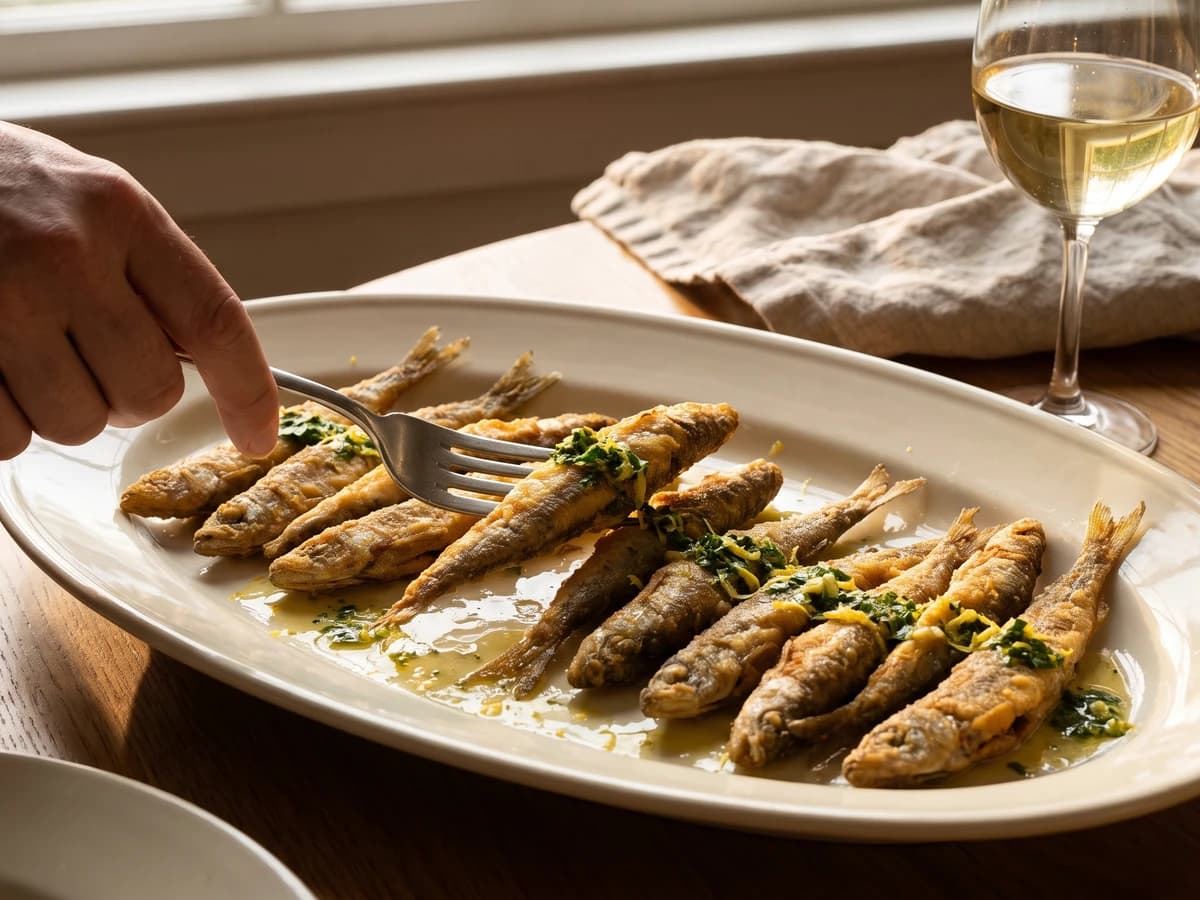
Éperlans à l’Anglaise turns small fish into a lesson in disciplined coating: boned smelts under a close, crisp crumb, pan-fried in clarified butter and finished with bright, half-melted maître d’hôtel butter.

Chef Juliette
Tiny smelts, shallot, mushrooms, white wine, gratin sauce, and fine bread raspings meet a fierce oven, where the fish must turn tender in the same breath the buttered crust bronzes.