
Chef Juliette
John Dory (St. Pierre)
John Dory has the delicacy of sole and the firmness of turbot. A light flouring, a quick butter sauté, and nut-brown beurre noisette show exactly why looks never mattered.
A cooking platform built around craft, culture, and the stories behind what we eat.

Created by Chef Juliette
Based on No. 1235, Ris de Veau des Gourmets, from Le Guide Culinaire (1907) by Auguste Escoffier
Ris de Veau des Gourmets turns veal sweetbreads and raw black truffle into a lesson in captured aroma: braise gently, seal the cocotte with paste, and break it open only at the table.
Ris de Veau des Gourmets (veal sweetbreads with truffle sealed in a cocotte) teaches that aroma can be an ingredient you either keep or lose. The sweetbreads are braised until tender, buried beneath thick raw black truffle, then shut under a paste-sealed lid. When the seal is cut at the table, the first concentrated breath belongs to everyone at once. This isn't tableside theatre. It is the technique.
The old entry can say simply “braise the sweetbreads” because it assumed a saucier on staff, stock never off the fire, prepared sweetbreads arriving from another station, and small flat cocottes waiting for service. Here one shallow home cocotte handles the blanching, braise, and final bake; good prepared veal stock replaces the perpetual stockpot, and a fine sieve with a short reduction does the saucier's work. There is no salamander in this dish and none is needed. A home oven fully heated to 475°F / 245°C gives the prescribed ten-minute finish. The quantities are scaled to four, one cook, one stove, one evening.
Separate stations and extra pans are brigade scaffolding, so they can go. The blanching, pressing, gentle braise, thick raw truffle, strained liquor, flour seal, ten hot minutes, and opening only at the table are the dish itself, so every one stays. Before you touch the pan, know the step that decides everything: make the seal continuous and don't lift the lid to check.
Ris de Veau des Gourmets belongs to the grand Parisian table, where sweetbreads were prized for tenderness and a distinguished garniture could lend a dish its name. The black truffle points to Périgord as the larder, not the dish's home; the Paris kitchen married a southwestern treasure to a classical veal braise. Its flour-and-water luting borrows the household logic of sealed pots, then turns that practical seal into tableside service: the perfume is released before the guests, never in the kitchen.
Quantity
4 (about 1¾ lb / 800 g total)
trimmed of loose fat
Quantity
8 quarts (7.6 L / 7.6 kg)
divided
Quantity
1 tablespoon (15 ml / 18 g)
divided
Quantity
3 tablespoons (45 ml / 42 g)
divided
Quantity
½ cup (120 ml / 75 g)
cut into thin coins
Quantity
½ cup (120 ml / 80 g)
thinly sliced
Quantity
1
Quantity
2 cups (480 ml / 480 g)
Quantity
½ teaspoon (2.5 ml / 1 g)
Quantity
2 medium (about 2 oz / 60 g total)
scrubbed and cut into ⅛-inch / 3 mm slices
Quantity
¾ cup (180 ml / 90 g)
Quantity
¼ cup (60 ml / 60 g), plus a few drops if needed
| Ingredient | Quantity |
|---|---|
| veal heart sweetbreadstrimmed of loose fat | 4 (about 1¾ lb / 800 g total) |
| cold waterdivided | 8 quarts (7.6 L / 7.6 kg) |
| fine sea saltdivided | 1 tablespoon (15 ml / 18 g) |
| unsalted butterdivided | 3 tablespoons (45 ml / 42 g) |
| carrotcut into thin coins | ½ cup (120 ml / 75 g) |
| yellow onionthinly sliced | ½ cup (120 ml / 80 g) |
| bouquet garni of parsley stems, thyme, and bay leaf | 1 |
| light unsalted veal stock | 2 cups (480 ml / 480 g) |
| freshly ground white pepper | ½ teaspoon (2.5 ml / 1 g) |
| fresh black trufflesscrubbed and cut into ⅛-inch / 3 mm slices | 2 medium (about 2 oz / 60 g total) |
| all-purpose flour | ¾ cup (180 ml / 90 g) |
| cool water | ¼ cup (60 ml / 60 g), plus a few drops if needed |
Submerge the sweetbreads in 2 quarts of the cold water for 1 hour, changing the water once halfway through. They should become paler as the surface blood clears. Cover them with another 2 quarts of fresh cold water in the cocotte, add 2 teaspoons of the salt, and bring the water slowly to the barest tremble. Blanch for 5 minutes, never allowing a hard boil, then transfer them immediately to the remaining water made very cold with ice. Wash and dry the cocotte for the braise.
Working while the sweetbreads are cold, peel away the translucent membrane and pull out any hard cords without digging into the tender lobes. Lay them between two parchment-lined trays, place a 2 lb / 900 g weight on top, and refrigerate for 30 minutes. Pressing gives them an even thickness, which means they braise evenly and sit neatly beneath the truffles. If a lobe tears, keep every piece; snug arrangement in the cocotte will restore the shape.
Heat the oven to 350°F / 180°C. Melt 2 tablespoons of the butter in the clean cocotte over medium heat. Add the carrot and onion and cook gently for 5 minutes, until glossy but not browned. Season the pressed sweetbreads with the remaining salt and the white pepper, push the vegetables toward the edge, and lay the sweetbreads flat in the butter. Colour both broad faces lightly, about 3 minutes per side, until butter-gold. This light fond, the browned residue on the pot, gives the braising liquor its foundation.
Pour in the veal stock and scrape the pot floor gently so the fond dissolves into it. Add the bouquet garni; the liquid should reach roughly halfway up the sweetbreads. Cover the surface with a cartouche, a round of parchment cut to fit, put on the lid, and braise in the oven for 25 to 30 minutes. The sweetbreads are ready when they feel firm yet springy and their centres reach 160°F / 71°C. A fierce boil makes them rubbery, so the liquor should only tremble.
Lift the sweetbreads onto a warm plate and cover them loosely. Strain the braising liquor through a fine sieve without pressing the vegetables, discard the bouquet garni and vegetables, and skim away excess fat. Return the liquor to the wiped cocotte and reduce it over lively heat to about 1 cup (240 ml / 240 g). It should be glossy but still pour freely, because this is a braising liquor, not a thick sauce. If it reduces too far, loosen it with a spoonful of unsalted stock; if it tastes weak, reduce it a little longer.
Raise the oven to 475°F / 245°C and let it heat fully. Pour the reduced liquor into a jug, wipe the cocotte, and coat its base with the remaining tablespoon of butter. Arrange the hot sweetbreads snugly in one layer, cover them completely with overlapping thick slices of raw truffle, and strain the liquor over the whole. Mix the flour and cool water into a firm pâte à luter, a sealing paste, adding only enough extra water to make it pliable. Roll it into a cord long enough to encircle the rim, set the lid in place, and press the paste firmly over the entire seam. If the cord cracks, wet a pinch of paste and patch it now. Ça se rattrape.
Place the sealed cocotte in the very hot oven for exactly 10 minutes. Set it immediately on a heatproof serving dish and carry it to the table unopened. Cut through the baked paste with a small knife and lift the lid only when everyone is seated; the captured truffle aroma is part of the seasoning, and opening the pot in the kitchen spends it in an empty room. The flour seal is discarded, not eaten. À table!
1 serving (about 330g)
Culinary guides, cultural storytelling, and the editorial depth that makes cooking meaningful.
Discover Culinary ExplorerChef Juliette
John Dory has the delicacy of sole and the firmness of turbot. A light flouring, a quick butter sauté, and nut-brown beurre noisette show exactly why looks never mattered.

Chef Juliette
Fresh haddock proves its delicacy in the meunière pan: a fine flour crust, moist pearly flakes, and beurre noisette sharpened with lemon and parsley, ready from one skillet in half an hour.
Chef Juliette
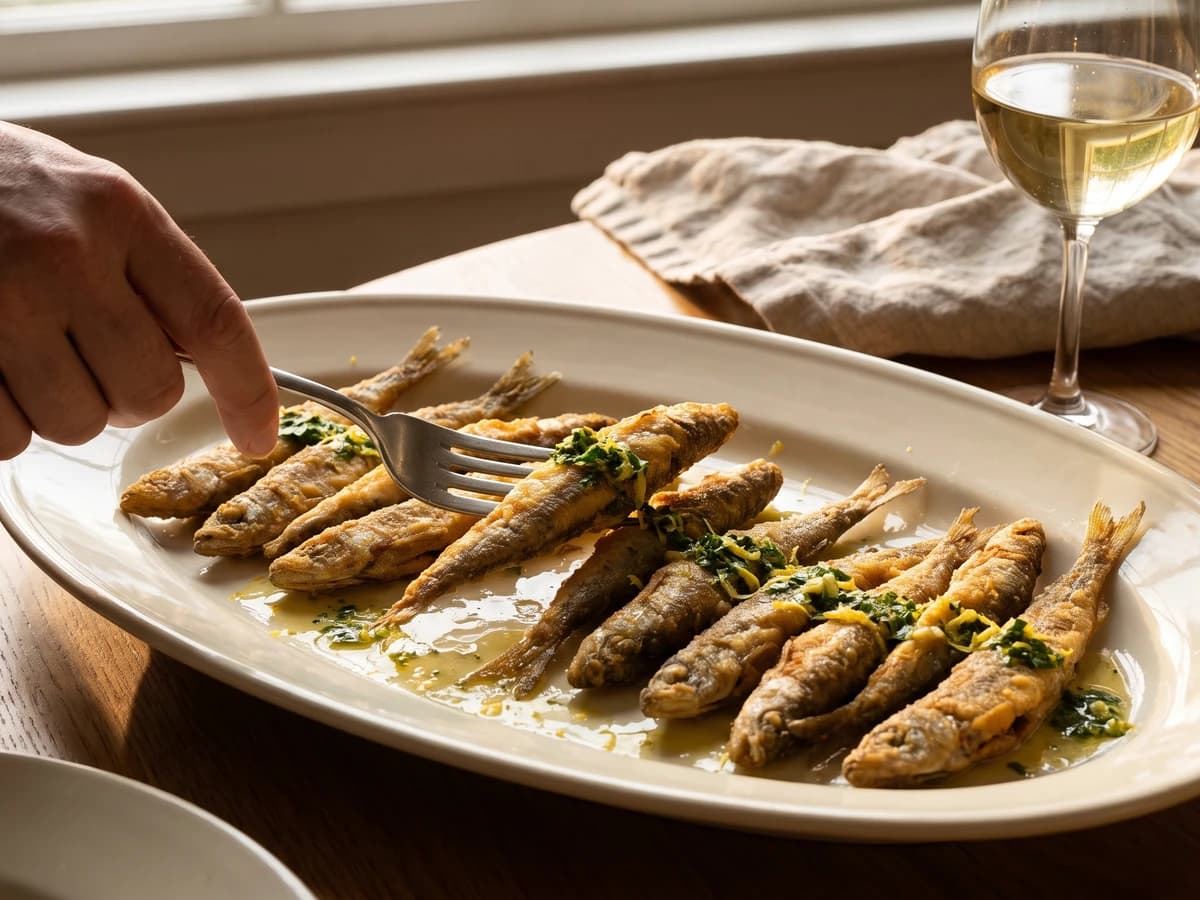
Éperlans à l’Anglaise turns small fish into a lesson in disciplined coating: boned smelts under a close, crisp crumb, pan-fried in clarified butter and finished with bright, half-melted maître d’hôtel butter.

Chef Juliette
Tiny smelts, shallot, mushrooms, white wine, gratin sauce, and fine bread raspings meet a fierce oven, where the fish must turn tender in the same breath the buttered crust bronzes.