
Chef Juliette
John Dory (St. Pierre)
John Dory has the delicacy of sole and the firmness of turbot. A light flouring, a quick butter sauté, and nut-brown beurre noisette show exactly why looks never mattered.
A cooking platform built around craft, culture, and the stories behind what we eat.

Created by Chef Juliette
Based on No. 1219, Attereaux de Ris de Veau à la Villeroy, from Le Guide Culinaire (1907) by Auguste Escoffier
Sweetbread, mushroom and truffle threaded in little ranks, cloaked in firm Villeroy sauce, crumbed and fried until bronze: a lesson in cold coating, hot fat, and composed abundance.
Attereaux de Ris de Veau à la Villeroy (Villeroy-coated veal sweetbread skewers) teaches the discipline of a cold set before hot fat. Know this one true thing before you touch a pan: the Villeroy coating must be solid through and through, or it will slide from the skewer the moment it meets the fryer. When it works, the crust is finely crisp, the sweetbread creamy within, and the truffle and mushroom carry their perfume through the rich coating.
The brigade kitchen assumed a saucier on staff, stock never off the fire, finished Villeroy and Périgueux sauces waiting in their pans, and enough hands to exchange frying skewers for silver ones before service. The salamander, useful elsewhere, has no business in this fried preparation. At home, make the finished sauces ahead, use short bamboo skewers and a deep saucepan, then serve twelve attereaux on a warm platter rather than constructing a rice pedestal under them. The pedestal, folded napkin and silver service are scaffolding. Alternating equal rounds, masking them generously, chilling the sauce firm, breading à l’anglaise and frying in properly hot fat are the dish, and every one stays.
This is a rich main course for four, scaled to three small skewers per person. Press the sweetbreads so they cut cleanly, dry every round before assembly, and give the masked skewers all the cold time they ask for. If the sauce slips while you coat them, it hasn't cooled enough. Ça se rattrape, and the method will show you where. The complete cold set is the step that matters most.
Attereaux belong to the formal Parisian grand-kitchen repertoire, where small skewers allowed several prized ingredients to be presented as one precise, breaded piece. À la Villeroy names the method of masking the assembled food in a thick sauce, cooling it until firm, then breading and frying it, not a regional style of village cooking. The accompanying Périgueux sauce points toward the black-truffle country around Périgueux, but the dish itself traveled from grand service rather than from the farmhouse table.
Quantity
4 quarts (3.8 L / 3.8 kg), plus more for changing and chilling
Quantity
2 large sweetbreads (about 1¾ lb / 800 g total)
Quantity
1 tablespoon (15 ml / 18 g)
divided
Quantity
½ teaspoon (2.5 ml / 1 g)
Quantity
24 caps (about 4 cups / 950 ml / 450 g)
Quantity
24 roundels (about ½ cup / 120 ml / 100 g)
cut about ⅛ inch (3 mm) thick
Quantity
2 cups (480 ml / 500 g)
Quantity
1½ cups (360 ml / 360 g) finished Anglaise (for Egg-and-bread-crumbing) (No. 174)
Quantity
3 cups (720 ml / 300 g)
Quantity
3 quarts (2.8 L / 2.6 kg)
Quantity
1 small bunch (about 2 cups loosely packed / 475 ml / 55 g)
washed and completely dried
Quantity
1 cup (240 ml / 250 g)
| Ingredient | Quantity |
|---|---|
| cold water | 4 quarts (3.8 L / 3.8 kg), plus more for changing and chilling |
| throat veal sweetbreads | 2 large sweetbreads (about 1¾ lb / 800 g total) |
| fine sea saltdivided | 1 tablespoon (15 ml / 18 g) |
| finely ground white pepper | ½ teaspoon (2.5 ml / 1 g) |
| large button mushroom caps | 24 caps (about 4 cups / 950 ml / 450 g) |
| black truffle roundelscut about ⅛ inch (3 mm) thick | 24 roundels (about ½ cup / 120 ml / 100 g) |
| finished thick Villeroy sauce | 2 cups (480 ml / 500 g) |
| finished Anglaise (for Egg-and-bread-crumbing) | 1½ cups (360 ml / 360 g) finished Anglaise (for Egg-and-bread-crumbing) (No. 174) |
| very fine fresh white breadcrumbs | 3 cups (720 ml / 300 g) |
| refined peanut or other neutral frying oil | 3 quarts (2.8 L / 2.6 kg) |
| flat-leaf parsleywashed and completely dried | 1 small bunch (about 2 cups loosely packed / 475 ml / 55 g) |
| finished Périgueux sauce | 1 cup (240 ml / 250 g) |
Put the sweetbreads in a bowl of cold water and soak them for 1 hour, changing the water twice, until they look pale and the water remains nearly clear. Trim away visible blood vessels and loose fat without tearing into the lobes. Keep your knife modest here; the outer membrane comes away more cleanly after blanching.
Bring 2 quarts (1.9 L / 1.9 kg) of the water to a bare simmer with 2 teaspoons (10 ml / 12 g) of the salt. Add the sweetbreads and hold the water just below a boil for 8 minutes, then transfer them immediately to very cold water. When cool enough to handle, peel away the membrane and any remaining sinew. Set the sweetbreads between two trays, weight the top with about 2 lb (900 g), and chill for 45 to 60 minutes. Pressing gives you the close, even texture needed for clean roundels.
Cut 24 sweetbread roundels about 1⅓ inches (3.4 cm) across and ⅓ inch (8 mm) thick. Cut 24 mushroom roundels and 24 truffle roundels to roughly the same diameter, making both slightly thinner than the sweetbread. Pat everything thoroughly dry, then season the sweetbread and mushrooms lightly with the remaining salt and the white pepper. Save the trimmings for another sauce or forcemeat; trimming is the price of the classical shape, not permission to waste good food.
Thread two roundels of each ingredient onto every 4-inch (10 cm) bamboo skewer, alternating sweetbread, mushroom and truffle, then repeating the sequence. Keep the pieces close enough to form a neat cylinder but don't crush them together. Make 12 attereaux and chill them for 15 minutes so their surfaces are cold and firm.
Bring the finished Villeroy sauce to a cool, thick but fluid consistency. Holding each skewer by its bare end, dip and turn it until every round is completely masked, then lay it on a parchment-lined tray and spoon sauce over any exposed seam. If the coating runs into a puddle or leaves the ingredients showing, stop. The sauce is too warm or the skewer too wet. Chill both for 10 minutes, lift away the pooled sauce and mask the bare places again. Ça se rattrape.
Refrigerate the masked attereaux for at least 2 hours, until the Villeroy sauce is solid and no longer yields under a light fingertip. Lift each one from the tray and clear away the skirts and drips of excess sauce with a small knife, shaping the coating into a tidy cylinder. Patch any bare spot with cold Villeroy sauce and chill that skewer for another 20 minutes. Don't proceed while any coating remains soft. Cold now makes the crust secure later.
Pour the finished Anglaise (for Egg-and-bread-crumbing) (No. 174) into a shallow dish and spread the fine fresh breadcrumbs in another. Dip each cold attereau in the Anglaise, coating it completely, then roll it in the crumbs. Turn and press it gently between your fingers to restore the small cylindrical shape. The entry calls for Anglaise and crumbs over the firm sauce, so no flour is needed here. Chill the breaded attereaux for 30 minutes while the frying oil heats.
Warm the finished Périgueux sauce gently and keep it covered. Heat the frying oil in a deep, heavy pot to 350°F (175°C), leaving at least 3 inches (7.5 cm) of headroom. Put the completely dry parsley in a wire skimmer, lower it carefully into the oil for 10 to 15 seconds, then drain it on a rack and season with a small pinch of salt. Any water left on the leaves will make the oil spit, so dry means dry.
Begin frying about 8 minutes before you intend to serve, which is the source's timing for service, not an instruction to cook each skewer for 8 minutes. Fry three or four attereaux at a time for 2½ to 3½ minutes, turning once, until the crumb is evenly bronze and the sweetbread reaches 160°F (71°C) at the centre. Let the oil return to 350°F (175°C) between batches. If the first coating splits or shows a pale streak of sauce, remove it, restore the oil temperature and chill the remaining attereaux for 15 minutes before continuing. Hot fat and a cold coating must meet decisively.
Drain the fried attereaux on a wire rack rather than leaving them on paper, which traps oil beneath the crust. Carefully withdraw the frying skewers and replace them with clean cocktail picks, silver if you own them and ordinary ones if you don't. Arrange three per person on a warm oval platter with the fried parsley gathered in the centre, and serve the finished Périgueux sauce separately in a small sauceboat. Bring them to the table at once. À table!
1 serving (about 605g)
Culinary guides, cultural storytelling, and the editorial depth that makes cooking meaningful.
Discover Culinary ExplorerChef Juliette
John Dory has the delicacy of sole and the firmness of turbot. A light flouring, a quick butter sauté, and nut-brown beurre noisette show exactly why looks never mattered.

Chef Juliette
Fresh haddock proves its delicacy in the meunière pan: a fine flour crust, moist pearly flakes, and beurre noisette sharpened with lemon and parsley, ready from one skillet in half an hour.
Chef Juliette
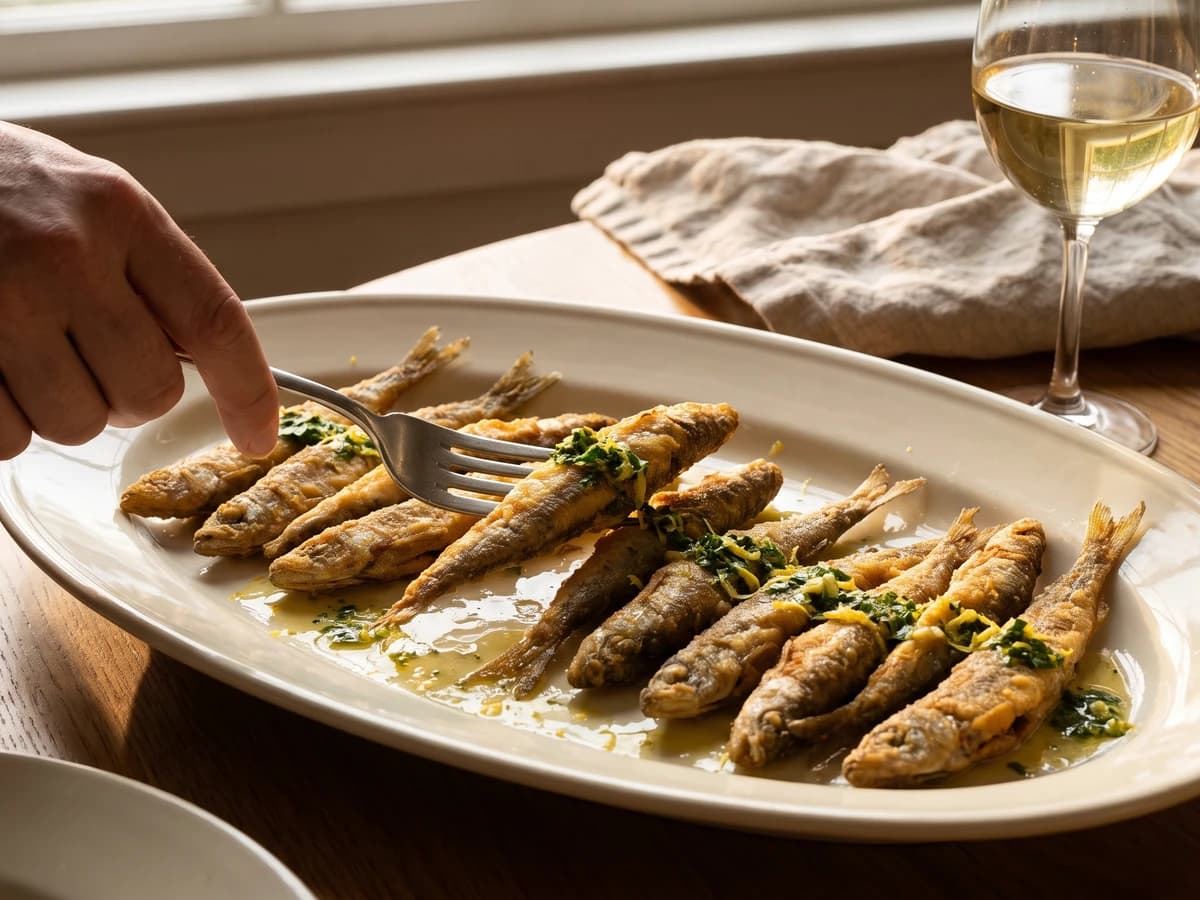
Éperlans à l’Anglaise turns small fish into a lesson in disciplined coating: boned smelts under a close, crisp crumb, pan-fried in clarified butter and finished with bright, half-melted maître d’hôtel butter.

Chef Juliette
Tiny smelts, shallot, mushrooms, white wine, gratin sauce, and fine bread raspings meet a fierce oven, where the fish must turn tender in the same breath the buttered crust bronzes.