
Chef Juliette
John Dory (St. Pierre)
John Dory has the delicacy of sole and the firmness of turbot. A light flouring, a quick butter sauté, and nut-brown beurre noisette show exactly why looks never mattered.
A cooking platform built around craft, culture, and the stories behind what we eat.
Created by Chef Juliette
Based on No. 1212, Tête de Veauà la Poulette, from Le Guide Culinaire (1907) by Auguste Escoffier
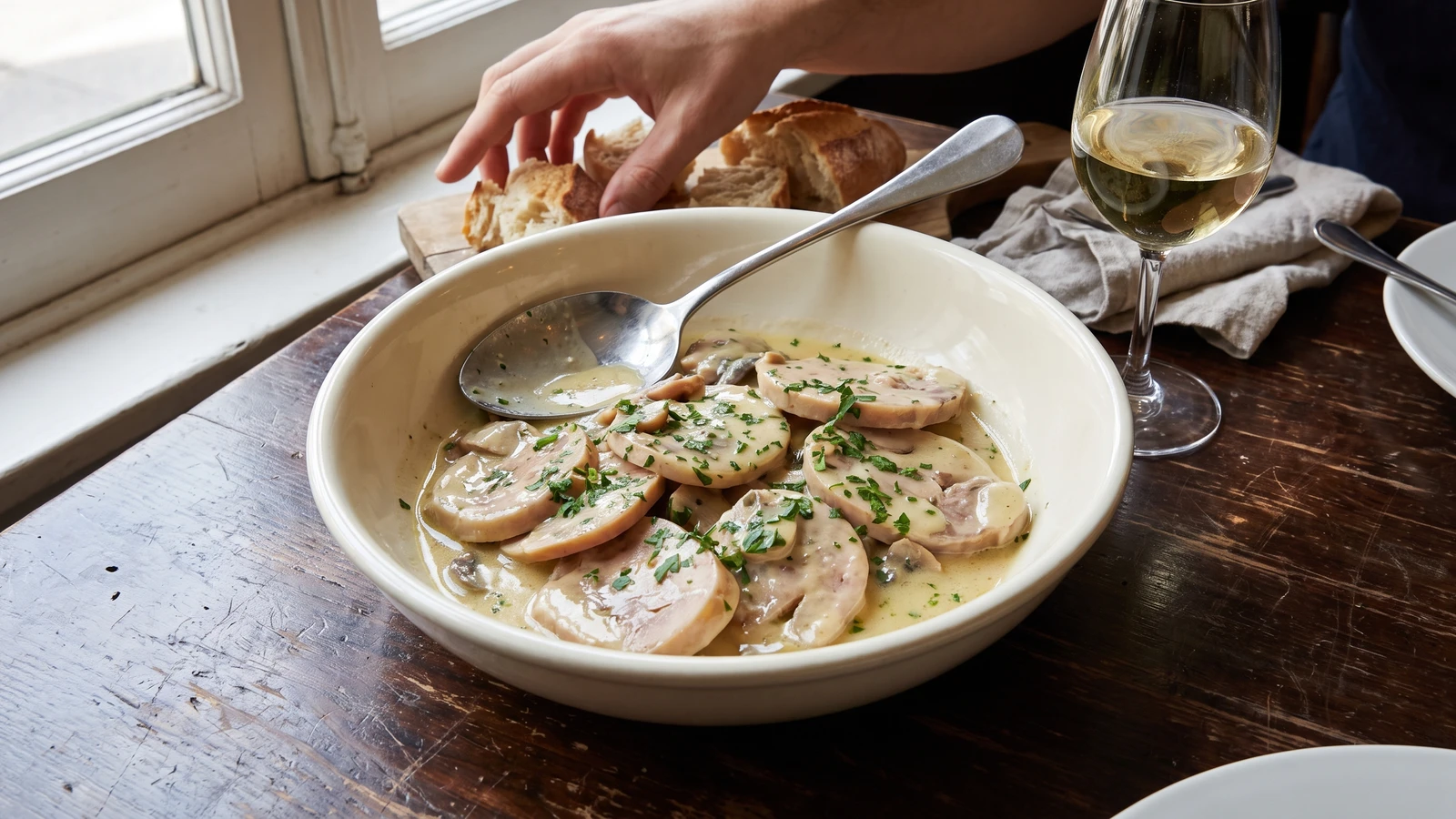
Tête de Veau à la Poulette makes thrift magnificent: tender, pearly slices of calf’s head folded through Poulette Sauce (No. 101), glossy with butter, sharpened by lemon, and finished with parsley.
Tête de Veau à la Poulette, calf’s head with Poulette Sauce (No. 101), teaches the clean division of heat. The head needs a long, quiet poach until its collagen gives and the slices turn tender; the finished sauce needs the gentlest warming because a boil will drive out its gloss. Know that before you touch the pan, and the dish becomes calm work rather than an ordeal.
The book assumed a whole head already cleaned by the butcher, a blanc every cook knew by reflex, Poulette Sauce (No. 101) waiting from the saucier, and stock never off the fire behind him. Your home equivalent is a cleaned, boned head rolled and tied to fit one stockpot, plus a four-serving batch of the referenced sauce prepared from its own entry while the meat cooks. I have changed the shape and quantity because a loose head and a brigade yield are needless at home; I have not changed the blanc, the bias cut, the sequence, or the buttered finish. The brigade’s holding and service choreography are scaffolding. Those four things are the dish.
At the table, the pale, yielding slices sit under an ivory sauce scented with mushroom and sharpened by lemon, with parsley scattered at the last second. One cook, one stove, one evening. The final toss decides everything: keep it below a simmer, move the slices gently, and serve as soon as the sauce clings.
Tête de veau belongs broadly to French cuisine bourgeoise rather than to one regional pantry, with lasting homes on Parisian bistro tables and in Lyon’s bouchons, where economical cuts are judged by the care given them. Serving it à la poulette marks its passage into the classical sauce system: the head cooks gently in a blanc before meeting a mushroom-scented velouté sharpened with lemon and finished with butter. Although many diners now associate calf’s head only with sharper caper sauces, this warm, pale preparation is equally at home in the canon.
Quantity
1 (3½ to 4 lb / 1.6 to 1.8 kg)
fully cleaned, boned, rolled, and tied
Quantity
About 6 quarts (5.7 liters / 5.7 kg), divided, plus more as needed to cover
Quantity
⅓ cup (80 ml / 40 g)
Quantity
⅓ cup (80 ml / 80 g)
Quantity
2 tablespoons (30 ml / 36 g)
Quantity
2 tablespoons (30 ml / 28 g)
Quantity
2 medium (about 2 cups / 300 g)
quartered
Quantity
2 medium (about 1 cup / 120 g)
thickly sliced
Quantity
1
Quantity
2½ cups (600 ml / about 600 g) Poulette Sauce (No. 101)
prepared according to its own entry
Quantity
1 tablespoon (15 ml / 4 g)
finely chopped
| Ingredient | Quantity |
|---|---|
| butcher-prepared calf’s headfully cleaned, boned, rolled, and tied | 1 (3½ to 4 lb / 1.6 to 1.8 kg) |
| cold water | About 6 quarts (5.7 liters / 5.7 kg), divided, plus more as needed to cover |
| plain flour | ⅓ cup (80 ml / 40 g) |
| white wine vinegar | ⅓ cup (80 ml / 80 g) |
| fine salt | 2 tablespoons (30 ml / 36 g) |
| unsalted butter | 2 tablespoons (30 ml / 28 g) |
| onionsquartered | 2 medium (about 2 cups / 300 g) |
| carrotsthickly sliced | 2 medium (about 1 cup / 120 g) |
| bouquet garni of parsley stems, thyme, and bay leaf | 1 |
| Poulette Sauceprepared according to its own entry | 2½ cups (600 ml / about 600 g) Poulette Sauce (No. 101) |
| flat-leaf parsleyfinely chopped | 1 tablespoon (15 ml / 4 g) |
Set the tied calf’s head in a deep bowl, cover it with cold water, and refrigerate for 30 minutes. Drain and rinse it well. This brief soak draws away loose blood without leaching the meat for hours; a head already soaked by the butcher needs only a thorough rinse.
Put the head in an 8-quart stockpot and cover it by 1 inch with fresh cold water. Bring it slowly to a boil, skimming the grey foam as it rises, then boil for 3 minutes. Drain immediately, rinse the head under cool water, and wash the pot. This blanching is useful scaffolding: it clears the proteins that would otherwise muddy the blanc and cling to the finished slices.
Whisk the flour with 1 cup of the cold water until perfectly smooth, then pour it into the clean pot. Add enough remaining water to cover the head by 1 inch, followed by the vinegar, salt, butter, onions, carrots, and bouquet garni. Return the head to the pot and whisk the liquid gently as it approaches a simmer so the flour cannot settle and scorch. Lay a round of parchment directly over the surface and cover the pot slightly ajar; the acidulated, lightly thickened blanc protects the meat’s pale colour while it cooks.
Hold the blanc at a bare simmer, about 185 to 195°F (85 to 90°C), for 2½ to 3 hours. You want an occasional lazy bubble, never a rolling boil. Turn the roll once or twice and add hot water if the surface becomes exposed. The head is ready when a thin skewer passes through the cheek and skin with little resistance, and the centre reaches about 190°F (88°C); tenderness, not the clock, makes the decision. If the pot boils hard, lower the heat and add a cup of cold water. Ça se rattrape, provided you catch it before the outside tightens.
Transfer the prepared Poulette Sauce (No. 101) to a wide sauté pan and warm it over the lowest heat until it flows easily and naps the back of a spoon. Do not boil it. If it has tightened while waiting, loosen it with 1 tablespoon of strained hot blanc at a time; the sauce should cling generously without sitting like paste.
Lift the head from the blanc and let it settle for 10 minutes beneath a sheet of damp parchment. Remove every length of twine. If the tongue is included and its coarse outer skin remains, peel it away while warm. Cut the roll somewhat aslant into small slices about ¼ inch (6 mm) thick, halving any very broad pieces so they can be tossed without tearing. Keep the slices warm beneath a spoonful of strained blanc.
Slip the warm slices into the Poulette Sauce (No. 101) and turn them carefully with a flexible spatula over very low heat for 2 to 3 minutes. The sauce should coat every piece, but it must not simmer. If oily beads appear, lift out the meat, take the pan off the heat, and whisk in 1 tablespoon of cold water until the sauce becomes smooth and glossy again. Ça se rattrape. Return the slices, spoon everything into a warmed deep serving bowl or timbale, and scatter the chopped parsley over the top. Serve at once. À table!
1 serving (about 470g)
Culinary guides, cultural storytelling, and the editorial depth that makes cooking meaningful.
Discover Culinary ExplorerChef Juliette
John Dory has the delicacy of sole and the firmness of turbot. A light flouring, a quick butter sauté, and nut-brown beurre noisette show exactly why looks never mattered.

Chef Juliette
Fresh haddock proves its delicacy in the meunière pan: a fine flour crust, moist pearly flakes, and beurre noisette sharpened with lemon and parsley, ready from one skillet in half an hour.

Chef Juliette
Éperlans à l’Anglaise turns small fish into a lesson in disciplined coating: boned smelts under a close, crisp crumb, pan-fried in clarified butter and finished with bright, half-melted maître d’hôtel butter.

Chef Juliette
Tiny smelts, shallot, mushrooms, white wine, gratin sauce, and fine bread raspings meet a fierce oven, where the fish must turn tender in the same breath the buttered crust bronzes.